June 27, 2026
When Discovery Geology Meets a Structural Copper Deficit
The global copper industry is confronting a paradox that only intensifies with each passing year. Demand for the metal is accelerating across electrification, grid infrastructure, and electric vehicle manufacturing, yet the pipeline of genuinely significant new discoveries has been thinning for decades. Most analysts tracking the sector note that the average grade of newly discovered copper deposits has declined steadily since the 1990s, and the lead time from discovery to production now routinely stretches beyond a decade.
Against this backdrop, the Hot Chili La Verde copper-gold discovery in Chile has attracted growing attention from geologists, institutional investors, and ASX resource watchers. What makes La Verde worth examining closely is not simply the intercept grades or the scale of the system, but how it sits within a much broader strategic framework that could reshape the economics of the entire Costa Fuego district.
When big ASX news breaks, our subscribers know first
Understanding La Verde's Place Within Chile's Coastal Porphyry Belt
Chile's Atacama coastal porphyry belt is one of the world's most prolific copper-generating geological environments. The belt hosts a series of magmatic-hydrothermal systems formed during periods of intense tectonic activity, where copper-rich fluids migrated upward and precipitated within large intrusive bodies. The resulting porphyry deposits can extend hundreds of metres in all directions from a central mineralised core, often hosting both copper and gold in geologically meaningful concentrations.
La Verde occupies a position within this coastal belt that distinguishes it from many other exploration-stage systems. Its proximity to existing infrastructure corridors and its geological characteristics suggest a system that formed under favourable conditions for large-scale copper-gold porphyry development. Critically, the deposit sits just 30 kilometres from Hot Chili's planned Costa Fuego central processing hub, a geographic relationship that fundamentally alters the project economics compared to a standalone remote discovery.
How La Verde Fits Into Hot Chili's District-Scale Costa Fuego Strategy
Hot Chili has been advancing the Costa Fuego copper-gold project as a district-scale development strategy rather than a single-asset play. The logic is straightforward: multiple deposits feeding into a central processing facility can achieve economies of scale that individual smaller mines cannot. La Verde represents a potentially significant addition to this hub-and-spoke model, providing what could become a meaningful source of additional mill feed.
The company is currently working toward both a maiden Mineral Resource Estimate for La Verde and a revised Pre-Feasibility Study for Costa Fuego. Should La Verde's resource be large enough to justify inclusion, the revised study could materially alter the project's production profile and mine life assumptions. Furthermore, the copper supply crunch facing global markets only amplifies the strategic importance of bringing new district-scale discoveries like this one into formal resource definition.
La Verde Discovery Metrics: What the Drilling Data Actually Reveals
Drilling results at La Verde have consistently impressed observers familiar with Chilean copper porphyry geology. The system has now returned multiple long intercepts with grades that sit comfortably above the typical threshold considered economic for large-scale bulk mining.
Breaking Down the Key Intercept Results at La Verde
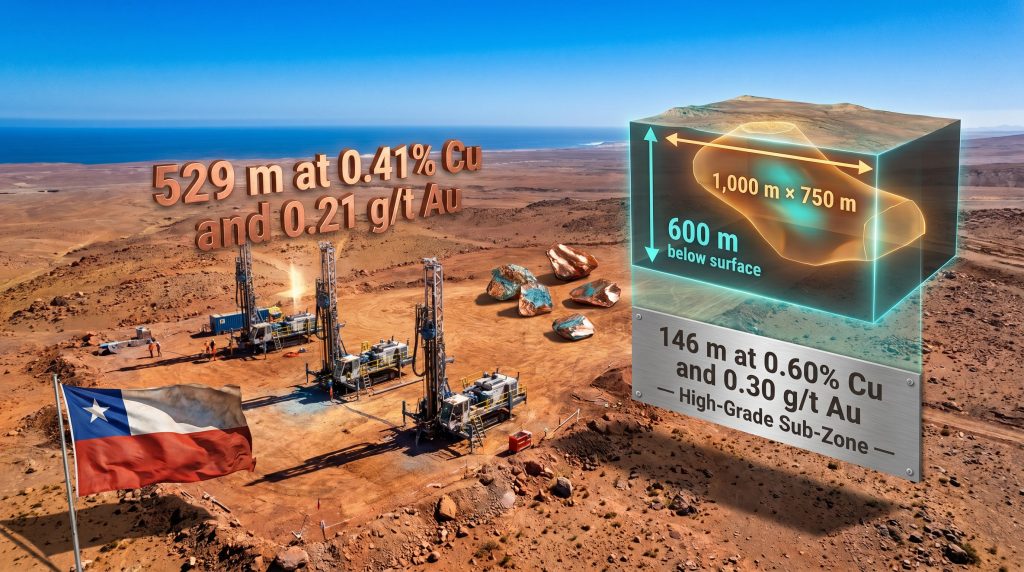
La Verde's most significant diamond drill hole to date returned 529 metres at 0.41% copper and 0.21 g/t gold from 41 metres depth to end of hole. A separate hole confirmed 391.1 metres grading 0.51% copper equivalent (CuEq) from surface, comprising 0.42% Cu and 0.11 g/t Au, with a high-grade sub-interval of 40.7 metres at 0.60% CuEq from 103.3 metres.
What makes these results particularly notable is the consistency of grade across very long intervals. In porphyry exploration, grade continuity over hundreds of metres is often more valuable than isolated high-grade spikes, because it supports the case for a bulk-tonnage resource that can be mined at scale with predictable feed grades. Investors who are new to this asset class should consider interpreting drill results carefully before drawing conclusions from headline intercept numbers alone.
La Verde Drill Result Summary Table
| Drill Hole | Intercept Length | Copper Grade | Gold Grade | Depth From Surface |
|---|---|---|---|---|
| DKD032 (Diamond) | 529 m | 0.41% Cu | 0.21 g/t Au | 41 m to EOH |
| High-Grade Sub-Zone 1 | 146 m | 0.60% Cu | 0.30 g/t Au | Within DKD032 |
| High-Grade Sub-Zone 2 | 66 m | 0.45% Cu | 0.31 g/t Au | Within DKD032 |
| Latest Diamond Hole | 391.1 m | 0.42% Cu | 0.11 g/t Au | From surface |
| Surface High-Grade Interval | 17.8 m | 0.63% Cu | 0.06 g/t Au | From surface |
| Mid-Depth Interval | 40.7 m | 0.50% Cu | 0.12 g/t Au | From 103.3 m |
The latest diamond drill hole's result was described internally as returning grades well above visual expectation, a notable statement given that experienced geologists typically set visual estimates conservatively. When assay results outperform visual logging by a meaningful margin, it often indicates that fine-grained or disseminated copper mineralisation is contributing grade that the eye cannot easily detect.
What Copper Equivalent Means and Why It Matters for Grade Assessment
The copper equivalent (CuEq) metric combines copper and gold grades into a single figure that reflects the combined economic value of both metals at prevailing prices. With copper trading at US$13,745 per tonne, up more than 42% over the past 12 months, the copper component alone carries substantial value. The gold contribution, while secondary in this system, adds meaningful upside, particularly at elevated gold prices.
Investors should note that CuEq calculations are price-dependent. A shift in the copper-to-gold price ratio would alter the CuEq figure even if the underlying geology remained unchanged. This makes the raw copper and gold grades arguably more informative for long-term resource assessment than the composite figure alone.
How Large Is the La Verde Porphyry System? Footprint, Depth, and Open Extensions
Current Discovery Footprint: 1,000 m x 750 m and Growing
The confirmed mineralised footprint at La Verde now spans approximately 1,000 metres by 750 metres at surface projection, with mineralisation confirmed to extend beyond 600 metres below surface in more recent drilling phases. Critically, the system remains open in all lateral directions and at depth, meaning every additional drill hole has the potential to extend the resource boundary rather than simply infill known ground.
Key characteristics of the current La Verde footprint include:
- Mineralisation confirmed beyond 600 metres vertical depth, with no signs of the system closing off
- The deposit boundary remains open to the east, west, and at depth, providing multiple vectors for future resource growth
- Initial drilling established the 1,000 m by 750 m surface footprint, with step-out holes progressively expanding that envelope
- Multiple higher-grade internal zones have been identified within the broader porphyry shell, supporting a bulk-tonnage interpretation with enriched cores
Why Porphyry Systems of This Scale Matter to Global Copper Supply
Large copper porphyry systems are among the most important ore deposit types in the world from a supply perspective. They are typically lower grade than volcanogenic or skarn deposits, but their sheer scale enables mining at very high throughputs, often tens of millions of tonnes per year, which translates into significant annual copper production even at grades below 0.5% Cu.
The scarcity of new large-scale discoveries is well documented. According to S&P Global research, the number of significant copper discoveries globally has declined substantially since the early 2000s, with the period from 2010 to 2020 representing one of the least productive discovery decades in modern mining history. This makes any system demonstrating the scale characteristics of La Verde inherently significant to the development pipeline.
Comparing La Verde's Footprint to Established Chilean Copper Porphyry Benchmarks
For context, many of the largest copper mines began as exploration discoveries with footprints and grades broadly comparable to what La Verde is currently demonstrating at an early stage. The distinction is that those mines benefited from decades of resource delineation and infrastructure development. La Verde is at the beginning of that same progression, which represents both the opportunity and the risk for investors.
Important Disclaimer: Exploration-stage discoveries carry substantial uncertainty. Drill results do not guarantee a commercially viable mineral resource. Past performance of comparable deposits does not predict outcomes for La Verde. Investors should seek professional financial advice before making investment decisions.
Why Is La Verde Located 30 km from Costa Fuego and Why Does That Distance Matter?
The Strategic Logic of Proximity to a Central Processing Hub
In copper mining, the distance between an ore source and a processing facility is one of the most consequential variables in project economics. Ore haulage costs accumulate rapidly at the tonnages required by bulk-tonnage porphyry operations. A deposit located 30 kilometres from an existing or planned processing facility sits within a range that, depending on terrain and infrastructure quality, can make shared processing arrangements genuinely economical.
The relevance of this proximity becomes clearer when you consider what happens to operating costs per tonne when multiple deposits feed into a single mill. Fixed processing costs are spread across a larger ore volume, reducing the cost per tonne of copper produced. This is the economic rationale underpinning Hot Chili's district-scale approach at Costa Fuego.
How Shared Infrastructure Shapes the Economics of Multi-Deposit Mining Districts
The hub-and-spoke model in mining has been demonstrated successfully in several jurisdictions. When a central processing facility can draw feed from multiple satellite deposits, the overall project achieves:
- Higher plant utilisation rates, reducing unit processing costs
- Greater flexibility in ore blending, allowing management of feed grade variability
- Extended mine life through sequential or simultaneous exploitation of multiple ore sources
- Reduced capital intensity per deposit, since processing infrastructure is a shared rather than duplicated cost
For La Verde specifically, inclusion in a revised Costa Fuego Pre-Feasibility Study would represent the formal recognition that the discovery has reached a level of confidence sufficient to contribute to district-wide project planning. In addition, copper major-junior partnerships have increasingly emerged as a pathway for exactly this kind of district-scale development, where shared infrastructure logic attracts larger strategic partners.
What Stage Is La Verde At? Exploration Timeline and the Path to a Maiden Resource
From Discovery to Maiden Mineral Resource: Where La Verde Currently Stands
Step-by-step exploration progression at La Verde:
- Initial discovery drilling — The first diamond hole confirmed a large-scale copper-gold porphyry system with exceptional intercept lengths
- Footprint expansion — Systematic step-out drilling has extended the system laterally and tested depth continuity beyond 600 metres
- Assay acceleration — A second ISO-accredited laboratory has been engaged to reduce result turnaround times, a logistically important step given the volume of pending holes
- Pending assay results — 22 drill holes (6 diamond + 16 reverse circulation) are currently awaiting assay confirmation
- Maiden Mineral Resource Estimate — Targeted as the next major value inflection milestone
- Integration into Costa Fuego revised Pre-Feasibility Study — Potential inclusion of La Verde resources into district-wide project economics
What Are the 22 Pending Drill Holes Expected to Confirm?
The combination of six diamond holes and 16 reverse circulation holes represents a substantial volume of geological information that has not yet been assayed. Management has indicated that results from this program are anticipated to confirm meaningful extensions to La Verde's high-grade mineralised core.
The distinction between diamond and RC drilling is worth understanding here. RC drilling is faster and cheaper, making it suitable for wide-spaced footprint testing and resource definition work. Diamond drilling recovers intact core samples, enabling detailed geological logging, structural analysis, and higher-confidence grade determination. The mix of both methods suggests a program designed simultaneously to expand the deposit boundary and refine internal grade distribution.
Why Hot Chili Engaged a Second ISO-Accredited Laboratory
Assay laboratory turnaround times are a frequently underappreciated constraint in active drilling programs. When three rigs are turning simultaneously, samples accumulate faster than a single laboratory can process them, creating backlogs that delay the release of results to market. Engaging a second ISO-accredited laboratory is a practical operational decision that serves both the company's technical timeline and its obligations to keep the market informed.
ISO accreditation is the relevant quality standard here. It provides assurance that laboratory procedures meet internationally recognised protocols for sample preparation, analysis, and quality control, which is essential for results to be accepted by independent resource estimation professionals under JORC or equivalent reporting codes.
The next major ASX story will hit our subscribers first
How Does La Verde Rank Among Chile's Emerging Coastal Copper-Gold Discoveries?
What Makes a Copper-Gold Porphyry Significant at the Exploration Stage
Analytical Framework: Geologists and resource analysts typically assess emerging porphyry discoveries across four dimensions:
- Grade continuity — Does high-grade mineralisation persist across large intercept lengths?
- System scale — Is the footprint large enough to support a bulk-tonnage resource?
- Depth extent — Does mineralisation remain open at depth, indicating resource growth potential?
- Infrastructure proximity — Can the deposit leverage existing or planned processing facilities?
La Verde currently demonstrates constructive indicators across all four dimensions, though formal resource quantification remains a future milestone.
Chile's Coastal Atacama Region: A Geological Context for New Porphyry Discoveries
Chile accounts for approximately 27% of global mined copper output, making it the world's largest copper-producing nation by a considerable margin. The Chile copper price forecast for 2025 and beyond underscores why this coastal Atacama porphyry corridor, where La Verde is situated, is receiving renewed attention from explorers and investors alike. This relative underexploration is itself a geological opportunity, as modern geophysical techniques and improved understanding of porphyry system architecture are enabling explorers to identify targets that earlier surveys missed.
What Does La Verde Mean for Global Copper Supply Dynamics?
The Structural Copper Supply Gap: Why New Discoveries Are Increasingly Scarce
The broader context for the Hot Chili La Verde copper-gold discovery in Chile reaches well beyond a single company or single discovery:
- Global copper demand is forecast to grow substantially through the 2030s, driven by grid-scale battery storage, offshore wind installation, electric vehicle adoption, and data centre build-out
- Major new copper discoveries have become progressively rarer, with most supply growth coming from expansions at established operations rather than genuinely new greenfield systems
- Chile's status as the world's dominant copper-producing nation means new coastal discoveries in the country carry outsized strategic importance to the global development pipeline
- The lead time from initial discovery to first copper production typically spans 10 to 15 years, meaning discoveries made today will not contribute meaningful supply until the mid-2030s at the earliest
Copper Price Context: Trading at US$13,745 Per Tonne
With copper trading at US$13,745 per tonne, a level representing more than a 42% increase over the prior 12 months, the economic threshold for new porphyry development has shifted materially. Deposits that might have been considered marginal at US$9,000 per tonne copper become economically compelling at current prices, particularly when gold credits are factored in.
This price environment has also renewed institutional interest in exploration-stage copper assets, as fund managers and strategic investors seek exposure to future supply before resources are formally defined and valuations reflect proven deposits.
Three Drill Rigs, 22 Pending Holes: What to Watch at La Verde Over the Coming Months
Current Drilling Activity and Upcoming Catalysts
| Upcoming Milestone | Expected Significance |
|---|---|
| Assay results from 22 pending holes (6 diamond + 16 RC) | Could confirm significant extensions to La Verde's high-grade core |
| Step-out drilling results from third rig | Potential to further expand lateral and depth boundaries |
| Maiden Mineral Resource Estimate | First formal quantification of La Verde's deposit scale |
| Revised Costa Fuego Pre-Feasibility Study | Integration of La Verde into district-wide project economics |
How Reverse Circulation vs. Diamond Drilling Results Differ in Resource Definition
A subtlety often overlooked by investors new to mining exploration is that RC and diamond drill results carry different weightings in resource estimation. RC drilling produces rock chips rather than intact core, which can introduce sample bias in certain mineralisation styles, particularly where mineralisation is structurally controlled or unevenly distributed. Diamond core preserves the spatial relationships between minerals, allowing geologists to identify veining, alteration zonation, and structural controls with much greater precision.
For JORC-compliant resource estimation, both RC and diamond results can be incorporated, but the modelling assumptions and confidence classifications applied to each may differ. This is why programs like La Verde's typically use RC drilling for broad footprint testing and diamond drilling to anchor the geological model in areas of highest interest. The latest high-grade results from diamond core at La Verde illustrate precisely this dynamic, with core analysis revealing internal grade structures that RC alone would not have resolved.
Frequently Asked Questions: Hot Chili La Verde Copper-Gold Discovery
What is the La Verde copper-gold discovery in Chile?
La Verde is a large-scale copper-gold porphyry system discovered by Hot Chili Ltd (ASX: HCH) within Chile's coastal Atacama region. Drilling has confirmed a mineralised footprint of approximately 1,000 metres by 750 metres, with mineralisation extending beyond 600 metres depth and remaining open in multiple directions.
Where exactly is La Verde located relative to Hot Chili's other projects?
La Verde sits approximately 30 kilometres from Hot Chili's Costa Fuego project, where the company plans to build a central copper-gold processing facility. This proximity is central to the economic case for incorporating La Verde into the broader district development strategy.
What grades has La Verde returned in drilling so far?
The best single intercept to date is 529 metres at 0.41% copper and 0.21 g/t gold. The most recent diamond hole returned 391.1 metres at 0.51% CuEq from surface, including a high-grade interval of 40.7 metres at 0.60% CuEq from 103.3 metres depth.
How deep does mineralisation extend at La Verde?
Current drilling has confirmed copper-gold mineralisation beyond 600 metres below surface, and the system remains open at depth, meaning additional drilling could extend this further.
What is a copper-gold porphyry deposit and why is it significant?
A porphyry deposit forms when magmatic fluids carrying copper, gold, and other metals migrate into large intrusive rock bodies and precipitate as disseminated and vein-hosted mineralisation. These systems are typically large in volume, enabling bulk-tonnage mining at scale, and are responsible for the majority of the world's mined copper production.
When will Hot Chili deliver a maiden Mineral Resource for La Verde?
A maiden Mineral Resource Estimate is the company's stated next major milestone for La Verde. No specific date has been publicly confirmed, and timing will depend on the completion of ongoing drilling and laboratory assay turnaround.
How many drill rigs are currently operating at La Verde?
Three drill rigs are currently active at La Verde simultaneously, enabling rapid expansion of both the lateral footprint and depth extent of the system.
What is copper equivalent (CuEq) and how is it calculated?
CuEq converts the value of gold (and sometimes other by-product metals) into a copper-equivalent grade using prevailing metal prices and assumed recoveries. It provides a single composite grade figure for deposits containing multiple payable metals. Because it is price-dependent, CuEq values will shift as the copper and gold price ratio changes over time.
Key Takeaways: Why La Verde Is Emerging as One of Chile's Most Closely Watched New Copper Discoveries
Summary of La Verde's Most Critical Data Points
At a Glance:
- Discovery footprint: approximately 1,000 m x 750 m, open in all directions
- Deepest confirmed mineralisation: approximately 600 m below surface
- Best intercept to date: 529 m at 0.41% Cu and 0.21 g/t Au (DKD032)
- High-grade sub-zone: 146 m at 0.60% Cu and 0.30 g/t Au
- Distance to planned processing hub: approximately 30 km from Costa Fuego
- Active drilling: 3 rigs operating, 22 holes with pending assays
- Next milestone: Maiden Mineral Resource Estimate
What Investors and Industry Observers Should Monitor Going Forward
The most consequential near-term data point for La Verde will be the assay results from the 22 pending drill holes. If those results confirm meaningful grade continuity across new step-out positions, the system's resource potential will be substantially clearer before a formal resource estimate is completed.
Beyond the drilling data itself, the revised Costa Fuego Pre-Feasibility Study represents the milestone that could begin translating La Verde's geological scale into project-level economics. Until that study is published, the deposit's contribution to district value remains speculative, however well supported by current drilling evidence.
Hot Chili shares have risen 237.9% over the past 12 months, reflecting the market's reassessment of the company's asset base in the context of elevated copper prices and a strengthening discovery narrative. Whether that re-rating has fully priced in the Hot Chili La Verde copper-gold discovery in Chile, or whether the maiden resource and revised PFS represent additional re-rating events, depends entirely on the data still to come from the drill rigs currently turning in Chile's Atacama coastal belt.
General Disclaimer: This article contains general information only and does not constitute financial advice. Mineral exploration involves significant uncertainty, and drill results at an early stage do not guarantee the delineation of a commercially viable resource. Past share price performance is not indicative of future returns. Readers should consult a licensed financial adviser before making any investment decisions.
Readers interested in learning more about copper-gold porphyry systems and their significance to global critical minerals supply can explore related educational content and ASX mining coverage at fool.com.au.
Want to Be First When the Next Major Copper Discovery Hits the ASX?
Discovery Alert's proprietary Discovery IQ model scans ASX announcements in real time, instantly identifying significant mineral discoveries — including copper-gold systems like those reshaping the Costa Fuego district — and delivering actionable insights directly to subscribers. Explore historic discoveries and the extraordinary returns they've generated, then begin your 14-day free trial to position yourself ahead of the market.