July 10, 2026
The Polymetallic Frontier: Why Nigeria's Geological Endowment Has Been Systematically Underestimated
For most of the past six decades, conversations about Nigeria's natural resource wealth began and ended with crude oil. The Niger Delta dominated exploration budgets, regulatory attention, and foreign investment frameworks, leaving the country's vast northern geology largely unmapped by modern geoscientific methods. Yet beneath the basement complexes and ancient rock formations of states like Kaduna, a fundamentally different category of mineral wealth has been accumulating across geological timescales, waiting for the institutional conditions and exploration technology to make it visible.
That moment has now arrived. The Nigeria rare earth discovery in Kaduna, confirmed by the Nigerian Geological Survey Agency (NGSA) and announced publicly at the African Natural Resources and Energy Investment Summit (AFNIS) 2026 in Abuja, represents more than a single geological find. It signals the emergence of Nigeria as a serious polymetallic frontier at precisely the moment critical minerals demand is accelerating beyond the capacity of existing supply chains.
Understanding the full weight of this development requires examining the geology, the economics, the governance architecture being constructed around it, and the geopolitical forces that make the timing of this discovery particularly consequential.
When big ASX news breaks, our subscribers know first
Nigeria's Geological Architecture: Why the North Was Always Prospective
The West African Craton and Its Mineral Implications
Nigeria sits atop a complex geological foundation shaped by the West African Craton and associated Precambrian basement terranes. These ancient crystalline rock systems, which formed over 500 million years ago, are precisely the geological environments associated with polymetallic mineralisation globally. The same basement geology that hosts West Africa's gold deposits in Ghana and Mali extends into northern Nigeria, where it has received comparatively little systematic exploration attention.
The Kaduna region sits within Nigeria's broader solid minerals belt, a zone characterised by geological conditions conducive to the concentration of rare earth elements (REEs), platinum group metals (PGMs), lithium pegmatites, and base metals including gold, nickel, and copper. The co-occurrence of all these mineral types within a single province is not coincidental. It reflects the same deep crustal processes that formed some of the world's most economically significant polymetallic deposits.
What makes the Kaduna province particularly notable from a geological standpoint is the reported grade quality of the rare earth elements. In the critical minerals sector, grade is the variable that separates a geological curiosity from a commercially viable asset. High-grade REE deposits command premium investor attention because they translate directly into lower processing costs per unit of saleable output, stronger project economics, and faster paths to production.
Why Oil Dependency Suppressed Northern Geological Surveying
Nigeria's petroleum sector generated the fiscal conditions that, paradoxically, discouraged systematic exploration of its non-oil mineral endowment. Exploration budgets flowed overwhelmingly to the Niger Delta. The NGSA, while operationally active, lacked the sustained funding and technology deployment required to conduct basin-wide geophysical surveys across northern states at the resolution necessary to identify polymetallic provinces.
This suppression of geological knowledge creation is a well-documented pattern across petro-states. Angola, Gabon, and Equatorial Guinea exhibit similar dynamics, where hydrocarbon revenues simultaneously fund the state and crowd out institutional attention to alternative resource development. Nigeria's current reform trajectory represents a deliberate break from that pattern.
What the Kaduna Discovery Actually Contains
Breaking Down the Mineral Suite
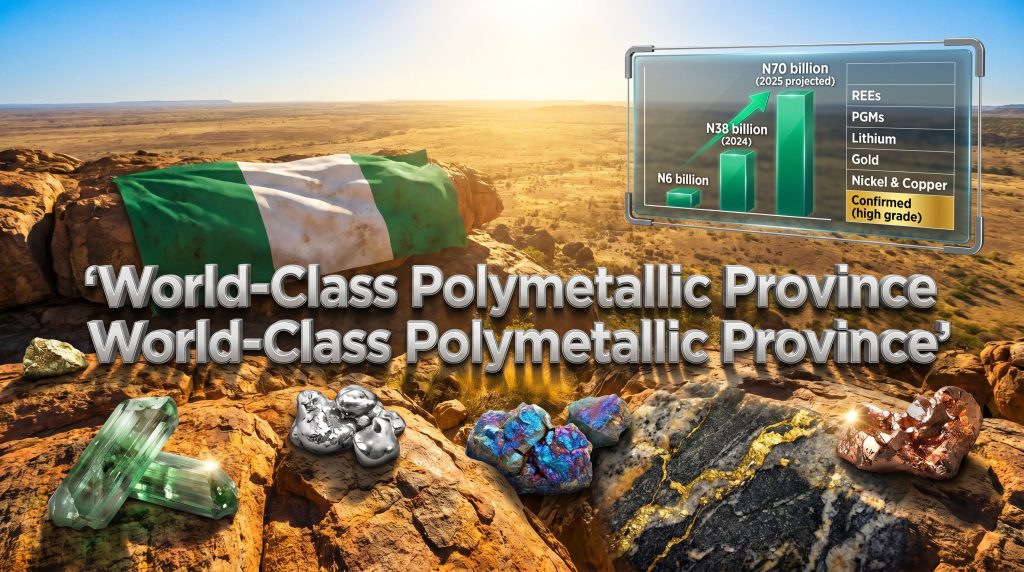
The Kaduna polymetallic province, as confirmed by the NGSA following collaborative exploration with a private sector partner, contains a remarkably diverse mineral inventory. According to reporting from Leadership Nigeria, the deposits have been described as world-class in scope:
-
Rare earth elements (REEs): Used in permanent magnets for EV motors, wind turbine generators, missile guidance systems, and advanced semiconductor manufacturing. REEs are classified as critical minerals by the US, EU, UK, and Australia, reflecting their indispensability to both the energy transition and defence industries.
-
Platinum group metals (PGMs): This category includes platinum, palladium, and crucially, rhodium. Rhodium, valued at approximately $471,000 per kilogram at peak market pricing, is among the most commercially valuable naturally occurring elements on earth. Its primary applications are in automotive catalytic converters, industrial chemical processing, and emerging hydrogen fuel cell technologies.
-
Lithium: The electrochemical backbone of modern battery technology. Lithium demand is projected to grow by more than 40 times current levels by 2040 under International Energy Agency forecasts tied to EV adoption trajectories.
-
Gold, nickel, and copper: Established commodity markets with deep global liquidity, providing near-term revenue optionality alongside the longer development timelines typically associated with REE and PGM projects.
How the Kaduna Province Compares to Global Polymetallic Benchmarks
| Mineral Type | Kaduna Province (Nigeria) | DRC Copperbelt | South Africa's Bushveld Complex |
|---|---|---|---|
| Rare Earth Elements | Confirmed (high grade) | Limited | Moderate |
| Platinum Group Metals | Confirmed | Absent | World's largest known |
| Lithium | Confirmed | Emerging | Limited |
| Gold | Confirmed | Present | Significant |
| Nickel and Copper | Confirmed | Dominant | Present |
The polymetallic diversity of the Kaduna province gives it a structural characteristic that single-commodity deposits lack: multiple revenue streams and natural hedging against individual commodity price cycles. When rhodium prices soften, lithium or REE revenues can offset the impact. Furthermore, this portfolio effect within a single geological province is genuinely uncommon at a global scale.
The confirmation of this discovery by a sovereign geological agency rather than a junior exploration company carries meaningfully greater credibility with institutional capital allocators. Sovereign verification removes a layer of speculative risk that typically suppresses institutional participation in early-stage African mining opportunities.
Nigeria's Mining Revenue Trajectory: The Numbers Behind the Reform Story
From N6 Billion to a Projected N70 Billion
The financial architecture underpinning Nigeria's mining sector renaissance is perhaps the most concrete indicator of genuine structural change. Annual mining sector revenue has grown from approximately N6 billion prior to the current administration's tenure to over N38 billion in 2024. The trajectory toward more than N70 billion by end of 2025 suggests that licensing discipline and compliance reforms are already generating measurable fiscal returns.
This revenue ramp matters beyond its absolute scale. It demonstrates that governance reforms are producing real economic outputs, which strengthens the credibility of Nigeria's minerals narrative with international investors who have historically discounted African mining opportunities due to institutional risk premiums.
Capital Already Flowing Into Nigerian Minerals Processing
Alongside the Kaduna announcement, a pipeline of downstream processing investments signals that the shift toward domestic value addition is progressing beyond policy rhetoric:
| Project | Location | Investment Value | Development Focus |
|---|---|---|---|
| Iron ore-to-steel processing facility | Kogi State | $1 billion | Domestic steel production capacity |
| Lithium processing investment | Undisclosed location | $800 million | Battery-grade output for export |
| Lithium processing facility | Nasarawa State | $600 million | Integrated beneficiation |
| Lithium processing plant | Near Abuja | $200 million | Commissioning phase underway |
The aggregate investment commitment across these projects exceeds $2.6 billion, a figure that would have been implausible for Nigeria's solid minerals sector even five years ago. The geographic distribution across Kogi, Nasarawa, and the Federal Capital Territory corridor also suggests that investment activity is not concentrated around a single asset, reducing systemic concentration risk.
Three Strategic Scenarios for Nigeria's Rare Earth Future
Scenario 1: Nigeria Emerges as a Tier-1 Critical Minerals Supplier
The optimistic pathway requires the convergence of several conditions: sustained governance reform, infrastructure investment (particularly energy and transport connectivity to the Kaduna province), foreign direct investment inflows from multiple geopolitical blocs, and the development of domestic processing capacity capable of producing refined mineral compounds rather than raw ore.
If these conditions materialise, Nigeria could realistically generate billions in annual critical minerals export revenue within a decade, meaningfully diversifying its foreign exchange earnings away from crude oil. Precedent exists: Botswana transformed its diamond discovery into sustained institutional development over several decades, demonstrating that resource wealth can underpin state-building when governance architecture is constructed carefully around the asset.
Scenario 2: Selective Development with Persistent Structural Gaps
The more likely near-term pathway involves flagship projects succeeding while broader mineralisation across the Kaduna province remains underdeveloped. Infrastructure deficits in northern Nigeria, security dynamics in surrounding states, and the capacity constraints of the NGSA in conducting follow-up detailed surveys across a large geographic area will create uneven development patterns.
The revocation of over 3,000 inactive and non-performing mining licences addresses one structural bottleneck by returning assets to operators with genuine development intentions. However, this measure alone does not resolve the energy infrastructure gap, the shortage of domestic technical expertise in REE and PGM processing chemistry, or the logistical challenges of moving heavy mineral concentrates from landlocked northern Nigeria to Atlantic ports.
Scenario 3: Resource Curse Dynamics and the Governance Test
The historical record of African mineral discoveries is sobering. The conditions under which a major find accelerates inequality, stimulates corruption, or triggers conflict rather than broad-based prosperity are well-documented in the academic literature on the resource curse. Nigeria itself has direct experience with this phenomenon in the Niger Delta hydrocarbon sector.
The critical variable differentiating this scenario from the optimistic pathway is institutional durability. Lessons from Zamfara State, where uncontrolled artisanal gold mining created security crises that actively undermined formal sector development, illustrate the speed with which an unprotected mineral discovery can be captured by informal networks operating outside the regulatory framework.
Whether the Kaduna discovery translates into sustained economic development will be determined less by the quality of the geology and more by the institutional architecture Nigeria builds around the asset over the next 24 to 36 months. The geology is confirmed. The governance test is still underway.
Nigeria in the Global Critical Minerals Competition
Why Geopolitical Timing Amplifies the Kaduna Discovery's Significance
China currently controls approximately 60% of global rare earth refining capacity, a concentration of processing power that has prompted the United States, European Union, and United Kingdom to classify REE supply chain diversification as a national security priority. China's rare earth strategy and the US-China rare earth trade tensions that escalated from 2023 onward have created structural demand for alternative supply sources that can be brought into production before 2030.
Nigeria's potential positioning as a non-aligned supplier is geopolitically significant. Unlike some African mineral jurisdictions that have moved decisively toward Chinese investment frameworks, Nigeria's regulatory environment and existing economic relationships with Western multilateral institutions create conditions under which it could attract capital from multiple geopolitical blocs simultaneously. This competitive dynamic could accelerate investment inflows and reduce Nigeria's dependence on any single counterparty for technology transfer and offtake agreements.
The Kenya situation provides an instructive parallel. Kenya's rare earth deposits, estimated at $62.4 billion in value, have attracted competing interest from US and Chinese capital, with the preliminary US deal representing a significant geopolitical manoeuvre in African minerals diplomacy. The energy security implications of this competition are considerable, and Nigeria, with a more diverse mineral suite and greater institutional scale, may find itself at the centre of a similar dynamic as the Kaduna province's full extent becomes clearer through follow-up surveying.
How Nigeria's Discovery Compares to Other Major African Critical Mineral Finds
| Country | Key Find | Primary Minerals | Development Stage |
|---|---|---|---|
| Nigeria (Kaduna) | World-class polymetallic province | REEs, PGMs, Li, Au, Ni, Cu | Early-stage confirmation |
| DRC | Copperbelt expansion zones | Co, Cu, Li | Active production |
| Kenya | Northern REE deposits | REEs, Niobium | Geopolitical competition phase |
| Tanzania | Graphite and REE zones | Graphite, REEs | Emerging development |
| Zimbabwe | Lithium belt | Lithium | Rapid development underway |
Nigeria's polymetallic diversity stands apart from most of these comparators. The simultaneous presence of REEs, PGMs, battery metals, and precious metals within one geological province provides a structural resilience that single-commodity mineral economies cannot replicate. In addition, the broader context of rare earth supply chains under strain globally only amplifies the strategic importance of this find.
The next major ASX story will hit our subscribers first
Governance Reforms Enabling Nigeria's Mining Sector Transformation
Licensing Discipline as an Investor Signal
The revocation of more than 3,000 inactive mining titles is not merely an administrative housekeeping exercise. In the language of institutional investor risk assessment, it signals that Nigeria's mining governance framework is moving from a permissive, speculative licence-holding culture toward a performance-based compliance model. This distinction directly affects the sovereign risk premium that international capital allocators apply when evaluating Nigerian mining opportunities.
Speculative licence banking, where operators hold titles without development intention to extract future rents from genuine developers, is a pathology common to mining jurisdictions with weak enforcement mechanisms. Nigeria's willingness to confront this practice signals a maturation of its regulatory posture.
The Value-Addition Mandate: Processing Over Raw Export
Requiring mining lease applicants to present credible domestic processing and value-addition plans before licence approval mirrors policy approaches taken by Indonesia for nickel, Zimbabwe for lithium, and Namibia for uranium. The economic logic is straightforward: the difference in export value between raw spodumene concentrate and battery-grade lithium carbonate can exceed ten times on a per-tonne basis, with the majority of that value captured by the processing jurisdiction rather than the mining jurisdiction.
Nigeria is explicitly attempting to capture a larger share of the rare earth and battery metals value chain domestically. The broader context of mining geopolitics makes this ambition timely. However, whether its industrial infrastructure can support that ambition at the scale required remains the central execution challenge of the coming decade.
Frequently Asked Questions: Nigeria Rare Earth Discovery in Kaduna
What minerals were discovered in Kaduna State, Nigeria?
The Kaduna polymetallic province contains confirmed deposits of rare earth elements at exceptionally high grades, platinum group metals (including rhodium), lithium, gold, nickel, and copper. The combination of these mineral types within a single province is geologically unusual and commercially significant.
Who confirmed the Nigeria rare earth discovery in Kaduna?
The Nigerian Geological Survey Agency (NGSA) verified the deposit following collaborative exploration work conducted with a private sector exploration partner. The discovery was announced publicly by Nigeria's Minister of Solid Minerals Development, Dele Alake, at the AFNIS 2026 summit in Abuja.
How significant is this discovery relative to global REE and PGM deposits?
The combination of high-grade REEs with platinum group metals including rhodium, lithium, and base metals in a single province places Kaduna in rare geological company globally. Most known polymetallic provinces of comparable diversity are already in advanced development or active production, making Kaduna one of the most significant undeveloped polymetallic finds announced in recent years.
What is Nigeria doing to prevent illegal mining at the Kaduna site?
The government is applying lessons from the Zamfara artisanal mining crisis, where informal mining networks operating outside the regulatory framework created serious security challenges. Establishing a formal security and licensing perimeter around the Kaduna province before large-scale development begins is a stated priority of the solid minerals governance reform agenda.
How does this discovery affect Nigeria's oil dependency?
Mining sector revenue has already grown from approximately N6 billion to N38 billion annually under current reforms, with projections exceeding N70 billion by end of 2025. While these figures remain modest relative to hydrocarbon revenues, the trajectory indicates that solid minerals are progressing toward becoming a meaningful non-oil fiscal contributor over the coming decade.
Key Takeaways: What the Kaduna Discovery Means Strategically
-
Geological rarity: A confirmed polymetallic province containing REEs, PGMs, lithium, gold, nickel, and copper simultaneously is an uncommon find at a global scale.
-
Institutional credibility: NGSA verification rather than junior explorer self-reporting provides a higher baseline of discovery credibility for institutional capital.
-
Value-chain ambition: Nigeria's explicit push toward domestic processing, backed by over $2.6 billion in announced downstream investment, signals intent to capture more of the mineral value chain than traditional resource exporters.
-
Geopolitical optionality: Nigeria's non-aligned positioning enables it to attract competing investment interest from Western and Asian capital blocs, potentially accelerating development timelines.
-
Governance as the decisive variable: The geology of Kaduna is confirmed. What remains to be tested is whether Nigeria's institutional reforms prove durable enough to convert that geology into sustained, broad-based economic development.
This article is intended for informational purposes only and does not constitute financial or investment advice. Forecasts, revenue projections, and scenario analyses involve inherent uncertainty and should not be relied upon as predictions of future outcomes. Readers should conduct independent research before making any investment decisions related to Nigeria's mining sector or critical minerals markets.
Want to Track the Next Major Critical Minerals Discovery Before the Market Does?
Discovery Alert's proprietary Discovery IQ model delivers real-time alerts on significant ASX mineral discoveries across more than 30 commodities — instantly transforming complex geological data into actionable investment insights for both short-term traders and long-term investors. Explore Discovery Alert's discoveries page to see how historic finds have generated substantial returns, and begin your 14-day free trial today to position yourself ahead of the broader market.