July 21, 2026
The Geology Behind the Hype: Why Lunahuasi Is Unlike Most Copper-Gold Discoveries
Most large-scale copper discoveries announced over the past two decades have followed a familiar template: broad, low-grade porphyry systems requiring enormous tonnage to justify their economics. These deposits typically grade between 0.3% and 0.8% copper equivalent, demanding massive capital expenditure, complex processing infrastructure, and years of feasibility work before a single dollar of metal revenue is realised. The inverse relationship between deposit size and grade is almost axiomatic in exploration geology.
Lunahuasi, situated in the Vicuña District of northern Argentina, is challenging that assumption in ways that have captured serious attention across the global mining investment community. The latest NGEx Lunahuasi project drill results from the Phase 4 program not only confirm the breadth of the deposit but reveal a grade profile that occupies an almost singular position in the landscape of undeveloped polymetallic systems worldwide.
What makes Lunahuasi structurally unusual is its multi-phase hydrothermal architecture. Rather than a single mineralisation style, the deposit hosts overlapping systems: disseminated and stockwork copper-gold mineralisation typical of porphyry environments, crosscut by structurally controlled veins that deliver grades an order of magnitude above even the best-performing porphyry benchmarks. This layering of mineralisation styles within a single deposit envelope is rare at this scale and carries meaningful implications for both resource definition and eventual metallurgical processing.
When big ASX news breaks, our subscribers know first
Understanding the Vicuña District and NGEx Minerals' Position Within It
The Vicuña District of northern Argentina has been gradually recognised as one of South America's most prospective corridors for world-class copper-gold polymetallic systems. The district sits within a broader Andean metallogenic belt that has historically produced some of the planet's largest copper deposits, yet Lunahuasi's combination of structural complexity and grade intensity sets it apart from many of its regional peers. The Argentina copper system developing across this corridor has attracted growing institutional interest as drill results continue to impress.
NGEx Minerals (TSX: NGEX; US-OTC: NGXXF) operates Lunahuasi as a cornerstone asset within its Vicuña corridor portfolio. The project is located approximately 1,300 kilometres northwest of Buenos Aires, placing it within Argentina's high-altitude Andean terrain, a geography familiar to the major copper-producing regions of neighbouring Chile. Infrastructure development in the broader region is an ongoing consideration, though the project itself remains at an active exploration stage.
Understanding the deposit's geology before interpreting drill results is critical. Lunahuasi does not behave like a conventional porphyry target, and applying standard porphyry valuation frameworks without accounting for its vein-hosted ultra-high-grade component risks materially underestimating its combined metal value.
Phase 4 Drill Program: Scale, Scope, and What Remains Pending
Defining the Deposit's Footprint
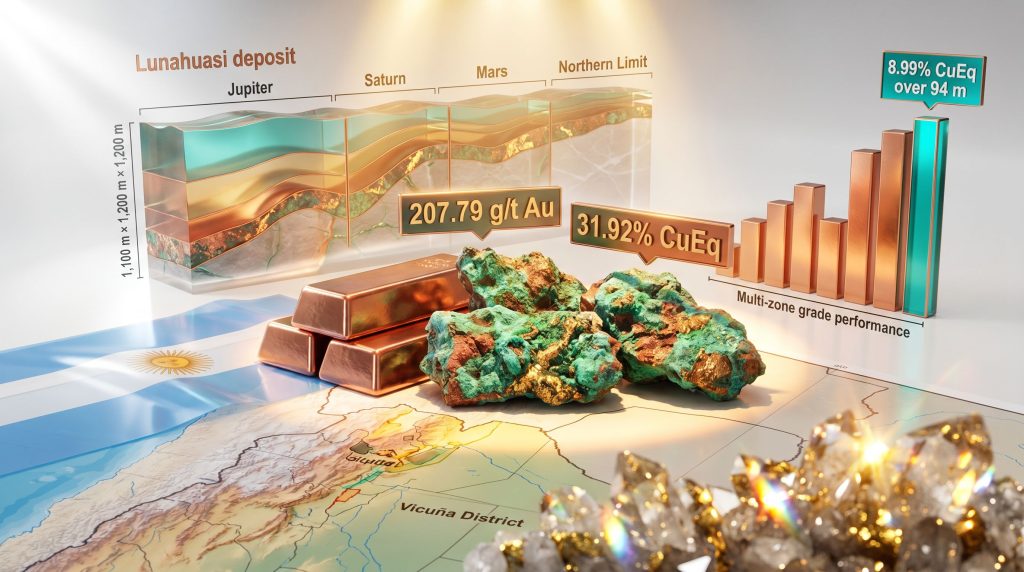
The Phase 4 program at Lunahuasi comprised 27,318 metres drilled across 32 holes, with the program subsequently expanded from an initial 25,000-metre target to 30,000 metres as results continued to support the deposit's growth trajectory. The defined deposit footprint now spans a minimum volume of 1,100 metres north-south, 1,200 metres east-west, and 1,200 metres vertically, representing a total defined volume exceeding 1.58 cubic kilometres.
Critically, the system remains open in all directions. In exploration terminology, this means that every boundary currently defined by drilling represents an exploration boundary, not a geological one. The deposit has not yet been closed off at depth or along strike, which is a powerful indicator that the final resource envelope could be considerably larger than current drilling suggests.
Approximately 50% of Phase 4 assay results remain pending, with staged release anticipated through Q3 2026. This means the information flow from Phase 4 alone continues to represent a material near-term catalyst for investors and geological interpreters alike. Furthermore, interpreting drill results at this stage of a project requires careful contextualisation against deposit geometry and zone boundaries.
The Four Zones and Their Structural Relationships
Phase 4 has advanced three primary targets simultaneously while also identifying additional zones:
- Jupiter Zone: First intersected in the original Lunahuasi discovery drillhole; now confirmed across a 400-metre x 500-metre area
- Saturn Zone: The largest continuous intercept zone; structurally complex with disseminated, stockwork, and vein-hosted mineralisation
- Mars Zone: The highest-grade zone in the deposit, characterised by exceptional gold concentrations within copper-dominant intervals
- Northern Limit Zone: Extends the deposit's geographic boundary northward; system remains geologically open
- Eastern Saturn Extension: Identified during Phase 4; not yet formally defined as a separate zone but significant enough to alter Saturn's total resource potential
The spatial relationships between these zones raise a particularly important geological question: whether the zones represent discrete structural corridors or interconnected parts of a single, contiguous mineralised system. If the latter interpretation proves correct, the implications for resource continuity and bulk tonnage calculations would be substantial.
Jupiter Zone: The Discovery Zone That Keeps Delivering
Why Jupiter Has Been Underappreciated
There is a tendency in exploration-stage markets to focus attention on the most recently active drill zone rather than revisiting the original discovery zone. Jupiter, which provided the first mineralised intersection in the deposit's history, received fewer drill holes during Phase 4 than either Saturn or Mars. This relative drilling deficit has contributed to a degree of analytical underweighting, despite the zone demonstrating consistent high-grade results across its defined footprint.
NGEx's leadership has directly addressed this perception gap. Company CEO Wojtek Wodzicki stated that hole DPDH077 serves as an important reminder that Jupiter should not be overlooked, emphasising that intersections across the zone demonstrate significant size potential that warrants its designation as a primary target for the Stage 5 program, as reported by the Northern Miner.
Highlight Intercept: DPDH077
The headline result from the Jupiter Zone in the latest Phase 4 release was hole DPDH077:
- Broad interval: 10 metres grading 0.88% copper, 3.14 g/t gold, and 12.2 g/t silver from 89 metres depth
- High-grade sub-interval: 7.6 metres at 18.84% copper, 5.54 g/t gold, and 336.7 g/t silver
The sub-interval grades are extraordinary by any measure. An 18.84% copper grade is not a porphyry-style result. It is indicative of massive or semi-massive sulphide mineralisation within a vein or replacement-style structure, hosted within the broader copper-gold envelope. The 336.7 g/t silver component of this interval also introduces a meaningful silver credit that adds to the deposit's combined metal value.
What makes this intercept strategically significant is its shallow depth. Beginning at just 89 metres below surface, DPDH077 suggests that a portion of Jupiter's highest-grade mineralisation may be accessible at relatively modest mining depths, a factor that carries material implications for future mine design considerations.
Saturn Zone: Scale, Continuity, and a New Eastern Frontier
Saturn Drill Results Summary
Saturn has emerged as the zone most likely to anchor the deposit's bulk tonnage credentials. Its intercepts span extended intervals and demonstrate a structural complexity consistent with a major, multi-kilometre mineralised corridor.
| Drill Hole | Interval | Cu Grade | Au Grade | Ag Grade | Notes |
|---|---|---|---|---|---|
| DPDH069 | 13 m (outer) | 1.07% | 1.31 g/t | 37.6 g/t | From 437 m depth |
| DPDH069 | 135 m (inner) | 1.18% | 0.81 g/t | 27.2 g/t | Broad continuous interval |
| DPDH072 | 34 m (outer) | 1.43% | 1.80 g/t | 40.2 g/t | From 193 m depth |
| DPDH072 | 6 m (inner) | 3.75% | 4.82 g/t | 93.1 g/t | Points to eastern extension |
| DPDH051 | 327.40 m | 3.74% CuEq | — | — | Broad high-grade interval |
| DPDH059 | 335.15 m | 4.08% CuEq | — | — | Incl. 19.5 m at 18.96% CuEq |
The 335-metre interval at 4.08% CuEq from DPDH059 deserves particular attention. At that grade over that width, this intercept would rank among the most economically compelling drill results from any copper project globally in recent years. For reference, a deposit grading above 1.0% CuEq is generally considered high-grade for a bulk-tonnage copper system; grades above 2.0% CuEq over extended widths are exceptional. In the context of broader copper market trends, results of this magnitude are increasingly rare and consequently attract significant investor attention.
The Eastern Saturn Extension: A Potentially Game-Changing Discovery Within a Discovery
Hole DPDH072's geometry and grade distribution have led NGEx geologists to hypothesise the existence of a distinct high-grade zone east of the currently defined Saturn footprint. If confirmed through follow-up drilling, this eastern extension could materially alter the deposit's structural model and resource potential.
This kind of intra-program discovery — identifying a new zone while drilling an existing one — is a hallmark of genuinely large-scale mineralised systems. It reflects the complexity of hydrothermal fluid pathways in these environments and suggests that Saturn's current defined footprint may represent only a portion of its total extent.
Mars Zone: Where Grade Records Are Being Written
The Ultra-High-Grade Gold Signature
The Mars Zone at Lunahuasi has produced intercepts that are difficult to contextualise within conventional copper-gold exploration frameworks because they sit so far beyond typical grade benchmarks.
| Drill Hole | Interval | CuEq Grade | Notable Sub-Interval |
|---|---|---|---|
| DPDH054 | 94.00 m | 8.99% CuEq | 21.70 m at 31.92% CuEq |
| DPDH054 | 7.30 m sub-interval | — | 15.90 g/t Au |
| DPDH070 | 17.3 m | — | 207.79 g/t Au, 2.02% Cu, 16.2 g/t Ag |
| DPDH062 | ~19 m | — | 4.47 g/t Au, 5.28% Cu, 274.1 g/t Ag |
The 207.79 g/t gold intercept over 17.3 metres from hole DPDH070 stands alone in the context of global copper-gold exploration. Grades exceeding 200 g/t gold are typically associated with narrow high-grade gold vein deposits rather than copper-dominant systems. The presence of such values within a broader copper-mineralised envelope suggests a multi-phase hydrothermal history in which a late-stage, gold-rich fluid event overprinted earlier copper-dominant mineralisation along favourable structural corridors. NGEx has highlighted this high-grade gold discovery as among the most significant results in the project's history.
For comparison, most world-class copper-gold porphyry deposits are developed at grades between 0.3% and 0.8% CuEq. The Mars zone sub-intervals exceed this benchmark by a factor of thirty to forty, placing Lunahuasi in a category occupied by very few discoveries at any scale globally.
Metallurgical Complexity as Both a Challenge and an Opportunity
The coexistence of conventional copper sulphide mineralisation and ultra-high-grade gold-bearing quartz veins within the same deposit envelope introduces genuine metallurgical complexity. Processing circuits optimised for bulk copper recovery may not capture the maximum value from gold-rich vein intervals, and vice versa. This is a factor that will require careful attention during any future feasibility-stage metallurgical testwork.
However, this complexity also represents a potential opportunity. If selective mining methods can isolate the highest-grade gold intervals for differential processing, the economic profile of the deposit could be meaningfully enhanced relative to a bulk-tonnage approach. 3D geological modelling will consequently play a critical role in defining the spatial relationships between these contrasting mineralisation styles.
The next major ASX story will hit our subscribers first
Northern Limit Zone: Confirming the Open-Ended Nature of the System
Hole DPDH058 from the Northern Limit Zone returned 109 metres at 3.37% CuEq, including a 6-metre sub-interval at 14.53% CuEq. This result is significant not primarily for its absolute grade — though that is exceptional by conventional standards — but for what it implies about the deposit's northern boundary.
The Northern Limit Zone currently represents the northernmost confirmed extent of mineralisation at Lunahuasi. That it remains open northward means the deposit's geographic footprint has not yet been closed in this direction, reinforcing the overall interpretation that the full system extent is still being defined.
How the Market Is Pricing Lunahuasi's Discovery Potential
Share Price and Valuation Context
At the time of the latest Phase 4 result release, NGEx Minerals carried a market capitalisation of approximately $5.2 billion CAD, with shares trading at $23.96 on the TSX, representing a 2% intraday decline on the announcement day. The stock's 12-month trading range of $16.35 to $32.41 reflects the high-impact, sentiment-driven volatility characteristic of advanced exploration companies with no formal resource estimate.
The 2% decline on a strong drill result is an interesting market psychology signal. In exploration markets, counterintuitive price reactions to positive news often reflect:
- Profit-taking by investors who accumulated ahead of anticipated results
- Broader market conditions overriding company-specific news flow
- Investor uncertainty about how to value results without a formal resource framework
- The absence of a resource estimate creating a valuation anchor, leaving prices subject to sentiment rather than fundamentals
Pre-Resource Valuation Frameworks and Exploration Optionality
With no formal mineral resource estimate published, the market is pricing Lunahuasi on exploration optionality rather than defined asset value. This is a structurally different valuation basis from post-resource or development-stage assets, and it carries corresponding risk.
Historically, pre-resource exploration companies with drill intercepts of comparable grade and scale have experienced their most significant re-rating events upon publication of an initial resource estimate. The transition from drill-result-driven to resource-driven valuation typically introduces institutional capital that cannot participate in pure exploration plays, creating meaningful demand-side dynamics.
Investor Note: Pre-resource exploration companies carry inherent geological, technical, and development risk. Drill results, regardless of their grade profile, do not guarantee economic viability, resource conversion, or future development. Investors should conduct independent due diligence before making investment decisions.
The Pathway from Drilling to Resource Definition
NGEx's development trajectory for Lunahuasi follows a logical progression, though no formal timelines have been publicly committed to beyond the Phase 4 assay release schedule through Q3 2026.
- Complete Phase 4 assay reporting: The remaining approximately 50% of Phase 4 results are expected through Q3 2026
- Integrate geological modelling: Assay data from all four zones plus the eastern Saturn extension will need to be synthesised into updated structural and mineralisation models
- Execute Stage 5 drilling: Jupiter confirmed as primary target; eastern Saturn extension and newly identified zones also require systematic testing
- Initiate maiden resource estimation: Requires sufficient drill density and geological confidence across all defined zones
- Advance preliminary economic studies: Scoping-level assessments of processing configurations, infrastructure requirements, and development scenarios; a definitive feasibility study remains a longer-term milestone contingent on successful resource definition
- Engage Argentine regulatory frameworks: Project advancement will require navigation of Argentine mining permitting processes at the appropriate development stage
Frequently Asked Questions: NGEx Lunahuasi Project Drill Results
What is the Lunahuasi project and where is it located?
Lunahuasi is a copper-gold-silver exploration project operated by NGEx Minerals (TSX: NGEX; US-OTC: NGXXF), located in the Vicuña District of northern Argentina, approximately 1,300 kilometres northwest of Buenos Aires. It is widely regarded as one of the highest-grade undeveloped polymetallic discoveries currently under active exploration globally.
What zones make up the Lunahuasi deposit?
The deposit comprises at least four confirmed mineralised zones: Jupiter, Saturn, Mars, and the Northern Limit. An additional zone east of Saturn has been identified during Phase 4 drilling and requires further definition through follow-up work.
What is the highest-grade intercept ever reported at Lunahuasi?
Among the most exceptional NGEx Lunahuasi project drill results on record is a 17.3-metre interval grading 207.79 g/t gold from hole DPDH070 in the Mars zone, alongside a 21.7-metre sub-interval at 31.92% CuEq from hole DPDH054, both representing globally outstanding grades for a copper-gold system.
How much drilling has been completed at Phase 4?
Phase 4 comprised 27,318 metres across 32 holes, subsequently expanded to a 30,000-metre target. Approximately 50% of Phase 4 assay results remain pending as of the most recent disclosure.
When will Stage 5 drilling begin at Lunahuasi?
NGEx has identified Jupiter as the primary target for Stage 5 drilling, though no formal start date has been publicly confirmed. Stage 5 planning is expected to follow the completion of Phase 4 assay reporting through Q3 2026.
Has a formal mineral resource estimate been published for Lunahuasi?
No formal mineral resource estimate has been published as of the most recent disclosures. Lunahuasi remains in active exploration, with resource definition anticipated to follow the accumulation of sufficient drill density across all defined zones.
Key Takeaways: What the Latest NGEx Lunahuasi Project Drill Results Mean for 2026
- The Phase 4 program confirms Lunahuasi as a multi-zone, high-grade copper-gold-silver system of exceptional scale and grade intensity, with no formal resource estimate yet published
- Jupiter's promotion to a Stage 5 primary target signals that the deposit's most historically significant zone remains materially underexplored relative to its demonstrated potential
- Ultra-high-grade gold intercepts in the Mars zone, including 207.79 g/t over 17.3 metres, represent a distinct mineralisation style that could materially enhance the deposit's economics relative to conventional copper porphyry benchmarks
- The identification of an eastern Saturn extension introduces a further layer of resource growth optionality that was not part of the deposit's geological model at the start of Phase 4
- With approximately half of Phase 4 assays still pending release through Q3 2026, the near-term information flow remains a significant market catalyst
- The deposit's open geometry across all directions, combined with a minimum defined volume exceeding 1.58 cubic kilometres, positions Lunahuasi among the most consequential undeveloped copper-gold discoveries of the current decade
Want to Stay Ahead of the Next Major Mineral Discovery?
Discovery Alert's proprietary Discovery IQ model scans ASX announcements in real time, instantly translating complex mineral data into actionable opportunities — no geology degree required. Explore how historic discoveries have generated extraordinary returns on Discovery Alert's dedicated discoveries page, and begin your 14-day free trial today to ensure you're positioned before the broader market catches on.