
August 5, 2026
British Columbia's Golden Triangle and the Search for the Next Giant Deposit
Few exploration districts anywhere in the world compress as much geological potential into as small a geographic footprint as British Columbia's Golden Triangle. Stretching across the northwestern corner of the province, this corridor has produced historic mines, active operations, and a growing roster of large-scale deposits that are reshaping how the global mining industry thinks about Canada's resource endowment.
The region's geological architecture, shaped by ancient hydrothermal systems that deposited gold, silver, and copper across vast structural corridors, creates conditions where a single drill programme can meaningfully redefine a project's scale. Furthermore, understanding how to interpret mineral exploration drill results is essential context for evaluating what each new hole genuinely tells us.
It is within this framework that Tudor Gold's Treaty Creek Project, and specifically its CBS Zone, deserves careful examination. The Tudor Gold Treaty Creek CBS Zone drilling results released in July 2026 are not simply a routine seasonal update. They represent a meaningful step in understanding whether Treaty Creek's mineralised footprint extends further than previously mapped, and whether the CBS Zone represents an independent discovery, a lateral extension of the existing Goldstorm deposit, or something more complex altogether.
Investors and geologists following this story should note that all drill results discussed below are based on Tudor Gold's announced 2026 Phase One programme. This article does not constitute financial advice. Exploration-stage results involve significant uncertainty, and past intercepts are not necessarily indicative of future resource definition or economic viability.
When big ASX news breaks, our subscribers know first
Treaty Creek's Position Within a World-Class Mining Neighbourhood
Tudor Gold holds an 80% ownership stake in the Treaty Creek Project, a position that concentrates the economic leverage of any future discovery or resource expansion directly at the project level. The property sits adjacent to two of the most significant assets in the region: Seabridge Gold's KSM property and Newmont's Brucejack mine. This geographic placement is not incidental.
Proximity to already-advanced projects provides Treaty Creek with meaningful geological context, established infrastructure corridors, and a degree of industry validation that exploration properties in more remote or untested terrains cannot claim. In addition, the current state of gold exploration across the Golden Triangle reinforces why this neighbourhood commands such sustained institutional attention.
The flagship Goldstorm deposit, defined through an independent technical report completed in late 2025, is already recognised as one of the larger gold, silver, and copper deposits in the Golden Triangle. That existing scale functions as an interpretive anchor for all new drilling across the property. When results arrive from zones like CBS, the central analytical question is never purely whether the numbers are impressive in isolation.
The more meaningful question is whether new mineralisation is part of the same broader hydrothermal system that created Goldstorm, and if so, how much additional scale that connectivity implies. Cumulative drilling at the CBS Zone now totals approximately 3,380 metres across the zone's history, providing a meaningful baseline dataset against which the 2026 results can be evaluated.
What the Two 2026 CBS Zone Holes Actually Intersected
CBS-26-08: A Vertically Layered Discovery
The more analytically complex of the two holes, CBS-26-08, returned distinct mineralisation at multiple depths within a single drillhole. This vertical layering — a phenomenon sometimes described in the geological literature as telescoped or stacked mineralisation — occurs when different metals are deposited at different levels within the same hydrothermal system as it evolves over time.
Near the surface, CBS-26-08 returned:
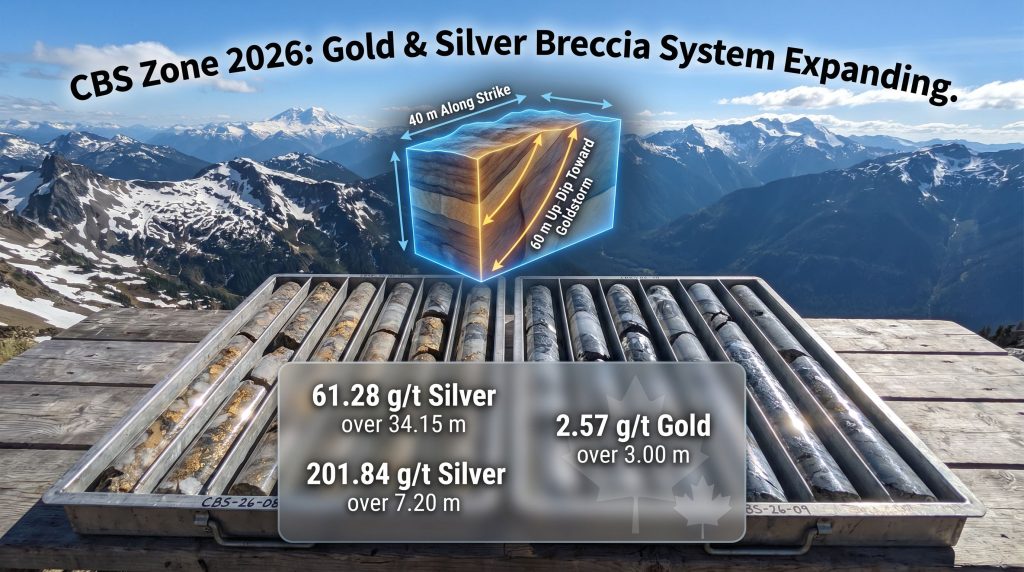
- 2.57 g/t gold and 0.39 g/t silver over 3.00 metres from 6.00 metres downhole
- 0.53 g/t gold and 9.81 g/t silver over 20.60 metres from 61.90 metres downhole, including a higher-grade sub-interval of 0.92 g/t gold and 16.99 g/t silver over 9.30 metres
These near-surface gold intercepts are geologically consistent with the style of mineralisation that has been the primary focus of CBS Zone drilling to date. However, it is the deeper intercept in CBS-26-08 that fundamentally changes the CBS Zone's exploration profile.
At 264 metres downhole, the hole intersected a silver-rich breccia system that had not previously been tested at this depth within the CBS Zone:
- 61.28 g/t silver and 0.09 g/t gold over 34.15 metres
- A high-grade sub-interval of 201.84 g/t silver and 0.07 g/t gold over 7.20 metres
Strategically, CBS-26-08 extended the gold-rich breccia system 40 metres along strike to the northeast, adding measurable spatial dimension to the zone's known footprint.
CBS-26-09: Testing the Connection Toward Goldstorm
The second hole, CBS-26-09, was designed with a different geometric objective. Rather than probing depth, it was oriented to test whether the gold breccia system extends vertically upward, specifically in the up-dip direction toward the Goldstorm deposit. The results confirmed that it does:
- 0.79 g/t gold and 4.71 g/t silver over 47.00 metres from 153.00 metres downhole
- High-grade sub-interval: 1.04 g/t gold and 1.49 g/t silver over 24.50 metres from 153.00 metres downhole
CBS-26-09 extended the gold-rich breccia system 60 metres up-dip in the direction of the Goldstorm deposit, narrowing the interpreted gap between the two zones and adding structural credibility to the hypothesis that CBS and Goldstorm may share a common mineralisation corridor.
Summary Table: 2026 CBS Zone Drill Results
| Hole | Target | From (m) | Width (m) | Gold (g/t) | Silver (g/t) | Strategic Extension |
|---|---|---|---|---|---|---|
| CBS-26-08 | Shallow gold | 6.00 | 3.00 | 2.57 | 0.39 | Structural confirmation |
| CBS-26-08 | Shallow gold | 61.90 | 20.60 | 0.53 | 9.81 | Broad gold envelope |
| CBS-26-08 | Sub-interval | 61.90 | 9.30 | 0.92 | 16.99 | Higher-grade corridor |
| CBS-26-08 | Deep silver breccia | 264.00 | 34.15 | 0.09 | 61.28 | 40 m NE along strike |
| CBS-26-08 | Deep silver sub-interval | 264.00 | 7.20 | 0.07 | 201.84 | Peak grade concentration |
| CBS-26-09 | Up-dip gold | 153.00 | 47.00 | 0.79 | 4.71 | 60 m up-dip toward Goldstorm |
| CBS-26-09 | High-grade sub-interval | 153.00 | 24.50 | 1.04 | 1.49 | Confirmed high-grade core |
The Deep Silver Breccia: Why This Discovery Changes the CBS Zone's Profile
What Breccia-Hosted Silver Mineralisation Tells Geologists
Breccia-hosted precious metal deposits form when hydrothermal fluids fracture host rock and subsequently infill those fractures with mineralised material. In gold-dominant systems like those typically found in the Golden Triangle, the presence of a distinct silver-rich breccia at depth introduces an important geological variable.
Silver tends to be deposited at shallower crustal levels and lower temperatures than gold within many hydrothermal systems, which means a deep silver breccia can indicate either a separate mineralising event or a structurally complex system where the standard depth-temperature relationship has been inverted or overprinted. For investors, interpreting drill results of this nature requires understanding which geological scenario is most likely at play.
The depth of 264 metres downhole for the silver intercept in CBS-26-08 suggests this part of the CBS Zone was genuinely untested before the 2026 programme. That is geologically significant: it means the silver target was identified, in part, by extrapolating between existing data points rather than by following up an obvious surface expression.
Bridging the Data Gap: How Three Separate Lines of Evidence Align
The analytical weight of the new CBS silver intercept is amplified by the fact that it connects two independent prior observations:
- CBS-22-04, a drillhole from 2022, previously returned 54.82 g/t silver, establishing that silver mineralisation existed at the CBS Zone but leaving its lateral and vertical extent undefined.
- Seven surface chip samples grading between 30 and 62 g/t silver had already indicated near-surface silver anomalism across the zone.
- The 2026 deep intercept of 61.28 g/t silver over 34.15 metres now provides spatial continuity between the legacy hole and the surface geochemical work.
When a new drill intercept bridges a spatial gap between a historical hole result and surface geochemical anomalies, it typically indicates that the mineralised system is more coherent than isolated data points alone would suggest. This triangulation of evidence is a key reason why Tudor Gold has characterised the CBS silver target as warranting dedicated follow-up drilling.
The zone remains open in multiple directions, meaning neither its strike length nor its depth extent has been closed off by drilling. That openness is both a risk and an opportunity: the silver target's true dimensions will only become clear through the planned September follow-up campaign. Tudor Gold's 2026 CBS zone results have been covered in detail by Resource World, offering additional technical commentary on the silver breccia discovery.
Three Scenarios for the CBS Zone's Relationship With Goldstorm
The up-dip extension from CBS-26-09 narrows the interpreted gap between CBS and Goldstorm, but does not yet confirm physical or resource-model continuity between the two zones. Three plausible interpretations exist, each carrying different implications for Treaty Creek's overall resource potential.
| Scenario | Interpretation | Implication for Resource Potential |
|---|---|---|
| Scenario A: Connected System | CBS and Goldstorm form part of a single, continuous mineralised corridor | Significant resource upside; CBS drilling adds directly to the Goldstorm footprint |
| Scenario B: Analogous but Separate | CBS hosts independent mineralisation with similar characteristics to Goldstorm | Standalone resource potential; adds project-level diversification |
| Scenario C: Transitional or Feeder Zone | CBS represents a peripheral or feeder structure linked to Goldstorm's margins | Moderate upside; important for understanding deposit architecture but limited standalone scale |
Resolving which of these scenarios applies will require additional drilling that specifically targets the interpreted gap between CBS and Goldstorm. The 2026 data set provides directional evidence for Scenario A but does not yet eliminate Scenarios B or C. Investors should weigh this interpretive uncertainty carefully when assessing the significance of the current results.
The 2026 Exploration Strategy: Multiple Targets, Phased Allocation
How Tudor Gold Is Deploying Its Two Drill Rigs
Tudor Gold's 2026 Phase One exploration programme initially allocated 2,000 metres of drilling capacity to the CBS Zone. This phased, multi-target approach reflects a resource-stage exploration strategy designed to test several geological hypotheses simultaneously across Treaty Creek's broader land package.
Following the completion of CBS-26-08 and CBS-26-09, both drill rigs shifted to the Perfectstorm Zone, where the geological hypothesis under examination is whether the zone hosts a style of gold, silver, and copper mineralisation analogous to Goldstorm. This is a particularly meaningful test for Treaty Creek's overall scale potential. If Perfectstorm confirms Goldstorm-style mineralisation, it would suggest the broader Treaty Creek system is more laterally extensive than current resource models reflect.
Results from Perfectstorm are expected through the summer of 2026. The Perfectstorm Zone drilling programme represents one of the most closely watched near-term milestones across the entire Treaty Creek land package.
Key Milestones to Monitor Through 2026
| Timeframe | Activity | Why It Matters |
|---|---|---|
| July to August 2026 | Continued drilling at Perfectstorm Zone | Tests for Goldstorm-analogous mineralisation across a separate part of the property |
| September 2026 | Return to CBS Zone for follow-up drilling | Targets the new deep silver breccia and further up-dip gold extension |
| Ongoing 2026 | Underground mine economics study at Goldstorm | Advances development-stage planning for the flagship deposit |
| Pending regulatory approval | Underground tunnel permit application for SC-1 Zone | Would enable close-spaced drilling of Goldstorm's high-grade SC-1 corridor |
The next major ASX story will hit our subscribers first
The SC-1 Zone and the Significance of the Underground Tunnel Permit Application
Why Surface Drilling Has Limitations at Depth
Within the broader Goldstorm deposit, the SC-1 Zone has been characterised as a higher-grade corridor. Defining high-grade zones at significant depth using surface drill rigs alone presents practical constraints. Drill angles become increasingly difficult to optimise, core recovery can be affected by the weight of the drill string, and the spacing of holes needed to achieve resource confidence at depth becomes prohibitively expensive from the surface.
An underground exploration tunnel would address each of these limitations directly. Drill stations positioned within the tunnel allow horizontal or near-horizontal holes to be drilled through a high-grade zone at close spacing, dramatically improving both the precision and the density of sampling within the SC-1 corridor. The permit application for such a tunnel signals that Tudor Gold is thinking about Goldstorm in development-stage terms, not merely as an exploration target.
The Underground Mine Economics Study: What It Signals
An underground mine economics study is a formal analytical exercise that typically incorporates resource estimates, geotechnical characterisation of the host rock, metallurgical test work on ore samples, and preliminary cost modelling for mine infrastructure. Furthermore, positive metallurgical test results previously reported for the Goldstorm deposit provide an encouraging foundation for this economic analysis.
The initiation of such a study does not confirm that an underground mine will be built, but it does represent a meaningful transition point in a project's lifecycle. It shifts the question from whether mineralisation exists to whether that mineralisation can be extracted at an acceptable cost relative to expected commodity revenues. For Treaty Creek, the combination of an ongoing economics study and a pending underground tunnel permit application creates two distinct near-term catalysts that extend well beyond the Tudor Gold Treaty Creek CBS Zone drilling results themselves.
Frequently Asked Questions: Tudor Gold CBS Zone Drilling Results 2026
What are the CBS Zone drilling results from Tudor Gold's 2026 programme?
The first two holes of Tudor Gold's 2026 Phase One programme at the CBS Zone returned a new deep silver breccia intercept grading 61.28 g/t silver over 34.15 metres (including 201.84 g/t silver over 7.20 metres) and extended the known gold breccia system 40 metres along strike to the northeast and 60 metres up-dip toward the Goldstorm deposit.
What is the CBS Zone at Treaty Creek?
The CBS Zone is a mineralised exploration target within Tudor Gold's Treaty Creek Project in British Columbia's Golden Triangle. With approximately 3,380 metres of cumulative drilling completed to date, it is being investigated both as a potential standalone resource and as a possible extension of the flagship Goldstorm deposit.
How does the CBS Zone relate to the Goldstorm deposit?
CBS Zone drilling is oriented in part to determine whether the gold and silver mineralisation at CBS is spatially and geologically connected to Goldstorm. The 2026 results have extended the CBS gold system in Goldstorm's direction, however the current dataset does not yet confirm physical or resource-model continuity between the two zones.
What is the Perfectstorm Zone and when will results be available?
The Perfectstorm Zone is a separate exploration target at Treaty Creek currently being drilled by Tudor Gold's two rigs following completion of the first two CBS holes. Results are expected through the summer of 2026, with drilling scheduled to return to the CBS Zone in September.
Why is the new silver discovery at the CBS Zone significant?
The deep silver breccia intersected in CBS-26-08 at 264 metres downhole represents a previously untested style and depth of mineralisation at CBS. Critically, the intercept provides spatial continuity between a 2022 drillhole result grading 54.82 g/t silver and a cluster of surface chip samples grading between 30 and 62 g/t silver, suggesting the silver target is more spatially coherent than individual data points alone would indicate.
What other development work is Tudor Gold pursuing at Treaty Creek in 2026?
Beyond exploration drilling, Tudor Gold is conducting an underground mine economics study at Goldstorm and has submitted a permit application to construct an underground exploration tunnel that would enable close-spaced drilling of the high-grade SC-1 Zone within the Goldstorm deposit.
Key Takeaways: What the CBS Zone Results Mean for Treaty Creek
The Tudor Gold Treaty Creek CBS Zone drilling results from the 2026 Phase One programme advance Treaty Creek's exploration story on several parallel fronts. Moreover, understanding true widths versus apparent widths in these intercepts remains essential context for correctly evaluating their resource significance. The most important takeaways for investors and geologists following this project are:
- A dual mineralisation profile is now confirmed at CBS. The zone hosts both a near-surface gold breccia system and a newly identified deeper silver breccia, fundamentally broadening its exploration significance beyond its original gold-focused characterisation.
- The spatial expansion has been precisely quantified. The two holes extended the gold system by a combined 40 metres along strike and 60 metres up-dip, with both directions remaining open for further drilling in September.
- The Goldstorm connectivity question remains unresolved but has become more tractable. CBS-26-09's up-dip extension narrows the gap toward Goldstorm, but confirming or ruling out physical continuity will require additional drilling specifically targeting the interpreted corridor between the two zones.
- Multiple near-term catalysts exist beyond CBS. Perfectstorm Zone results through summer 2026, the September CBS follow-up campaign, the Goldstorm underground economics study, and the SC-1 tunnel permit decision each represent independent milestones that could materially update the market's understanding of Treaty Creek's overall scale and development trajectory.
- The silver breccia is the most analytically novel element of this release. With the zone open in multiple directions and a planned follow-up campaign confirmed, the ultimate dimensions of the CBS silver target remain the single most consequential unresolved question heading into the second half of the 2026 drilling season.
Furthermore, drilling results in gold exploration of this complexity are rarely resolved in a single season, which is precisely why the September CBS return campaign carries such interpretive weight for the broader Treaty Creek story.
This article is for informational purposes only and does not constitute investment advice. Exploration drilling results are inherently uncertain, and readers should conduct their own due diligence before making any investment decisions related to Tudor Gold or the Treaty Creek Project.
Want to Stay Ahead of the Next Major Mineral Discovery?
Discovery Alert's proprietary Discovery IQ model delivers real-time alerts the moment significant ASX mineral discoveries are announced, transforming complex geological data into clear, actionable insights for investors at every level — explore the historic returns major discoveries have generated and begin your 14-day free trial today to ensure you're positioned before the broader market moves.