August 5, 2026
When Exploration Drilling Becomes the Real Story Behind a Producing Mine
Silver mining has always rewarded patience. The most enduring operations in Mexico's historic mining districts were rarely defined by their initial resource estimates. They were built over decades through systematic underground exploration, successive resource additions, and the disciplined conversion of geological potential into mine plan tonnage. Against that historical backdrop, the latest Endeavour Silver Terronera drill results deserve to be read not as a news event, but as the opening chapter of a resource growth story that is only beginning to take shape.
When big ASX news breaks, our subscribers know first
What the Terronera Drill Program Is Actually Testing
The distinction between exploration drilling and infill drilling is one that investors frequently underestimate. Infill drilling tightens the confidence level around already-defined mineralisation, moving resources from inferred to indicated or measured categories. Exploration drilling, by contrast, chases the unknown edges of a system, testing whether mineralisation continues beyond what has already been modelled.
The 2025-2026 program at Terronera is firmly in the second category. After a five-year pause in systematic exploration, two drill rigs are now operating simultaneously across the property, with the program expected to continue through mid-Q4 2026. The scale is meaningful: 43 holes totalling 7,015m on the La Luz system and 10 holes covering 1,904m on the Terronera vein itself. Drill platforms were established using approximately 500m of underground access ramp developed during 2025, giving exploration teams a positional advantage that surface drilling programs simply cannot replicate.
Why Underground Drill Platforms Change the Economics of Exploration
Surface drilling at depth requires longer hole lengths, introduces greater deviation risk, and produces wider confidence intervals around true width calculations. Underground platforms allow geologists to position the drill collar much closer to the target horizon, enabling shorter, more accurate holes that are easier to correlate with adjacent intercepts.
This is particularly significant at structurally complex vein systems like Terronera, where multiple sub-parallel veins and splays can intersect at varying angles. The ability to drill from within the mine workings reduces the geometric uncertainty that often plagues surface-based exploration of deep vein targets.
Interpreting the Terronera Vein Intercept Data
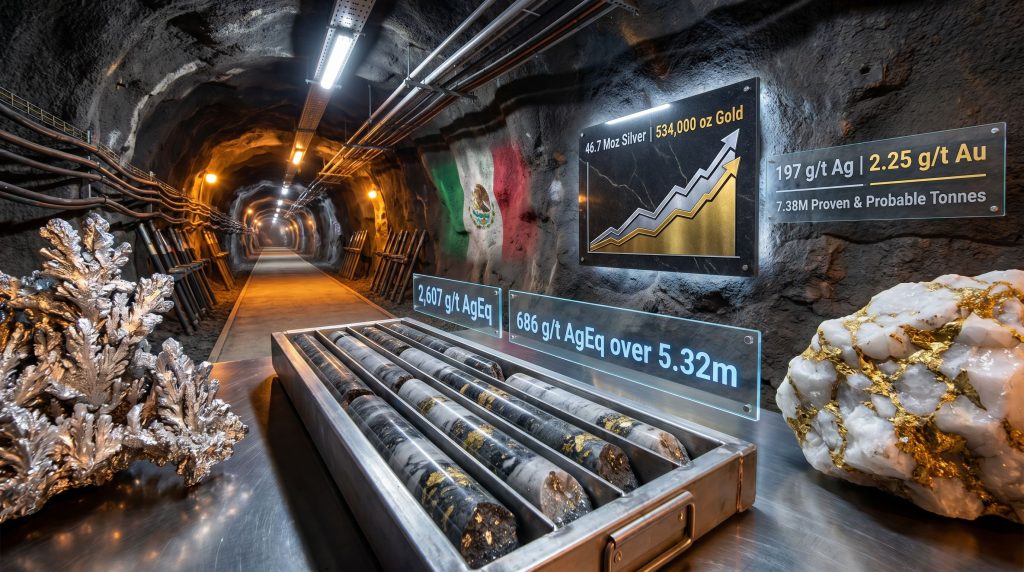
The Terronera vein results present a geologically coherent picture of a high-grade system with meaningful width. Hole TRU-001 returned 282 g/t silver and 1.80 g/t gold for a combined 435 g/t AgEq over 8.11m true width, making it the widest high-grade intercept in the campaign. Hole TRU-003 delivered 150 g/t silver and 6.30 g/t gold for 686 g/t AgEq over 5.32m — notable because the gold grade here is the highest recorded across the entire program to date.
| Drill Hole | AgEq (g/t) | True Width (m) | Silver (g/t) | Gold (g/t) |
|---|---|---|---|---|
| TRU-001 | 435 | 8.11 | 282 | 1.80 |
| TRU-003 | 686 | 5.32 | 150 | 6.30 |
| TRU-006 | Deepest high-grade intercept confirmed | |||
| TRU-010 | Confirms structural continuity at depth |
The significance of TRU-006 and TRU-010 extends beyond their individual grade results. TRU-006 represents the deepest confirmed high-grade intercept on the Terronera structure to date, while TRU-010 demonstrates that the structural host of that mineralisation persists at depth. Together, they establish that the vein system has not terminated and that the December 2024 resource boundary at depth is a function of drill coverage, not geological closure.
Furthermore, when interpreting drill results such as these, context matters enormously. At current gold prices, a gold co-credit of 6.30 g/t Au in hole TRU-003 would materially improve the revenue contribution per tonne mined in any future development scenario incorporating that zone. Gold-rich intercepts within silver-dominant systems can disproportionately influence project economics when gold spot prices are elevated.
La Luz System: Exceptional Grades, Critical Width Context
The La Luz intercepts generate the most striking headline numbers in the Endeavour Silver Terronera drill results release, but they also require the most careful contextualisation.
| Drill Hole | AgEq (g/t) | True Width (m) | Silver (g/t) | Gold (g/t) |
|---|---|---|---|---|
| LL-43 | 2,607 | 1.06 | 574 | 23.92 |
| LL-77 | 1,340 | 0.94 | 1,271 | 0.81 |
| LL-68, LL-69, LL-75, LL-76 | Down-dip extensions | Open |
Hole LL-43's grade of 2,607 g/t AgEq is exceptional by any primary silver standard. For comparison, the global average grade of operating primary silver mines sits in the range of 150 to 300 g/t AgEq. Terronera's existing reserve grade of 197 g/t silver already places it comfortably within the upper tier of primary silver producers globally. Intercepts at La Luz exceeding ten times the global industry average demand attention, particularly given the broader gold-silver market trends that continue to support elevated precious metal prices.
However, the true widths of 0.94m to 1.06m require sober analysis. In underground mining, narrow veins impose real constraints:
- Minimum mining width (the practical narrowest cut a stope can achieve) often exceeds the true vein width, meaning lower-grade wall rock is inevitably included in the mined tonnes
- Selective mining methods such as cut-and-fill are better suited to capturing narrow, high-grade material but carry higher unit costs than bulk methods
- The grade-thickness product (grade multiplied by true width) is a more useful screening metric than headline grade alone when assessing narrow-vein economics
Management has already indicated that La Luz will be mined using a combination of long-hole and cut-and-fill methods when operations begin in 2027, suggesting the mine planning team is already accounting for the width constraints identified in the drill program.
What "Open Along Strike and at Depth" Means in Practice
Both the Terronera vein and the La Luz system are described as remaining open along strike and at depth. This is not standard promotional language. In geological reporting, a mineralised zone is described as open when no hole has yet been drilled far enough in a given direction to intercept barren or significantly lower-grade rock that would define an economic boundary.
In the San Sebastián mining district, approximately 160km west of Guadalajara, vein systems have historically demonstrated substantial along-strike continuity. The district's production history supports the interpretation that Terronera and La Luz are not isolated pods of mineralisation but components of a larger, structurally controlled hydrothermal system. That geological context makes the open geometry of both systems considerably more significant than it would be in a district with less established continuity. For additional context, Terronera's official project portal provides background on the structural setting of the wider district.
Capital Allocation: Where Terronera Sits in the 2026 Budget
Understanding how capital is being deployed at Terronera provides important context for interpreting the pace and ambition of the exploration program.
| Budget Category | Allocated Capital (US$ million) |
|---|---|
| Mine Development – Terronera and La Luz | 32.9 |
| Mine and Plant Infrastructure | 23.8 |
| Total Terronera Sustaining Capital | 56.7 |
| Total Company Sustaining Budget | 91.0 |
Terronera commands approximately 62% of Endeavour Silver's total 2026 sustaining capital allocation. The US$32.9 million directed toward underground development encompasses approximately 9km of new development, which simultaneously serves production access and creates the underground platforms required for targeted exploration drilling.
This dual-purpose nature of mine development spending is a feature of well-managed underground operations. Development metres that open up future stoping blocks also create the infrastructure from which exploration holes can be drilled cost-effectively. Consequently, the exploration program at Terronera is partially subsidised by capital that would have been required anyway for production development.
2026 Production Guidance and Grade Transition Timing
Terronera's 2026 production guidance stands at 2.4 to 2.6 million ounces of silver and up to 36,000 ounces of gold, with plant throughput targeted at approximately 2,000 tonnes per day. The first half of 2026 focused operations on lower-grade areas while ground conditions and access to higher-grade stopes were being prepared. The transition to higher-grade production zones is scheduled for the second half of the year.
Company-wide, Endeavour Silver is targeting 14.6 to 15.6 million ounces AgEq for 2026 across all operations. That guidance figure sits against a 2025 baseline of 11.2 million ounces AgEq, itself a company production record driven by Terronera's ramp-up to commercial production in October 2025 and the integration of the Kolpa mine in Peru.
Portfolio Focus Following the Bolañitos Divestment
The January 2026 sale of the Bolañitos mine to Guanajuato Silver for up to US$50 million was a deliberate portfolio simplification. By exiting a mature, lower-priority asset, the company concentrated its financial and management attention on two high-conviction growth assets: Terronera in Jalisco and the Pitarrilla project in Durango. This strategy reflects a broader pattern of Endeavour Silver expansion through selective asset consolidation rather than portfolio sprawl.
Pitarrilla has received a US$65.8 million capital allocation in 2026, including US$15 million set aside for a feasibility study. That commitment signals that Endeavour is running a genuine two-asset growth strategy rather than relying exclusively on Terronera to drive the company's transition toward senior-producer scale.
The next major ASX story will hit our subscribers first
The Resource-to-Reserve Conversion Pathway: A Step-by-Step Framework
For investors seeking to understand how today's Endeavour Silver Terronera drill results translate into future mine value, the conversion pathway involves several distinct stages:
- Exploration drilling identifies and spatially delineates mineralised intervals beyond the current mine plan boundary
- Geological modelling integrates new drill data into updated wireframes and grade interpolations
- Resource estimation applies cut-off grades and continuity criteria under NI 43-101 or JORC standards to produce a formal resource statement
- Economic assessment tests whether resources meet the economic thresholds required for reserve classification under prevailing cost and metal price assumptions — a process broadly aligned with the feasibility study process
- Reserve declaration elevates qualifying resources into the proven and probable category
- Mine plan revision incorporates new reserves into the production schedule, extending the operational life of the asset
Based on the drilling timeline running through mid-Q4 2026, an updated resource estimate incorporating the full 2025-2026 program would realistically be expected 6 to 12 months after drill completion, depending on the volume of assay data requiring processing. Any reserve update and associated mine plan revision would follow subsequently, suggesting that tangible mine-life extension announcements are more likely to emerge in 2027 rather than 2026.
Key Risks Investors Should Weigh
No assessment of exploration results is complete without a frank examination of the risks involved. Several factors warrant careful consideration:
- Exploration results are not resources. Drill intercepts, regardless of their grade or width, carry no formal economic status until subjected to a resource estimation process under a recognised reporting standard. High-grade intercepts can and do fail to convert into economically mineable resources when continuity or geometry assumptions are not met
- Narrow-width risk at La Luz. True widths below 1m at La Luz require mining methods that increase unit costs, and the dilution inherent in practical minimum mining widths could reduce effective recovered grades below the assay headline
- H2 2026 grade transition execution. The planned shift from lower-grade to higher-grade stopes in the second half of 2026 introduces scheduling and geotechnical risk. Delays in accessing the higher-grade areas would compress full-year production results toward the lower boundary of guidance
- Jurisdiction and permitting timelines. Operations in Jalisco carry standard considerations associated with Mexican regulatory processes, including community engagement requirements and environmental permitting for underground development extensions
Disclaimer: This article contains forward-looking statements, production guidance figures, and exploration result interpretations that involve known and unknown risks. Readers should not rely on exploration intercepts as indicators of future resource or reserve additions. Independent financial and technical advice should be sought before making investment decisions.
Frequently Asked Questions
What is the highest-grade intercept from the Terronera drill program?
The highest AgEq grade was recorded at La Luz in hole LL-43, which returned 574 g/t silver and 23.92 g/t gold for a combined 2,607 g/t AgEq over a true width of 1.06m. On the Terronera vein itself, hole TRU-003 returned high-grade silver and gold results of 686 g/t AgEq over 5.32m, including the campaign's highest gold grade of 6.30 g/t Au.
When is La Luz expected to begin contributing to production?
La Luz mining is targeted to commence in 2027, using a combination of long-hole and cut-and-fill mining methods. Current drilling is informing the mine design for that future operation.
How do these results affect Endeavour Silver's existing resource estimate?
The December 2024 resource estimate of 7.38 million proven and probable tonnes grading 197 g/t silver and 2.25 g/t gold represents the current defined inventory, containing 46.7 million ounces of silver and 534,000 ounces of gold. The 2025-2026 exploration program targets zones outside this boundary. Results must be incorporated into a formal updated resource estimate before they affect the official resource base. For a broader investor overview of what these drill results mean for the stock, independent market analysis provides useful additional context.
Is the Terronera vein system fully drilled out?
No. Both the Terronera vein and the La Luz system remain open along strike and at depth. Holes TRU-006 and TRU-010 confirm the Terronera structure persists beyond the current deepest defined resource boundary, while multiple La Luz holes drilled below the published resource boundary extended mineralisation in multiple directions without closing the system.
Ready to Catch the Next Major ASX Mineral Discovery Before the Market Does?
Discovery Alert's proprietary Discovery IQ model scans ASX announcements in real time, instantly identifying high-potential mineral discoveries across more than 30 commodities and converting complex data into clear, actionable insights — explore historic examples of exceptional discovery returns to understand what early positioning can mean, then begin your 14-day free trial at Discovery Alert to secure your market-leading edge.