
May 21, 2026
The Physical Layer Beneath the Digital Economy: Energy, AI, and Australia's Strategic Moment
Every major technological revolution in history has eventually collided with the physical world. Steam power needed coal. Electrification needed copper wire and generation capacity. The internet needed undersea cables and server farms. Artificial intelligence is no different, and the collision is now happening in real time, with AI energy demand and energy security in Australia converging alongside critical minerals supply chains and geopolitical fault lines all at once.
For Australian investors, this convergence is not a distant macroeconomic abstraction. It is reshaping the ASX, influencing federal budget priorities, and reordering the strategic value of assets that sit right beneath Australian soil.
When big ASX news breaks, our subscribers know first
How AI Energy Demand Is Reshaping the Global Power Equation
The scale of electricity demand generated by artificial intelligence infrastructure is difficult to overstate. According to the International Energy Agency, global data centre electricity consumption is projected to exceed 945 terawatt-hours by 2030, a figure roughly equivalent to Japan's entire annual electricity output today. That trajectory represents more than a doubling of current consumption within the space of a single investment cycle.
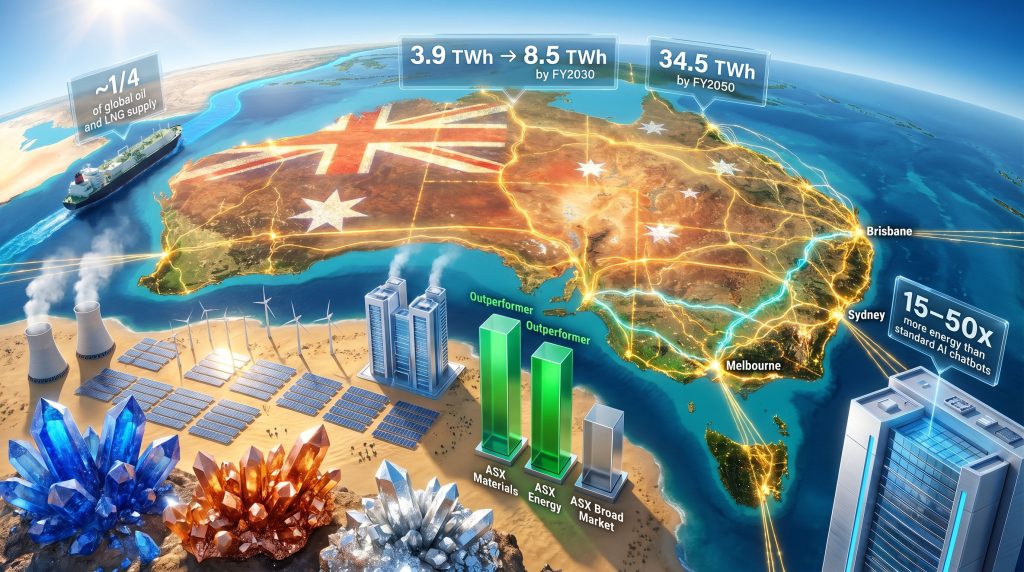
Within Australia specifically, the Australian Energy Market Operator's modelling tells a similarly striking story. Under its Step Change scenario, domestic data centre electricity demand is forecast to grow from approximately 3.9 TWh today to around 8.5 TWh by FY2030. Under a high-growth case, that figure climbs to an estimated 34.5 TWh by FY2050, representing close to a ninefold increase from current levels. Hyperscaler facilities operated by global technology majors are identified as the primary driver of near-term load growth in AEMO's projections.
| Scenario | Current Demand | Projected FY2030 | Projected FY2050 |
|---|---|---|---|
| AEMO Step Change | ~3.9 TWh | ~8.5 TWh | Not specified |
| AEMO High-Growth | ~3.9 TWh | Not specified | ~34.5 TWh |
Goldman Sachs forecasts that US electricity demand will expand at roughly 3.2% annually through 2030, with potential upside to 3.8% if the next generation of AI tools scales faster than current projections assume. Australia is tracking a broadly similar pattern, where concentrated data centre infrastructure creates localised grid stress and transmission congestion in ways that earlier demand models simply did not anticipate.
Agentic AI: The Demand Multiplier That Most Forecasts Are Not Fully Pricing In
Most energy demand forecasts are built on consumption patterns derived from current-generation conversational AI tools, but the technology is not standing still. The emerging category known as agentic AI refers to autonomous systems capable of executing complex, multi-step tasks across multiple AI models simultaneously, running in persistent computational loops without human intervention between steps.
Unlike a single-query chatbot interaction that terminates after generating a response, agentic systems maintain continuous processing cycles that compound energy consumption per task. Goldman Sachs analysis estimates that agentic AI could be 15 to 50 times more energy-intensive than today's standard large language model chatbots. If this technology tier scales faster than anticipated, current grid planning assumptions may materially underestimate the load that arrives by the early 2030s.
This is a critical planning blind spot. Grid infrastructure investment decisions being made today are based on demand curves that may have already been rendered conservative by the pace of AI development. The gap between forecast and actual demand could become a defining feature of energy security risk this decade.
This matters directly for AI energy demand and energy security in Australia because infrastructure investment decisions require long lead times. Transmission lines, generation assets, and storage systems take years to build. A demand surprise of this magnitude has the potential to create supply gaps that are extremely difficult to close quickly.
Australia's Grid Under Pressure: Supply, Storage, and the Coal Retirement Clock
Understanding Australia's energy security position requires holding two facts simultaneously. First, Australia possesses one of the world's most abundant renewable energy endowments, with exceptional solar irradiance across the continent, strong wind corridors in southern states, and the land availability to deploy generation at scale. Second, the transition away from coal-fired baseload generation is accelerating at the same moment that new demand from electrification and AI infrastructure is arriving in volume.
The intersection of these two dynamics creates a window of vulnerability. Renewable energy in mining and broader industrial sectors now constitutes a growing share of national generation, but coal assets continue to provide significant dispatchable baseload capacity. As these assets retire, the grid requires both replacement generation and the storage and firming capacity to manage the intermittency of wind and solar.
Three Risk Scenarios for Australia's Electricity System
| Risk Scenario | Primary Trigger | Most Likely Outcome |
|---|---|---|
| Moderate Supply Gap | Renewable buildout lags by 2-3 years | Higher wholesale prices; increased reliance on gas peaking capacity |
| Severe Supply Gap | Coal retirements outpace firming deployment | Reliability stress events; potential industrial load curtailment |
| Managed Transition | Storage, transmission and renewables scale in parallel | Stable pricing, improved security, reduced emissions intensity |
Grid infrastructure constraints compound the generation challenge. Large-scale data centres require dedicated high-capacity connections that existing transmission networks were not designed to accommodate. Globally, approximately 40% of Europe's power grid infrastructure is more than 40 years old, a benchmark that illustrates the scale of renewal required across developed-world electricity systems. Furthermore, meeting decarbonisation and electrification targets by 2030 is estimated to require annual global investment of around $600 billion in grid infrastructure alone.
Australia faces its own version of this investment requirement, with network upgrades and connection reform increasingly identified as prerequisites for managing the AI-era demand surge rather than optional enhancements.
Geopolitical Shock and the New Economics of Energy Security
The Iran conflict of early 2026 transformed critical minerals and energy security from a long-running policy discussion into an immediate economic priority. The Strait of Hormuz carries approximately one quarter of the world's oil and LNG supply under normal operating conditions. Disruptions to this corridor produced one of the largest oil supply shocks in recent history, with downstream price effects radiating through fertiliser, chemical, and food supply chains in ways that will persist long after active hostilities subside.
The episode delivered a sharp lesson in the asymmetry between net energy exporters and net energy importers. The United States, which transitioned from energy dependency to net export status over the past decade, demonstrated significantly greater financial market and economic resilience during the March 2026 commodity sell-off compared with nations that remained structurally exposed to import disruptions. China, despite being a net energy importer, partially buffered the impact through a combination of strategic reserve depth and a mature domestic renewables ecosystem. Nations without either of those buffers, particularly smaller emerging economies, proved considerably more exposed.
Australia's Dual Position: LNG Strength, Oil Vulnerability
Australia occupies a structurally interesting position within this framework. Its substantial LNG production capacity makes it a net energy exporter overall, providing a meaningful degree of insulation from global supply shocks. However, Australia remains a net oil importer, which represents a specific and distinct vulnerability.
The 2026 Federal Budget addressed this directly with a $14.8 billion fuel resilience package designed to strengthen domestic liquid fuel supply security. Equally significant was the budget's decision not to introduce new levies on gas exports. The government confirmed that recent Petroleum Resource Rent Tax reforms already deliver an adequate community return from the sector, consequently removing what had been a meaningful regulatory overhang for LNG producers and preserving a cleaner investment outlook for the energy sector.
The decision to hold the line on gas taxation represents a deliberate prioritisation of energy sector investment stability. For LNG-exposed investors, this removes a layer of policy uncertainty that had been weighing on sector sentiment.
The Nuclear Question and the Uranium Opportunity
The energy security repricing underway globally has accelerated a reassessment of nuclear power that would have seemed unlikely just a few years ago. Microsoft, Amazon, and Google have each signed landmark agreements to procure nuclear-generated electricity, collectively contracting more than 10 gigawatts of new nuclear capacity over the past year. Nuclear's specific appeal in the AI era is its ability to provide always-on, carbon-free, high-density baseload power, precisely the load profile that data centres require and that intermittent renewables cannot consistently deliver.
Globally, sustainable investment fund managers have begun relaxing long-standing nuclear exclusions from their mandates, reflecting a shift in the primary portfolio screening criterion from climate policy toward energy security. This is a meaningful institutional change with implications for capital flows into uranium and nuclear infrastructure assets.
In Australia, the pathway to domestic nuclear generation remains politically contested, with questions around cost, safety regulation, and construction timelines expected to feature prominently in the electoral cycle ahead. Commercial deployment of nuclear power in Australia, including small modular reactor technology, remains a medium-to-long-term scenario rather than an imminent reality. For Australian investors seeking exposure to the nuclear theme domestically, considering uranium investment strategies through uranium producers currently represents the primary available avenue.
Critical Minerals: Australia's Geological Advantage in a Fractured Supply Chain
Every component of the AI-energy infrastructure stack depends on a specific basket of physical materials. Battery storage systems, grid transmission hardware, data centre cooling infrastructure, and clean energy generation equipment all embed critical minerals at their core. Cobalt, lithium, copper, and rare earth elements are not peripheral inputs — they are foundational requirements for the physical layer that makes the digital economy function.
China's position within this supply chain creates a strategic vulnerability that Western governments are actively working to address. The scale of that dominance is stark:
| Material | China's Share of Global Mining | China's Share of Global Processing |
|---|---|---|
| Rare Earth Elements | Over 60% | Approximately 90% |
| Cobalt Refining | Significant | Over 70% |
| Lithium Processing | Significant | Dominant |
China's control over rare earth supply chains in particular represents a chokepoint with few near-term substitutes. The Western diversification imperative is real and is translating into concrete investment and procurement decisions by governments across the United States, European Union, Japan, and South Korea.
Why Australia Is Central to the Western Diversification Strategy
Australia's geological endowment positions it at the centre of the alternative supply chain that Western nations are working to construct. The combination of world-class deposits of lithium, rare earths, cobalt, and copper within a stable, rule-of-law jurisdiction with established export infrastructure makes Australia a preferred partner for supply chain diversification programs.
Critically, the strategic value of Australian critical minerals is not merely a resource story. It is a geopolitical asset in the context of US-China strategic competition, and that distinction is elevating the policy priority attached to expanding Australian processing capacity beyond raw extraction toward downstream value-add manufacturing. Australia's strategic mineral reserve framework further reinforces this position as a trusted supplier to allied nations.
It is worth noting that employment growth in Australia's mining sector has continued to be a positive feature of the labour market through 2026, providing some offset to the more subdued picture in business services sectors where AI-related headcount reductions have been more visible. Companies including WiseTech, Telstra, and Atlassian have each made workforce reductions that analysts have linked, at least in part, to AI-driven efficiency programs, a pattern observed globally across industries where cognitive task automation is advancing most rapidly.
The next major ASX story will hit our subscribers first
AI as a Solution to the Problem It Creates
The relationship between AI and energy security is not purely extractive. AI offers a genuinely powerful set of tools for managing the grid challenges that AI-driven demand growth itself creates, provided those capabilities are deployed deliberately.
Key areas where AI contributes to grid stability include:
- Demand forecasting precision: Machine learning models can anticipate load fluctuations with significantly greater accuracy than conventional methods, reducing the need for expensive and emissions-intensive peaking capacity held in reserve
- Renewable dispatch optimisation: AI-powered scheduling of variable solar and wind generation improves output predictability and reduces curtailment, increasing the effective capacity value of installed renewable assets
- Demand response coordination: AI systems can coordinate large industrial and commercial loads to shift consumption away from peak periods, improving stability without requiring additional generation investment
- Predictive maintenance: Early fault detection in transmission and distribution assets reduces outage frequency and extends infrastructure service life
There is also an emerging model in which hyperscale data centre operators design facilities with flexible load profiles, capable of modulating consumption in response to grid signals. If properly integrated into market frameworks, this demand flexibility could transform large data centres from passive grid consumers into active stability assets, a concept that energy regulators in several jurisdictions are beginning to formalise.
Investment Exposure: Navigating the Energy Security Theme on the ASX
ASX Materials and Energy sectors have been the standout performers across the first half of 2026, driven by the convergence of AI infrastructure demand, energy security repricing following the Iran conflict, and renewed strategic interest in critical minerals supply chains. The structural drivers underpinning this performance are not straightforwardly cyclical phenomena, but investors entering at current levels need to apply discipline around valuation.
Exposure to the energy security and critical minerals theme can be accessed through several instruments, each carrying different risk characteristics:
- Lynas Rare Earths (ASX: LYC): One of the largest rare earth producers outside China, with mining in Australia and processing facilities across Australia and Malaysia
- Pilbara Minerals (ASX: PLS): A leading Australian lithium producer focused on the Pilgangoora project in Western Australia, providing exposure to battery-grade critical minerals
- Paladin Energy (ASX: PDN): An Australian uranium producer with operations at the Langer Heinrich Mine in Namibia, offering direct exposure to uranium production and price movements
- Global X Rare Earth and Critical Metals ETF (ASX: GMTL): Diversified exposure to a global basket of companies involved in rare earth mining, refining, and production
- VanEck Uranium and Energy Innovation ETF (ASX: URAN): Exposure to a global basket of uranium mining, nuclear energy generation, and related energy innovation companies
Key Risks to the Energy Security Investment Thesis
| Risk Category | Description | Mitigant |
|---|---|---|
| Valuation stretch | Materials and energy stocks have re-rated significantly | Entry point discipline; staged accumulation |
| Geopolitical resolution | Middle East resolution could remove commodity risk premium | Structural diversification theme persists beyond conflict cycle |
| Policy reversal | Changes to PRRT, royalties, or export controls | Monitor legislative pipeline; budget confirmation provides near-term clarity |
| Demand timing | AI buildout may proceed more slowly than projected | Diversified exposure across demand timeline |
Important Disclaimer: This article is general in nature and does not constitute financial advice. It does not take into account your personal financial situation, objectives, or needs. You should consider whether any information is appropriate to your circumstances and seek professional advice from a licensed financial adviser before making any investment decisions. Past performance is not a reliable indicator of future returns. All financial projections and forecasts cited are sourced from third-party analysts and involve inherent uncertainty.
The Deeper Structural Shift: Who Consumes Power Is Changing
Perhaps the most underappreciated dimension of the AI energy demand challenge is not the volume of consumption growth but the nature of it. Traditional electricity demand forecasting was built around residential load cycles, industrial operating hours, and commercial building patterns. Data centre demand breaks almost all of those assumptions.
Data centres consume power continuously, at high and relatively stable loads, growing predictably year-on-year regardless of weather, season, or economic cycle fluctuations. This always-on baseload profile is fundamentally different from the demand the Australian grid was designed to serve, and it interacts poorly with a generation mix that is becoming increasingly weather-dependent. Research from Hamilton Locke highlights how this misalignment between infrastructure design and emerging demand patterns represents one of the most pressing policy challenges of the current decade.
The implication is that Australia's energy security challenge in the AI era is not simply about adding more generation capacity. It is about adding the right kind of capacity at the right locations, paired with storage systems capable of providing the firm, dispatchable power that data centre operators require. Solving that problem will require coordinated investment across generation, transmission, and storage simultaneously, sustained over at least a decade.
That investment task, and the critical minerals required to execute it, is precisely why the intersection of AI energy demand and energy security in Australia has become one of the defining structural investment themes of this decade.
Want to Know Which ASX Companies Are Positioned to Benefit From Australia's Critical Minerals Boom?
Discovery Alert's proprietary Discovery IQ model delivers real-time alerts the moment significant mineral discoveries are announced on the ASX, cutting through the complexity of over 30 commodities to surface actionable opportunities in lithium, rare earths, uranium, and beyond — exactly the materials powering the AI-energy infrastructure build-out. Start your 14-day free trial today and explore how historic discoveries have generated extraordinary returns for investors who moved early.