
June 30, 2026
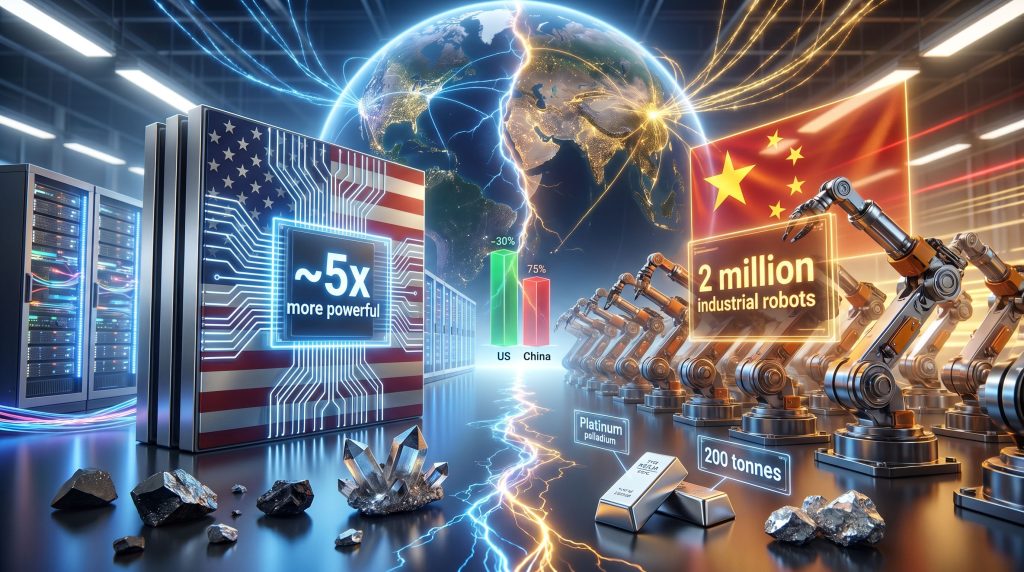
The AI Race Between Two Superpowers Is Already Reshaping Civilisation
Few technological transitions in history have arrived with such compressed timelines and such expansive consequences. The steam engine, electrification, and the internet each unfolded across generations, giving societies time to adapt institutions, realign industries, and absorb disruption incrementally. Artificial intelligence is different. Its development is being driven not by commercial curiosity alone, but by the explicit strategic ambitions of two competing superpowers, each of which has concluded that losing this contest is simply not an option.
The AI war between the US and China is not a metaphor. It is a live geopolitical contest with real resource constraints, real military implications, and a set of economic stakes that dwarf any previous technology competition. Understanding why requires looking beyond the benchmark leaderboards and into the underlying infrastructure, the critical material dependencies, and the ideological frameworks that each side believes are on the line.
When big ASX news breaks, our subscribers know first
Why This Competition Is Structurally Unlike Any That Came Before
Previous technology races, including the space race and the nuclear arms buildup, were largely contests in a single domain. One side built a better rocket. The other responded. The AI war is categorically more complex because it is simultaneously being fought across frontier model development, industrial robotics deployment, semiconductor manufacturing, energy infrastructure capacity, rare earth supply chains, and open-source software diffusion.
Each of these dimensions has its own dynamics, its own timelines, and its own set of advantages and vulnerabilities. A nation can lead on one front and trail badly on another. This multi-front structure is essential context for any honest assessment of who is winning, because the answer changes dramatically depending on which front you are measuring.
The Two Competing Strategic Visions
The United States and China have not simply adopted different tactics. They have adopted fundamentally different strategic theories about what winning actually looks like.
The American approach is built around achieving dominance in frontier model performance, particularly in the race toward artificial general intelligence. US labs have prioritised closed-source development to protect model weights and intellectual property, and have leveraged enormous compute advantages to push benchmark performance to levels that Chinese models have not yet matched. Leading US models currently outperform Chinese equivalents by roughly 20% in software engineering tasks and approximately 35% in operating cost efficiency, according to publicly available benchmark comparisons.
China's strategy is oriented differently. Rather than racing exclusively toward AGI, Beijing has pursued what it describes as an AI Plus integration agenda, embedding artificial intelligence across manufacturing, logistics, healthcare administration, and government services. The physical manifestation of this strategy is striking: China currently operates approximately 2 million industrial robots, with 295,000 new installations recorded in 2024 alone. This is not a software story. It is a story about embedding intelligence into the physical economy at a scale no other nation has approached.
| Dimension | United States | China |
|---|---|---|
| Primary Goal | Frontier model performance, AGI pursuit | AI integration into physical and industrial economy |
| Model Philosophy | Predominantly closed-source | Predominantly open-source for global diffusion |
| Core Strength | Compute scale, benchmark leadership | Industrial robotics, embodied AI deployment |
| Performance Gap | Leading by ~20-35% on key benchmarks | Closing rapidly through cost-efficient development |
| Energy Position | Significant structural deficit | ~250% more electricity generation capacity |
Semiconductors: The Single Most Contested Resource in the AI War
At the foundation of every large language model, every inference workload, and every AI-powered robot is a semiconductor. Advanced graphics processing units are the irreplaceable substrate of modern AI, which is precisely why critical minerals and semiconductors have become a primary instrument of US strategic policy.
Washington has deployed export controls on advanced Nvidia GPUs and AI model weights as the principal mechanism for limiting China's path toward frontier AI capability. The logic is straightforward: if you cannot build the hardware, you cannot train the models. The restrictions have been progressively tightened, creating what amounts to a technology embargo on the most capable AI chips.
China's response has been to engineer around the constraint rather than simply wait for it to be lifted. The most consequential outcome of this engineering effort has been DeepSeek, a large language model developed to achieve near-frontier performance at a fraction of the compute cost of American equivalents. DeepSeek's emergence revealed something important: the relationship between hardware access and model capability is not linear. Sufficiently motivated engineers, given sufficient time and competitive pressure, can find efficiency gains that partially substitute for raw compute power.
The DeepSeek development demonstrated that hardware containment strategies have real limits. Compute efficiency can, to a meaningful degree, substitute for compute scale. This does not eliminate the US advantage, but it does complicate the assumption that export controls alone can maintain a decisive capability gap indefinitely.
What Model Distillation Reveals About the Limits of IP Protection
Beyond hardware, the US faces a second category of concern: the systematic replication of AI capabilities through a process known as model distillation. This technique involves querying a frontier model at industrial scale to extract patterns that can be used to train a cheaper, lighter model that approximates the original's behaviour without direct access to its weights.
The US Department of Justice has begun prosecuting cases involving the smuggling of advanced AI servers, and legislative proposals such as the Decoupling America's AI Capability from China Act represent attempts to formalise a broader separation of the two nations' AI ecosystems. Furthermore, as The Diplomat reports, this contest is entering a new and more dangerous phase, where technical ingenuity increasingly outpaces legal architecture. Whether these frameworks can keep pace with state-sponsored adversaries remains an open question.
Rare Earth Minerals: China's Physical Leverage Over the AI Supply Chain
While the semiconductor debate attracts most of the attention, a quieter and arguably more durable form of leverage exists at the base of the AI hardware supply chain: rare earth elements. China controls the dominant share of global rare earth processing capacity, giving Beijing structural influence over the production of the magnets, sensors, and electronic components that every AI system ultimately depends on.
Beijing has extended this leverage aggressively. A regulatory declaration has asserted Chinese jurisdiction over any product containing as little as 0.1% Chinese heavy-rare-earth content, regardless of where final manufacturing occurs. This rule effectively reaches deep into global supply chains, including those that believe they have already diversified away from direct Chinese inputs.
The export restrictions have expanded beyond raw materials to encompass rare-earth processing expertise and magnet production technology itself. This downstream chokehold is significantly harder to circumvent than a simple commodity export ban. Building alternative processing capacity requires years of capital investment, workforce development, and geological survey work that cannot be shortcut through policy announcements alone.
The strategic importance of these materials is perhaps best illustrated by a single data point: when the United States imposed sanctions on Russia following the invasion of Ukraine, it specifically carved out platinum and palladium from those sanctions. The carve-out was not an oversight. It reflected the recognition that American industrial and technological systems simply could not absorb a supply disruption in those metals without serious consequences.
Energy Is Destiny: The Infrastructure Dimension of the AI War
Of all the asymmetries between the two competing powers, the one that receives the least attention relative to its importance is energy. Training and running large AI models requires enormous, continuous electricity consumption. Data centres cannot be built faster than grid capacity allows. And grid capacity cannot be expanded on software timelines.
China currently generates approximately 250% more electricity than the United States. This is not a marginal advantage. It represents a structural lead in the foundational infrastructure that determines how quickly AI capability can be scaled. As one financial analyst with decades of market experience has described it, electricity is destiny, and AI is electricity. The logic chain is simple but underappreciated:
- AI model training and inference require massive, continuous electricity consumption.
- Data centre construction is directly constrained by available grid capacity.
- Nations with larger, more flexible electricity grids can scale AI infrastructure faster.
- China's generation advantage translates directly into a larger deployable AI infrastructure base.
- The US nuclear buildout, while accelerating, faces multi-year construction timelines before new capacity comes online.
- Energy dominance is therefore not a future concern. It is a present competitive variable.
The reversal in American attitudes toward nuclear power has been dramatic. Two years ago, proposing a new nuclear station was a fringe position in most mainstream policy circles. Today, it is government strategy. This shift reflects the dawning recognition that without a decisive expansion of electricity generation, every other element of the AI buildout faces an ultimate ceiling.
China, by contrast, has pursued an all-of-the-above energy strategy without ideological constraint, combining renewables, nuclear, natural gas, and coal in whatever combination maximises total output. The strategic lesson is uncomfortable for Western policymakers: energy pragmatism beats energy ideology in a geopolitical competition with no finish line.
The Robotics Dimension: Where China Has Already Surpassed the US
The physical deployment of AI into industrial systems represents perhaps the most underappreciated front in the broader competition. China's robotics supremacy is not a projection. It is a current reality. The country already banned its trade partners from accessing its most advanced robotics platforms, while simultaneously selling consumer-grade robots internationally at price points, approximately $18,000 per unit, that undercut American and European alternatives substantially.
The US-China trade war has prompted import restrictions on Chinese robots, a move that acknowledges what market dynamics already implied: American robotics manufacturing cannot currently compete on cost, scale, or deployment speed. This matters enormously for the reindustrialisation thesis, because the plan to reshore manufacturing through automation depends on having competitive automation systems to deploy.
The next major ASX story will hit our subscribers first
The Investment Cascade: How Capital Is Flowing Through the AI Buildout
For investors seeking to understand where value is being created in this competition, the useful analytical framework is a causality chain that runs from frontier model development all the way down to financial intermediation. Exploring the AI investment implications across each layer is essential for identifying where value has not yet been priced in.
| Layer | Sector | Representative Assets |
|---|---|---|
| Layer 1 | Frontier AI Models | Nvidia, AI model developers |
| Layer 2 | Data Centre Infrastructure | Server manufacturers, cooling systems |
| Layer 3 | Power Generation | Nuclear operators, natural gas, grid developers |
| Layer 4 | Physical Infrastructure | Construction, transformers, fibre optics |
| Layer 5 | Capital Allocation | Investment banks, asset managers |
The AI buildout is not a software cycle. It is an infrastructure cycle with decade-long capital expenditure timelines. Investors who trace the full causality chain from frontier models down to energy generation and financial intermediation are better positioned to identify where value has not yet been priced in.
Financial analysts with long track records in market cycle analysis have noted that the repricing across these layers has occurred sequentially, with each sector taking off roughly as the prior layer's repricing completed. The final layer, large financial institutions that will distribute and intermediate the enormous capital flows required, has not yet repriced to reflect the scale of activity coming toward it.
Precious Metals, Geopolitical Risk, and the Overlooked Case for Platinum and Palladium
The AI war has material consequences for commodity markets, and not only through the demand channels most commonly discussed. Gold's repricing over recent years has been partially driven by geopolitical risk premiums associated with Taiwan. As the near-term probability of a Taiwan conflict has receded, gold has lost some of its crisis premium and is returning to a valuation framework more closely tied to inflation expectations than to war risk.
The longer-term case for gold remains intact but is often misunderstood. Annual mine production of approximately 3,200 tonnes adds meaningfully to global above-ground stockpiles each year. When considering only the freely tradeable float rather than institutionally locked gold, the annual supply addition as a percentage of available supply is closer to 2 to 2.5%, a non-trivial drag that investors in the metal rarely factor explicitly into their return expectations.
The more compelling structural case, in the view of experienced precious metals analysts, lies with platinum and palladium. Annual production of each metal sits at approximately 200 tonnes, a fraction of gold output. But unlike gold, which accumulates in vaults and portfolios, nearly the entire annual production of platinum and palladium is consumed and destroyed through catalytic converter degradation as vehicles age and are scrapped.
Unlike gold, where annual mine production adds to an already vast global stockpile, platinum and palladium face a unique supply dynamic. Roughly 200 tonnes of each are produced annually, and approximately that same quantity is destroyed through catalytic converter wear each year. Net additions to the global investable stockpile are negligible, creating a structurally different and arguably more compelling supply-demand profile.
Production is geographically concentrated in Russia and South Africa, two jurisdictions carrying significant political risk, with smaller contributions from Canada and the United States. The American decision to exempt these metals from Russian sanctions speaks louder than any analyst recommendation about their strategic indispensability.
Three Scenarios for How the AI War Resolves
| Scenario | Probability Driver | Economic Implication | Geopolitical Implication |
|---|---|---|---|
| US Resurgence | Nuclear buildout succeeds, onshoring accelerates, AGI breakthrough achieved | Massive domestic investment boom, dollar system reinforced | Western democratic order stabilised and extended |
| Chinese Consolidation | Energy advantage compounds, robotics deployment outpaces US reindustrialisation | Global manufacturing dominance deepens further | Authoritarian governance model gains influence over global institutions |
| Prolonged Stalemate | Decoupling accelerates, parallel ecosystems solidify with no decisive winner | Higher costs globally, reduced economic efficiency | Fragmented geopolitical blocs, elevated but contained conflict risk |
The stalemate scenario is arguably the most probable near-term outcome given the structural timelines involved. Building nuclear power stations, reshoring semiconductor fabs, and retraining an industrial workforce are all decade-scale projects. Furthermore, as the critical minerals demand required for this buildout intensifies, supply-side constraints will add further complexity to both nations' timelines. The Brookings Institution notes that neither side is likely to achieve a decisive breakaway within the next five years, making this a long, expensive, and consequential contest for every asset class touched by energy, technology, or geopolitical risk.
Frequently Asked Questions: The AI War Between the US and China
Is China currently ahead of the US in artificial intelligence?
Neither country holds a clean lead across all dimensions. The US leads on frontier model benchmarks and raw compute performance. China leads on energy infrastructure, industrial robot deployment, and the physical integration of AI into its economy. The honest answer is that they are ahead on different fronts of a multi-dimensional competition.
Why did the US restrict GPU exports to China?
Advanced Nvidia GPUs are the primary training hardware for frontier AI models. Export controls represent Washington's attempt to maintain a hardware ceiling on China's ability to develop AGI-level systems. China has responded by engineering more compute-efficient models rather than simply accepting the constraint.
What is DeepSeek and why did it matter?
DeepSeek is a Chinese large language model that achieved near-frontier performance at significantly lower compute cost than American equivalents. Its emergence demonstrated that hardware export controls have limits, because sufficiently motivated engineers can partially substitute efficiency for raw compute scale.
How does energy infrastructure affect a country's AI capabilities?
AI training and inference are extraordinarily energy-intensive. Nations with larger electricity generation capacity can build and operate more data centres, train larger models, and scale AI infrastructure faster. China's approximately 250% electricity generation advantage over the United States represents a structural lead that cannot be closed through software development alone.
Could the AI competition lead to military conflict over Taiwan?
The Taiwan risk has been a primary driver of elevated gold prices in recent periods. However, analysts with long experience in geopolitical risk assessment note that China's governance structure, which operates through consensus rather than individual mandate, means that military action requires broad internal alignment that has not been fully achieved.
How are rare earth minerals connected to the AI war between the US and China?
Every AI hardware system depends on rare earth elements for magnets, sensors, and electronic components. China controls the dominant share of global processing capacity for these materials and has extended its regulatory jurisdiction to any product containing even trace quantities of Chinese rare earth content. This supply chain leverage represents a durable and difficult-to-circumvent form of geopolitical influence.
This article is intended for general informational and educational purposes only. Nothing contained herein constitutes investment advice, financial advice, or a solicitation to buy or sell any securities or financial instruments. All views, projections, and scenario analyses represent opinion and are subject to change without notice. Readers should conduct their own research and consult a licensed financial adviser before making any investment decisions. Past performance of any asset class or investment strategy discussed is not indicative of future results.
Want To Stay Ahead Of The Next Major ASX Mineral Discovery Driving The AI Supply Chain?
As the AI race between the US and China intensifies demand for critical minerals, rare earths, and energy infrastructure, Discovery Alert's proprietary Discovery IQ model delivers real-time alerts on significant ASX mineral discoveries the moment they are announced — turning complex geological data into actionable investment insights. Explore historic discoveries and their returns or start your 14-day free trial today to position yourself ahead of the broader market.