August 12, 2026
The Pacific Supply Gap That Asia's Energy Giants Are Racing to Fill
For decades, the architecture of global LNG supply has been oriented toward a handful of chokepoints: the Strait of Hormuz, the Malacca Strait, and the Panama Canal. Nations across East and Southeast Asia have built their entire energy import strategies around navigating these vulnerabilities, paying both financial and geopolitical premiums for the privilege. That structural fragility has never been more visible than now, with Hormuz traffic periodically collapsing under the weight of regional conflict and canal transit costs eating into the economics of long-haul LNG delivery.
Against that backdrop, the question of where the next major Pacific-facing LNG terminal will come from is not merely academic. It is a supply chain imperative for some of the world's largest energy importers. The Alaska LNG project buyers ahead of FID are accumulating at a pace that makes this $55 billion dual-phase development, spearheaded by Glenfarne Group, increasingly the most credible answer to that question, and the evidence for its commercial momentum is now measurable in contracted tonnes.
When big ASX news breaks, our subscribers know first
How Alaska LNG Is Structured: From North Slope to Pacific Export Hub
Understanding why Alaska LNG project buyers ahead of FID are accumulating so rapidly requires first understanding the project's engineering logic, which is as much about sequencing risk as it is about geography. Furthermore, the broader LNG supply outlook for the Pacific basin makes this project's timing particularly significant.
Phase One: Domestic Gas Monetisation Before Export Infrastructure
The project's first phase is deliberately focused on building domestic energy value before committing to the capital-intensive export terminal. This phase centres on a 765-mile, 42-inch diameter main pipeline, constructed across four simultaneously built sections, routing natural gas from Prudhoe Bay on Alaska's North Slope southward to the Anchorage and Southcentral region.
An optional 63-mile, 32-inch Point Thomson Lateral Pipeline extends access to secondary North Slope fields, providing volume optionality from a resource base that has been stranded for decades due to the absence of export infrastructure. This phased structure matters commercially: it allows the project to generate domestic revenue and demonstrate operational capability before the more capital-intensive export phase begins.
Phase Two: Transforming Pipeline Infrastructure Into a Global LNG Terminal
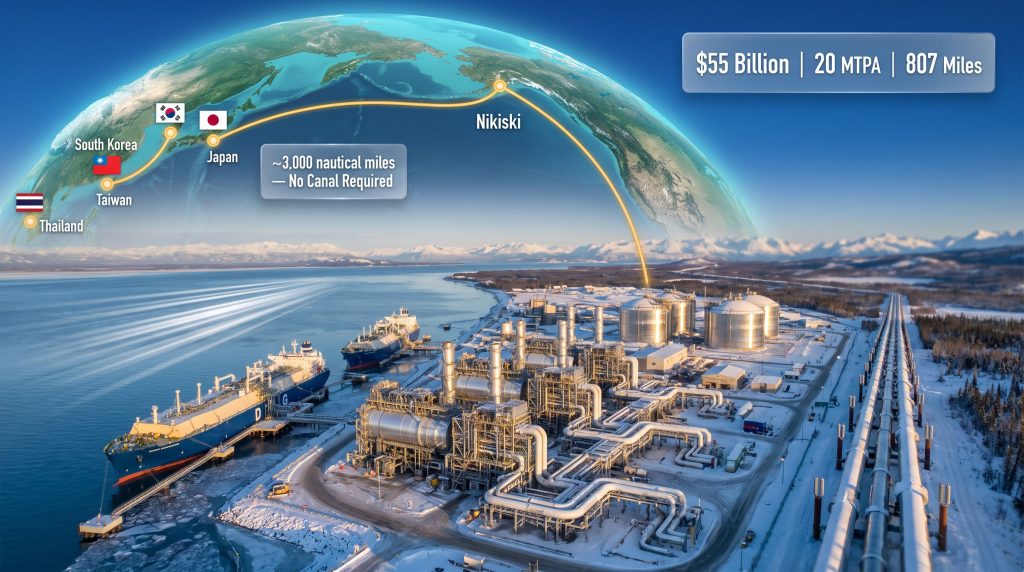
Phase Two extends the full pipeline to 807 miles, terminating at Nikiski on the Kenai Peninsula. At Nikiski, a three-train LNG liquefaction and storage terminal with combined output capacity of 20 million tonnes per annum (MTPA) is constructed. The Kenai Peninsula's position on Alaska's northwest shore provides direct, unobstructed access to North Pacific shipping lanes.
Alaska LNG: Key Project Metrics at a Glance
| Metric | Detail |
|---|---|
| Total Project Cost | $55 billion |
| Pipeline Length (Full) | 807 miles |
| Export Capacity | 20 MTPA |
| Lead Developer | Glenfarne Group (75% stake) |
| State Partner | Alaska Gasline Development Corporation (AGDC) – 25% |
| FID Offtake Threshold | 80% of 20 MTPA (~16 MTPA) |
| Offtake Secured (Latest) | ~13 MTPA |
| Remaining Gap to FID | ~3 MTPA |
The FID Threshold Explained: Why 80% Offtake Is the Critical Commercial Gate
How Project Finance Lenders Use Contracted Volumes as Credit Support
The Final Investment Decision (FID) for Alaska LNG is gated behind a commercially rational threshold: 80% of total 20 MTPA export capacity, or approximately 16 MTPA, must be covered by binding or preliminary long-term offtake agreements before Glenfarne can mobilise the full capital structure.
This is not an arbitrary figure. In project finance, long-term offtake contracts serve as the foundational layer of debt serviceability modelling. Lenders need predictable cash flow coverage ratios before they will commit to infrastructure-scale facilities, and in LNG project financing, that predictability comes from contracted volumes delivered under multi-decade agreements.
The logic was articulated clearly by U.S. Energy Secretary Chris Wright, who stated publicly that once commercial offtakers are in place for the gas, arranging financing becomes a straightforward exercise. Wright further noted that nations seeking to reduce their trade surpluses with the United States have a direct commercial incentive to purchase American-origin energy, reinforcing the bilateral diplomatic dimension of the project's commercial strategy.
As of the latest reporting, Glenfarne has secured approximately 13 MTPA in preliminary long-term agreements, leaving a gap of roughly 3 MTPA that is now the subject of active negotiations with two additional prospective buyers. Glenfarne CEO Brendan Duval, speaking at a business forum in Tokyo, indicated his confidence that the remaining volume would be secured rapidly once negotiations concluded.
Why the Last 3 MTPA May Be the Easiest to Close
A counter-intuitive dynamic operates in large LNG projects: the final tranches of offtake capacity often attract buyers more readily than earlier volumes, because late-stage buyers can observe a near-complete commercial book and assess execution risk with far greater confidence. With 13 MTPA already committed across five major buyer groups, the remaining 3 MTPA represents a relatively low-risk position for any buyer seeking Pacific-origin LNG supply diversification.
Alaska LNG Project Buyers Ahead of FID: Who Has Committed and What's Still Pending
The buyer composition for Alaska LNG reveals a deliberate geographic diversification strategy, reducing counterparty concentration risk across multiple sovereign demand bases.
Confirmed and Pending Offtake Buyers
| Buyer | Country | Volume | Agreement Type | Status |
|---|---|---|---|---|
| JERA | Japan | ~2 MTPA combined with Tokyo Gas | Preliminary offtake | Confirmed |
| Tokyo Gas | Japan | Part of ~2 MTPA combined | Preliminary offtake | Confirmed |
| POSCO International | South Korea | 1 MTPA | 20-year heads of agreement + pre-FID investment role | Confirmed |
| CPC Corporation | Taiwan | Undisclosed | Preliminary offtake | Confirmed |
| PTT Group | Thailand | Undisclosed | Preliminary offtake | Confirmed |
| TotalEnergies | France/Global | 2 MTPA | Letter of intent (Feb 2026) | Confirmed |
| Two undisclosed buyers | TBC | ~3 MTPA combined | Active negotiations | Pending |
Why Japan and South Korea Are the Cornerstone Markets
Both Japan and South Korea occupy a structurally irreplaceable role in the global LNG demand picture. Neither nation possesses meaningful domestic gas production, making imported LNG the primary fuel source for baseload power generation and industrial heating. JERA, Japan's largest power generator formed through the joint venture of Tokyo Electric Power and Chubu Electric Power, and Tokyo Gas, one of Japan's largest urban gas distributors, represent exactly the kind of creditworthy, long-duration demand anchors that project finance lenders require as counterparties.
The diplomatic dimension is equally significant. Both Japan and South Korea have been actively engaged in discussions around purchasing U.S. energy as a mechanism for managing their bilateral trade balances with the United States. Indeed, Asian demand for US LNG has been further accelerated by ongoing tariff pressures, creating a convergence of commercial logic and diplomatic incentive that is accelerating negotiation timelines.
Southeast Asian Buyers Add a Structural Layer of Demand Diversification
The inclusion of CPC Corporation from Taiwan and PTT Group from Thailand extends the buyer base beyond Northeast Asia's traditional LNG heartland. Southeast Asian LNG demand is growing structurally as regional governments accelerate the retirement of coal-fired generation capacity and domestic gas fields across the region mature toward depletion.
From a lender's perspective, this diversification is meaningful. A buyer pool spanning five or more sovereign nations substantially reduces the counterparty concentration risk that characterises single-market export projects.
Geographic Advantage: Why Alaska LNG's Pacific Position Is Commercially Non-Replicable
The North Pacific Great Circle Route and Its Financial Implications
The shipping economics of Alaska LNG are rooted in a geographic reality that no Gulf Coast terminal can replicate. Vessels departing from Nikiski travel via the North Pacific Great Circle route, the mathematically shortest path between Alaska and East Asian ports, across entirely canal-free waters.
U.S. Interior Secretary Doug Burgum, addressing attendees at the Tokyo conference, quantified this advantage: from a trade standpoint, Alaska sits approximately one-third the distance to Japan or South Korea compared to Middle Eastern supply sources. This structural reduction in transit distance translates directly into lower per-unit shipping costs, faster cargo turnaround, and meaningfully reduced geopolitical exposure.
Comparative Shipping Distance and Risk Matrix
| Supply Origin | Approximate Distance to Japan | Canal Dependency | Key Chokepoint Exposure |
|---|---|---|---|
| Alaska (Nikiski) | ~3,000 nautical miles | None | None |
| U.S. Gulf Coast (via Panama) | ~9,000-10,000 nautical miles | Panama Canal | Panama Canal, Pacific routing |
| Middle East (Persian Gulf) | ~6,000-7,000 nautical miles | None (direct) | Strait of Hormuz, Malacca Strait |
The strategic value of Hormuz avoidance is not theoretical. At the time of writing, Hormuz traffic has been severely disrupted by Iranian-linked tensions, with tanker transits dropping sharply and insurance premiums for Middle Eastern LNG cargoes rising substantially. For Japanese and South Korean utilities whose power grids depend on uninterrupted LNG supply, a Pacific-origin source that bypasses both Hormuz and the Panama Canal represents genuine energy security value, not merely a cost optimisation. However, the energy security risks associated with continued dependence on Middle Eastern supply routes are increasingly shaping long-term procurement strategies across the region.
Cold-Weather Infrastructure: A Capital Cost Premium With Long-Term Payback
Alaska's Arctic-adjacent operating environment does impose real cost premiums. Specialised cold-weather cargo handling systems, year-round ice-capable port infrastructure, and robust logistics networks for high-volume LNG carrier operations in sub-zero conditions represent meaningful upfront capital requirements. These factors contributed to earlier financing hesitancy among lenders when the project was first being evaluated.
However, these costs are front-loaded and do not compound over the operational life of the asset. Once constructed, the shipping economics and geographic advantages operate as permanent structural tailwinds for the project's long-term competitiveness.
The Danaos Partnership: Solving the Shipping Certainty Problem
Why Dedicated LNG Carrier Capacity Is a Commercial Prerequisite
One of the less-discussed commercial prerequisites for large-scale LNG project financing is shipping capacity certainty. Offtake buyers entering multi-decade agreements require confidence that cargoes will be reliably delivered, which means the project developer must demonstrate access to sufficient, dedicated vessel capacity before buyers will sign binding commitments.
Greece-based Danaos Corporation addressed this requirement directly in January 2026, announcing a $50 million equity investment in Glenfarne Alaska Partners LLC. In exchange, Danaos secured the role of preferred tonnage provider for the project, with a commitment to build and operate between 6 and 10 dedicated LNG carriers serving the project's Asian buyer base across Japan, South Korea, Taiwan, and Thailand.
This arrangement is structurally significant for two reasons:
-
It provides offtake buyers with delivery assurance, removing a key barrier to finalising binding agreements.
-
It brings an equity investor into the project's capital structure at the pre-FID stage, demonstrating third-party commercial confidence in the project's viability.
The next major ASX story will hit our subscribers first
Alaska LNG Within the Broader U.S. LNG Expansion: A Unique Pacific Position
The Gulf Coast Buildout and Its Geographic Limitation
The United States is executing the largest single expansion of LNG export capacity in the history of the industry. Projects currently under development could collectively add up to 14 billion cubic feet per day (Bcf/d) of new export capacity between 2025 and 2029, according to the U.S. Energy Information Administration, effectively doubling existing U.S. LNG export volumes. These developments are closely connected to broader trade war energy impacts that are reshaping how nations approach long-term energy procurement.
U.S. LNG Projects Currently Under Development
| Project | Developer | Location |
|---|---|---|
| Plaquemines LNG | Venture Global | Louisiana |
| Golden Pass LNG | QatarEnergy / ExxonMobil | Texas |
| Corpus Christi Stage 3 | Cheniere Energy | Texas |
| Rio Grande LNG | NextDecade | Texas |
| Port Arthur LNG | Sempra Energy | Texas |
| CP2 LNG | Venture Global | Louisiana |
| Louisiana LNG | Woodside Energy | Louisiana |
| Alaska LNG | Glenfarne / AGDC | Alaska (Pacific Coast) |
Every project in this pipeline is located on the Gulf Coast with the sole exception of Alaska LNG. This is not a minor distinction. Gulf Coast terminals shipping to Japan or South Korea must route through the Panama Canal, adding thousands of nautical miles and significant canal toll expenses to each cargo's delivered cost. Alaska LNG would be the only U.S. terminal capable of delivering Pacific-origin LNG to Asian buyers via the shortest possible maritime route.
The Property Tax Problem That Nearly Derailed the Project
A factor that receives insufficient attention in mainstream coverage of Alaska LNG is the role that Alaska's property tax structure played in earlier financing failures. Unlike most U.S. infrastructure projects where tax burdens are spread across the operational life of an asset, Alaska's framework historically imposed significant upfront property tax liabilities on pipeline and LNG infrastructure during the construction phase, before any revenue was generated.
This front-loaded tax burden made debt service modelling significantly more difficult for prospective lenders, contributing to the financing hesitancy that characterised the project's earlier iterations under previous developers. The resolution of this structural issue, alongside the improvement in the commercial offtake picture, has been central to the project's renewed momentum. In addition, the gas price impacts in Europe have indirectly underscored the strategic value of diversified, long-term LNG supply arrangements globally.
Remaining Obstacles Between Alaska LNG and Final Investment Decision
Despite meaningful progress, three substantive challenges remain before FID can be formally declared:
1. Closing the 3 MTPA Offtake Gap
Glenfarne is in active discussions with two undisclosed buyers to fill the remaining volume required to reach the 80% FID threshold. Until these agreements are formalised, FID cannot proceed. The timeline for conclusion of these negotiations is the single most important near-term variable for the project.
2. Arctic Construction Execution Risk
The $55 billion project cost reflects the genuine complexity and risk premium associated with large-scale construction in Arctic-adjacent conditions. Labour availability, materials logistics, and environmental permitting across an 807-mile pipeline corridor through remote Alaskan terrain represent execution risks that sophisticated project finance lenders will price carefully into their debt terms.
3. Financing Execution at Infrastructure Scale
Even with 80% offtake coverage in place, assembling the financing architecture for a $55 billion infrastructure asset requires coordination across commercial banks, export credit agencies, development finance institutions, and equity investors. POSCO International's pre-FID investment role and Danaos Corporation's $50 million equity commitment represent important early anchors in this capital structure, but the full financing syndication will be one of the most complex project finance exercises in recent energy history.
Frequently Asked Questions: Alaska LNG and the Path to FID
What does FID mean for Alaska LNG?
FID, or Final Investment Decision, is the formal commitment by Glenfarne Group and its financing partners to proceed with full construction. For Alaska LNG project buyers ahead of FID, the trigger point requires approximately 16 MTPA in contracted offtake volumes, a completed financing structure, and all necessary regulatory clearances.
Who owns Alaska LNG?
Glenfarne Group holds a 75% ownership stake, with the remaining 25% held by the Alaska Gasline Development Corporation (AGDC), a state entity established to advance Alaska's natural gas commercialisation objectives.
Which countries are buying Alaska LNG?
Confirmed preliminary buyers include entities from Japan (JERA, Tokyo Gas), South Korea (POSCO International), Taiwan (CPC Corporation), Thailand (PTT Group), and France/global (TotalEnergies). Two additional buyers are in active negotiation.
What is the total export capacity of the Alaska LNG terminal?
The Phase Two liquefaction facility at Nikiski is designed as a three-train complex with combined annual production capacity of 20 MTPA.
Disclaimer: This article is intended for informational purposes only and does not constitute financial or investment advice. Forecasts, commercial timelines, and project outcomes referenced in this article are subject to material uncertainty. Readers should conduct independent due diligence before making any investment decisions related to companies or projects discussed herein.
Want to Capitalise on Major Resource and Energy Discoveries Before the Broader Market?
Discovery Alert's proprietary Discovery IQ model delivers real-time alerts on significant ASX mineral discoveries, turning complex resource data into actionable investment insights for both short-term traders and long-term investors — explore historic examples of exceptional discovery returns to understand the opportunity, then begin your 14-day free trial at Discovery Alert to position yourself ahead of the market.