August 12, 2026
Graphite's Invisible Role in Modern Warfare and Why Domestic Supply Has Never Existed
Most discussions about critical mineral dependency focus on rare earth elements, lithium, or cobalt. Yet one material sits beneath all of them in terms of strategic fragility: natural graphite. The United States does not mine or process a single tonne of natural graphite at commercial scale. Every unit consumed by American defense contractors, aerospace manufacturers, and battery producers arrives from abroad, with the overwhelming majority originating from Chinese-controlled supply chains. This is not a recent development. It is a structural gap that has existed for decades, quietly deepening as downstream graphite applications multiplied across sectors that now sit at the core of U.S. national security.
Understanding why Titan Mining New York graphite defense interest has converged into a single strategic narrative requires understanding what graphite actually does inside the weapons systems, aircraft, and energy storage platforms that define modern military capability.
When big ASX news breaks, our subscribers know first
What Makes Graphite Non-Substitutable Across Defense and Aerospace Systems
Graphite is not simply a carbon-based industrial commodity. Its unique combination of properties, including exceptional thermal conductivity, chemical inertness across extreme temperature ranges, self-lubricating characteristics under friction, and structural stability under mechanical stress, makes it functionally irreplaceable in a specific set of high-performance applications.
Within aerospace and defense manufacturing, natural graphite feeds into:
- Jet engine hot-section components and thermal barrier coatings that must withstand temperatures exceeding 1,500 degrees Celsius
- Structural composite materials used in airframes, satellite bodies, and drone platforms where weight-to-strength ratios are critical
- Landing gear and brake assemblies requiring consistent lubrication under extreme mechanical loads
- Rocket nozzle liners and missile guidance housing where thermal shock resistance is non-negotiable
- Nuclear reactor moderator rods, where graphite's neutron-moderating properties remain unmatched
The two product grades most relevant to defense applications are Purified Micronized Graphite (PMG) and Coated Spherical Purified Graphite (CSPG). PMG is used extensively in dry lubrication, thermal management, and composite applications. CSPG is the dominant anode material in lithium-ion batteries, including those powering electric military vehicles, drones, and portable field equipment.
Both require raw flake graphite as the upstream feedstock and multi-stage purification processes to reach the purity thresholds demanded by defense procurement specifications, typically exceeding 99.95% carbon purity. Furthermore, the connection between critical minerals and energy security makes graphite's domestic production increasingly urgent.
The distinction between raw flake graphite and purified, application-ready graphite products is critical for investors and analysts to understand. Mine output alone does not satisfy defense specifications. The purification pathway is what creates strategic value, and it is exactly this end-to-end capability that most domestic projects have historically lacked.
The Kilbourne Deposit: Geology, Location, and What the Numbers Actually Mean
The Kilbourne graphite deposit sits within Titan Mining Corp.'s Empire State Mines (ESM) property in St. Lawrence County, northern New York, approximately 30 miles from the Canadian border. The broader ESM complex is not a new or speculative site. It hosts one of the northeastern United States' longest continuously operating zinc mining districts, with the active ESM #4 zinc mine providing ongoing production, operational cash flow, and established site infrastructure.
Kilbourne was first identified in 2023 during exploration work conducted adjacent to the zinc operation. Its emergence as a distinct, delineated graphite resource within roughly 12 months of initial discovery is notably rapid by industry standards. This reflects favourable near-surface geology and the advantage of working from an already-operational mining platform.
Kilbourne Resource Estimate: Key Metrics
| Metric | Figure |
|---|---|
| Total resource tonnage | ~22 million tonnes |
| Average graphite grade | ~3% graphitic carbon |
| Contained graphite | ~650,000 tonnes |
| Distance from existing mill | Less than 1 mile |
| Demonstration plant capacity | 1,200 tonnes per year |
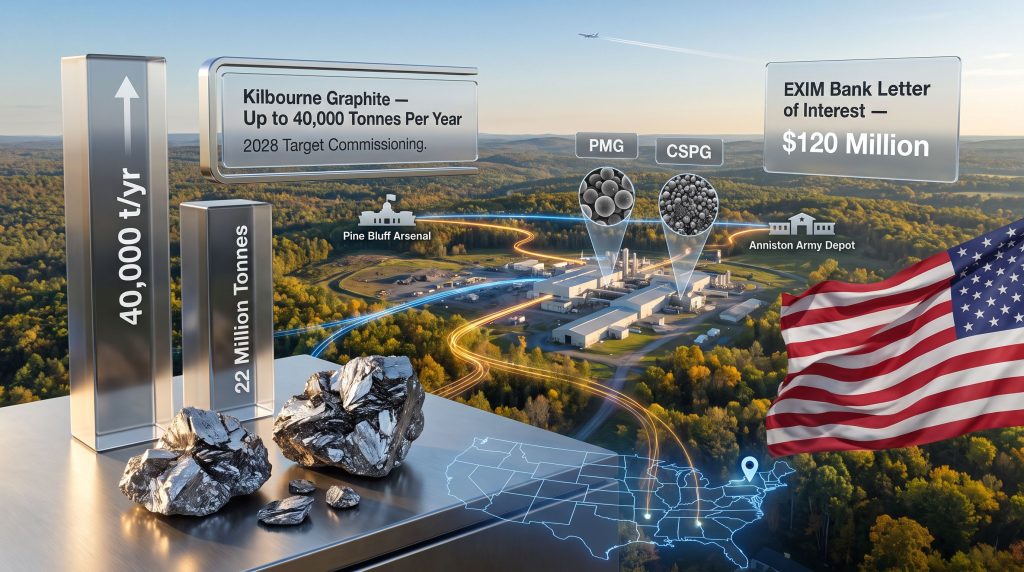
| Commercial facility target output | Up to 40,000 tonnes per year |
| Target commissioning year | 2028 |
The 3% graphitic carbon grade warrants specific context. Graphite deposits globally span a wide grade range, from sub-1% in some disseminated deposits to above 10% in high-grade vein-type occurrences. Large-tonnage flake graphite deposits in Africa, which have historically attracted the most exploration capital, often grade between 5% and 12% but require significant capital investment for processing infrastructure from scratch.
Kilbourne's 3% grade is moderate by global comparison, however the proximity to an existing processing facility fundamentally changes the capital equation. Infrastructure that would cost tens or hundreds of millions of dollars to build on a greenfield site already exists within one mile of the deposit.
The proximity advantage is not merely logistical. It compresses the capital expenditure profile of the project relative to any comparable greenfield graphite development, which is a meaningful differentiator when assessing project economics at the feasibility study stage.
How Titan Mining Is Building Its Defense Customer Pipeline
Rather than proceeding directly to commercial-scale permitting and construction, Titan took a deliberate, sequenced approach by first commissioning a 1,200-tonne-per-year demonstration plant integrated with the existing Empire State zinc mill. This decision reflects a sophisticated understanding of how defense and aerospace supply qualification actually works.
Qualification in defense supply chains is not simply a matter of meeting published specifications on paper. Procurement officers and materials engineers require physical samples, test batches, and often multi-year evaluation periods before approving a new supplier. By generating qualified material at demonstration scale before commercial production exists, Titan is compressing its customer qualification timeline and entering commercial negotiations with verified product data.
The demonstration plant strategy achieves three simultaneous objectives:
- Technical validation of the processing flowsheet, confirming that Kilbourne ore responds to the intended beneficiation and purification methods and produces material meeting aerospace and defense purity thresholds
- Physical sample supply for customer testing programmes, enabling prospective buyers to run their own internal qualification processes in parallel with Titan's commercial development
- Market credibility establishment, transforming Kilbourne from a resource estimate on paper into an operating materials business with verifiable output
The most significant commercial signal to emerge from this strategy so far is a non-binding letter of intent (LOI) executed between Titan's wholly owned Empire State Mines LLC subsidiary and an undisclosed U.S. manufacturer operating within the aerospace, defense, and advanced industrial supply chain. Titan Mining secured this graphite supply deal with a manufacturer that has commenced testing samples produced at the demonstration plant, with early positive results and indicative pricing consistent with the premium commanded by aerospace- and defense-grade graphite products.
No volumes, delivery timelines, contract duration, or customer identity have been disclosed. The agreement is explicitly non-binding and remains conditional on the completion of the manufacturer's internal qualification process and the negotiation of a definitive supply contract. These are standard conditions at this stage of defense supply chain development, and their presence does not diminish the signal value of the LOI itself.
Titan Mining President and CEO Rita Adiani described the development as a meaningful commercial validation, noting that early interest from a qualified U.S. manufacturer operating at the core of the aerospace and defense supply chain indicates that the project's output meets the most demanding specifications in the market.
The U.S. Army Partnership and What Military Depot Leases Signal
In June 2026, Titan's subsidiary received Conditional Selection Notices from the U.S. Army for Enhanced Use Lease (EUL) opportunities at two military installations:
- Pine Bluff Arsenal, Arkansas
- Anniston Army Depot, Alabama
These leases are structured to host dedicated graphite purification facilities capable of producing PMG and CSPG at the purity grades required for defense applications. The Enhanced Use Lease mechanism allows the Army to make underutilised land at military installations available for compatible commercial use, generating value for both the military and the private sector operator.
The strategic logic of co-locating purification infrastructure at active military depots is significant. It positions the highest-value processing steps, those that transform raw flake concentrate into defence-specification finished products, physically within the military supply chain. This is a qualitatively different arrangement from simply supplying a defence contractor from an external site. Furthermore, Titan Mining was selected by the U.S. Army to establish the first-ever public-private partnership for domestic critical minerals processing on strategic defence installations, integrating the graphite purification function into the institutional fabric of the U.S. Army's own materials infrastructure.
Together with the EXIM Bank's non-binding letter of interest for $120 million in project financing and $5.5 million in approved funding for feasibility and engineering work, these developments position Kilbourne within a web of institutional relationships that collectively validate its strategic importance. The EXIM financing interest, the Army depot leases, and the defence manufacturer LOI represent three independent signals from three distinct institutional categories, all converging on the same project.
Competitive Position: Why No Other U.S. Project Replicates This Structure
Titan has positioned Kilbourne as the foundation of what it describes as the only end-to-end natural flake graphite production capability in the United States, spanning mining, processing, and purification within a domestic supply chain. The absence of any comparable established capability is the central market reality that makes this project strategically significant.
Kilbourne vs. Typical Greenfield Critical Mineral Development
| Factor | Kilbourne (Titan Mining) | Typical Greenfield Critical Mineral Project |
|---|---|---|
| Existing site infrastructure | Yes (active zinc mill and processing equipment) | No |
| Demonstration-scale production | Operational at 1,200 t/yr | Pre-production or conceptual |
| Federal financing interest | $120M EXIM LOI + $5.5M approved funding | Rarely at early stage |
| Military facility partnerships | 2 Army depot conditional selections | Uncommon |
| Commercial facility output target | Up to 40,000 t/yr | Highly variable |
| Commissioning timeline | 2028 targeted | Typically 5 to 10 years from discovery |
| Ore-to-product integration | Mine through purified finished product | Typically mine output only |
The 40,000-tonne annual output target for the planned commercial facility represents approximately half of current total U.S. natural graphite import demand. Reaching that scale would not merely create a domestic supplier. It would constitute the single largest structural shift in U.S. graphite supply chain history in the modern industrial era. In addition, the surging critical minerals demand across defense, energy, and industrial sectors makes this domestic output increasingly consequential.
The next major ASX story will hit our subscribers first
Risks, Gating Conditions, and What Investors Should Monitor
The 2028 commissioning target is contingent on three interdependent conditions being met in parallel:
- Feasibility study completion producing bankable project economics that support capital commitment
- Project financing closure, including conversion of the EXIM letter of interest into committed debt and any additional equity or grant capital required
- Regulatory approvals covering environmental permitting, New York state mining authorisations, and any federal reviews associated with the Army depot lease facilities
The non-binding nature of both the EXIM financing interest and the manufacturer LOI means that neither represents a committed obligation. All commercial relationships and financing arrangements remain subject to further negotiation and execution of binding agreements. A completed definitive feasibility study will be a pivotal milestone in converting institutional interest into committed capital.
Risk framework note: Investors should treat the current milestone set as a validation-stage signal rather than a confirmed commercial outcome. The LOI, the EXIM letter of interest, and the Army depot conditional selections each confirm institutional interest but not institutional commitment. The transition from interest to obligation is the critical inflection point to monitor.
Key Milestones and Current Status
| Milestone | Status | Timing |
|---|---|---|
| Initial resource estimate completed | Confirmed | December 2024 |
| Demonstration plant commissioned | Operational | 2025 to 2026 |
| EXIM financing letter of interest issued | Confirmed ($120M) | Prior to mid-2026 |
| Army depot conditional selections received | Confirmed (2 sites) | June 2026 |
| Defence manufacturer LOI signed | Confirmed | July 2026 |
| Feasibility study completion | In progress | TBD |
| Commercial facility commissioning | Targeted | 2028 |
The Broader Structural Context: China's Export Restrictions and the Urgency Shift
China's implementation of export restrictions on graphite and graphite-related materials, beginning in late 2024 and extended into 2025, fundamentally altered the risk calculus for U.S. manufacturers dependent on Chinese-controlled supply. Prior to those restrictions, supply security concerns existed in policy documents but were rarely treated as operational procurement risks by purchasing departments. After the restrictions, however, the urgency became tangible and immediate.
China's export controls on critical minerals, including graphite, have consequently accelerated the willingness of U.S. manufacturers to engage in early-stage supply qualification discussions with domestic producers who do not yet have commercial output. The demonstration plant strategy, which might have seemed premature or speculative in a stable supply environment, is consequently well-timed relative to a procurement landscape in which qualified domestic alternatives carry genuine scarcity value.
The global graphite shortage has further intensified scrutiny on projects like Titan Mining New York graphite defense interest, particularly as the Empire State Mines complex represents something conceptually distinct from a single-commodity mining project. Its combination of active zinc production, demonstration-scale graphite processing, planned commercial graphite output, and Army-co-located purification facilities positions it as a multi-metal critical materials hub with direct links to U.S. defence supply chains, advanced industrial manufacturing, and domestic energy storage production.
Whether the 2028 timeline holds, whether feasibility economics support commercial investment, and whether the current LOI matures into a binding supply agreement are all open questions. What is not open to debate is that the structural gap in U.S. graphite supply chain capability is real, that Kilbourne represents the most advanced domestic attempt to close it, and that the institutional interest now converging on this single northern New York site reflects a level of strategic validation that few critical mineral projects at this stage of development can match.
This article is intended for informational purposes only and does not constitute financial or investment advice. Statements regarding future project milestones, financing arrangements, and supply agreements involve forward-looking assumptions that may not be realised. Readers should conduct their own due diligence before making any investment decisions.
Want to Know When the Next Major Mineral Discovery Hits the ASX?
Discovery Alert's proprietary Discovery IQ model delivers real-time alerts on significant ASX mineral discoveries — turning complex geological and market data into actionable investment insights the moment they're announced. Explore why historic discoveries have generated substantial returns and start your 14-day free trial today to position yourself ahead of the broader market.