August 12, 2026
The Economics That Could Finally Unlock Mexico's Unconventional Gas Potential
For decades, the economics of unconventional gas extraction functioned as a near-impenetrable barrier for emerging markets outside North America. High per-well costs, long drilling timelines, and limited local service infrastructure meant that shale resources in countries like Mexico remained geological curiosities rather than investable assets. That calculus has shifted fundamentally over the past five years, and Mexico shale fracking plans are now firmly on the policy agenda with considerable implications for the country's energy security equation.
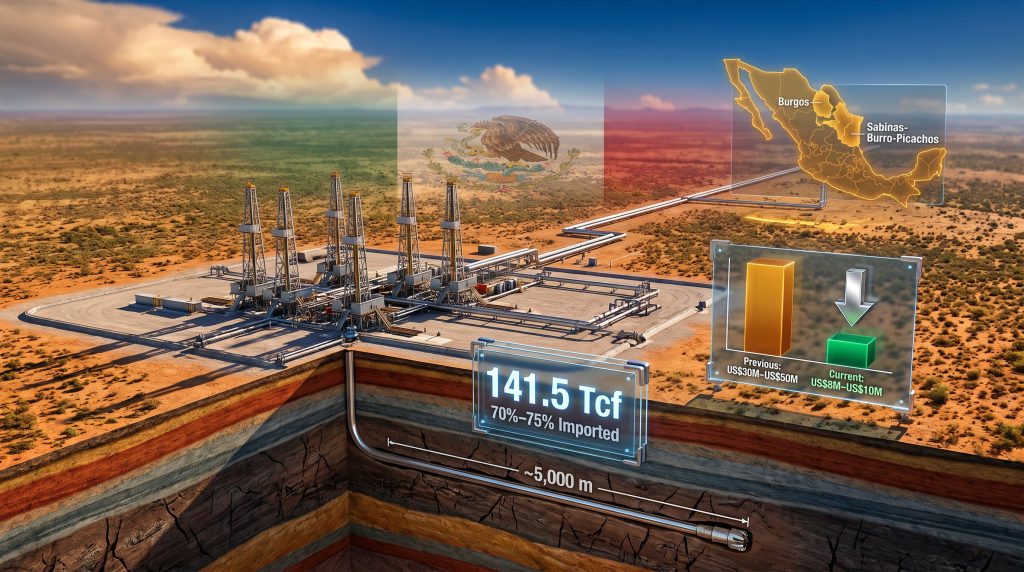
Mexico's unconventional resource base is substantial. The federal technical committee has estimated total prospective unconventional natural gas resources at 141.5 trillion cubic feet (Tcf), with the Burgos and Sabinas-Burro-Picachos basins alone accounting for a combined 120.8 Tcf of that figure. A separate government estimate from SENER places the broader resource base at a lower bound of 60 billion barrels of oil equivalent (boe) distributed across multiple basins including Chihuahua, Veracruz, and Tampico-Misantla.
What has changed is not the geology. It is the technology required to access it affordably.
When big ASX news breaks, our subscribers know first
How Fracking Technology Transformed the Cost Equation
The operational transformation of hydraulic fracturing over the past five years has been remarkable in its scale and speed. According to oil exploration and production expert Alma América Porres, a member of the technical committee analysing Mexico's fracking potential, the efficiency gains achieved across North American basins have fundamentally altered what unconventional development costs and how long it takes.
The numbers speak clearly:
| Operational Parameter | Previous Benchmark | Current Benchmark |
|---|---|---|
| Well drilling and completion time | Up to 35 days | 8 to 20 days |
| Wells per platform | 1 well | 6 to 9 wells (up to 24 in the US) |
| Horizontal drilling reach | Up to 1,500 metres | Up to 5,000 metres |
| Fracturing stages per day | 3 stages | 10 stages |
| Well development cost (US) | US$38M to US$50M | US$8M to US$10M |
| Well development cost (Canada) | Not applicable | US$8M to US$12M |
| Well development cost (Argentina) | Not applicable | US$13M to US$15M |
The reduction in per-well costs from the US$38M to US$50M range down to US$8M to US$15M across comparable basins represents approximately an 80% cost reduction in under a decade. For Mexico's unconventional development calculus, this single variable carries more weight than any other factor currently under discussion.
Why Multi-Well Pad Drilling Is a Game Changer
Multi-well pad drilling is a core driver of this transformation. Concentrating 6 to 9 wells on a single surface platform reduces land disturbance, duplicated surface infrastructure, and logistics complexity per unit of gas produced. Extended horizontal sections of up to 5,000 metres allow a single wellbore to drain far greater reservoir volumes than was previously achievable, reducing the total number of wells required to develop a given resource block.
Faster fracturing operations, moving from 3 stages per day to 10 stages, compress completion timelines and reduce the capital sitting idle between spud and first production. These are not theoretical projections for Mexico — they represent the operational standard already achieved across established plays in the United States, Canada, and increasingly in Argentina's Vaca Muerta formation.
Mexico's Structural Import Problem and Why It Makes Shale Relevant
To understand why Mexico shale fracking plans matter beyond geological interest, the starting point is the country's energy security exposure. Mexico currently consumes more than 9 billion cubic feet per day (Bcf/d) of natural gas, and SENER projects that figure could approach 11 Bcf/d by 2030 in the absence of meaningful supply-side intervention. Broader natural gas price trends in global markets further reinforce the urgency of reducing import dependency.
The critical vulnerability sits within the supply mix. Between 70% and 75% of Mexico's natural gas is sourced via pipeline from the United States, where hydraulic fracturing is itself the primary extraction method. This dependency exposes Mexico to a compounding set of risks:
- Cross-border pricing dynamics and US domestic gas market fluctuations
- Pipeline infrastructure disruption along interconnected corridor systems
- Trade policy uncertainty affecting bilateral energy arrangements, particularly given the current trade war supply chains disruptions
- Geopolitical exposure that narrows Mexico's energy negotiating leverage
The federal strategy has set an ambitious target to reduce natural gas imports by up to 50% through a multi-pronged approach combining expanded renewable power generation, energy efficiency measures, reduced gas flaring, and increased domestic fuel production. Within that framework, unconventional gas development has emerged as a supplementary but potentially significant supply lever.
The central irony of Mexico's position is that the country sits above one of Latin America's largest identified unconventional gas resource bases while sourcing the majority of its supply from a neighbour whose own production depends almost entirely on the same extraction technology Mexico has yet to meaningfully deploy.
Understanding Mexico's Basin Geography and Geological Analogues
Mexico's unconventional resource potential is not evenly distributed, and basin selection carries significant implications for development sequencing, cost structure, and community relations.
The federal technical committee has identified the Burgos and Sabinas-Burro-Picachos basins in northern Mexico as the primary candidate areas for evaluation. Together these hold an estimated 120.8 Tcf in prospective resources, making them the focal point of Mexico's shale development ambitions.
What the Geology Actually Tells Us
From a geological standpoint, several Mexican plays share structural characteristics with proven US formations. Formations including Ojinaga, the Mexican extension of the Eagle Ford, Agua Nueva, Maltrata, La Casita, and Pimienta exhibit stratigraphic and depositional similarities to the Eagle Ford and Haynesville shales in Texas and Louisiana respectively. This geological correspondence strengthens the case for analogous producibility, though it does not substitute for basin-specific exploratory drilling.
One structurally important distinction between Mexico and the United States is surface land ownership. Unlike the fragmented private surface ownership that characterises much of the US shale landscape, Mexico's field units tend to be larger and more consolidated. This feature creates meaningful potential advantages:
- Lower per-unit discovery costs through economies of scale
- Extended lateral drilling without surface rights complications
- More efficient shared pipeline and processing infrastructure
- Reduced legal and negotiation overhead for development programmes
In the Tampico-Misantla and Veracruz basins, an additional geological characteristic creates a theoretically compelling production scenario. Jurassic shale formations coexist with Tertiary tight oil formations currently under conventional production in these areas. Commingled production techniques could leverage existing transportation infrastructure to significantly reduce breakeven costs, potentially bringing Tampico-Misantla breakeven costs down from US$55/b to US$65/b to approximately US$40/b.
However, the federal scientific committee has formally excluded Tampico-Misantla from unconventional extraction consideration based on assessments of biodiversity sensitivity, environmental risk, and social protection requirements. The cost advantage is real, but it is currently academic.
The Tampico-Misantla Exclusion: A Policy Signal With Broader Implications
The decision to exclude Tampico-Misantla from Mexico shale fracking plans is not merely a basin-specific judgement. It signals how the federal scientific committee intends to weight environmental and social risk factors against geological and economic potential across all future basin evaluations.
The committee's preference for basins with saline water aquifer characteristics rather than freshwater-adjacent geology reflects an attempt to structurally separate hydraulic fracturing operations from competition with drinking water systems — a concern that has been central to anti-fracking opposition across multiple countries.
Water intensity is not a trivial concern in Mexico's northern states. Several candidate basin regions already face significant groundwater scarcity, and the political sensitivity of allocating water to industrial extraction in water-stressed communities adds a non-geological risk dimension that no amount of cost reduction can fully neutralise.
The Tampico-Misantla precedent therefore functions as a template for future exclusions and inclusions. Understanding which environmental criteria the committee treats as binding constraints versus advisory inputs will be critical for any operator or investor assessing Mexico's unconventional development landscape.
The Political Language of Fracking in Mexico
President Claudia Sheinbaum's administration has been openly exploring pilot fracking projects as part of its domestic gas strategy, with reporting from August 2026 identifying Coahuila and Tamaulipas as candidate regions for early-stage evaluation. Yet the official communication strategy has been deliberately indirect.
Government communications consistently substitute technical euphemisms such as sustainable extraction and stimulation of complex geological deposits for the term fracking. This linguistic approach reflects the enduring political weight of anti-fracking sentiment in Mexico, where civil society organisations, environmental groups, and indigenous rights advocates have maintained consistent opposition since a moratorium was enacted under the previous administration.
Furthermore, PEMEX's 2025 to 2035 strategic plan contains language that analysts have read as pointing toward unconventional resource development, while the company's CEO has simultaneously stated that plans do not include shale fracking and focus on conventional deposits. This internal tension is less a contradiction than a reflection of the political difficulty of openly committing to a fracking expansion programme in Mexico's current environment.
The next major ASX story will hit our subscribers first
What Actually Needs to Happen Before Mexico Can Produce Shale Gas
Geological potential and improved technology are necessary but not sufficient conditions for commercial unconventional production. Three structural barriers remain firmly in place:
1. Fiscal regime design
Royalty structures and cost recovery mechanisms must reflect the capital-intensive, long-lead-time characteristics of unconventional development. Early-phase exploration requires fiscal terms that tolerate extended payback horizons rather than conventional production-linked royalty calculations.
2. Regulatory certainty
Operators require stable, predictable permitting frameworks covering hydraulic fracturing operations, water management plans, and surface land access protocols. Mexico's regulatory environment for unconventional activity remains underdeveloped relative to what international capital requires before committing to exploration campaigns.
3. Social licence and security conditions
In several candidate basins, community relations challenges and local security dynamics represent material non-geological risks. These factors can delay or halt development programmes regardless of technical and economic merit, and they require proactive engagement strategies that extend well beyond the permitting process.
Beyond these structural barriers, the block auction imperative is arguably the most underappreciated prerequisite for building a viable sector. A single-operator pilot approach, however technically successful, cannot by itself attract the international well services companies, justify shared infrastructure investment, or establish a competitive local supply chain. Argentina's Vaca Muerta trajectory is instructive here: costs fell progressively as sustained block auction programmes attracted multiple operators and created the critical mass needed for local service market development.
Without equivalent policy commitment and private sector participation depth, capital will continue flowing toward mature US shale plays where infrastructure, regulatory frameworks, and well services markets are already established. Consequently, the US-China trade war impacts on global energy demand add yet another layer of uncertainty for investors evaluating emerging markets like Mexico.
Comparing Mexico's Position Against Regional Peers
| Country | Key Basin | Approximate Well Cost | Development Stage |
|---|---|---|---|
| United States | Eagle Ford, Haynesville | US$8M to US$10M | Mature, large-scale production |
| Canada | Montney, Duvernay | US$8M to US$12M | Advanced development |
| Argentina | Vaca Muerta | US$13M to US$15M | Rapidly scaling |
| Mexico | Burgos, Sabinas-Burro-Picachos | TBD, pre-exploratory | Pilot evaluation phase |
Mexico's position in this table is revealing. The country has not yet conducted the exploratory drilling campaigns required to determine whether prospective resources can be converted into commercially viable reserves. All 141.5 Tcf figures currently in circulation represent geological estimates derived from subsurface mapping and analogue analysis, not confirmed producible volumes.
This distinction matters enormously for both investment decision-making and policy planning. Prospective resources become reserves only after exploratory wells confirm producibility, and production profiles, well spacing requirements, and ultimate recovery factors can vary significantly even between geologically analogous formations. In addition, for a broader view of how commodities fit into this evolving picture, the commodity outlook 2025 provides useful context.
Three Scenarios for Mexico's Unconventional Gas Future
The range of plausible outcomes for Mexico shale fracking plans spans a wide spectrum depending on the pace and depth of regulatory, fiscal, and political decisions made over the next two to three years.
Scenario 1: Accelerated Development
Pilot projects in Coahuila and Tamaulipas proceed, exploratory drilling confirms commercially viable reserve volumes in priority basins, a structured block auction programme attracts multiple private operators, and a local supply chain begins developing. Under this pathway, Mexico could meaningfully reduce import dependency before 2035.
Scenario 2: Cautious Incremental Progress
Pilots proceed at limited scale, data is gathered without triggering broader commercial development, regulatory uncertainty and political sensitivity constrain private sector participation, and import dependency declines only modestly over the decade.
Scenario 3: Policy Stagnation
Political opposition, regulatory inaction, and PEMEX's institutional focus on conventional asset development prevent meaningful unconventional progress. Mexico remains heavily dependent on US pipeline imports through the 2030s, and the window for cost-competitive development progressively narrows as US shale matures and cross-border infrastructure becomes further entrenched. For investors seeking resilience against such volatility, commodities investment diversification remains a worthwhile consideration.
Key Signals Worth Monitoring
For industrial gas consumers, energy investors, and policy observers tracking the evolution of Mexico's unconventional energy sector, several leading indicators will reveal the direction of travel well before formal announcements:
- Block auction framework announcements from regulators will be the clearest signal of commercial intent, distinct from pilot exploration activity
- PEMEX capital expenditure allocations for unconventional exploration within annual budget cycles will reveal whether strategic language translates into operational commitment
- Federal scientific committee recommendations on additional candidate basins will show whether the geographic scope of potential development expands beyond the current priority areas
- Water management regulatory developments will indicate how seriously the government is treating the environmental constraints that have already shaped basin selection decisions
Disclaimer: This article contains forward-looking statements, scenario projections, and analysis based on publicly available information and technical assessments as of mid-2026. Resource estimates represent geological potential, not commercially confirmed reserves. Nothing in this article constitutes financial or investment advice. Readers should conduct independent due diligence before making any investment or commercial decisions related to Mexico's unconventional energy sector.
Want to Capitalise on Major Resource Discoveries Before the Broader Market?
Discovery Alert's proprietary Discovery IQ model scans ASX announcements in real time, instantly identifying significant mineral discoveries and turning complex data into actionable investment insights — explore the historic returns major discoveries have generated and begin your 14-day free trial today to position yourself ahead of the market.