August 12, 2026
The Paradox of Resource Wealth and Supply Vulnerability in Global Agriculture
Few contradictions in global commodity markets are as striking as a nation simultaneously holding world-class untapped mineral reserves while importing nearly all of its domestic requirement for that same mineral. This structural disconnect between geological endowment and productive capacity defines Brazil's potash predicament, and it frames why the Proyecto Autazes de Brazil Potash carries significance that extends well beyond a single mining development.
Potash markets operate within long commodity cycles measured in decades, not quarters. The barriers to entry are immense: deeply buried evaporite deposits, billion-dollar capital requirements, complex environmental permitting, and the logistical challenge of moving bulk product to agricultural end-users. Projects that successfully navigate these hurdles are rare, which is precisely why regulatory milestones in potash development attract serious attention from investors, governments, and agricultural industries simultaneously.
When big ASX news breaks, our subscribers know first
Why Brazil's Potash Dependency Is a National Economic Vulnerability
The 97% Import Problem: A Structural Fault Line in Agribusiness
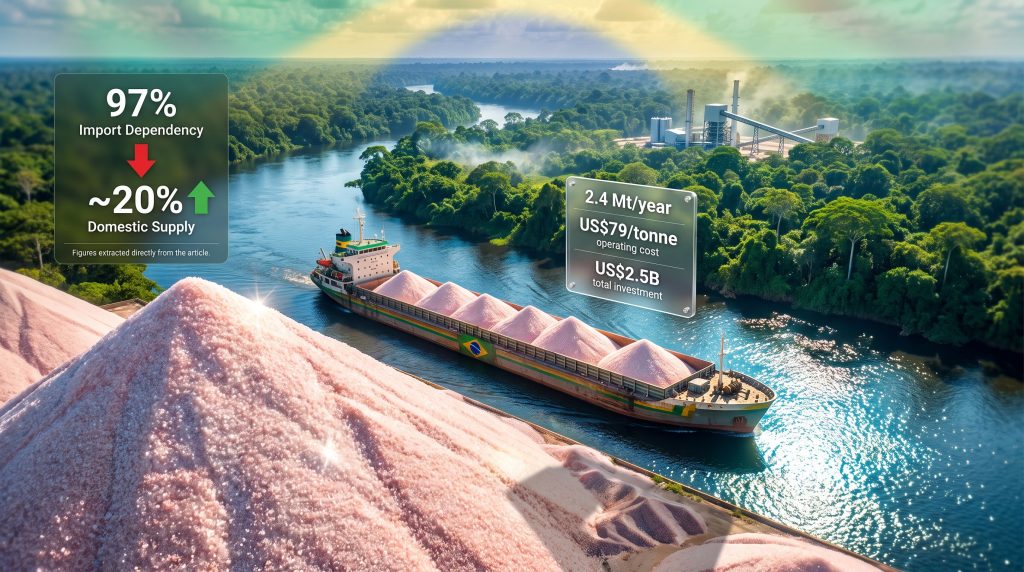
Brazil's agricultural sector is one of the most productive on the planet, accounting for a substantial share of global soybean, corn, sugarcane, and cotton exports. Yet the fertilizer supply chain underpinning this productivity contains a fragility that commodity strategists have flagged for years. In 2025, Brazil imported approximately 97% of its potash requirements, making it one of the most exposed major agricultural economies to external supply disruptions of any single nutrient input.
This dependency is not simply a matter of cost efficiency. It represents a genuine geopolitical vulnerability. Potash supply is heavily concentrated among a small number of producing nations. Canada's Saskatchewan basin dominates global output, while Russia and Belarus historically accounted for a combined share exceeding 40% of global exports before market access constraints emerged after 2022. Brazil's near-total reliance on this concentrated supplier pool means that any geopolitical disruption, sanctions regime, or logistics bottleneck directly threatens the fertilizer availability underpinning its food production capacity.
Furthermore, the broader critical minerals demand surge underscores why nations are increasingly prioritising domestic resource development over continued import dependency.
The paradox is well established among commodity researchers: Brazil holds some of the largest undeveloped potash reserves on the planet, yet its domestic production capacity has remained negligible. Resource abundance and supply vulnerability have coexisted in a pattern that has persisted for decades.
What Is Potash and Why Does It Matter for Food Security?
Understanding the strategic importance of the Proyecto Autazes de Brazil Potash requires clarity on what potash actually is and why it cannot simply be substituted:
- Potash refers primarily to potassium chloride (KCl), also known as muriate of potash (MOP), which is one of three primary macronutrients used in commercial fertilizers alongside nitrogen and phosphorus
- Potassium directly governs crop yield efficiency, drought tolerance, disease resistance, and root development in most commercially cultivated plant species
- Unlike nitrogen, which can be synthesised from atmospheric sources through the Haber-Bosch process, potassium must be mined from geological deposits, creating a finite and geographically concentrated supply base
- Brazil's dominant export crops, particularly soybeans and sugarcane, are among the most potassium-intensive cultivated species globally, consuming fertilizer inputs at industrial scale
- Disruptions to potash availability translate rapidly into higher farm-gate input costs, reduced yields, and ultimately downstream food price inflation
Mapping the Import Dependency: Current vs. Post-Autazes Scenario
| Metric | Current Status | Post-Autazes Scenario |
|---|---|---|
| Domestic potash production share | ~3% | ~20%+ |
| Annual import volume dependency | ~97% | Significantly reduced |
| Projected domestic supply addition | Negligible | Up to 2.4 Mt/year MOP |
| Logistics emissions intensity | High (ocean freight) | Reduced via river transport |
| Exposure to geopolitical supply shocks | Extreme | Materially lowered |
What Is the Proyecto Autazes de Brazil Potash?
A Tier-One Asset in an Underexplored Basin
The Proyecto Autazes de Brazil Potash is the most advanced large-scale potash development initiative in Brazil's history. Operated through Potássio do Brasil, the Brazilian subsidiary of Brazil Potash Corp., the project is situated in the municipality of Autazes within Amazonas State, positioned approximately 100 to 120 kilometres from Manaus. This location is not incidental: it places the project within practical reach of the Madeira River, one of the Amazon Basin's primary navigable commercial waterways, which becomes central to the project's logistics and environmental differentiation.
What separates the Autazes deposit from many comparable greenfield resource projects globally is the combination of scale, cost position, and market proximity. Most large potash developments face either a cost disadvantage or a logistics challenge. The Autazes Project, by design, addresses both simultaneously through the river transport model and its integration with established agricultural logistics infrastructure.
Core Project Parameters
| Parameter | Specification |
|---|---|
| Location | Autazes, Amazonas State, Brazil |
| Distance from Manaus | ~100-120 km |
| Projected Annual Production | Up to 2.4 million tonnes of MOP |
| Estimated Operating Cost | ~US$79 per tonne |
| Project Lifespan | ~23 years |
| Total Capital Investment | ~US$2.5 billion |
| Capital Already Deployed | ~US$270-280 million |
| Domestic Demand Coverage | ~20% of Brazil's annual potash requirement |
Why Cost Position Matters in Global Potash Markets
The projected operating cost of approximately US$79 per tonne deserves particular attention. Global potash pricing is volatile, having swung from below US$200 per tonne to above US$1,000 per tonne within a single decade depending on geopolitical and supply conditions. Producers sitting in the lower quartile of the global cost curve maintain profitability across the widest range of market conditions, making cost position arguably the most critical variable in long-term potash project viability.
At sub-US$80 per tonne operating costs, the Autazes Project would sit competitively alongside, and in some market scenarios below, major established producers. Canadian Saskatchewan basin operations typically carry higher cost structures due to deposit depth, processing complexity, and export logistics. The combination of shallow evaporite geology and river-based transport to a captive domestic market creates a genuinely distinctive cost architecture.
The Amaggi Partnership: Logistics as Competitive Moat
In bulk commodity production, the delivered cost to the customer is what ultimately matters, not simply the mine-gate operating cost. The partnership with Amaggi, one of Brazil's largest and most established agricultural logistics operators, addresses this reality directly. For additional context on the project's broader logistics and positioning, the Autazes project overview provides comprehensive technical detail.
In commodity markets, logistics infrastructure represents a competitive barrier that is often harder to replicate than the resource itself. Established river transport routes, port facilities, and distribution networks built over decades cannot be quickly duplicated by new entrants.
The Madeira River corridor provides a natural, low-energy-intensity transport pathway from the project site toward agricultural demand centres. This fluvial distribution model not only reduces delivered cost but also forms the basis of the project's greenhouse gas reduction claims, estimated at approximately 1.4 million tonnes of GHG emissions annually compared to the equivalent volume of potash transported via conventional ocean freight import routes.
The TRF-1 Court Ruling: What It Decided and Why It Matters
Understanding Brazil's Federal Regional Court System
Brazil's Tribunal Regional Federal (TRF) structure operates as the primary appellate jurisdiction for disputes involving federal agencies, environmental licensing decisions, and indigenous consultation processes. The TRF-1, covering the Amazon region, has been the central judicial arena through which the Autazes Project's legal standing has been tested repeatedly.
What makes the TRF-1's role particularly significant is that it sits above state-level courts but below the Superior Court of Justice (STJ) and the Federal Supreme Court (STF). Blocking the escalation pathway to these highest courts effectively seals lower-court determinations from immediate further review, which is precisely what the August 2026 rulings accomplished.
The Ruling Explained: What Was Blocked and What Was Preserved
The Vice-President of the TRF-1 issued decisions declaring inadmissible a series of extraordinary appeals filed by multiple challenging parties who sought to escalate unresolved licensing disputes to Brazil's highest judicial bodies. The ruling did not revisit the substantive merits of prior decisions but instead determined that the procedural requirements for admissibility of extraordinary appeals had not been met, blocking the escalation pathway.
What the ruling specifically preserved:
- The validity and procedural regularity of the indigenous consultation process conducted with the Mura people, which the court had previously affirmed was conducted appropriately
- The jurisdictional competence of IPAAM (Instituto de Proteção Ambiental do Amazonas), the State of Amazonas environmental agency, to issue environmental licenses for the project
- The legal standing of all existing environmental permits granted to the Autazes Project through IPAAM
Challenging Parties and Outcomes
| Challenging Party | Legal Mechanism Attempted | Outcome |
|---|---|---|
| Federal Public Prosecutor's Office | Extraordinary appeal to Superior Court | Declared inadmissible |
| Mura Indigenous Leadership Organization (Careiro da Várzea) | Extraordinary appeal | Declared inadmissible |
| Lago do Soares Indigenous Community | Extraordinary appeal | Declared inadmissible |
The Critical Legal Distinction Investors Often Miss
A nuance that is frequently misunderstood in reporting on mining project legal battles is the difference between a court ruling on the merits of a case versus a ruling on the admissibility of an appeal. The TRF-1's August 2026 decisions belong to the latter category, meaning the court did not reopen or re-examine the substantive questions around environmental licensing authority or indigenous consultation validity. Instead, it found that the procedural requirements necessary to escalate those questions to a higher court had not been satisfied.
This distinction matters for two reasons. First, it means the substantive determinations favourable to the project remain intact and have now survived multiple rounds of challenge within the TRF-1 system. Second, it signals that the court views the core legal controversies as having been adequately resolved at the regional appellate level, not requiring intervention from the STJ or STF.
Is the Legal Battle Entirely Concluded?
Brazilian procedural law permits the filing of agravos (interlocutory appeals) against inadmissibility rulings, meaning opposing parties retain a procedural mechanism to continue challenging the project's licensing status. This residual pathway should not be dismissed as theoretical. However, the consistent pattern of favourable determinations across multiple TRF-1 panels over successive rounds of challenge indicates that the court system has repeatedly examined and resolved the central legal questions in the project's favour.
How the Project Addresses Indigenous and Environmental Considerations
The Mura People and Free, Prior, and Informed Consultation
Brazil's constitutional framework and its obligations under ILO Convention 169 require that indigenous communities receive free, prior, and informed consultation before major resource development projects proceed within or adjacent to their traditional territories. For the Autazes Project, this obligation centred on engagement with the Mura people, whose ancestral territories overlap with the project's operational footprint.
The consultation process has been among the most contested dimensions of the project's regulatory history. Indigenous leadership organisations and federal prosecutors argued, through successive rounds of legal challenge, that the consultation either was not conducted adequately or that its outcomes should not be treated as determinative. The TRF-1 has affirmed on multiple occasions that the consultation process met the procedural standards required under Brazilian law and applicable international conventions.
Potássio do Brasil has publicly communicated its commitment to sustained engagement with local communities and stakeholders throughout both the construction and operational phases of the project, framing this ongoing engagement as integral to responsible development rather than merely a regulatory compliance exercise. This approach reflects a broader shift in mining sustainability transformation that is increasingly shaping how resource projects are structured and financed globally.
The IPAAM Jurisdiction Question: Why It Was Contested
A technically important but often underreported aspect of the legal dispute centred on which environmental agency held valid jurisdiction to issue the project's operating licences. Challengers argued that a project of the Autazes scale and location required federal-level environmental licensing through IBAMA (Brazil's federal environmental agency), rather than state-level licensing through IPAAM.
This jurisdictional argument, if accepted by the courts, would have required the project to restart its environmental licensing process from scratch under a different regulatory framework, representing a potentially multi-year setback. The TRF-1 rejected this argument consistently, affirming IPAAM's competence, and the August 2026 inadmissibility rulings further insulate this determination from higher-court challenge.
GHG Reduction Through Fluvial Logistics
One less commonly discussed dimension of the Autazes environmental case involves the emissions arithmetic of domestic production versus continued importation. The company's position is that replacing imported potash with domestically produced MOP transported via river results in a net greenhouse gas reduction of approximately 1.4 million tonnes annually, primarily by eliminating ocean freight emissions from trans-Atlantic or trans-Pacific shipping routes.
This framing repositions the project not merely as resource development but as an emissions reduction mechanism embedded within Brazil's agricultural supply chain, a distinction that carries relevance for sustainability-linked financing discussions as the project moves toward capital mobilisation.
Strategic and Economic Impact for Brazil's Agricultural Sector
A Structural Shift in Fertilizer Supply Architecture
The potential for a single project to address approximately one-fifth of Brazil's total annual potash demand represents a supply chain transformation of genuine macro-level significance. Brazil's current 97% import dependency creates price transmission pathways that connect international potash market volatility directly to farm-gate input costs across the country's most productive agricultural regions.
At full production capacity, the Autazes Project would sever a meaningful portion of this transmission mechanism, providing a domestic price anchor that could partially insulate Brazilian farmers from international supply disruptions of the kind witnessed when Belarusian export capacity was constrained in 2022.
Global Potash Competitive Positioning
| Producer Region | Cost Structure | Market Dynamics | Competitive Outlook |
|---|---|---|---|
| Canada (Saskatchewan) | Higher, depth-driven | Mature, benchmark setter | Dominant but high-cost relative to Autazes |
| Russia / Belarus | Low-cost, access-constrained | Reduced market reach post-2022 | Geopolitically uncertain |
| Germany | Mid-range | European market focused | Niche regional relevance |
| Brazil (Autazes) | ~US$79/tonne projected | Captive domestic market | Emerging, cost-competitive |
Investment Scale and Regional Economic Multipliers
The Proyecto Autazes de Brazil Potash carries a total projected capital expenditure of approximately US$2.5 billion, with roughly US$270-280 million already committed to early-stage development activities. Projects of this financial scale generate economic activity well beyond the mining operation itself:
- Substantial construction-phase employment across engineering, civil works, and logistics disciplines
- Infrastructure investment in transport, power, and communications within Amazonas State
- Long-term operational employment and supply chain development in a region where formal sector economic activity is limited
- Tax revenue flows to state and municipal governments over the projected 23-year mine life
The next major ASX story will hit our subscribers first
Remaining Risks and Challenges
Residual Legal Risk: The Agravo Pathway
Despite the consolidation achieved through the TRF-1 rulings, investors and analysts should recognise that the agravo mechanism preserves procedural options for opposing parties. Experienced observers of Brazilian mining project legal histories will note that procedural persistence can extend timelines even when substantive legal outcomes have been determined favourably. Further delays cannot be categorically ruled out.
Capital Mobilisation at Scale
The transition from regulatory clearance to construction financing presents its own distinct set of challenges. Mobilising approximately US$2.5 billion in project financing requires:
- Engagement with development finance institutions, commercial lenders, and equity investors simultaneously
- Navigating a global capital market environment where large greenfield mining projects face elevated scrutiny over ESG commitments, community relations, and permitting stability
- Demonstrating that the legal consolidation achieved is durable enough to satisfy project finance lenders' requirements for political and regulatory risk assessment
In addition, the evolving landscape around mining permits globally highlights how regulatory environments can shift rapidly, reinforcing why durable legal clearances — such as those achieved through the TRF-1 — are increasingly valued by institutional lenders assessing project bankability. A completed definitive feasibility study will also be critical to satisfying lender requirements at this stage of the capital mobilisation process.
Community Relations: Beyond Legal Compliance
Legal vindication of a consultation process does not substitute for the ongoing social licence to operate that large-scale resource projects require throughout their entire lifecycle. The Autazes Project's long-term operational stability will depend in part on whether the economic and environmental commitments made during the permitting process translate into tangible outcomes for the Mura people and other local communities. This is a dimension that project finance lenders increasingly examine as a material risk factor rather than a secondary consideration.
Consequently, the pattern of mining industry consolidation observed globally suggests that projects with robust community frameworks and legally sound permitting histories are better positioned to attract strategic partners and joint venture interest as they approach the construction financing stage.
Furthermore, reporting from World Fertilizer confirms the project's continued advancement toward construction, adding independent validation to the milestones disclosed by the company.
Key Takeaways: Project Status as of Mid-2026
- Environmental licences confirmed valid, legally insulated from immediate higher-court challenge through TRF-1 inadmissibility rulings
- Indigenous consultation process affirmed as procedurally regular through multiple rounds of TRF-1 review
- IPAAM's licensing authority definitively upheld, resolving the jurisdictional question that represented one of the most consequential legal risks
- Production target of 2.4 Mt/year maintained, positioning the project to address approximately 20% of Brazil's annual potash demand
- Logistics partnership with Amaggi provides cost and emissions differentiation that strengthens the project's competitive architecture
- Residual procedural challenge pathways remain available to opposing parties through the agravo mechanism
- Capital mobilisation for approximately US$2.5 billion in construction expenditure represents the primary execution challenge ahead
This article contains forward-looking statements and projections regarding project timelines, production targets, cost estimates, and market conditions. All such information is subject to material uncertainty and should not be construed as financial or investment advice. Readers should conduct their own due diligence before making any investment decisions related to the companies or projects discussed herein.
Want to Stay Ahead of Significant ASX Mineral Discoveries in Real Time?
Discovery Alert's proprietary Discovery IQ model instantly identifies high-potential ASX announcements across more than 30 commodities — including potash and other critical agricultural minerals — delivering actionable insights to subscribers before the broader market reacts. Explore Discovery Alert's dedicated discoveries page to understand how historic mineral discoveries have generated substantial returns, and begin your 14-day free trial to secure your market-leading edge.