August 24, 2026
When Price Beats Volume: The Counterintuitive Economics of Primary Aluminium
In commodity-intensive industries, the instinctive assumption is straightforward: produce more, earn more. Yet the mechanics of primary aluminium smelting repeatedly defy this logic. When metal prices move sharply, the fixed-cost structure of a smelter creates extraordinary earnings leverage, meaning a relatively modest price gain can generate profit amplification that no volume increase could replicate on the same timeline. Understanding this dynamic is essential context before examining Alba H1 profit growth and Q2 aluminium output decline — a period in which the company simultaneously experienced one of its most severe production disruptions and one of its most exceptional earnings outcomes.
When big ASX news breaks, our subscribers know first
Key Financial Metrics: H1 2026 vs H1 2025
The headline numbers from Alba's first-half 2026 results represent a structural divergence between volume-based operational performance and price-driven financial outcomes.
| Metric | H1 2025 | H1 2026 | Change |
|---|---|---|---|
| Profit attributable to equity holders (BHD) | BD 42.7 million | BD 140.2 million | +228% |
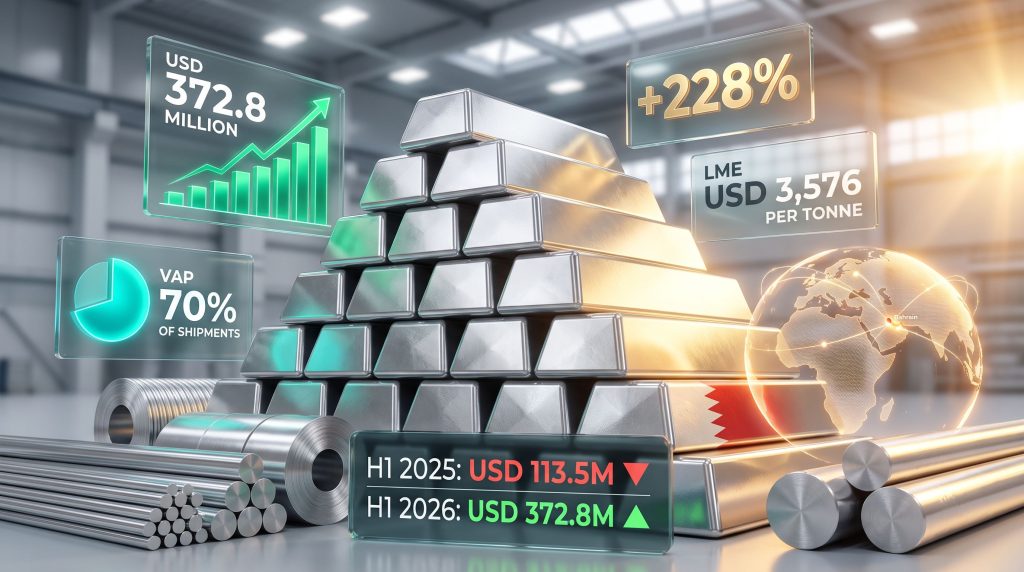
| Profit attributable to equity holders (USD) | USD 113.5 million | USD 372.8 million | +228% |
| Basic and diluted EPS | 30 fils | 99 fils | +230% |
| Total comprehensive income (BHD) | BD 38.6 million | BD 140.6 million | +264% |
| Total comprehensive income (USD) | USD 102.8 million | USD 374 million | +264% |
| Shareholders' equity (USD) | approx. USD 5.5 billion | USD 5.7 billion | +4% |
| Total assets (USD) | approx. USD 7.0 billion | USD 7.6 billion | +9% |
Critical context: H1 2025 profit had itself fallen approximately 54% year-on-year, largely because elevated landed alumina costs compressed gross margins. The 2026 rebound is therefore measured against a notably weak comparative base, though the absolute profit figure of USD 372.8 million remains exceptional in isolation.
This two-year earnings cycle is worth internalising. The trough in 2025 was an input-cost problem, reflecting broader alumina market pressures that weighed heavily on producers across the sector. The recovery in 2026, however, was a price realisation event. These are fundamentally different drivers, and confusing them leads to misreading the durability of the earnings improvement.
The LME Price Tailwind: How a 46% Price Rise Overwhelmed a 61% Output Drop
The central feature of Alba's H1 2026 result is the extraordinary price leverage inherent in large-scale smelting operations. Average LME aluminium prices reached USD 3,576 per tonne in Q2 2026, representing a 46% increase year-on-year. Regional aluminium premiums also strengthened alongside spot prices, further compounding revenue gains on each tonne shipped.
To appreciate the mechanics here, consider the cost structure of a modern aluminium smelter. Once a potline is operational, the majority of costs — including electricity contracts, labour, maintenance and depreciation — are largely fixed or semi-fixed in nature. Alumina is the primary variable input, and even that is often contracted on a semi-formula basis linked to aluminium prices.
This means that when LME prices rise sharply, the incremental revenue on each additional dollar per tonne flows disproportionately toward the earnings line rather than being absorbed by proportionally higher costs. Consequently, a 46% price increase, applied across a production base even at curtailed output levels, generates a far larger percentage earnings uplift than the price move alone might suggest. This is precisely why Alba H1 profit growth and Q2 aluminium output decline produced such a paradoxical outcome — 228% earnings growth alongside a 61% production fall.
Q2 2026 Operational Performance: The Production Curtailment in Detail
| Operational Metric | Q2 2025 | Q2 2026 | Change |
|---|---|---|---|
| Net finished aluminium production | approx. 402,912 MT | 155,469 MT | -61% |
| Sales volume | approx. 411,007 MT | 280,799 MT | -32% |
| VAP as percentage of shipments | Not disclosed | 70% | N/A |
| Q2 profit (BHD) | BD 24.6 million | BD 64.9 million | +164% |
| Q2 profit (USD) | USD 65.4 million | USD 172.5 million | +164% |
| Q2 total comprehensive income (USD) | N/A | USD 171.5 million | +195% YoY |
According to Alba's official Q2 2026 financial disclosure, the production shortfall was primarily caused by the controlled shutdown of Lines 1, 2 and 3 at Alba's smelting complex in Bahrain. Management attributed the decision to regional geopolitical tensions combined with constraints on raw material availability. Critically, this was a managed curtailment rather than an unplanned failure, and that distinction carries significant operational and financial implications.
Why Controlled Shutdowns Matter More Than They Appear
The difference between a controlled potline shutdown and a forced outage is not merely procedural. In aluminium smelting, each electrolytic reduction cell (commonly called a pot) contains a molten cryolite and alumina bath operating continuously at approximately 960 degrees Celsius. These cells cannot simply be switched off without causing irreversible damage to the carbon cathode lining and the cell structure itself.
A properly managed controlled shutdown involves:
- Gradual reduction of electrical current to individual cells in a planned sequence
- Careful thermal management to prevent cathode freeze or bath penetration
- Protection of busbar infrastructure and rectifier equipment from load-change stress
- Preservation of the cell lining integrity for future restart
By contrast, an emergency or forced shutdown risks permanent potline damage, meaning a smelter facing an unplanned outage may face months of relining work and capital expenditure before resuming full capacity. Alba's emphasis on the controlled nature of the shutdown signals that management prioritised long-term asset integrity over near-term output, preserving what industry practitioners call restart optionality — the ability to bring capacity back online rapidly when conditions improve.
The steps taken during the disruption were specifically framed by management as preserving the flexibility needed to support a swift operational recovery as supply chain conditions normalise, reflecting a deliberate prioritisation of long-term smelter health over short-term volume metrics.
Value-Added Products: The Margin Shield During Curtailment
One of the less-discussed but strategically important aspects of Alba's Q2 2026 performance was the composition of its shipment mix. Despite producing only 155,469 tonnes of net finished aluminium during the quarter, Alba shipped 280,799 tonnes, drawing on inventory built in prior periods. Of total shipments, VAP represented 70%, equating to 195,891 tonnes.
This is a deliberate strategic lever rather than a coincidence. Value-added products — which include extrusion billets, rolling slabs, wire rod and foundry alloys — command premiums above standard commodity ingot. Furthermore, these premiums are negotiated through long-term contracts with end users rather than being directly exposed to daily LME spot price volatility.
The implications for revenue quality are meaningful:
- VAP sales provide a partial buffer against LME price weakness in future periods
- Product mix concentration toward VAP raises average realised revenue per tonne above the benchmark LME price
- Long-term VAP contracts with industrial buyers in automotive and aerospace provide volume visibility that pure commodity sales cannot offer
- Maintaining VAP shipment share during a production curtailment demonstrates supply chain discipline and customer relationship management
For investors and analysts evaluating Alba's earnings sustainability, the VAP ratio is arguably a more informative metric than total production volume alone.
The Global Aluminium Supply-Demand Context
Alba's results did not emerge in isolation. The broader aluminium market in Q2 2026 created structural conditions that amplified the company's financial performance, reflecting dynamics familiar to aluminium industry leaders navigating a period of unusual supply tightness.
The Global Deficit: By the Numbers
Global aluminium demand grew approximately 1% year-on-year in Q2 2026, supported by five primary end-use sectors:
- Automotive: Lightweighting requirements in both internal combustion and electric vehicle platforms continue to structurally expand aluminium content per vehicle
- Renewable energy: Solar panel mounting systems, wind turbine nacelle components and high-voltage transmission cables represent growing consumption pools
- Data centres: Hyperscale computing infrastructure requires aluminium for structural applications and thermal management systems, a demand channel that barely existed a decade ago
- Power transmission: Grid expansion across emerging markets and grid modernisation in developed economies are driving sustained demand for conductor-grade aluminium
- Infrastructure: Construction and civil engineering applications continue to absorb significant primary aluminium volumes globally
Against this demand backdrop, global supply contracted approximately 1% year-on-year, primarily reflecting Middle East production disruptions of which Alba's curtailment was a component. The combined effect produced an estimated global market deficit of 934,000 tonnes including China and 626,000 tonnes excluding China.
LME warehouse inventories, which function as a real-time barometer of physical market tightness, declined 13% year-on-year to 302,000 tonnes. This level is historically low relative to global consumption, and low inventory conditions have a well-documented amplifying effect on prices.
Middle East Supply Concentration and Systemic Price Sensitivity
A less widely appreciated dimension of this episode is what it reveals about global aluminium supply geography. The Middle East has become a structurally significant smelting hub over the past two decades, attracting investment on the basis of competitive energy costs and proximity to bauxite and alumina trade flows. Alba itself operates one of the world's largest single-site aluminium smelters.
This geographic concentration creates a specific form of systemic risk. When regional disruptions occur simultaneously across multiple Middle East operations, the aggregate capacity reduction is large enough relative to global trade volumes to generate measurable price impacts. In addition, the effects of aluminium market tariffs in key consuming nations have further tightened regional trade flows, amplifying the price sensitivity of supply disruptions.
Speculative but informed perspective: If Middle East smelting capacity continues to grow as a share of global ex-China production, the correlation between regional geopolitical volatility and LME aluminium price spikes may strengthen over time, creating a structural risk premium in aluminium pricing that did not exist to the same degree in earlier decades.
The next major ASX story will hit our subscribers first
Strategic Direction: Dunkerque, Decarbonisation and the Green Premium
Alba's forward-looking priorities, as outlined alongside the H1 2026 results, point toward two distinct but complementary strategic threads.
Aluminium Dunkerque: Geographic Diversification of Production Risk
The proposed acquisition of Aluminium Dunkerque, subject to regulatory approvals, would place production capacity in a Western European jurisdiction with fundamentally different geopolitical risk characteristics than Bahrain. Beyond risk diversification, European smelting capacity provides direct access to automotive and aerospace customers in one of the world's most demanding markets for value-added aluminium products.
A European production base would also position Alba closer to the growing number of industrial buyers who require supply-chain-level carbon emissions documentation to satisfy their own scope 3 reporting obligations under emerging sustainability frameworks.
Alba Daiki Sustainable Solutions and the Low-Carbon Premium
Alba Daiki Sustainable Solutions (ADSS) represents Alba's investment in sustainable aluminium processing capabilities, broadly aligned with Bahrain's national net-zero commitments. The commercial rationale extends beyond regulatory compliance, and the green premium dynamics observed across industrial metals suggest the financial case for low-carbon investment is strengthening.
Certified low-carbon aluminium, produced using lower-emission power sources or accompanied by verified carbon offset documentation, commands a market premium over standard LME-priced metal. This premium has been expanding as automotive OEMs, aerospace manufacturers and consumer electronics companies face increasing pressure to reduce their scope 3 emissions. These industrial decarbonisation trends are reshaping how buyers select and pay for primary metal across multiple sectors.
The competitive implication is straightforward: smelters that can demonstrate a credibly lower carbon intensity per tonne of aluminium produced gain access to a premium price tier unavailable to commodity-grade producers. For Alba, the ADSS investment represents a long-term margin enhancement strategy built on sustainability credentials rather than volume expansion alone.
Two-Year Earnings Cycle: What the Arc Reveals
| Period | Profit (USD) | Primary Driver |
|---|---|---|
| H1 2025 | USD 113.5 million (-54% YoY) | Elevated landed alumina costs, margin compression |
| H1 2026 | USD 372.8 million (+228% YoY) | LME price surge, VAP mix optimisation |
The journey from a 54% profit decline to a 228% profit surge within twelve months encapsulates the extreme earnings cyclicality inherent in primary aluminium production. This is not a company-specific phenomenon but a sector-wide characteristic driven by the interaction between fixed-cost operating structures and volatile commodity prices.
For investors, this earnings profile raises several analytical considerations:
- Mean-reversion risk: Earnings at USD 372.8 million in H1 2026 reflect an unusually favourable combination of high LME prices, a weak comparative base and VAP mix strength. Forward earnings will depend heavily on whether the supply deficit and price premium persist.
- Input cost monitoring: The 2025 trough was an alumina cost story. Bauxite and alumina market dynamics remain a key variable for future margin outcomes regardless of LME price direction.
- Restart trajectory: The speed at which Lines 1, 2 and 3 return to full capacity will determine whether volume recovery compounds the price tailwind in future quarters.
- VAP contract repricing cycles: Long-term VAP contracts reprice periodically, meaning the full benefit of higher LME prices may flow through over time rather than being immediately captured.
As noted by industry analysts tracking Alba's results, the interaction between tariff headwinds, alumina cost cycles and volume recovery will be the key determinant of whether Alba H1 profit growth and Q2 aluminium output decline represents a turning point or a transient peak.
Disclaimer: This article is informational in nature and does not constitute financial advice. Past performance and historical earnings data are not indicative of future results. Readers should conduct their own due diligence before making any investment decisions related to companies mentioned in this analysis.
Frequently Asked Questions
What caused Alba's profit to increase 228% despite lower production?
A 46% year-on-year rise in average LME aluminium prices, combined with a global supply deficit and a deliberate shift toward higher-margin value-added products, drove earnings significantly higher even as total output volumes fell sharply.
Why did Alba shut down Lines 1, 2 and 3 in Q2 2026?
The curtailment was a controlled operational response to regional geopolitical tensions and constraints on raw material availability. Management prioritised preserving asset integrity and long-term restart capability over near-term production volumes.
How large was the global aluminium market deficit in Q2 2026?
The estimated global deficit was approximately 934,000 tonnes including China and 626,000 tonnes excluding China, reflecting simultaneous demand growth and supply contraction.
What is Alba's value-added product strategy?
Alba prioritises shipments of processed, higher-margin aluminium products such as extrusion billets, rolling slabs and wire rod rather than standard commodity ingot. In Q2 2026, VAP accounted for 70% of total shipments despite the production curtailment.
What is the Aluminium Dunkerque acquisition?
Alba has proposed acquiring Aluminium Dunkerque, a European smelting operation, subject to regulatory approvals. The acquisition would diversify Alba's production base geographically and expand access to European aluminium markets.
Want to Capitalise on the Next Major Commodity Price Surge Before the Market Catches On?
Discovery Alert's proprietary Discovery IQ model delivers real-time alerts on significant ASX mineral discoveries — instantly translating complex commodity data into actionable opportunities for both short-term traders and long-term investors. Explore how historic discoveries have generated exceptional returns on Discovery Alert's dedicated discoveries page, and begin your 14-day free trial today to position yourself ahead of the broader market.