June 26, 2026
When Geopolitics Rewrites the Energy Rulebook
Global commodity markets are rarely disrupted by a single event. More often, a chain of interconnected forces, stretching from military conflict to regulatory policy to pricing arbitrage, reshapes trade flows in ways that confound conventional seasonal expectations. The current behaviour of Alberta LPG exports by rail to the US is a textbook illustration of exactly this dynamic: a convergence of geopolitical shock, temporary regulatory intervention, and near-historic price spreads that has flipped one of the most predictable seasonal patterns in North American energy markets.
Understanding what is actually happening, and what it means for Alberta's long-term energy export strategy, requires looking well beyond the headline numbers. Furthermore, the resource export challenges faced by other commodity-producing nations provide a useful comparative lens for understanding Alberta's position.
When big ASX news breaks, our subscribers know first
Understanding LPG and Alberta's Role in North American Supply Chains
What LPG Is and Why Alberta Produces So Much of It
Liquefied petroleum gas is not a single product. It is a broad category encompassing primarily propane and butane, both of which are extracted as byproducts during natural gas processing and crude oil refining. Alberta sits atop one of the most prolific natural gas processing infrastructures in North America, generating substantial LPG volumes as a natural consequence of its upstream hydrocarbon production.
Edmonton functions as the central logistics and pricing node for Western Canadian LPG. Its position at the intersection of pipeline gathering systems, rail terminals, and storage infrastructure makes it the effective clearing house for Alberta-origin propane and butane volumes heading to domestic and export markets alike.
Because pipeline capacity connecting Western Canada to US Gulf Coast and East Coast markets is finite, rail remains an indispensable transport mode for incremental LPG volumes. When pipeline space is unavailable or uneconomic relative to the prevailing price spread, rail provides the flexibility that traders and producers need to respond to short-notice demand signals, a characteristic that becomes particularly important during periods of market dislocation.
How LPG Typically Flows Between Canada and the United States
The Canada-US LPG trade relationship is one of the most structurally embedded commodity partnerships in the Western Hemisphere. Canadian LPG moves south through a combination of dedicated pipelines and unit train rail services, supplying refiners and blenders concentrated in the US Midwest, Northeast, and West Coast markets.
Mont Belvieu, Texas, occupies a uniquely powerful position in this system. As the largest LPG storage hub in the United States, it sets the primary pricing benchmark for propane and butane across the Americas. When Edmonton-origin LPG enters the US by rail, Mont Belvieu pricing is typically the reference point against which traders assess whether a shipment is commercially viable.
The scale of Canada's dominance in US butane import supply is often underappreciated. According to data published by the US Energy Information Administration, Canada supplied 100% of total US butane imports in the prior year, averaging approximately 51,000 barrels per day. This is not merely a trading relationship: it is a structural dependency that amplifies Canada's sensitivity to any policy or pricing shift in the US blending market.
What Is Actually Driving the Surge in Alberta LPG Rail Exports
The Iran Conflict's Transmission into North American Fuel Markets
Military conflict in the Middle East has historically transmitted price shocks through global energy supply chains with a speed and intensity that frequently surprises market participants. The 2026 conflict involving Iran proved no different. Disruption to regional supply expectations drove upward pressure on crude oil and refined product prices globally, and the US retail gasoline market absorbed the impact directly.
Consequently, there was a regulatory response by the US government aimed at providing consumers with near-term price relief. The mechanism chosen was a temporary relaxation of summertime fuel blending specifications, specifically the rules governing how much butane refiners and blenders are permitted to add to motor gasoline during the summer period. This is broadly consistent with how an oil price rally driven by geopolitical tensions typically cascades into downstream policy responses.
Why Summertime Blending Rules Matter More Than Most People Realise
To understand why this regulatory waiver matters so profoundly for Alberta LPG exports by rail to the US, it helps to understand the mechanics of the US summer blending season.
During warmer months, the US Environmental Protection Agency enforces tighter Reid Vapour Pressure limits on gasoline. Reid Vapour Pressure, or RVP, measures a fuel's tendency to evaporate and contribute to smog formation. Butane is a high-RVP component: it evaporates readily, which makes it an effective octane booster and volume extender in winter blends but a regulatory liability in summer formulations.
Under normal summer specifications, the volume of butane that can be blended into gasoline is sharply curtailed. This seasonal restriction drives butane demand lower between roughly April and September each year, creating a predictable softening in both price and trade volumes. Alberta-origin butane exports to the US historically follow this same seasonal rhythm, declining as the blending window closes.
Key Insight: The 2026 US regulatory waivers did not simply increase butane demand. They effectively suspended the seasonal demand cycle entirely, creating a mid-year procurement requirement that refiners and blenders were structurally unprepared to meet from domestic sources alone.
The additional butane demand generated by the waivers has been estimated by energy brokerage StoneX at approximately 50,000 to 100,000 barrels per day. Given that Canada already supplies the entirety of US butane import volumes, the directional beneficiary of this incremental demand was always going to be Alberta.
According to StoneX energy market analysis, blending dynamics in the US have been fundamentally inverted by the waiver regime, creating a demand environment with no meaningful historical precedent during the summer calendar period.
Rail Export Volume Data: What the Numbers Actually Show
The volume data compiled by storage broker The Tank Tiger and rail analytics firm RailState leaves little ambiguity about the scale of the shift underway. In addition, Canadian National's rail connections to Prince Rupert illustrate how rail infrastructure is simultaneously being leveraged for both US and Asian export ambitions.
| Metric | May 2025 | May 2026 | Year-on-Year Change |
|---|---|---|---|
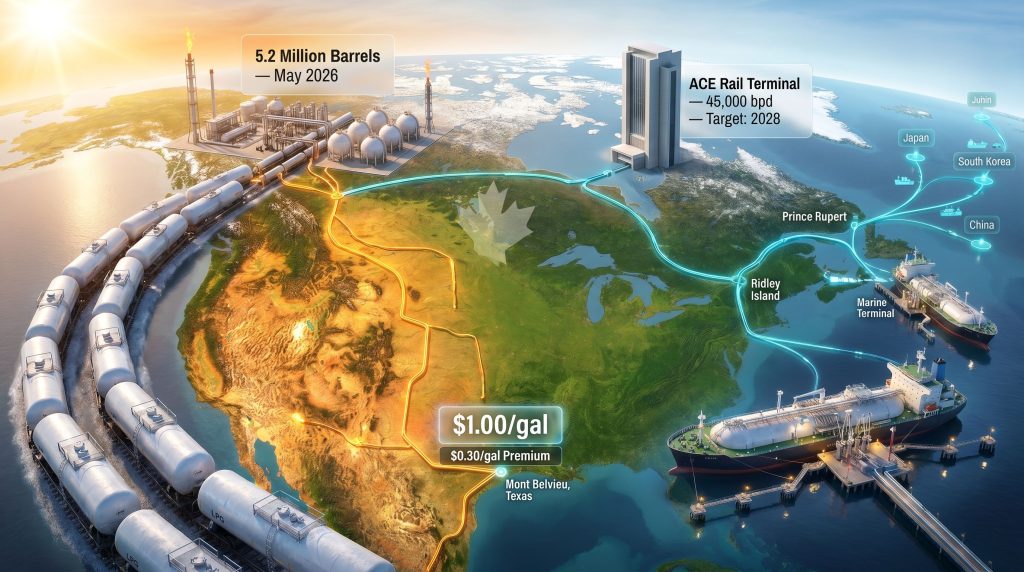
| Edmonton LPG rail exports | ~3.6 million barrels | ~5.2 million barrels | +44% |
| Weekly peak exports (early June) | Baseline | ~1.4 million barrels | +~400,000 bbl above prior year |
| US total butane imports (annual avg.) | 51,000 bpd | Elevated (est.) | Sourced entirely from Canada |
A critical caveat applies to this data. Rail manifest records do not specify the individual product grade loaded into LPG railcars, as propane and butane can share the same rolling stock. However, market participants with direct visibility into terminal activity have indicated that the overwhelming majority of the elevated volumes consist of butane, driven specifically by the blending waiver demand signal. Most of these cargoes are understood to flow toward Mont Belvieu as the primary US destination.
The Price Spread Arbitrage Powering the Trade
Edmonton vs. Mont Belvieu: A Near-Historic Pricing Gap
Price spread arbitrage is the engine behind the surge in Alberta LPG exports by rail to the US. The mechanics are straightforward: when the price at the destination market exceeds the price at the origin point by more than the cost of transport, it is rational to move as much volume as logistics will allow.
Butane at Mont Belvieu is currently priced at approximately $1.00 per gallon, carrying a premium of roughly $0.30 per gallon relative to Edmonton prices, according to StoneX energy market analysis. That spread is described as being near historical highs for this corridor. At typical rail economics for LPG unit trains operating between Edmonton and the US Gulf region, a $0.30 per gallon spread represents a meaningful and commercially compelling margin for traders positioned to execute.
The arithmetic explains the volume data precisely. When the economics justify moving incremental barrels, traders who have access to rail loading capacity at Edmonton terminals and delivery options at Mont Belvieu or Midwest storage hubs will maximise throughput for as long as the spread holds.
Who Captures the Arbitrage and What Limits It
The primary beneficiaries of the current pricing environment are:
- Alberta-based LPG producers and midstream operators with surplus volumes and rail loading access
- Trading firms holding positions across Edmonton and Mont Belvieu price curves
- US Midwest, Northeast, and West Coast refiners sourcing incremental butane supply to fulfil blending obligations during the waiver period
However, the arbitrage window carries significant duration risk. The US regulatory waivers are temporary instruments. When they expire, summer blending restrictions will reimpose their normal demand suppression effect on butane. The Edmonton-to-Mont Belvieu price spread would be expected to compress rapidly, potentially within days of waiver expiry, as buyers no longer need incremental supply.
Rail capacity and terminal throughput at Edmonton also impose a physical ceiling on how much volume can be loaded and moved, regardless of how attractive the spread becomes. The commodity market volatility inherent in such policy-driven demand spikes means traders must manage duration risk carefully.
Alberta's Long-Term Direction: Away From the US, Not Deeper Into It
The Tariff Threat and the Strategic Pivot Toward Asian Markets
The current export surge should not be mistaken for evidence that Alberta is deepening its structural integration with the US LPG market. The opposite trajectory is arguably more evident when examining where long-term infrastructure capital is being deployed.
US tariff policy has introduced persistent uncertainty into the commercial calculus for Canadian energy exporters. The broader US-China trade war impacts have furthermore reinforced the message that no single market relationship should be treated as structurally permanent. For Alberta LPG producers, the risk that tariff escalation could erode the economics of southbound flows has accelerated interest in developing alternative export routes that do not depend on US market access.
Operators including AltaGas have been building commercial relationships and infrastructure oriented toward Asian buyers, particularly in Japan, South Korea, and China, where growing petrochemical and residential energy demand creates durable long-term offtake potential.
The ACE Rail Terminal: Alberta's $240 Million Commitment to the Pacific Basin
The clearest statement of Alberta's long-term export ambitions is the Alberta Corridor Export (ACE) Rail Terminal, a $240 million infrastructure project currently under development. Reports on Alberta's LPG energy strategy have highlighted how this project signals a deliberate structural shift in trade orientation.
Key specifications of the project include:
- Designed throughput capacity: approximately 45,000 barrels per day of propane and butane
- Target commissioning date: mid-2028
- Connectivity: linking Edmonton-area production directly to West Coast marine export terminals at Prince Rupert and Ridley Island
- Target markets: Pacific Basin buyers in Japan, South Korea, and China
The strategic intent of the ACE terminal is unambiguous. It is designed to route Alberta LPG volumes to tidewater, bypassing the US market entirely and connecting Canadian production to Asian demand centres via marine shipment.
Strategic Framing: The current surge in US-bound rail exports represents a short-term, policy-driven arbitrage opportunity. The simultaneous capital commitment to West Coast marine export infrastructure signals the actual long-term direction of Alberta LPG trade flows: toward the Pacific Basin, not deeper into the US heartland.
These two phenomena are not contradictory. They reflect the rational behaviour of producers and traders who will capture near-term opportunities where economics permit, while simultaneously reducing structural dependence on a single buyer market over a longer horizon. The tariffs impact markets in ways that make this kind of strategic diversification not merely prudent but commercially necessary.
Scenario Analysis: Three Pathways for Alberta LPG Rail Flows
| Scenario | Trigger | Expected Rail Volume Impact |
|---|---|---|
| Waivers expire, seasonal norms resume | Regulatory expiry | Volumes revert to 2024-2025 seasonal baseline |
| US tariffs escalate, Asian pivot accelerates | Trade policy deterioration | Structural decline in US-bound flows; West Coast volumes rise |
| Prolonged geopolitical disruption sustains elevated demand | Extended conflict dynamics | Rail volumes remain elevated, constrained by terminal throughput |
Scenario 1 is the base case under current regulatory settings. Once the blending waivers lapse, the seasonal demand suppression effect on butane returns and the Edmonton-Mont Belvieu spread compresses. There is no structural reason to expect volumes to remain at May-June 2026 levels.
Scenario 2 represents the longer-term structural risk to the Canada-US LPG trade relationship. Escalating tariff barriers would accelerate the already-underway strategic pivot, making the ACE terminal not merely aspirational but commercially urgent.
Scenario 3 introduces the possibility of extended waiver regimes tied to sustained geopolitical disruption. While this scenario would sustain elevated rail volumes, physical throughput constraints at Edmonton terminals would cap the volume upside regardless of how wide the price spread becomes.
The next major ASX story will hit our subscribers first
FAQ: Alberta LPG Rail Exports and the US Market
How Much LPG Did Alberta Export by Rail to the US in May 2026?
Approximately 5.2 million barrels were exported by rail from Edmonton in May 2026, compared with roughly 3.6 million barrels in the same month the prior year, representing a year-on-year increase of approximately 44%, according to data compiled by The Tank Tiger and RailState.
Why Is US Butane Demand Elevated During Summer 2026?
The US government issued temporary waivers relaxing summertime gasoline blending specifications after fuel price surges linked to Middle East conflict. These waivers allowed refiners to blend higher quantities of butane into motor fuel outside the normal seasonal window, generating an estimated 50,000 to 100,000 bpd of additional demand, according to StoneX energy market analysis.
Is Canada the Exclusive Supplier of US Butane Imports?
Yes. US Energy Information Administration data confirms that Canada supplied 100% of total US butane imports in the prior year, averaging approximately 51,000 bpd.
Is the New Alberta Rail Infrastructure Designed to Increase US Exports?
No. The ACE Rail Terminal, a $240 million project targeting mid-2028 commissioning, is specifically designed to connect Edmonton-area production to West Coast marine terminals for export to Asian markets, not to increase southbound US volumes.
How Long Will the Current Export Surge Last?
The elevated volumes are directly linked to temporary regulatory waivers and a historically wide price spread. When the waivers expire and the spread compresses, rail export volumes are expected to normalise toward historical seasonal baselines.
Key Takeaways
- Alberta LPG exports by rail to the US surged 44% year-on-year in May 2026, driven entirely by a temporary regulatory and geopolitical demand shock, not structural market realignment
- US blending waivers generated an estimated 50,000 to 100,000 bpd of out-of-season butane demand, inverting the normal summer demand cycle
- A $0.30 per gallon Edmonton-to-Mont Belvieu price premium is sustaining the arbitrage window for rail traders, near historical highs for the corridor
- Canada supplies 100% of US butane imports, making Alberta the only practical source of incremental supply during the waiver period
- Long-term Alberta LPG infrastructure investment, exemplified by the $240 million ACE Rail Terminal targeting 2028, is oriented toward Asian Pacific markets, not deeper US integration
- The current US-bound rail surge and the long-term Asian pivot are not contradictory: they reflect rational short-term opportunism alongside deliberate strategic diversification away from US market dependency
Disclaimer: This article contains forward-looking statements, market estimates, and scenario projections based on publicly available data and third-party analysis. These should not be construed as financial or investment advice. Commodity market conditions, regulatory frameworks, and geopolitical dynamics are subject to rapid change. Readers should conduct independent research before making any investment or commercial decisions.
Want to Stay Ahead of the Next Major Resource Discovery?
Discovery Alert's proprietary Discovery IQ model scans ASX announcements in real time, delivering instant alerts on significant mineral discoveries across more than 30 commodities — turning complex market data into clear, actionable insights for both traders and long-term investors. Explore historic discoveries and the returns they generated, then begin your 14-day free trial at Discovery Alert to position yourself ahead of the market.