June 26, 2026
The Aluminium Market at a Crossroads: Decoding Price Signals and Inventory Trends in 2026
Global commodity markets have a habit of telling two stories at once. On the surface, a price softening can look like weakness. Beneath it, however, structural forces can be quietly tightening supply chains in ways that take months to fully register in spot pricing. The aluminium market in mid-2026 is a compelling example of this dynamic, where declining exchange inventories, constrained smelter output, and a widening supply deficit are all pointing toward a fundamentally different conclusion than short-term price movements alone might suggest.
Understanding LME aluminium prices and inventories requires looking beyond daily movements and into the architecture of the forward curve, the mechanics of warrant classification, and the structural production limits that no single quarter of demand moderation can easily offset. Furthermore, the interplay between aluminum and alumina markets adds another layer of complexity that informed participants must account for.
When big ASX news breaks, our subscribers know first
What Current LME Aluminium Price Levels Are Actually Signalling
The price action recorded across LME aluminium contracts on June 25, 2026 offers a nuanced picture that rewards careful interpretation. Near-term contracts softened modestly, while longer-dated instruments moved in the opposite direction.
Breaking Down the LME Aluminium Price Structure (June 2026)
| Contract Type | June 24 Price (USD/t) | June 25 Price (USD/t) | Change (%) |
|---|---|---|---|
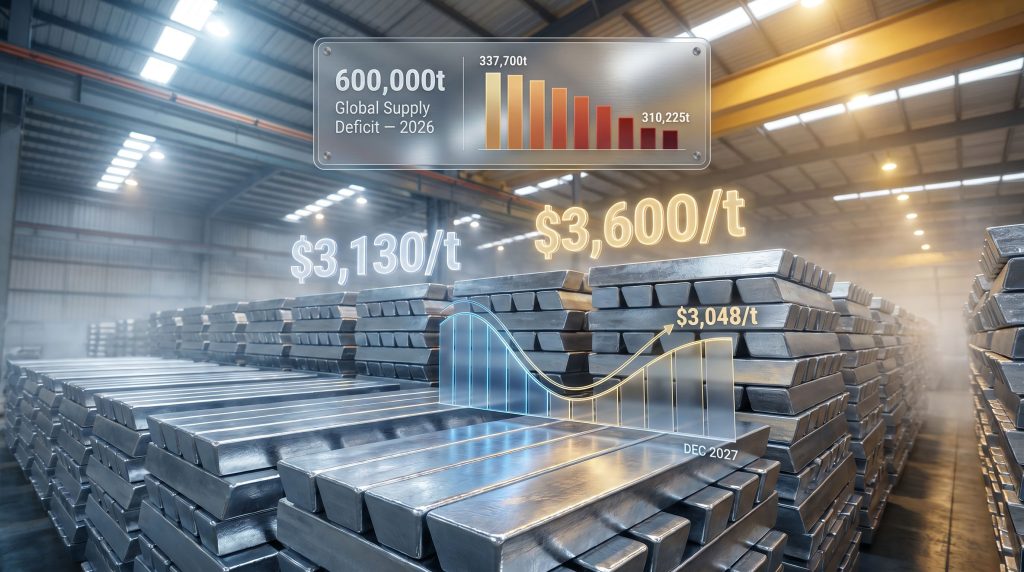
| Cash Bid | $3,148 | $3,130 | -0.57% |
| Cash Offer | $3,150 | $3,132 | -0.57% |
| 3-Month Bid | $3,160 | $3,144 | -0.51% |
| 3-Month Offer | $3,160.50 | $3,146 | -0.46% |
| Dec 2027 Bid | $3,038 | $3,043 | +0.16% |
| Dec 2027 Offer | $3,043 | $3,048 | +0.16% |
| Asian Reference | $3,122.50 | $3,164.50 | +1.35% |
The divergence between falling cash prices and rising December 2027 contracts is not incidental. It reflects a market structure known as contango, where forward prices exceed spot prices, often indicating that participants expect near-term supply to be relatively adequate but anticipate tighter conditions further out. You can explore live contract data directly on the LME aluminium price page for the most current reference points.
"The simultaneous decline in near-term LME contracts and the uptick in longer-dated December 2027 prices suggests that market participants are pricing in near-term supply relief while maintaining a structurally bullish view on aluminium fundamentals beyond 2026."
The Asian Reference Price Divergence
Particularly striking was the Asian reference price, which climbed to $3,164.50 per tonne on June 25, representing a 1.35% gain from the prior session's $3,122.50 per tonne. This sharp regional premium diverging from a softer LME spot reflects stronger physical demand signals from Asia-Pacific consumers, where downstream manufacturing activity and restocking cycles can operate on different rhythms to Western trading sentiment.
The Asian reference price is not simply a derivative of LME spot. It incorporates regional physical premiums, freight, and local supply-demand balances, making it a more granular indicator of actual buying appetite in the world's largest aluminium-consuming region.
This divergence matters for investors tracking LME aluminium prices and inventories because it suggests that the spot price softness on June 25 was more a function of Western trader positioning than a broad deterioration in physical demand fundamentals. In addition, shifting China industrial demand trends continue to play a pivotal role in shaping these regional pricing dynamics.
How LME Aluminium Warehouse Inventories Are Trending in 2026
Inventory data from LME-registered warehouses is often where the real story hides. While prices can be moved by speculative positioning, futures rolling, and macro sentiment, physical stock levels reflect actual supply-and-demand behaviour at the warehouse floor.
LME Aluminium Stock Levels: June 2026 Progression
| Inventory Metric | Earlier June 2026 | June 18, 2026 | June 25, 2026 | Change |
|---|---|---|---|---|
| Total Registered Stocks | ~337,700 t | 315,525 t | 310,225 t | Consistent decline |
| Live Warrants | – | – | 247,575 t | Unchanged (June 25) |
| Cancelled Warrants | – | – | 60,650 t | -3.19% vs. June 24 |
Total registered stocks fell by 1,500 tonnes on June 25 alone, bringing the cumulative month-to-date drawdown to approximately 27,500 tonnes, or roughly 8% of opening June stock levels. That pace of erosion is not trivial.
Understanding Live Warrants vs. Cancelled Warrants
These two classifications are central to reading LME inventory data correctly, yet they are frequently misunderstood outside specialist trading circles.
- Live warrants represent aluminium sitting in LME-registered warehouses that remains fully available for exchange trading and physical delivery settlement.
- Cancelled warrants represent metal that has been earmarked by a warrant holder for physical withdrawal from the warehouse system. Once cancelled, this metal is no longer available for LME settlement.
A rising ratio of cancelled warrants to total stocks is typically interpreted as a leading indicator of imminent physical withdrawal, signalling that real buyers want real metal, not just financial exposure. The decline in cancelled warrants from 62,650 tonnes to 60,650 tonnes on June 25, a drop of 3.19%, may reflect some withdrawal orders being completed rather than new orders slowing, as total stocks also fell simultaneously.
Risk Callout: With LME registered stocks declining from over 337,700 tonnes at the start of June to approximately 310,225 tonnes by June 25 — a reduction of roughly 8% in under four weeks — the pace of inventory drawdown is accelerating. If this trajectory continues, available exchange-registered supply could reach critically low levels by Q3 2026, potentially triggering a sharp price response.
The March 2026 Precedent
Earlier in 2026, the LME warrant system signalled a major structural shift. In March, live warrants dropped by approximately 98,300 tonnes while cancelled warrants surged by around 96,050 tonnes, a reclassification of roughly 116.4% on the cancelled side.
This kind of rapid reclassification typically precedes a significant wave of physical metal being pulled from exchange warehouses and often serves as a leading warning of tightening available supply. The June 2026 data, while more modest in scale, follows a directionally similar pattern.
The Broader Supply-Demand Equation Underpinning Aluminium Prices
Short-term price and inventory data only make sense when placed within the larger supply-demand framework shaping the 2026 aluminium market. Consequently, understanding the structural production limits facing the world's top aluminium producers is essential context for any forecast.
Quantifying the 2026 Supply Shortfall
Analyst estimates from institutions including ING point to a global aluminium supply deficit of approximately 600,000 tonnes for the full year 2026. Several structural factors are converging to sustain this gap:
- China's production ceiling: Chinese smelter output is expected to plateau near 45 million tonnes per annum, constrained by domestic energy policy frameworks that cap new capacity additions. This is not a cyclical slowdown but a structurally embedded limit.
- Energy cost headwinds outside China: Smelting is among the most energy-intensive manufacturing processes in existence, consuming roughly 13–14 MWh of electricity per tonne of aluminium produced. In Bahrain, Indonesia, and several other key non-Chinese producing economies, elevated energy prices are actively compressing the economics of smelter expansion.
- No quick substitute for lost capacity: Unlike some commodity sectors, primary aluminium smelting requires years of capital investment and construction before new capacity comes online. The lag between investment decision and production start is typically three to five years for a greenfield facility.
A 600,000-tonne annual deficit translates to roughly 50,000 tonnes of unmet demand per month, a figure that, against a backdrop of declining LME registered stocks, creates a mathematically uncomfortable trajectory for exchange inventory levels through the second half of 2026.
Alumina Price Stability as a Cost Signal
The LME alumina Platts reference price held steady at $307.33 per tonne on June 25, 2026. Alumina, the intermediate product refined from bauxite ore before being smelted into primary aluminium, represents the single largest variable input cost in the smelting process.
Its stability provides a degree of cost predictability for primary producers, reducing the likelihood of margin-driven smelter curtailments in the near term that could unexpectedly tighten supply further.
Where Are LME Aluminium Prices Headed? Institutional Forecasts for 2026–2027
Consensus Price Targets and Scenario Modelling
| Institution / Model | Price Target | Scenario Conditions |
|---|---|---|
| Citi / Goldman Sachs | $3,600/t (base case) | Continued supply constraints |
| Citi / Goldman Sachs | $4,000/t (bull case) | Prolonged production losses |
| Trading Economics Model | $3,406.78/t (end Q2 2026) | Consensus model projection |
| LME Cash Settlement (June 18) | $3,402/t | Actual settlement price |
The $3,600 per tonne base case maintained by major institutional forecasters represents an approximate 15% premium to late-June spot levels near $3,130. For that target to be reached, supply constraints would need to persist through H2 2026 without meaningful new capacity entering the market — a scenario that current production data makes plausible rather than speculative.
The $4,000 per tonne bull case would require a more acute supply shock, potentially driven by energy disruptions at major smelting facilities, unexpected trade flow interruptions, or an acceleration of demand from green energy infrastructure build-outs requiring large volumes of aluminium for solar frames, EV battery casings, and transmission infrastructure.
"Major institutional forecasters maintain a structurally bullish medium-term outlook for aluminium, with the $3,600/t threshold representing a realistic near-term target should supply disruptions persist or intensify through H2 2026."
Reading the Volatility Cycle
Aluminium prices reached their highest level in four years in the period leading up to the late-June 2026 correction. The subsequent four-week decline of approximately 12.28% has drawn some bearish commentary, but experienced commodity market participants typically frame this kind of correction as a consolidation phase within a longer bullish cycle rather than a trend reversal.
The prior month's performance, which included a five percent weekly gain and a ten percent monthly gain before the correction, illustrates the intensity of the preceding rally. Markets rarely sustain parabolic moves without pausing to rebalance positioning. In aluminium's case, the supply deficit, China's production ceiling, and the ongoing inventory drawdown all suggest the structural drivers remain intact. For broader context, the global metals demand outlook reinforces why these fundamentals are unlikely to reverse quickly.
Key Risk Factors for Aluminium Market Participants in 2026
Macro and Micro Risk Framework
Any honest assessment of the aluminium market must acknowledge the risks that could delay or derail the bullish thesis:
- Geopolitical trade disruptions: Shifts in tariff regimes, sanctions, or trade flow restrictions between major aluminium-producing and consuming nations can rapidly alter the physical premium landscape. The broader impact of US aluminium tariffs on trade flow continuity remains a key variable.
- Demand slowdown risk: A deceleration in global manufacturing activity, particularly in automotive and construction sectors, could compress aluminium demand faster than supply adjusts, temporarily reversing the deficit narrative.
- Currency volatility: Because LME aluminium is priced in US dollars, significant dollar strengthening can suppress prices in USD terms even when underlying demand in local currency terms remains robust.
- Contango deepening: If the forward curve steepens further into contango, it can incentivise restocking of exchange warehouses rather than physical withdrawal, temporarily reversing the inventory drawdown trend.
- Energy policy reversals: Any easing of energy restrictions on Chinese smelters could unlock additional capacity and quickly shift the supply balance.
The next major ASX story will hit our subscribers first
Frequently Asked Questions: LME Aluminium Prices and Inventories
What is the current LME aluminium price in 2026?
As of June 25, 2026, LME aluminium cash prices were trading at approximately $3,130 to $3,132 per tonne on a bid/offer basis. The three-month contract was positioned near $3,144 to $3,146 per tonne, while the Asian reference price reached $3,164.50 per tonne on the same date. For continuously updated figures, Trading Economics provides a reliable real-time commodity tracker.
Why are LME aluminium inventories falling?
The drawdown reflects a combination of sustained physical demand, a structural 2026 supply deficit estimated at 600,000 tonnes by analysts, constrained production growth in key smelting regions, and China's effective output ceiling near 45 million tonnes annually.
What is the difference between live warrants and cancelled warrants?
Live warrants represent aluminium held in LME warehouses that remains fully available for exchange trading. Cancelled warrants indicate metal earmarked for physical removal from the warehouse system. A rising cancelled warrant proportion relative to total stocks typically signals accelerating physical demand and imminent inventory reduction.
What is the alumina price on the LME?
The LME alumina Platts reference price held at $307.33 per tonne as of June 25, 2026, reflecting stability in upstream input costs despite softness in primary aluminium spot pricing.
What is the long-term price forecast for LME aluminium?
Major financial institutions have set near-term targets at $3,600 per tonne, with a bull-case scenario of $4,000 per tonne under conditions of prolonged production disruption. December 2027 LME contracts were already trading near $3,043 to $3,048 per tonne as of late June 2026, reflecting measured long-term confidence from forward market participants.
Key Takeaways: What the LME Aluminium Market Is Telling Us in 2026
- Near-term spot price softening from recent multi-year highs does not negate the underlying structural supply deficit, which remains a primary market driver
- The 8% decline in LME registered stocks across June 2026 represents a meaningful acceleration in physical inventory erosion
- The divergence between falling near-term contracts and rising December 2027 prices reflects a market consolidating within a broader bullish cycle, not abandoning it
- The Asian reference price premium on June 25 indicates robust physical demand from Asia-Pacific buyers even as LME spot eased
- Alumina price stability at $307.33 per tonne reduces near-term cost-driven smelter curtailment risk
- Institutional consensus anchors around $3,600 per tonne as a realistic medium-term target, with $4,000 per tonne achievable under acute supply disruption scenarios
Disclaimer: This article contains forward-looking statements, analyst price targets, and supply-demand projections that are inherently speculative and subject to change. Nothing in this article constitutes financial or investment advice. Readers should conduct their own due diligence before making any investment decisions related to aluminium markets or associated commodities. Price targets from institutional forecasters reflect their own assumptions and methodologies and may not materialise.
Further exploration: Readers seeking comprehensive data on global aluminium market dynamics and LME price movements can explore industry coverage published by AL Circle, which tracks primary aluminium pricing, inventory trends, and trade developments across the global aluminium value chain.
Want to Capitalise on the Next Major Mineral Discovery Before the Broader Market?
Discovery Alert's proprietary Discovery IQ model delivers real-time alerts on significant ASX mineral discoveries — turning complex commodity data into actionable investment insights for traders and long-term investors alike. Explore historic discoveries and their exceptional market returns, then begin your 14-day free trial to position yourself ahead of the next major move in resources markets.