June 26, 2026
The Quiet Crisis Burning at the Wellhead
Every day, across hundreds of oil production sites spanning six continents, enormous volumes of natural gas are set alight and destroyed. No electricity generated. No industrial process powered. No household heated. The gas simply burns away into the atmosphere, representing one of the most extraordinary examples of simultaneous economic waste and environmental harm in the modern energy system.
This is gas flaring, and contrary to reasonable assumptions, it is getting worse, not better. Global gas flaring rising trends are now directly challenging international climate commitments and energy security strategies alike.
When big ASX news breaks, our subscribers know first
What the Latest Data Reveals About Global Gas Flaring Rising
A Three-Year Trend That Defies Climate Ambitions
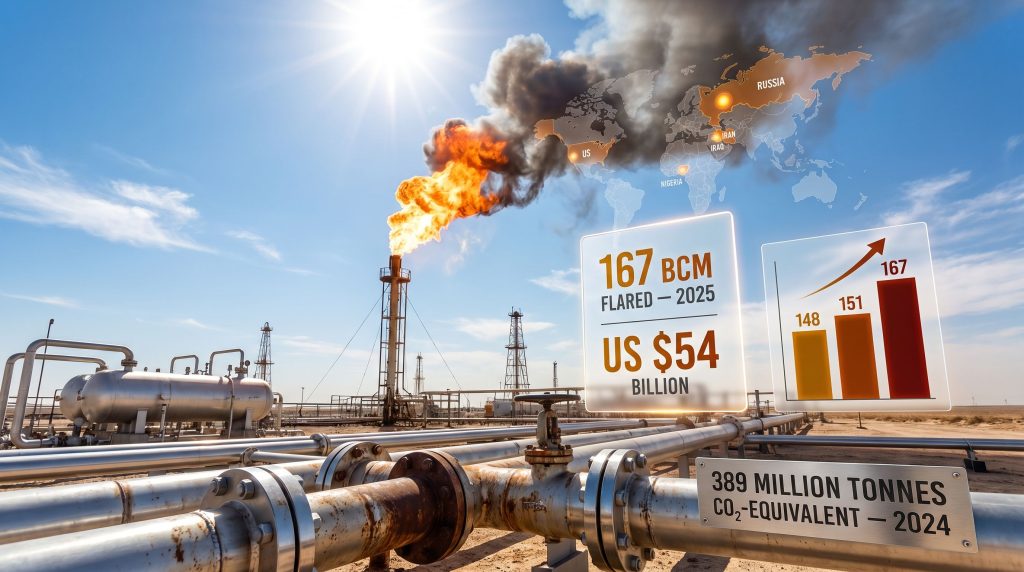
The World Bank Group's annual Global Gas Flaring Tracker, released in June 2026, confirmed that global gas flaring reached 167 billion cubic metres (bcm) in 2025, the highest recorded volume since 2007 and the third consecutive annual increase.
The trajectory leading to this point has been steep:
- 2023: Flaring surged by approximately 6%, signalling a reversal of earlier progress
- 2024: A further 2% increase pushed volumes from roughly 148 bcm to 151 bcm
- 2025: A continued climb to 167 bcm, cementing the trend as structural rather than cyclical
To contextualise what 167 bcm actually represents, consider the following comparisons:
| Reference Point | Annual Volume |
|---|---|
| Global gas flared in 2025 | ~167 bcm |
| Africa's total annual gas consumption | ~167 bcm (approximate) |
| Annual LNG volumes transiting the Persian Gulf | Less than 167 bcm |
The scale is not marginal. The gas being destroyed annually rivals the energy consumption of an entire continent.
Flaring Intensity: A Signal of Deepening Operational Failure
Beyond raw volume, the data reveals a more troubling dimension. Flaring intensity, measured as the volume of gas burned per barrel of oil produced, deteriorated from 5.0 m³/bbl to 5.1 m³/bbl in 2024, a decline of between 1.2% and 2%.
This matters because it separates the volume effect from the efficiency question. Even when oil production remains relatively stable, flaring is rising, which means the problem is not simply that more oil is being extracted. Operational standards are slipping, infrastructure investment is lagging, and governance frameworks are failing to keep pace with production activity.
Who Is Burning the Most? The Countries Responsible for Global Flaring
Nine Nations, One Enormous Problem
The geographic concentration of global gas flaring is striking. Just nine countries collectively account for more than 83% of all flared volumes worldwide, while those same nations produce roughly half of the world's oil output. Furthermore, natural gas price trends in key markets are making the economics of flaring reduction harder to justify for operators already under margin pressure.
| Country | Notable 2024-2025 Trend |
|---|---|
| Russia | Elevated volumes, marginal reductions in 2024 |
| Iran | Increases observed through 2025 |
| Iraq | Persistently high volumes |
| Venezuela | Structural infrastructure constraints limiting capture |
| Mexico | Reductions recorded in 2024 |
| Libya | Increases noted in 2024 |
| Algeria | Volumes remain elevated |
| Nigeria | Increases recorded in 2024 |
| United States | Bakken shale region driving increases |
Russia, Iran, and Iraq alone are estimated to account for approximately 25% of all global flaring, a concentration that reflects both the scale of their oil production and the regulatory environments within which that production occurs.
Country-Specific Drivers Worth Understanding
The reasons flaring is increasing differ meaningfully by geography, and understanding these distinctions is important for assessing where reduction is realistically achievable:
-
United States (Bakken Basin): The primary driver here is infrastructure, specifically the lag between drilling activity and gas gathering capacity. When new wells are brought online faster than pipelines and processing facilities can absorb the associated gas, flaring becomes the default option. This is an investment timing problem with a known solution.
-
Nigeria: Regulatory enforcement has historically been inconsistent, and underinvestment in gas utilisation infrastructure has created a situation where operators face little financial incentive to capture gas. The social cost is borne by surrounding communities and the atmosphere.
-
Libya: Geopolitical instability has disrupted both the investment environment and the institutional oversight capacity needed to enforce flaring regulations. This represents a category of problem distinct from purely technical or financial barriers.
The Economic Case Against Continued Flaring
US$54 Billion Destroyed Every Year
The World Bank Group's 2026 report estimated that the gas flared globally in 2025 carried a market value of approximately US$54 billion. That figure alone commands attention, but the broader economic mathematics make the case even more forcefully.
The total investment required to eliminate routine flaring worldwide is estimated at between US$70 billion and US$100 billion. The gas currently being destroyed is worth more than half that figure every single year. The payback period on full elimination investment would be less than two years based on current valuations.
In 2024, the annual value loss from flared gas was estimated at approximately US$31 billion, equivalent to the energy needed to power more than 340 million average UK homes. These are not abstract climate statistics. They are forfeited revenues, foregone industrial activity, and absent economic development.
The paradox deepens when examined at the country level. Numerous high-flaring nations simultaneously import expensive LNG to meet domestic energy demand while burning domestically produced associated gas at their own wellheads. Shifts in global LNG supply dynamics are consequently making this contradiction even more financially painful for those governments. The economic incoherence is difficult to overstate.
The Energy Poverty Dimension
Perhaps the most morally complex aspect of the global gas flaring crisis is its relationship to energy poverty. Many of the nations with the highest flaring volumes are also among those with the most acute domestic energy access deficits.
The populations bearing the highest opportunity cost of continued flaring are frequently the poorest communities in oil-producing regions, who live closest to production infrastructure but receive none of the energy value it destroys. Capturing and utilising this gas could:
- Provide affordable electricity to underserved communities
- Support industrial development and job creation
- Generate government revenue that could fund public services
- Reduce the need for costly gas imports that strain national budgets
Environmental Consequences: What the Numbers Actually Mean
The Greenhouse Gas Footprint of Flaring
In 2024, gas flaring released approximately 389 million tonnes of CO₂-equivalent into the atmosphere through combustion alone. However, this figure substantially understates the true climate impact.
Flaring is never perfectly efficient. Incomplete combustion releases unburnt methane, a greenhouse gas with a warming potential estimated at more than 80 times that of CO₂ over a 20-year horizon. When methane slip is incorporated into the analysis, total climate impact estimates climb toward 1 billion tonnes of CO₂-equivalent annually, making flaring a material and frequently underreported contributor to global greenhouse gas inventories.
This is an area where standard reporting frameworks may be systematically underestimating the problem. Methane slip rates vary by flare design, wind conditions, and combustion temperature, and current satellite monitoring, while dramatically improved from a decade ago, still struggles to capture all emission events at smaller or more remote facilities.
Is the 2030 Target Still Credible?
The World Bank's Zero Routine Flaring by 2030 commitment, which attracted significant international support when launched, now faces a mathematical reality that is difficult to reconcile with the current trajectory.
Achieving the target would require flaring volumes to fall by approximately 23% per year from current levels for each of the remaining years to 2030. The actual direction of travel has been the opposite for three consecutive years.
This gap between stated commitments and operational reality represents one of the most significant credibility challenges facing the international energy sector's climate agenda. Targets without enforcement mechanisms, financing, and accountability structures are, in effect, aspirational statements rather than binding obligations.
Why Progress Has Stalled: Understanding the Structural Barriers
Technology Is Not the Bottleneck
A critical insight from the World Bank's analysis is that the persistence of routine flaring cannot be attributed to a lack of technical solutions. The methods for capturing associated gas, compressing it, processing it, and routing it to market are mature, well-understood, and commercially available across the price spectrum from small-scale micro-turbine solutions to full-scale gas gathering systems.
The actual barriers are structural and institutional:
- Regulatory inadequacy: Many jurisdictions lack binding flaring limits, credible penalties for non-compliance, or transparent public reporting requirements that would create accountability
- Capital allocation failures: Associated gas capture competes for investment capital against core oil production activities and frequently loses, particularly when gas prices are low or volatile
- Infrastructure gaps: In remote or underdeveloped production regions, the absence of gas gathering pipelines, processing facilities, and market access routes makes capture economically unviable regardless of regulatory intent
- Governance deficits: Where institutional accountability is weak and political will is absent, flaring persists even when technically and financially solvable
The World Bank's Global Director for Energy has noted that many countries are struggling to secure affordable and reliable energy at the same moment they are burning vast quantities of it at the wellhead, and that the development cost of this continued waste is simply too high to justify.
The Four Levers That Actually Drive Reduction
Evidence from countries that have successfully reduced flaring points to a consistent set of enabling conditions:
- Enforceable regulatory frameworks with credible penalties, transparent reporting, and consistent application across operators
- Targeted capital investment in gas gathering, processing, and monetisation infrastructure built in parallel with oil production, not as an afterthought
- Market access development that creates viable commercial pathways for captured gas before production begins
- Political leadership and institutional accountability at both operator and government levels that treats flaring reduction as a genuine priority rather than a public relations commitment
In addition, energy transition pressures from investors and regulators are beginning to sharpen corporate focus on flaring as a measurable and reportable emissions source, adding a further layer of accountability to the operating environment.
The next major ASX story will hit our subscribers first
Kazakhstan's Achievement: Proof That Dramatic Reduction Is Possible
An 87% Reduction in Thirteen Years
The single most compelling counter-narrative to the current trajectory of global gas flaring rising is Kazakhstan. Between 2012 and 2025, the country reduced its flaring volumes by 87%, including a further 16% reduction in 2025 alone, even as global volumes reached multi-decade highs.
This was not achieved through any novel technology. It was achieved through a combination of:
| Success Factor | Kazakhstan's Approach |
|---|---|
| Regulatory enforcement | Binding national flaring limits with genuine penalties |
| Infrastructure investment | Gas gathering systems developed alongside oil production |
| Market creation | Domestic utilisation pathways established at the field level |
| Government accountability | Ministerial-level ownership of reduction targets |
| Operator incentives | Financial structures favouring gas capture over destruction |
Kazakhstan demonstrates that an 87% reduction is achievable within a single policy cycle when leadership, regulation, and investment are aligned. It also demonstrates that the often-cited barriers of geography, production complexity, and legacy infrastructure are surmountable given sufficient institutional commitment.
What a Credible Reduction Pathway Would Actually Require
A Tiered Framework for Action
Reversing the three-year upward trend in global gas flaring rising would require coordinated action across three distinct time horizons:
Tier 1: Regulatory Reform (Immediate)
- Introduce binding national flaring limits with enforceable penalties at the operator level
- Mandate transparent public reporting of flaring volumes by field and by operator, accessible to civil society and investors
- Align national frameworks with international best-practice standards to reduce regulatory arbitrage
Tier 2: Infrastructure Investment (Medium-Term)
- Prioritise gas gathering and processing investment in high-flaring production regions, potentially through blended finance structures that reduce risk for private capital
- Develop domestic gas market pathways that create commercial pull for associated gas capture
- Direct multilateral development finance toward gas utilisation projects in lower-income producing nations where private capital alone will not flow
Tier 3: Governance and Accountability (Ongoing)
- Integrate flaring performance into sovereign credit assessments and ESG investment frameworks, creating financial consequences for persistent non-compliance
- Establish cross-border knowledge transfer programs that allow high-performing regulatory environments to share expertise with lower-performing peers
- Create international monitoring infrastructure that closes the satellite data gap on methane slip and incomplete combustion
The Investment Mathematics Revisited
The economic case for action is, in an important sense, already settled. The gas being destroyed globally each year carries a value that exceeds half the total estimated cost of eliminating routine flaring permanently. The return on investment is not speculative. The barrier is not financial in any fundamental sense. It is a governance and prioritisation problem dressed in the language of economic complexity.
Consequently, renewable energy solutions are increasingly being deployed alongside gas capture infrastructure at remote production sites, reducing the cost and complexity of monetising associated gas in regions with limited grid connectivity. Furthermore, crude oil price trends directly influence operator budgets for associated gas capture investment, meaning periods of price weakness can stall even well-intentioned reduction programmes.
As global energy demand continues to rise and energy security concerns intensify across both developed and developing economies, the gas currently being burned at wellheads worldwide represents one of the highest-return, lowest-complexity emissions reduction and energy access opportunities available to policymakers. The IEA's analysis of gas flaring reinforces this assessment, highlighting that technical solutions exist today and that the primary obstacle remains political and institutional rather than technological. Whether that opportunity is seized will ultimately depend on the same factor it has always depended on: whether the political cost of inaction is finally judged to exceed the political cost of acting.
Disclaimer: Statistical figures and projections referenced in this article are drawn from the World Bank Group's Global Gas Flaring Tracker and related reports. Forward-looking assessments regarding flaring trajectories, investment requirements, and emissions scenarios involve inherent uncertainty and should not be interpreted as definitive forecasts.
Want to Stay Ahead of the Next Major Resource Discovery?
While the energy sector grapples with structural inefficiencies like routine gas flaring, Discovery Alert's proprietary Discovery IQ model delivers real-time alerts on significant ASX mineral discoveries, transforming complex resource data into clear, actionable investment insights — explore historic discoveries and their returns to understand why being early to a major find can be genuinely transformative, and begin your 14-day free trial today.