August 6, 2026
The Infrastructure Behind the World's Most Critical Oil Corridor
Global crude markets are built on assumptions so deeply embedded in daily price discovery that they become invisible until they break. One of the most fundamental is this: tankers can move freely through the Persian Gulf. When that assumption is shattered, even temporarily, it exposes just how concentrated, fragile, and non-substitutable the infrastructure underpinning roughly one-fifth of the world's seaborne oil supply actually is.
The confirmation on June 26, 2026, that Saudi Aramco Ras Tanura oil loading resumed following a near four-month suspension is far more than a logistical footnote. It represents the reopening of what is widely considered the single most consequential crude oil dispatch point on earth, and with it, the beginning of a complex, multi-week process of returning the Gulf's export architecture to its pre-conflict configuration.
When big ASX news breaks, our subscribers know first
Why Ras Tanura Occupies a Unique Position in Global Energy Infrastructure
A Terminal Built for Scale
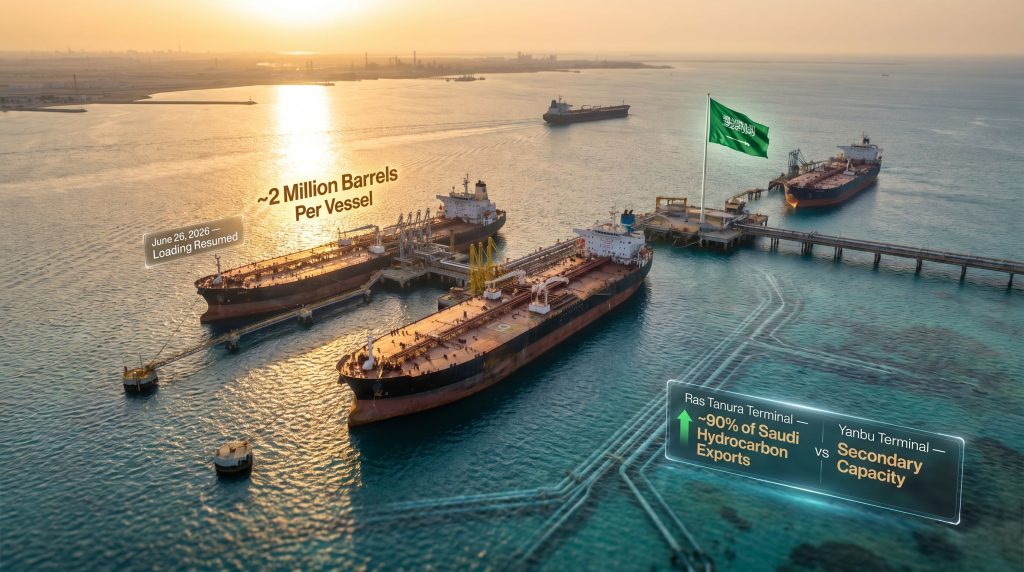
Situated in Saudi Arabia's Eastern Province along the Arabian Gulf coastline, Ras Tanura has functioned as the backbone of Saudi hydrocarbon export logistics for decades. Under normal operating conditions, the terminal complex routes approximately 90% of Saudi Arabia's total hydrocarbon exports outward to global markets, predominantly through Very Large Crude Carrier (VLCC) vessels destined for Asian refining hubs.
What makes Ras Tanura structurally distinct from other major export terminals is its offshore loading architecture. Rather than relying solely on conventional quay-side berths, the facility uses single-point mooring buoys positioned offshore, allowing VLCCs and Ultra Large Crude Carriers (ULCCs) to load in deep water without the constraints of coastal infrastructure. This design enables simultaneous loading of multiple large vessels, which is central to achieving the throughput volumes that make the terminal indispensable.
It is also critical to understand the operational distinction between two separate units within the broader Ras Tanura complex: the refinery, which processes crude into refined products, and the crude oil loading terminal, which dispatches unrefined crude to international buyers. These are independent systems with separate restart timelines, a distinction that became practically important during the disruption period.
What Is a VLCC and Why Does It Define Gulf Export Mechanics?
A Very Large Crude Carrier is a tanker vessel capable of transporting approximately 2 million barrels of crude oil per voyage. These ships represent the standard unit of Gulf-to-Asia crude trade, optimised for the long-haul routes connecting Saudi Arabia, the UAE, and Kuwait to refineries in China, South Korea, Japan, and India.
The significance of VLCC activity at Ras Tanura cannot be overstated from a market intelligence perspective. Shipping data platforms, particularly LSEG's vessel-tracking systems, treat confirmed VLCC loading events as primary evidence of terminal throughput. When LSEG data showed two VLCCs actively loading at Ras Tanura on June 26, 2026, with a third vessel positioned nearby awaiting its turn, the market received its first hard confirmation that the world's largest offshore crude loading facility had returned to active service.
Each VLCC loading at Ras Tanura carries approximately 2 million barrels of crude oil. With two vessels confirmed loading and a third positioned nearby on June 26, 2026, the immediate restart capacity represented a potential 4 to 6 million barrels of crude re-entering global supply channels within a single operational window.
The Strait of Hormuz Blockade: How Gulf Access Was Lost
A Chokepoint Under Closure
The Strait of Hormuz, the narrow waterway connecting the Persian Gulf to the Gulf of Oman and the broader Indian Ocean, carries an outsized share of global seaborne oil trade through a passage that narrows to roughly 33 kilometres at its tightest navigable point. An Iranian blockade of this corridor during the conflict involving the U.S. and Israel effectively terminated commercial tanker access to all Gulf loading terminals, including Ras Tanura, regardless of their operational readiness.
The final crude cargo loaded at Ras Tanura before the closure was dispatched on March 8, 2026, bound for China. This date marks the precise beginning of what would become an approximately four-month operational pause for the terminal's crude loading function.
The Drone Strike: A Separate but Concurrent Disruption
The disruption timeline at the Ras Tanura complex is complicated by a concurrent but distinct event: a drone strike on the refinery component of the facility on March 2, 2026, which temporarily took the refinery offline. Saudi Aramco restarted the Ras Tanura refinery around March 13, 2026, meaning the refinery and the crude loading terminal operated on entirely different recovery trajectories throughout the disruption period.
This separation is analytically important. The crude loading terminal's extended closure was driven by the Strait of Hormuz blockade, not by physical infrastructure damage at the terminal itself. Furthermore, the table below summarises the key events and their individual operational impacts:
| Event | Date | Operational Impact |
|---|---|---|
| Ras Tanura refinery drone strike | March 2, 2026 | Refinery temporarily offline |
| Refinery restart | ~March 13, 2026 | Refinery resumes; terminal remains closed |
| Last Ras Tanura crude loading | March 8, 2026 | Final cargo dispatched to China |
| Iranian blockade of Strait of Hormuz | March 2026 | Gulf tanker access suspended entirely |
| US-Iran interim ceasefire | Mid-2026 | Conditions established for Gulf reopening |
| Ras Tanura crude loading resumed | June 26, 2026 | Two VLCCs confirmed loading; third standby |
The Yanbu Pivot: Rerouting Through the Red Sea
With the Gulf closed, Saudi Aramco redirected its entire crude export volume to Yanbu, the kingdom's western coast terminal connected to eastern oilfields via the East-West Pipeline, also known as the Petroline. This pipeline stretches approximately 1,200 kilometres across the Arabian Peninsula, with a nameplate capacity that, while substantial, is considerably lower than the combined throughput capability of the Ras Tanura complex under normal operations.
The capacity asymmetry between the two terminals created a structural ceiling on Saudi export volumes during the disruption period. Yanbu primarily serves European, Mediterranean, and East African markets, and its vessel sizing is constrained by Suez Canal draft limitations, unlike Ras Tanura, which accommodates ULCCs unrestricted by such engineering thresholds.
| Metric | Ras Tanura Terminal | Yanbu Terminal |
|---|---|---|
| Location | Eastern Province, Arabian Gulf | Western coast, Red Sea |
| Primary export routes | Asia-Pacific, Far East | Europe, Mediterranean, East Africa |
| Normal share of Saudi exports | ~90% of hydrocarbon exports | Secondary and overflow capacity |
| Vessel class served | VLCCs and ULCCs | VLCCs (constrained by Suez sizing) |
| Pipeline feed | Direct connection to Abqaiq processing | East-West Pipeline (Petroline) |
| Disruption period | March 8 to June 26, 2026 | Elevated operations throughout disruption |
How a Major Crude Terminal Restarts After a Multi-Month Suspension
The Operational Restoration Sequence
Terminal restarts of this scale do not occur instantaneously. The process involves a structured sequence of assessments and coordination steps before the first barrels move through offshore loading systems:
- Maritime corridor clearance – Confirming that the Strait of Hormuz is free from active blockade enforcement and that vessel transit insurance risk has been formally reassessed.
- Infrastructure integrity review – Inspecting subsea pipelines, single-point mooring buoys, loading arms, and metering systems for any degradation accumulated during the inactive period.
- Crude inventory and quality verification – Confirming that stored crude grades meet the contractual quality specifications of waiting buyers, particularly the API gravity and sulphur content thresholds that Asian refiners specify.
- Tanker scheduling and berth sequencing – Coordinating VLCC arrival queues to avoid offshore congestion and ensure loading efficiency from the first operational day.
- Buyer notification and delivery timeline revision – Alerting contracted purchasers, predominantly Asian refiners, that loading has recommenced and updating cargo delivery schedules accordingly.
- Graduated throughput scaling – Progressively increasing daily loading rates from initial verification volumes toward full operational capacity over the following days and weeks.
The presence of Bahri vessels, the Saudi national tanker company's fleet, among the first carriers re-entering Gulf waters is a significant confidence signal. A national carrier's willingness to recommit its own fleet to the Gulf corridor indicates that Saudi Arabia's maritime risk assessment team has evaluated residual transit risk as commercially acceptable under the terms of the US-Iran interim arrangement.
The Broader Regional Pattern: More Than One Terminal Reactivating
The Saudi Aramco Ras Tanura oil loading resumed event does not exist in isolation. It is one component of a coordinated regional export recovery that is unfolding across multiple producer states simultaneously. Understanding the broader OPEC influence on oil markets helps contextualise why these simultaneous restarts carry such significant weight for global supply dynamics.
The Ras Tanura restart represents one node in a wider regional export recovery pattern that includes Iraq expanding northern crude routes, ADNOC adjusting official selling prices, and Gulf shipping lanes progressively reopening to commercial traffic, all occurring concurrently in late June 2026.
Iraq has moved in parallel to expand its oil export routes as northern crude shipments increase, reflecting a broader producer-level effort to recover export volumes lost during the conflict period. At the same time, Middle Eastern fuel oil exports are tracking toward a four-month high in June 2026, according to available shipping data, though aggregate volumes remain below pre-conflict levels, a distinction the IMF has been careful to preserve in its communications.
ADNOC's concurrent adjustment of its Murban crude official selling price to $101.48 per barrel for July deliveries provides a concurrent regional pricing data point, reflecting the supply normalisation dynamics flowing through the Gulf's pricing architecture as loading operations resume. Consequently, OPEC production decisions will remain pivotal in shaping how quickly supply discipline aligns with the recovering export landscape.
What Price Normalisation Actually Requires
The IMF's Caution on Supply Chain Lag
Energy market participants have a persistent tendency to treat physical restart events as synonymous with price equilibrium restoration. The IMF has explicitly pushed back on this assumption, noting that even following the US-Iran interim deal, energy and commodity prices will require additional time to normalise due to supply chain lag effects embedded throughout the physical delivery, insurance, and logistics ecosystem.
The distinction between terminal restart and full export volume restoration is meaningful. On day one of resumed loading, Ras Tanura is not operating at 100% of its pre-conflict throughput. Buyer procurement teams need time to redirect vessel bookings away from alternative suppliers secured during the four-month gap.
War risk insurance premiums in the Gulf corridor do not vanish the moment a ceasefire is announced; they taper as insurers accumulate transit data confirming the safety of the passage. Engineering contractors operating in the region have similarly noted that project-level disruptions persist even as geopolitical tensions ease at the headline level. The complexities of crude oil geopolitics make this lag effect a recurring challenge across every major supply disruption cycle.
Asian Refinery Demand and the Procurement Reset
China was the destination of the last cargo loaded at Ras Tanura before the shutdown on March 8, 2026, which itself is a telling indicator of where the terminal's primary commercial gravity lies. Over the four-month interruption, Chinese and broader Asian refiners were forced to diversify feedstock procurement toward alternative suppliers, including African grades, Atlantic Basin crudes, and increased spot purchases through Yanbu.
The resumption of Gulf loading is expected to trigger a reorientation of Asian procurement back toward Gulf-origin crude, particularly Saudi Arab Light and Arab Medium grades that Ras Tanura primarily handles. A surge in VLCC bookings on the Gulf-to-Asia route is the most likely near-term logistical consequence, which itself carries implications for VLCC freight rates and tanker market dynamics.
The next major ASX story will hit our subscribers first
Risks That Persist Beyond the Restart
Interim Deal vs. Durable Settlement
Energy markets price geopolitical risk along a spectrum. An interim ceasefire arrangement occupies a fundamentally different position on that spectrum than a formally ratified, multilaterally guaranteed diplomatic settlement. Historical precedent across Gulf shipping disruptions, including tanker wars of the 1980s and various Hormuz tension episodes, demonstrates that provisional arrangements can unravel with minimal warning.
Such reversals snap freight rates and insurance premiums back to conflict-era levels within days. Indeed, oil price volatility of this nature has historically persisted well beyond the initial resolution of hostilities, underscoring why analysts treat interim arrangements with considerable caution. Tanker operators and cargo underwriters are incorporating this residual uncertainty into their pricing, meaning that war risk surcharges applied to Gulf voyages have not fully unwound despite the terminal restart confirmation.
Concentration Risk: A Strategic Vulnerability
The drone strike on the Ras Tanura refinery on March 2, 2026, regardless of the speed with which it was remediated, demonstrated with uncomfortable clarity the exposure inherent in routing approximately 90% of a nation's hydrocarbon exports through a single terminal cluster. Asymmetric attack capability has expanded significantly in the regional threat environment, and the economic leverage available to any actor capable of disrupting Ras Tanura is disproportionate to the physical effort required.
This episode intensifies longer-term strategic questions about whether Saudi Arabia's export infrastructure diversification strategy, which currently operates on a Ras Tanura primary and Yanbu secondary basis, is sufficiently robust for the threat landscape of the 2020s and beyond. Furthermore, the broader pattern of oil market disruption events globally suggests that concentration risk of this magnitude warrants structural reassessment rather than tactical remediation alone.
Frequently Asked Questions
Why did Saudi Aramco stop loading oil at Ras Tanura?
An Iranian blockade of the Strait of Hormuz, implemented during the conflict involving the U.S. and Israel, prevented commercial tanker access to the Arabian Gulf, forcing Saudi Aramco to redirect all crude exports to the Yanbu terminal on the Red Sea coast.
When did Ras Tanura resume oil loading?
LSEG shipping data confirmed that Saudi Aramco Ras Tanura oil loading resumed on June 26, 2026, with two VLCCs actively loading and a third vessel positioned nearby awaiting berth allocation.
How long was the crude loading terminal offline?
Approximately four months, from the last confirmed loading on March 8, 2026, through to the June 26 restart.
What caused the refinery shutdown at Ras Tanura, and is it separate from the terminal closure?
A drone strike on the refinery component of the Ras Tanura complex on March 2, 2026, caused a temporary refinery shutdown. The refinery reportedly restarted around March 13, 2026. The crude loading terminal's extended closure was entirely attributable to the Strait of Hormuz blockade rather than to refinery infrastructure damage.
What does the Ras Tanura restart mean for oil prices?
The resumption of loading operations adds meaningful supply-side volume to global crude markets and has contributed to oil prices touching pre-war levels on rising Middle Eastern supply. However, the IMF has cautioned that full price normalisation will take additional time, given the lag effects embedded in supply chains, insurance markets, and procurement cycles.
A Structural Signal, Not Just a News Event
The speed at which Asian refiners re-anchor their procurement strategies to Gulf-origin crude will be among the most consequential determinants of crude price direction through the remainder of 2026. OPEC+ faces a parallel coordination challenge: managing output discipline at a moment when multiple member states are simultaneously attempting to recover lost export capacity, creating natural tension between collective production targets and individual revenue recovery imperatives.
Iraq's consideration of quota adjustments as its northern crude shipments rise adds a further layer of complexity to that dynamic. What the Ras Tanura restart ultimately confirms is that the Gulf crude supply architecture is transitioning from crisis-mode rerouting back toward its pre-conflict configuration. How completely and how quickly that transition completes will define the energy market narrative for the months ahead.
For further context on Gulf energy infrastructure and Middle Eastern crude export logistics, additional reporting and project-level analysis is available through Reuters and Zawya's Energy and Projects coverage at zawya.com.
Want to Stay Ahead of the Next Major Resource Market Shift?
When geopolitical events reshape commodity supply chains overnight, Discovery Alert's proprietary Discovery IQ model ensures subscribers receive real-time alerts on significant ASX mineral discoveries — turning complex market signals into actionable opportunities before the broader market catches on. Explore historic discoveries and their exceptional returns, then begin your 14-day free trial to position yourself at the forefront of the next major resource market move.