August 6, 2026
Why Canada's Aluminium Surtax Compliance Gap Could Cost Importers Millions
When trade enforcement agencies shift from passive monitoring to active verification, the financial consequences for unprepared businesses tend to arrive without warning. Retroactive duty assessments, interest charges, and administrative penalties can accumulate rapidly, particularly in industries where high import volumes amplify the cost of even minor classification errors. Canada's aluminium import sector is currently experiencing exactly this kind of enforcement intensification, and the implications extend well beyond the businesses that have already received CBSA audit notices.
Understanding why the Canada Border Services Agency has sharpened its focus on CBSA aluminium surtax exemptions requires looking beyond the immediate regulatory mechanics. The broader context involves North American trade tensions, tariff-driven supply chain shifts, and a compliance environment that has grown considerably more complex since 2025.
When big ASX news breaks, our subscribers know first
The Surtax Architecture Importers Must Understand First
Canada's current aluminium import framework layers multiple fiscal instruments on top of each other, creating compounding cost exposure for businesses that misread their obligations. The Steel Goods Aluminum Goods Surtax Order imposes a 25% surtax on designated aluminium products, which operates entirely separately from standard customs duties. This means an importer facing both standard tariff obligations and the surtax is not simply dealing with one elevated rate but with two simultaneous cost mechanisms.
A second instrument, the United States Surtax Order (Steel and Aluminum 2025), applies an equivalent 25% surtax specifically to steel, aluminium, and certain other goods originating from the United States. For North American supply chains, this dual-order architecture creates a particularly complex compliance environment because goods may move between jurisdictions under multiple regulatory frameworks simultaneously. The broader implications of steel and aluminium tariffs across the continent have reshaped how businesses structure their import operations.
The surtax framework does not replace standard tariff classifications. Importers must satisfy both the standard Customs Tariff requirements and the applicable surtax exemption conditions simultaneously to achieve full duty relief.
Since April 2026, CBSA verification of exemption claims has intensified significantly. The agency's July 2026 compliance priority update formalised this shift, introducing enhanced scrutiny of Chapter 99 tariff classification claims and end-use documentation practices across the aluminium import sector.
The Six Exemption Categories: A Structured Overview
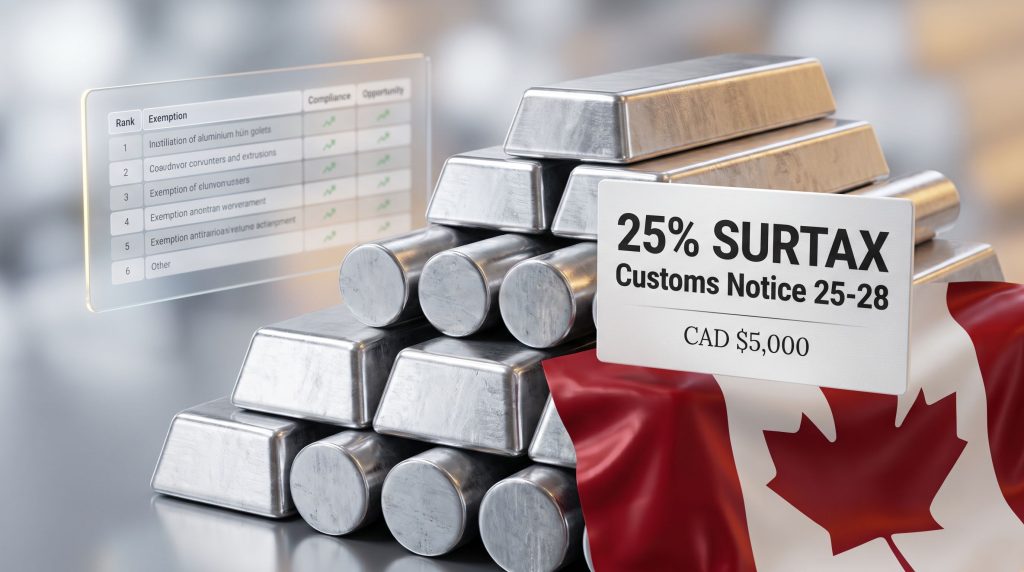
Customs Notice 25-28 and the underlying surtax order identify six discrete categories of aluminium goods that fall outside the surtax net. Each carries its own evidentiary requirements, and satisfying one category does not automatically satisfy another.
| Exemption Category | Core Qualifying Condition | Key Threshold or Parameter |
|---|---|---|
| In-Transit Goods | Goods physically en route to Canada on the surtax effective date | Transit timing must be demonstrable |
| Low-Value Shipments | Cumulative value on a single Commercial Accounting Declaration | CAD $5,000 or less |
| CUSMA-Origin Goods | Aluminium originating from the US under CUSMA rules | Must satisfy CUSMA origin regulations |
| China Surtax Overlap | Goods already subject to the China Surtax Order (2024) | Cannot be double-surtaxed |
| Casual Goods | Non-commercial personal imports | Standard casual goods definition applies |
| Chapter 98 Tariff Items | Goods classified under Chapter 98 of the Customs Tariff | Exempt even if otherwise surtax-eligible |
A distinction worth emphasising concerns Chapter 98 versus Chapter 99 provisions. Chapter 98 goods are categorically excluded from the surtax regardless of how they are used downstream. Chapter 99 exemptions, by contrast, are entirely conditional. Eligibility depends on both correct classification and the satisfaction of specific qualifying conditions, most commonly relating to intended end use. Chapter 98 therefore provides significantly stronger and more straightforward protection for importers who can access it.
How Chapter 99 Classifications Create Both Opportunity and Exposure
Chapter 99 of Canada's Customs Tariff functions as a supplementary classification layer. It does not replace a product's primary tariff heading but can modify the duty or surtax treatment that applies to that heading. For aluminium importers, this mechanism offers meaningful cost savings at scale when applied correctly, and significant financial exposure when applied incorrectly.
The opportunity is real. Correctly applied Chapter 99 provisions can eliminate or materially reduce 25% surtax exposure on otherwise taxable aluminium goods. At high import volumes, this represents a commercially significant advantage.
The enforcement risk is equally real. The CBSA has identified Chapter 99 classifications that deliver surtax relief as a primary verification target under its July 2026 compliance priority update. The agency will scrutinise whether importers have correctly applied these provisions and whether the underlying qualifying conditions have genuinely been met.
Scenario: An aluminium distributor imports 500 tonnes of extrusion billet and classifies the goods under a Chapter 99 provision to claim surtax relief. During a CBSA audit 18 months later, the agency requests end-use certificates from downstream customers. If those certificates cannot be produced, the importer faces retroactive surtax liability on the full shipment, potentially hundreds of thousands of dollars, plus interest and penalties calculated from the original importation date.
This scenario is not hypothetical. It reflects the audit mechanics that CBSA compliance reviews routinely apply, and it illustrates why documentation practices established at the time of importation, not retrospectively assembled during an audit response, determine the outcome.
End-Use Documentation: The Compliance Requirement Most Importers Underestimate
One of the most commercially significant features of many Chapter 99 exemptions is that eligibility turns on intended end use rather than the physical or chemical characteristics of the imported aluminium. This creates a documentation challenge that extends well beyond the point of importation and reaches into the downstream supply chain.
The compliance burden differs depending on where in the supply chain an importer operates:
- Manufacturers must demonstrate that imported aluminium was consumed in qualifying production processes, supported by production records and consumption data
- Distributors and wholesalers face heightened exposure where downstream customer end-use records have not been systematically retained at the point of sale
- Retailers may be unable to produce supporting certificates if customer-facing documentation practices were not established at the time of the original transaction
The critical timing issue is that end-use eligibility is assessed retrospectively during audits. Importers who cannot produce contemporaneous records at the moment a CBSA review commences, not merely at the time of import, face the full surtax liability plus interest and potential penalties. This creates a structural vulnerability for any business that treats documentation as an administrative afterthought rather than a commercial risk management tool.
Smelt-and-Cast Verification: A Transitional Window Now Closed
For country-of-origin verification, the CBSA requires importers to affirmatively demonstrate that aluminium goods are not Chinese in terms of their smelt and cast origin. This requirement goes beyond standard country-of-origin declarations and reflects concerns about the global aluminium supply chain's exposure to Chinese smelting capacity. Understanding how tariffs work in this context helps clarify why origin verification carries such significant compliance weight.
Acceptable documentation for smelt-and-cast verification includes:
- A certificate specifying the country of smelt and cast, which remains the primary and ongoing evidentiary standard
- A commercial invoice, which was accepted as transitional evidence only until September 22, 2025 and is no longer sufficient as a standalone document
Importers who relied on commercial invoices alone during the transitional window should urgently review their compliance posture for any outstanding declarations. The grace period has expired, and the CBSA now requires the higher evidentiary standard for all relevant import claims.
The next major ASX story will hit our subscribers first
Documentation Checklist: What CBSA Expects to See
A practical compliance framework for aluminium importers should address documentation requirements across multiple exemption types simultaneously.
For Chapter 99 and end-use exemption claims:
- End-use certificates or statutory declarations from downstream customers
- Production records demonstrating consumption in qualifying manufacturing processes
- Supply chain documentation linking imported goods to specific qualifying applications
- Customer purchase orders and delivery records where physical traceability is required
For the CAD $5,000 low-value exemption:
- A single Commercial Accounting Declaration must reflect cumulative value for duty at or below the threshold across all aluminium goods on that filing
- Importers should not attempt to engineer eligibility by artificially splitting shipments, as this practice itself constitutes a compliance risk
For CUSMA-origin claims:
- Origin documentation must demonstrably satisfy CUSMA origin regulations, not merely assert a US origin without substantiation
Recovering Surtax Already Paid: The Remission Order Pathway
For importers who have already remitted surtax payments but believe they qualified for CBSA aluminium surtax exemptions at the time of importation, a Remission Order filed through Canada's Department of Finance offers a formal recovery pathway. The Canada Border Services Agency guidance on this mechanism outlines the key parameters:
- Remission Orders can be granted retroactively for duties already paid
- Applications must demonstrate that qualifying exemption conditions were met at the time of importation
- The process is discretionary, with Finance Canada assessing applications individually
- Comprehensive documentary evidence supporting the original exemption claim must accompany the application
Importers with significant historical surtax exposure who believe they qualified for Chapter 99 or other exemptions should assess their filing position before limitation periods or evidentiary gaps make retroactive recovery impractical.
This pathway is particularly relevant for businesses that may have over-remitted surtax during the period before compliance processes were fully established. The financial recovery potential in high-volume import operations can be substantial, but the window for viable applications narrows as time passes and documentation becomes harder to reconstruct.
The Broader 2026 CBSA Enforcement Landscape
The aluminium surtax verification programme does not exist in isolation. It sits within a considerably broader CBSA enforcement expansion that spans multiple trade agreement frameworks and duty relief programmes. Furthermore, the effect of US aluminium tariffs continues to reverberate across the broader North American import environment. Active compliance priorities as of mid-2026 include:
- CETA origin verification covering Canada-EU trade agreement compliance
- Canada-UK Trade Continuity Agreement origin and tariff preference claims
- CUSMA automotive sector compliance, particularly rules-of-origin for vehicles and parts
- GST exemption accuracy across cross-border goods classifications
- Duties Relief Program compliance covering supply-managed goods and excise duties
- CPTPP compliance under the Comprehensive and Progressive Agreement for Trans-Pacific Partnership
- Precious metals classification and valuation accuracy
The CBSA has indicated that additional compliance priorities may be introduced throughout 2026 as enforcement capacity expands. This signals that the current aluminium focus reflects a sustained enforcement posture rather than a temporary or episodic campaign. Businesses operating across multiple trade agreement frameworks should treat all active compliance areas as live verification risks, not only aluminium.
Frequently Asked Questions
Does the CAD $5,000 Exemption Apply Per Shipment or Per Product Line?
The threshold applies to the cumulative value for duty on a single Commercial Accounting Declaration. The total declared value across all aluminium goods on a single filing must fall at or below this threshold to qualify.
Can Distributors Claim End-Use Exemptions If They Cannot Confirm How Customers Will Use the Goods?
This represents a significant compliance risk area. End-use exemptions require demonstrable evidence of qualifying downstream use. Distributors who cannot trace consumption face audit exposure. Best practice is to obtain end-use declarations from customers at point of sale and retain them for the full audit lookback period.
What Happens When a Chapter 99 Classification Is Rejected During a CBSA Audit?
The importer becomes liable for the full 25% surtax on the affected goods, calculated on the value for duty at the time of importation. Interest accrues from the original importation date, and administrative penalties may apply depending on the severity and nature of the misclassification.
Is the Commercial Invoice Still Sufficient for Smelt-and-Cast Origin Verification?
No. The transitional period that permitted commercial invoices as standalone smelt-and-cast evidence expired on September 22, 2025. A specific certificate identifying the country of smelt and cast is now required. The CBSA Customs Notice CN 25-28 provides authoritative guidance on current evidentiary standards for all affected importers.
Building a Defensible Aluminium Import Compliance Framework
The operational priorities for importers navigating Canada's CBSA aluminium surtax exemptions environment can be distilled into a clear set of actions. In addition, keeping pace with how tariffs across commodity markets continue to evolve is essential for maintaining a forward-looking compliance posture.
- Audit all active Chapter 99 classifications against current CBSA guidance to confirm ongoing eligibility
- Implement end-use documentation protocols at the point of sale, not retrospectively during an audit response
- Review smelt-and-cast certificates for all aluminium imports to ensure compliance with post-September 2025 evidentiary standards
- Assess Remission Order eligibility for any historical surtax payments where exemption conditions may have been met but were not properly documented
- Monitor CBSA compliance priority updates throughout 2026, as additional enforcement areas are expected to be formalised
- Engage customs counsel before filing Chapter 99 claims on high-value shipments where audit exposure is material
Canada's aluminium surtax exemption framework rewards importers with rigorous documentation practices and penalises those who treat tariff classification as an administrative formality. With CBSA actively expanding its verification capacity across multiple trade frameworks simultaneously, the cost of non-compliance has rarely been higher.
This article is intended for informational purposes only and does not constitute legal or customs compliance advice. Importers should seek qualified customs counsel for guidance specific to their circumstances. Regulatory frameworks, CBSA compliance priorities, and exemption conditions are subject to change. Readers are encouraged to consult official CBSA customs notices and Canada Gazette publications governing the Steel Goods Aluminum Goods Surtax Order for authoritative and current guidance.
Want to Stay Ahead of the Commodity Market Shifts Driving These Trade Disruptions?
Aluminium surtax enforcement and shifting North American trade frameworks are reshaping commodity supply chains in real time — and Discovery Alert's proprietary Discovery IQ model ensures subscribers receive instant alerts on significant ASX mineral discoveries tied to these evolving markets, turning complex commodity data into actionable investment insights. Explore historic discoveries and their market returns, then begin your 14-day free trial to position yourself ahead of the next major market move.