August 6, 2026
Europe's Mineral Discovery Deficit: Why the Clock Is Already Running Out
The global energy transition has created an uncomfortable paradox at the heart of European industrial policy. The continent most committed to decarbonising its economy is simultaneously among the least prepared to supply the raw materials that decarbonisation demands. To achieve EU exploration rise tenfold by 2030 to meet CRMA goals, the physical act of finding and developing new mineral deposits must keep pace with policy. The result is a growing disconnect between legislative ambition and geological reality, one that no amount of regulatory architecture can resolve without a fundamental rethinking of how exploration capital is deployed across the bloc.
Understanding this gap requires starting not with politics, but with physics. Minerals do not materialise because legislation demands them. They must be found, delineated, permitted, and extracted, each step requiring years of investment, technical expertise, and risk tolerance that European capital markets have historically been reluctant to provide for early-stage resource development. Furthermore, the importance of mineral exploration in underpinning supply security cannot be overstated.
When big ASX news breaks, our subscribers know first
The Scale of the Spending Gap Europe Cannot Ignore
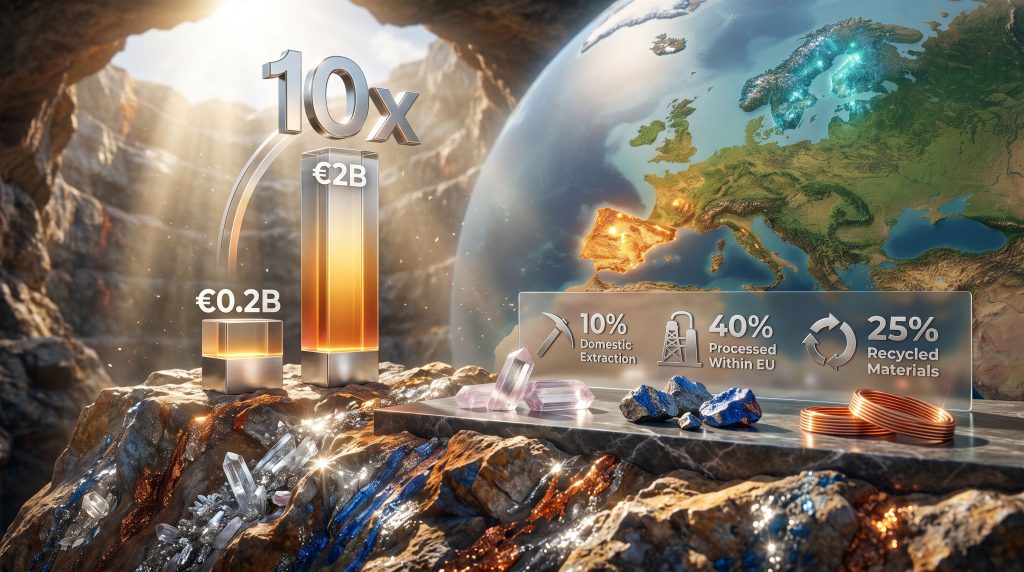
A study from the European Investment Bank has placed the exploration funding shortfall in stark numerical terms. Current annual exploration spending across the EU sits at approximately €200 million. To generate the discovery pipeline necessary to meet the Critical Raw Materials Act's benchmark of sourcing 10% of strategic mineral consumption from domestic extraction by 2030, that figure needs to reach roughly €2 billion per year. That is not an incremental adjustment. It is a structural transformation of how Europe values and funds the earliest, riskiest stage of the mining value chain.
| Metric | Current Level | Required Level | Implied Change |
|---|---|---|---|
| Annual EU exploration spend | ~€0.2 billion | ~€2 billion | +900% |
| Domestic extraction share | Below 5% estimated | 10% by 2030 | Doubling-plus required |
| Timeline remaining | Baseline (2025) | 2030 | Approximately 5 years |
To put this in comparative context, Australia spends roughly AUD $3-4 billion annually on mineral exploration across all commodities, benefiting from a deeply developed junior mining capital market, streamlined permitting pathways, and an extensive national geological database accumulated over more than a century of systematic surveying. Canada's TSX Venture Exchange performs a similar function, channelling billions in risk capital each year toward early-stage exploration companies that would struggle to access conventional financing.
The EU has no equivalent market infrastructure. This absence is not merely a curiosity; it is a structural constraint that actively suppresses exploration activity across member states that hold genuine mineral endowments. Consequently, the junior exploration funding landscape in Europe remains significantly underdeveloped compared to peer jurisdictions.
What the CRMA Actually Asks of Europe
The Critical Raw Materials Act establishes three headline benchmarks to be achieved by 2030:
- 10% of annual strategic raw material consumption from domestic extraction
- 40% of annual consumption processed within EU borders
- 25% of annual consumption sourced from recycled materials
These figures are policy benchmarks rather than hard legal quotas, a distinction with real consequences for how member states prioritise compliance and how investors assess regulatory certainty. However, the CRMA does introduce binding mechanisms, most notably the Strategic Projects designation, which grants qualifying mineral projects access to accelerated permitting timelines, preferential consideration for EU financial instruments, and enhanced visibility to institutional capital.
Member states are also required to produce national exploration plans, which represent a shift from passive geological inventory to active, policy-directed discovery strategy. According to analysis forecasting EU shortfalls, ambitious action across all three pillars will be necessary to avoid material gaps.
The recycling and processing pillars of the CRMA offer genuine complementary pathways to reducing import dependency, but they cannot substitute for primary extraction. Recycling volumes are constrained by the limited stock of end-of-life batteries and electronics currently available in Europe, while processing capacity needs feedstock from somewhere. Primary discovery remains the foundation.
The Time Compression Problem No Policy Can Solve
One of the most consequential and underappreciated dimensions of this challenge is the structural lag between exploration investment and productive output. Even in the most favourable geological and regulatory environments, the journey from initial field work to first ore production typically spans 10 to 20 years.
Drilling campaigns, resource estimation, feasibility studies, environmental impact assessments, permitting decisions, financing arrangements, and construction phases each consume years before a single tonne of ore is extracted. This timeline creates a compounding urgency.
Exploration spending committed in 2025 cannot realistically yield producing mines by 2030 in most cases. The practical implication is that the 2030 domestic extraction target depends almost entirely on advancing already-identified deposits through the development pipeline, while exploration capital deployed today builds the supply base for the decade that follows.
Investors and policymakers who treat the 2030 benchmark as the primary objective risk misunderstanding the strategic purpose of the current exploration push. The real value of a tenfold increase in exploration spending is not achieving a single legislative milestone; it is establishing a discovery inventory sufficient to sustain European mineral production through the 2030s and 2040s.
Where Europe's Geological Potential Is Concentrated
The EU is not geologically impoverished. Several member state jurisdictions host mineral endowments that compare favourably with established mining provinces globally but remain systematically underexplored relative to their potential.
| Region | Key Commodity Potential | Current Exploration Status |
|---|---|---|
| Iberian Peninsula (Spain, Portugal) | Lithium, copper, tungsten, tin | Active but chronically underfunded |
| Fennoscandian Shield (Finland, Sweden) | Cobalt, nickel, rare earth elements, copper | Advanced in select areas |
| Central and Eastern Europe (Romania, Czech Republic) | Copper-gold, graphite, lithium | Predominantly early-stage |
| Germany and Austria | Lithium, tungsten, indium | Nascent, limited systematic work |
The Iberian Peninsula carries particular strategic significance. Portugal hosts one of Europe's most advanced lithium endowments, while Spain's polymetallic belts contain copper and zinc deposits with characteristics comparable to some of southern Europe's historically significant mining districts.
The Fennoscandian Shield, stretching across Finland and Sweden, is geologically analogous to parts of Canada's Canadian Shield, an environment that has yielded world-class nickel and cobalt deposits. Romania's Rovina Valley, operated by Euro Sun Mining, represents the type of copper-gold project that illustrates both the opportunity and the challenge: significant mineralisation identified through drilling, yet still navigating the long road from resource definition to production amid complex permitting and financing requirements.
The Structural Barriers Suppressing Exploration Capital
Understanding why the EU exploration rise tenfold by 2030 to meet CRMA goals challenge is so difficult requires examining the interconnected barriers that collectively depress exploration investment.
1. Permitting Fragmentation Across 27 Member States
Exploration licence approval timelines in several EU jurisdictions routinely extend beyond five years. In a sector where exploration companies are burning capital without revenue, multi-year administrative delays are not merely inconvenient; they destroy the economics of speculative discovery. The permitting and land access framework challenge is a recurring theme across resource jurisdictions globally, and the EU is no exception. Capital that cannot be deployed within a predictable timeframe migrates to jurisdictions where it can.
2. Absence of a Junior Mining Capital Market
Early-stage mineral exploration is inherently high-risk, high-attrition work. Most exploration programs do not find economically viable deposits. This reality is well understood in Canadian and Australian capital markets, where junior exploration companies access equity financing specifically designed for this risk profile. The EU has no equivalent ecosystem. Exploration companies operating in Europe frequently list on the ASX, TSX, or AIM precisely because European exchanges do not offer the same investor base or analytical coverage for pre-revenue mining companies.
3. Social Licence Complexity in Densely Populated Regions
The EU's land-use environment is fundamentally different from that of sparsely populated mining frontiers. Exploration activities in Germany, France, or central Europe occur in landscapes with dense population, established land use, and heightened environmental sensitivities. Securing community acceptance for drilling programs, let alone mine development, requires engagement processes that add time and cost at every stage.
4. Geological Database Gaps
Comprehensive publicly accessible geological survey data accelerates exploration by reducing the cost of early-stage target identification. Several EU member states have survey databases that are fragmented, outdated, or not digitised to modern standards, forcing exploration companies to fund basic geological work that should already exist in national archives.
The next major ASX story will hit our subscribers first
Priority Minerals and Why Their Domestic Supply Matters
The CRMA's strategic raw materials list is not arbitrary. Each commodity reflects a specific vulnerability in Europe's critical minerals supply chain:
- Lithium feeds directly into battery cell manufacturing, the centrepiece of Europe's electric vehicle ambition. The EU has identified domestic lithium sources in Portugal, Czechia, and Germany, but extraction at scale remains years away for most projects.
- Cobalt remains heavily concentrated in the Democratic Republic of Congo for primary production, creating geopolitical exposure that only domestic or near-domestic supply can reduce.
- Rare earth elements, particularly the heavy rare earths used in permanent magnets for wind turbines and EV motors, represent perhaps the most acute single-commodity dependency. Europe has virtually no operating rare earth production and limited identified deposits of the specific elements most needed.
- Nickel and copper underpin the electrification infrastructure build-out and are required in quantities that dwarf what current EU production can supply.
- Manganese is essential for both steel production and emerging battery chemistries but remains largely sourced from outside Europe.
A rarely discussed dimension of this commodity landscape is the quality dimension of mineral deposits. Not all lithium is equal, not all cobalt is equal, and the specific mineralogy, grade, and metallurgical characteristics of a deposit determine its economic viability and suitability for downstream processing. Europe's nascent processing industry is still developing the technical capability to handle the specific ore types present in European deposits, some of which differ meaningfully from the feedstocks currently processed in established Asian refining operations.
Three Scenarios for 2030: What the Numbers Suggest
| Scenario | Exploration Trajectory | Permitting Reform | Likely Domestic Supply Outcome |
|---|---|---|---|
| Optimistic | Spending reaches €1.5-2B by 2027 | Significant streamlining achieved | 6-8% domestic supply; partial target achievement |
| Base Case | Spending reaches €0.8-1B by 2028 | Incremental reform only | 3-5% domestic supply; material shortfall |
| Pessimistic | Spending stagnates below €0.5B | Minimal regulatory change | Below 3%; continued deep import dependency |
The base case is arguably the most probable near-term trajectory. Exploration spending in Europe has been structurally suppressed for decades, and the institutional, regulatory, and cultural shifts required to redirect capital at scale cannot be achieved purely through legislative intent.
The EIB's own involvement, through blended finance structures, exploration-stage risk-sharing facilities, and technical assistance to member states developing national exploration plans, acknowledges that market forces alone will not close the gap within the required window. In addition, the European raw materials facility represents a meaningful step toward deploying targeted public capital alongside private investment.
Disclaimer: The scenario projections presented above are illustrative estimates based on publicly available research and industry analysis. They should not be interpreted as investment advice or as precise forecasts of policy outcomes.
Rethinking Exploration as Strategic Infrastructure
The most significant conceptual shift required in European policy thinking is the reframing of mineral exploration from a private sector discretionary activity into a category of strategic infrastructure investment. Roads, ports, energy grids, and broadband networks are all understood as foundational to economic competitiveness, justifying public investment even where private returns are uncertain. The geological discovery pipeline that feeds European mineral production deserves equivalent treatment.
What Must Happen in Parallel
Key actions that must advance simultaneously to translate increased exploration spending into actual production outcomes include:
- Harmonising permitting timelines across member states through enforceable EU-level standards for exploration licence processing
- Developing a European junior mining exchange mechanism or financing facility that provides risk-tolerant capital to early-stage exploration companies
- Accelerating national geological survey digitisation to lower the cost of target identification and attract exploration capital to underleveraged provinces
- Building technical workforce capacity in geoscience, drilling, and resource assessment, disciplines where European universities have historically underinvested relative to peer jurisdictions
- Prioritising known advanced-stage deposits for fast-track permitting while simultaneously expanding the greenfield discovery pipeline for post-2030 supply
However, according to reporting on EU exploration spending targets, the EU exploration rise tenfold by 2030 to meet CRMA goals remains one of the most demanding industrial policy challenges the bloc has set itself. The geological potential is real, the policy framework is in place, and the financial instruments are being assembled. What remains is the hardest part: converting legislative ambition into metres drilled, assays returned, and deposits defined, all within a timeframe that the geology of mineral discovery has never before been asked to accommodate.
Want to Track the Next Major Mineral Discovery Before the Market Does?
Discovery Alert's proprietary Discovery IQ model delivers real-time alerts on significant ASX mineral discoveries, cutting through complex geological data to surface actionable opportunities the moment they are announced — explore historic discoveries that demonstrate just how transformative early positioning can be, and begin your 14-day free trial today to secure a genuine market-leading edge.