August 6, 2026
The Demand-Side Revolution Quietly Reshaping How Oil Prices Are Formed
For most of modern energy history, the central question in oil market analysis has been a supply-side one: how much crude can the world's major producers bring online, and at what speed? This framing placed institutions like OPEC at the centre of price discovery, treating demand as a relatively stable and predictable force. That assumption is now being tested by a structural shift of considerable magnitude. The 2026 Strait of Hormuz disruption did not simply stress-test global supply chains — it exposed something far more consequential: the China swing buyer in the oil market, a demand-side actor capable of moving global prices with the same authority once reserved exclusively for major producers.
Understanding how this mechanism works, why it matters, and what it signals for the future of energy markets requires a fundamental rethink of how price formation models are constructed. Furthermore, as oil trade and geopolitics continue to evolve, the analytical frameworks used by market participants must evolve in parallel.
When big ASX news breaks, our subscribers know first
What Is a Swing Buyer and Why Does the Term Now Matter?
The concept of a swing producer is well-established in commodity economics. It refers to an entity, typically Saudi Arabia, that holds sufficient spare production capacity to adjust output volumes and thereby stabilise market prices. The parallel demand-side concept, a swing buyer, has received far less academic and analytical attention, despite becoming increasingly relevant.
A swing buyer is a nation or economic bloc whose import volumes are large enough that their procurement decisions, rather than physical supply changes, can materially shift the global supply-demand balance. The key distinction is that a swing buyer does not need to change what it consumes — it changes what it purchases on the open market, drawing instead on stockpiled reserves to sustain domestic activity while withdrawing from spot markets entirely.
What Conditions Must a Swing Buyer Meet?
This mechanism requires three structural prerequisites:
- Massive baseline import volumes that represent a material share of global seaborne crude trade
- Deep strategic and commercial inventory reserves capable of substituting for months of import activity
- Centralised procurement authority capable of executing large-scale adjustments with speed and coordination
China currently satisfies all three conditions in ways no other nation can replicate at comparable scale.
China's Import Profile: The Numbers Behind the Market Power
To appreciate why China functions as the China swing buyer in the oil market, it is essential to examine the raw scale of its procurement footprint. The following table summarises the key figures that defined China's role during the 2026 Hormuz disruption, as documented by S&P Global Energy:
| Metric | Estimated Figure |
|---|---|
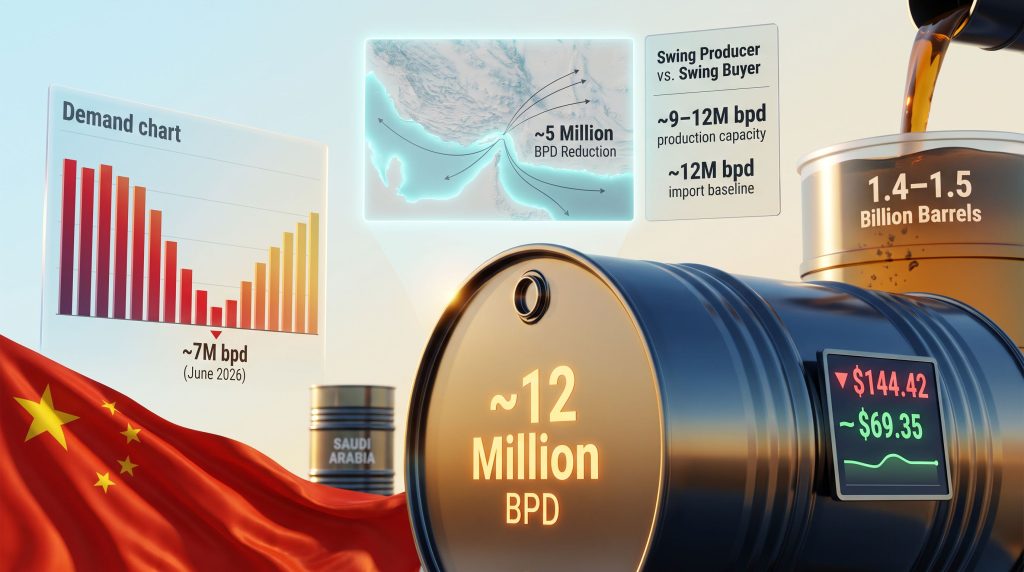
| China's average baseline seaborne crude imports | ~12 million bpd |
| Import volumes at peak reduction (June 2026) | ~7 million bpd |
| Total import reduction during disruption period | |
| Estimated crude and condensate inventory buffer | ~1.4–1.5 billion barrels |
| Chinese oil demand decline (Q2 2026 vs. prior year) | ~1.6 million bpd year-over-year |
The divergence between the 5 million bpd import reduction and the 1.6 million bpd demand decline is the single most revealing statistic in this entire analysis. It confirms that China was not experiencing demand destruction in the conventional sense. Instead, it was substituting inventory drawdowns for market purchases — a deliberate and strategically coordinated decoupling of consumption from procurement.
This is precisely what separates swing buyer behaviour from ordinary demand fluctuation. The former is strategic and reversible; the latter is structural and slow to unwind.
How the 2026 Hormuz Crisis Revealed China's Price-Setting Influence
The S&P Global Energy Crude Oil Markets team described the 2026 oil market cycle as extraordinary, and the price data supports that characterisation unambiguously. Brent crude surged to $144.42 per barrel on April 7, 2026, before collapsing to $69.35 per barrel by July 3, 2026. That is a round-trip decline of more than $75 per barrel in roughly 90 days, representing the most dramatic short-cycle price collapse ever recorded in the oil market.
Following the breakdown of the U.S.-Iran ceasefire, Middle Eastern crude and condensate shortfalls re-widened to levels approaching those seen during the early conflict period, pushing prices back into the $80 to $100 per barrel range. For broader context, the crude market overview during this period underscores just how exceptional these price movements were by historical standards.
Jim Burkhard, Vice President and Global Head of Crude Oil Research at S&P Global Energy, described China's import reduction as the primary reason prices fell as sharply as they did between April and July 2026, and identified it as the main factor preventing prices from rising even further once hostilities intensified again.
The logic is straightforward but counterintuitive. When Persian Gulf supply contracted sharply, China simultaneously removed approximately 5 million bpd of competing demand from global spot markets. The rest of the world maintained near pre-war import levels. This means the price-dampening effect was almost entirely attributable to Beijing's procurement withdrawal, not to any broad global demand weakness.
This is the price ceiling mechanism in practice: not a policy intervention, not a coordinated multilateral response, but the organic consequence of one nation's procurement flexibility operating at scale.
China vs. Saudi Arabia: Mapping the Bilateral Stabilisation Architecture
The emergence of a credible swing buyer creates what analysts are beginning to describe as a bilateral stabilisation architecture in global oil markets, where price formation is influenced by both supply-side and demand-side levers simultaneously. OPEC's market influence, long considered the dominant force in price stabilisation, now shares the stage with Beijing's demand-side authority.
The structural comparison between the two roles is instructive:
| Dimension | Saudi Arabia (Swing Producer) | China (Swing Buyer) |
|---|---|---|
| Mechanism | Adjusts crude output | Adjusts crude imports |
| Market channel | Supply side | Demand side |
| Buffer asset | Spare production capacity | Strategic crude inventory |
| Active price effect | Moves supply to shift prices | Moves demand to shift prices |
| Policy driver | OPEC+ multilateral framework | Unilateral state energy policy |
| Baseline market scale | ~9–12 million bpd capacity | ~12 million bpd import baseline |
| Adjustment speed | Weeks to months | Days to weeks |
Why Does the Speed Differential Matter?
A critical asymmetry here is the speed differential. Saudi Arabia requires weeks to months to meaningfully ramp production volumes, subject to infrastructure constraints and OPEC+ coordination dynamics. China's procurement adjustments can theoretically be executed within days through state-owned enterprise instructions, making it a faster-acting market variable than the swing producer it mirrors.
This speed differential matters enormously for price volatility modelling, because it means demand-side shocks from China can move faster than supply-side responses can compensate for.
The Restocking Risk: When the Cushion Becomes a Catalyst
The same strategic flexibility that suppressed prices through the disruption period contains within it a significant upside risk for crude prices. Burkhard noted explicitly that the factor which capped prices could rapidly amplify them once China returns to normalised procurement patterns.
A return to baseline import volumes of approximately 12 million bpd would reintroduce roughly 5 million bpd of incremental demand into a market that may still be contending with Hormuz supply constraints. The restocking dynamic is, consequently, the most consequential near-term variable in global oil price forecasting.
Goldman Sachs analysts, in research notes circulated during the same period, flagged that global visible crude stocks were drawing down at approximately 6.3 million bpd over a two-week window, with Asian imports — including a 2.3 million bpd increase from China — contributing to the tightening as prices moderated in late June and early July.
What Structural Constraints Limit China's Export Offset?
Goldman Sachs also identified three structural constraints limiting China's ability to offset supply tightness through increased refined product exports:
- Export quota constraints: China's total 2026 refined product export quota is tracking broadly in line with 2025 levels, limiting the incremental volume available for international markets.
- Domestic energy security priorities: Government policy reportedly requires refiners to maintain inventory levels above end-February 2026 thresholds, placing domestic supply security ahead of export revenue optimisation.
- Refinery utilisation softening: Chinese refinery run rates moved lower in recent weeks, reducing throughput available for both export and domestic consumption.
These three factors collectively limit China's ability to compensate for Hormuz supply losses through the product export channel, reinforcing the view that crude procurement decisions, not refinery output, remain the dominant Chinese variable in global oil market modelling.
The next major ASX story will hit our subscribers first
Three Scenarios for Chinese Import Resumption
The trajectory of global oil prices over the next six to twelve months will depend substantially on how, and how quickly, China rebuilds its procurement activity. Three pathways are plausible:
Scenario A: Gradual Re-entry (Base Case)
China incrementally increases seaborne purchases over a three to six month period as inventory levels approach operational minimums. Brent stabilises in the $85 to $100 per barrel range, with demand recovery partially offset by any Hormuz normalisation.
Scenario B: Accelerated Restocking (Bullish for Crude)
China moves aggressively to rebuild strategic reserves whilst prices remain below $90 per barrel, creating a demand surge that, combined with continued supply constraints, drives Brent toward the $110 to $130 per barrel range. Refinery utilisation increases sharply, amplifying refined product market tightness globally.
Scenario C: Prolonged Restraint (Bearish for Crude)
Geopolitical uncertainty and domestic economic headwinds suppress Chinese demand growth. Reduced import volumes persist for six to twelve months, keeping global prices capped despite supply limitations. Strategic inventory levels gradually decline until a procurement resumption becomes unavoidable, but from a lower price baseline.
Repricing Geopolitical Risk: The Beijing Variable in Energy Security Planning
Traditional geopolitical risk premiums in oil pricing were almost exclusively calibrated around supply disruption scenarios: pipeline sabotage, sanctions regimes, OPEC discipline failures, or conflict in producing regions. The 2026 Hormuz crisis has, however, forced a significant methodological revision. Indeed, geopolitical trade tensions are now inseparable from demand-side risk modelling in ways that were barely contemplated a decade ago.
The analytical question that now dominates oil market forecasting is no longer simply how much supply has been lost. It is how much China will choose to reduce purchases in response, and over what timeframe. This variable is politically determined rather than market-driven, making it far harder to model with conventional econometric tools.
China's centralised energy procurement structure, dominated by state-owned enterprises with policy mandates extending beyond pure commercial optimisation, creates an information asymmetry that disadvantages Western market participants. While demand destruction in market economies is driven by price signals and consumer behaviour, China's demand-side adjustments can be coordinated at a speed and scale that price-signal-driven systems cannot replicate. Furthermore, US-China oil price tensions add an additional layer of complexity to how Beijing calibrates its procurement decisions under geopolitical pressure.
Burkhard's analysis concluded that the Hormuz crisis has revealed a fundamental truth: the oil market's balance now depends heavily on a choice that Beijing controls, and that choice can be altered at any time without advance warning to global markets.
For energy security planners in oil-importing nations, this represents a structural shift that cannot be addressed through supply diversification alone. It requires incorporating demand-side geopolitical risk — specifically the risk that the world's largest crude importer could simultaneously withdraw from and flood global markets — into national energy security frameworks.
The 2026 disruption functioned as a live stress test of a mechanism that had previously been theoretical. It passed. And in passing, it permanently elevated China's status from the world's largest crude buyer to something qualitatively different: the China swing buyer in the oil market, with all the structural leverage that designation implies.
Disclaimer: This article contains forward-looking scenario analysis and commentary drawn from publicly available third-party research. It is intended for informational and educational purposes only and does not constitute financial or investment advice. Oil market forecasts involve significant uncertainty, and actual outcomes may differ materially from any scenarios described.
Want To Stay Ahead of the Next Major Market-Moving Discovery?
While geopolitical forces reshape global commodity markets, Discovery Alert's proprietary Discovery IQ model scans ASX announcements in real time, instantly identifying significant mineral discoveries before the broader market reacts — explore historic examples of exceptional discovery returns or begin your 14-day free trial today to position yourself at the forefront of the next major opportunity.