
August 6, 2026
Japan's Just-In-Time Manufacturing Model Meets Its Greatest Stress Test
Few industrial philosophies have proven as elegant and as fragile as Japan's just-in-time manufacturing system. Built over decades to eliminate inventory waste and synchronise production flows with pinpoint precision, it transformed Japanese automakers into global efficiency benchmarks. Yet that same precision carries an inherent vulnerability: when a single node in the supply chain falters, the tremor radiates outward with remarkable speed. A seismic event does not need to flatten a factory to halt production. It simply needs to sever the thread.
The 7.1-magnitude earthquake that struck the Kyushu region on July 28, 2026, did exactly that. And for the already-pressured Japanese aluminium market, the Kyushu earthquake impact on Japanese automakers and aluminium demand arrived not as an isolated shock, but as an additional weight on a structure already bending under considerable strain.
When big ASX news breaks, our subscribers know first
Kyushu's Industrial Footprint: Why This Region Matters Beyond Its Geography
Kyushu is not merely one of Japan's southernmost islands. It functions as one of the country's most industrially dense corridors, concentrating automotive assembly, semiconductor fabrication, electronic component manufacturing, and flat-rolled steel production within a geographically compact zone. The island hosts a layered ecosystem of original equipment manufacturers (OEMs) and their associated Tier 1 and Tier 2 parts suppliers, all operating in close proximity.
This clustering is deliberate. Proximity reduces logistics costs and supports the tight delivery schedules demanded by just-in-time operations. However, it also creates systemic concentration risk. When seismic activity disrupts infrastructure, utility services, and road networks simultaneously across a single region, the entire supplier ecosystem is affected in parallel rather than sequentially, making coordinated recovery far more complex.
Japan's position along the Pacific Ring of Fire means industrial planners have long factored earthquake risk into facility design. The 2016 Kumamoto earthquake, also centred on Kyushu, provided an earlier demonstration of how even events that cause limited direct structural damage to manufacturing facilities can generate prolonged operational stoppages through logistics failures and supply network fragmentation.
Production Halts Across Toyota, Nissan, and Honda
The immediate operational consequences of the July 28 earthquake unfolded across multiple OEMs within hours of the event.
| Automaker | Facilities Affected | Suspension Period | Primary Disruption |
|---|---|---|---|
| Toyota | 3 Fukuoka prefecture plants | July 28 – July 31 (extended) | Supply chain assessment; extended from initial one-day halt |
| Toyota (Daihatsu) | Oita and Kurume factories | Until July 31 | Subsidiary shutdown aligned with parent |
| Nissan | Nissan Motor Kyushu; Nissan Shatai Kyushu | Until July 31 | Parts procurement delays; no structural damage confirmed |
| Honda | Ozu town motorcycle factory | July 28 – July 31 | Major water leak requiring facility repairs |
Toyota's initial plan to resume operations on the morning of July 29 was revised by later that day when a second statement extended the suspension to July 31, with the next update scheduled for Monday August 3. Nissan confirmed no structural damage to its assembly plants but acknowledged that parts procurement had been disrupted. Honda's Ozu facility faced a more tangible physical complication in the form of a significant water leak requiring active repair work before operations could safely restart.
The Supplier Layer: Where Uncertainty Runs Deepest
Beyond the OEMs themselves, the more consequential uncertainty resided within the supplier network. Several key parts manufacturers confirmed damage assessments were ongoing without providing restart timelines, which is precisely the condition that extends automotive production disruptions well past initial estimates. Furthermore, automakers prolonging plant suspensions following the earthquake added to market unease.
- Aisin (Toyota Group): confirmed employee safety but remained in active damage assessment mode at its Kumamoto city facility as of late July
- Astemo (Honda-affiliated): reported three employees with minor injuries and a complete loss of water, electricity, and gas supply at its Fukuoka plant
- Giken Kogyo (Honda-affiliated, Kyoshi city): halted production from July 29 pending earthquake impact assessment
- FCC (motorcycle clutch supplier to Honda, Yamaha, Kawasaki, and Suzuki): closed from July 29 at its Uki city facility, with no confirmed restart date
The significance of these supplier shutdowns extends beyond Kyushu's borders. Under just-in-time logistics, an assembly plant in a distant Japanese prefecture can be rendered idle within days if a single critical component supplier in Kyushu cannot deliver. This transmission mechanism consistently causes the geographic footprint of earthquake-related automotive disruptions to exceed what physical damage surveys alone would predict.
Aluminium Demand: Understanding the Automotive Connection
The relationship between automotive production volumes and aluminium demand is direct and well-documented. Each modern vehicle contains substantial aluminium content across body panels, structural components, engine housings, transmission casings, and cast alloy wheels. When assembly lines stop, the downstream procurement of aluminium sheet, extrusions, and die-cast alloys contracts with them.
Two distinct aluminium segments face different degrees of exposure. In addition, commodity price pressures across the broader market have compounded the sensitivity of these segments to demand shocks.
| Aluminium Segment | Key Product Form | Primary Automotive Application | Earthquake Demand Impact |
|---|---|---|---|
| Primary (P1020A) | Ingot | Body sheet, structural extrusions | Moderate — spot restocking deferred |
| Secondary (ADC12) | Cast alloy ingot | Engine blocks, transmission housings, wheels | High — directly tied to casting volumes |
| Rolled products | Sheet and coil | Body panels, closures | Moderate — inventory buffers provide short-term insulation |
Among these, the secondary aluminium segment, specifically ADC12 cast alloy, carries the highest direct exposure. ADC12 is a silicon-copper aluminium casting alloy that is the workhorse of automotive die-casting operations in Japan. Its demand is tightly correlated with actual casting volumes at automotive suppliers rather than broader industrial activity, leaving it with less buffer when OEM production halts.
A key market participant perspective captured by commodity intelligence noted that while the earthquake registered as a significant seismic event by any measure, the underlying aluminium market sentiment had already been deeply bearish prior to the disruption, with activity so subdued that the incremental demand loss was difficult to distinguish from the pre-existing quiet.
A Market Already Under Pressure Before the Earthquake Struck
The timing of the Kyushu earthquake compounded an already deteriorating demand picture for Japanese automotive aluminium. The sector entered the second half of 2026 carrying substantial headwinds that, when viewed through the lens of the broader metals and mining outlook, reflect a wider pattern of industrial strain across the Asia-Pacific region.
- Toyota projected a profit decline for fiscal year ending March 2027 and deepened its overseas production reduction target to 100,000 units, widening from an initial 83,000-unit cut flagged in May 2026
- Honda Motor recorded its first annual net loss in approximately 70 years as of May 2026
- Nissan announced the closure of its Shatai Shonan factory by March 2027 and its flagship Oppama facility by end of fiscal 2027, with production consolidating at its Kyushu complex, the very region disrupted by the earthquake
- Multiple Japanese automakers had ceased exports to Middle Eastern markets from April 2026 following geopolitical disruption stemming from the US-Iran conflict that began in late February
Structural competitive pressure from Chinese electric vehicle manufacturers is eroding Japanese OEM global market share at an accelerating pace. This has particular significance for the secondary aluminium supply chain: as Japanese automakers produce fewer vehicles globally, the downstream die-casting and alloy processing industries face a demand base that may not recover to pre-2024 levels even as earthquake-related disruptions eventually resolve.
The Seasonal Timing Problem
The earthquake struck during the traditional summer off-peak period for automotive aluminium procurement, compressing the demand impact further. Several automakers had already communicated to aluminium and scrap suppliers that Q3 inventory positions were adequate, effectively removing restocking appetite independent of the seismic event.
Reduced working days across August and September, including the Mountain Day holiday, the Obon festival period running from August 11 to 16, and the September 21 to 23 holiday cluster, further narrow the purchasing windows available during the quarter. Market participants broadly characterised most procurement activity for the period as nearly complete before the earthquake occurred.
Price Signals: MJP Premiums and ADC12 Under Simultaneous Pressure
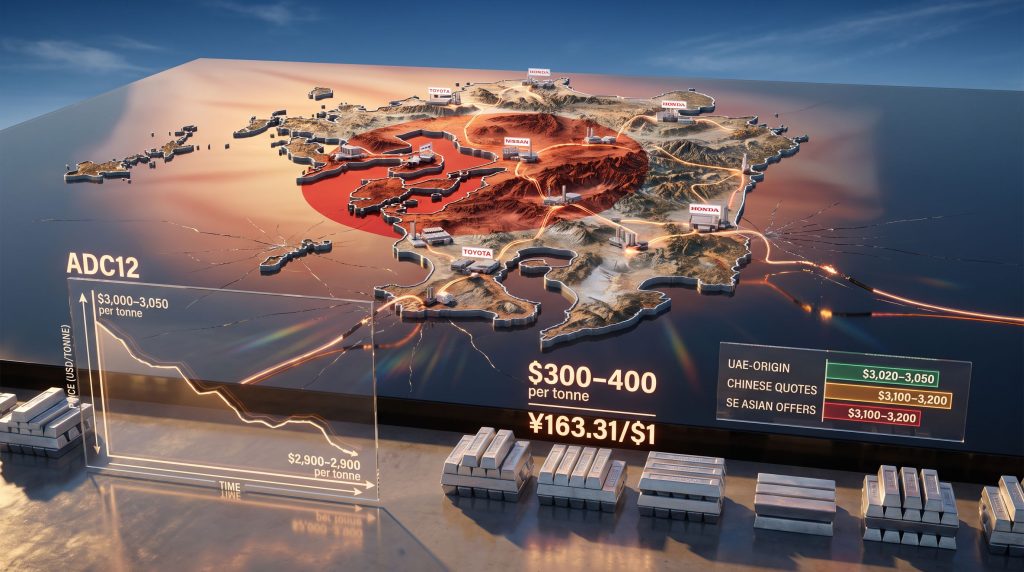
Fastmarkets' daily assessment for aluminium P1020A (MJP) spot premium, CIF Japan, registered at $300 to $400 per tonne on July 30, 2026, widening lower from $320 to $400 per tonne at the start of the same week. The directional softening reflects both the earthquake-related demand uncertainty and the pre-existing bearish tone. The aluminium tariff impact on global pricing structures has, furthermore, added another layer of complexity to the current Japanese market dynamic.
The ADC12 market faces a more complex convergence of pressures operating simultaneously from both the demand and supply sides.
Demand-side forces pulling prices lower:
- Automotive sector volume contraction reducing die-casting order flows
- Earthquake-driven production halts compressing near-term procurement activity
- Q3 inventory sufficiency signals from OEMs limiting spot restocking appetite
Supply-side forces amplifying downward pressure:
- The UAE scrap metal export ban, implemented in June 2026, triggered a surge in downstream ADC12 production within the UAE as producers redirected material from raw scrap exports toward finished cast alloy, flooding regional markets with competitively priced material
- UAE-origin ADC12 last traded at approximately $3,000 per tonne CFR MJP in the week to July 22, 2026
- Chinese suppliers quoted $3,020 to $3,050 per tonne CFR MJP as of July 29, unable to match UAE pricing partly due to elevated energy costs linked to Middle East geopolitical uncertainty
- Southeast Asian producers held firm at $3,100 to $3,200 per tonne, the least competitive regional source
Against these offers, Japanese buyers submitted bids of only $2,800 to $2,900 per tonne on July 30, widening lower from $2,850 to $2,900 per tonne the prior week. Fastmarkets' official ADC12 spot assessment (CFR Japan) held at $3,000 to $3,050 per tonne on July 29, stable for a second consecutive week but hovering near a four-month low of $2,850 to $2,950 per tonne last touched on March 4, 2026.
Currency as an Additional Import Deterrent
The Japanese yen has been trading above ¥160 per US dollar throughout July 2026, with the exchange rate at ¥163.31 per $1 on July 29 according to Fastmarkets' currency data. A persistently weak yen structurally inflates the landed cost of imported aluminium for Japanese buyers, reinforcing the reluctance to procure spot material during a period of already subdued demand.
The next major ASX story will hit our subscribers first
Scenario Analysis: Three Pathways for the Aluminium Market Through Q3 2026
Scenario 1: Rapid Supply Chain Restoration (Base Case)
Automakers resume full production within one to two weeks. The aluminium demand impact remains a transient soft patch consistent with the historical precedent set by the 2016 Kumamoto earthquake. ADC12 prices stabilise near current levels and MJP premiums find a floor as Q4 procurement discussions begin.
Scenario 2: Extended Supplier Disruptions (Downside Case)
Key Tier 1 and Tier 2 suppliers without confirmed restart timelines remain offline for three to four weeks or beyond. Accumulated automotive production losses reduce aluminium casting demand meaningfully through the remainder of Q3 2026. ADC12 bids decline toward the $2,800 per tonne floor, while MJP premiums test the lower end of the current range.
Scenario 3: Structural Acceleration of Industry Consolidation (Tail Risk)
Earthquake disruptions accelerate Nissan's already announced restructuring timeline or trigger additional rationalisation decisions across the sector. Combined with Chinese EV competition and Middle East export losses, the automotive aluminium demand base in Japan contracts more permanently, leaving the secondary alloy market in a state of structural oversupply as UAE-origin material continues to displace regional producers. Consequently, the tariffs and commodity markets relationship could further amplify these pressures across the broader supply chain.
Most commodity market participants currently assign the highest probability to Scenario 1, treating the earthquake as a near-term demand headwind rather than a structural break. However, the duration of supplier network disruptions, particularly among parts manufacturers operating without confirmed restart timelines, remains the single most critical variable to monitor through August and September 2026.
Which Market Participants Face the Greatest Exposure?
Not all segments of the aluminium supply chain carry equal vulnerability to the current demand disruption. Mapping exposure across the value chain helps clarify where the near-term risk is most concentrated.
Highest exposure:
- Die-casting operations supplying automotive OEMs directly, as their order books are most immediately sensitive to assembly line stoppages at Toyota, Nissan, and Honda
- Secondary alloy traders holding ADC12 inventory in a market where buyer bids sit well below offer levels, creating mark-to-market pressure on existing positions
Moderate exposure:
- Primary aluminium importers facing softening MJP premiums and reduced spot restocking demand during the off-peak season
- Scrap collectors and processors whose throughput volumes are correlated with automotive manufacturing activity
Lower near-term exposure:
- Upstream smelters, for whom the demand signal transmission from automotive production halts to primary output decisions takes considerably longer to materialise given inventory buffers distributed across multiple points in the supply chain
The Structural Dimension: Why Recovery May Be Slower Than Historical Precedent Suggests
A critical distinction often overlooked in earthquake impact analysis is the difference between cyclical disruptions and structural demand erosion. Historical comparisons with the 2016 Kumamoto earthquake are instructive but imperfect. In 2016, Japan's automotive sector was fundamentally sound and recovering production quickly translated into a return of aluminium demand.
The 2026 context is materially different. The Kyushu earthquake impact on Japanese automakers and aluminium demand must therefore be assessed against a backdrop of Asian industrial demand that is itself undergoing structural shifts driven by the rise of Chinese manufacturing capacity. Japanese automakers are navigating simultaneously deteriorating profitability, accelerating Chinese EV competition, geopolitically driven export market losses, and seismic supply chain disruption.
The aluminium demand recovery from the Kyushu earthquake may follow the same timeline as 2016 in absolute terms, but it will occur against a lower baseline and without the same underlying demand momentum. For secondary aluminium producers and traders in particular, distinguishing between a post-earthquake recovery and a structural step-down in the demand trajectory is increasingly important for commercial planning purposes.
Disclaimer: This article contains forward-looking statements, market forecasts, and scenario analyses that involve assumptions and uncertainties. Price assessments referenced are sourced from Fastmarkets and are accurate as of the dates specified. This content is for informational purposes only and does not constitute financial or investment advice. Commodity market conditions can change rapidly and past disruption patterns may not accurately predict future outcomes.
Want to Track the Commodity Ripple Effects of Global Supply Chain Disruptions?
Discovery Alert's proprietary Discovery IQ model delivers real-time alerts on significant ASX mineral discoveries, translating complex commodity market shifts — including those driven by demand shocks across aluminium, automotive, and industrial supply chains — into actionable investment insights for subscribers. Explore how historic mineral discoveries have generated substantial returns on Discovery Alert's discoveries page, and begin your 14-day free trial today to position yourself ahead of the next major market move.