
August 24, 2026
How a US Trade Law Is Redrawing the Global Aluminium Map
Few regulatory instruments reshape global commodity markets as quietly yet as decisively as a forced labour import ban. Unlike US aluminium tariffs, which adjust price signals, or export controls, which restrict outflows, a forced labour presumption law does something structurally different: it shifts the entire burden of proof onto the importer, creating a compliance wall that many businesses are wholly unprepared to scale. Understanding how this mechanism operates, and why aluminium has become one of its primary targets, is now essential knowledge for anyone operating in or adjacent to global metals markets.
When big ASX news breaks, our subscribers know first
The Legal Architecture Behind the UFLPA
The Uyghur Forced Labour Prevention Act operates on a legal principle known as rebuttable presumption. Under this standard, any goods produced wholly or in part by entities named on the UFLPA Entity List are automatically presumed to have been made using forced labour. Critically, the US government bears no obligation to demonstrate that forced labour actually occurred. Instead, the importer must affirmatively prove, with clear and convincing evidence, that the goods in question are free from forced labour taint.
This burden reversal is not a minor procedural nuance. It fundamentally changes the risk calculus for every company that sources materials from China, particularly from Xinjiang. The practical consequence is that goods from listed entities face detention or permanent exclusion at the US border unless an extraordinarily high evidentiary standard is met.
Enforcement under the UFLPA does not require proven wrongdoing by the importer. Proximity to a listed entity in the supply chain is, by itself, sufficient grounds for a customs detention. This structural asymmetry makes the list one of the most commercially disruptive trade enforcement tools currently in operation.
The Entity List itself is maintained through a multi-agency review process involving the Department of Homeland Security, the State Department, and the Department of Labour. Additions to the list reflect coordinated assessments of documented participation in Chinese government-administered labour programmes, not merely geographic location in Xinjiang.
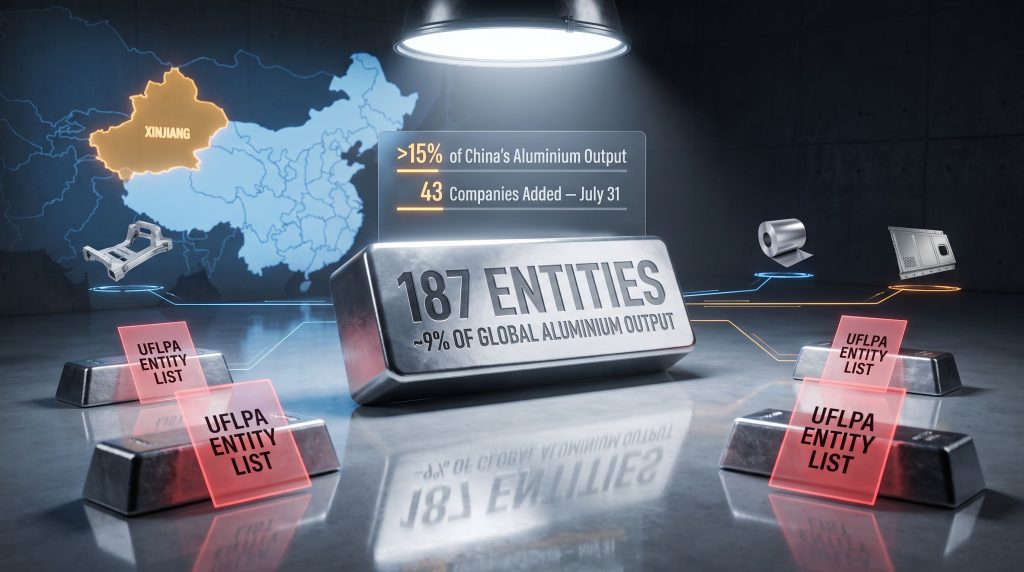
As of the most recent enforcement action on July 31, the total number of entities on the UFLPA list reached 187, following the addition of 43 Chinese companies spanning multiple sectors including aluminium, seafood, gold, copper, cotton, and garments.
Why Aluminium Became a Priority Enforcement Target
Aluminium's elevation to a high-priority enforcement sector under the UFLPA in July 2024 was not arbitrary. It reflected both the scale of Xinjiang's production footprint and the metal's deep integration into downstream industrial supply chains that feed directly into US-market goods.
According to a Human Rights Watch report published in February 2024, Xinjiang accounts for more than 15% of China's total aluminium output, which translates to approximately 9% of global aluminium production. That is a material share of a commodity that underpins automotive manufacturing, aerospace, consumer electronics, packaging, and renewable energy infrastructure.
What makes Xinjiang's aluminium sector particularly difficult to disentangle from forced labour concerns is the structural relationship between the region's smelting operations and its energy supply. The coal mines and power plants that supply electricity to Xinjiang's aluminium smelters have themselves been documented as participants in Chinese government labour transfer programmes targeting Uyghur and other Turkic Muslim minority populations. This means the forced labour exposure is not limited to the smelter floor — it extends upstream into the energy infrastructure that makes Xinjiang aluminium competitively priced in the first place.
This energy-labour nexus creates a traceability problem that goes beyond standard supply chain auditing. A company that traces its aluminium to a particular smelter and finds no direct labour violations may still face UFLPA exposure if that smelter's power inputs are linked to a listed coal or electricity entity. Furthermore, the broader impacts of tariffs on supply chains compound the already complex decisions manufacturers must navigate.
Xinjiang Aluminium: Key Figures at a Glance
| Metric | Figure |
|---|---|
| Xinjiang share of China's aluminium output | More than 15% |
| Xinjiang share of global aluminium output | Approximately 9% |
| Total UFLPA Entity List entities (post-July 2025) | 187 |
| New entities added in latest action | 43 companies |
| Xinjiang aluminium producers added in latest action | 5 major producers |
The Producers in the Crosshairs
The most recent enforcement wave added five major Xinjiang-based aluminium producers to the Entity List, continuing a pattern of escalating sector-specific targeting that began with earlier additions including Xinjiang Shenhuo Coal and Electricity, Xinjiang East Hope Nonferrous Metals, Xinjiang Joinworld, and affiliates of Tianshan Aluminum.
The common thread linking these entities is documented participation in state-administered labour transfer programmes. These programmes, which the Chinese government frames as vocational training and poverty alleviation initiatives, have been described by international human rights bodies and the US government as mechanisms for the coerced displacement and employment of ethnic minority populations.
A notable pattern in the progression of UFLPA additions is the movement further downstream in the aluminium value chain. Early enforcement actions focused heavily on upstream extraction and raw material processing. Successive waves have extended toward semi-fabricated products and processing operations, steadily expanding the compliance surface area for manufacturers. The steel and aluminum tariffs landscape has similarly shifted, with both trade law and forced labour enforcement reshaping sourcing decisions simultaneously.
The multi-sector character of the July 2025 addition — spanning aluminium alongside seafood, gold, copper, cotton, and garments — signals a broadening enforcement posture that is no longer confined to the textile origins that initially shaped the UFLPA's public profile.
The Downstream Exposure Problem: From Smelter to Finished Good
Aluminium's role in modern manufacturing is difficult to overstate. In the automotive sector alone, the metal appears in structural frames, engine blocks, wheel assemblies, suspension components, and, increasingly, as battery foil in electric vehicle packs. The lightweighting trend driving EV design has made aluminium even more central to vehicle architecture over the past decade.
The UFLPA's implications for the automotive sector are particularly acute because of how Chinese automakers and component suppliers sit between Xinjiang smelters and global original equipment manufacturers. A Tier 2 or Tier 3 Chinese supplier may source primary aluminium from Xinjiang, process it into a semi-fabricated component, and sell that component to a Tier 1 supplier who delivers it to a Western automaker. At no point in this chain does the final manufacturer necessarily have direct visibility into the metal's origin.
Under the UFLPA's rebuttable presumption standard, that lack of visibility is not a defence. It is precisely the compliance gap that the law is designed to close.
Industries Facing Immediate Supply Chain Review Pressure
- Automotive OEMs and their Tier 1 and Tier 2 supplier networks
- Electric vehicle manufacturers with aluminium-intensive battery and structural systems
- Consumer electronics producers reliant on extruded aluminium casings and heat sinks
- Aerospace and defence contractors sourcing high-purity aluminium alloys
- Renewable energy equipment makers using aluminium in solar framing and wind turbine components
- Infrastructure and construction material importers
What UFLPA Compliance Actually Demands
Meeting the rebuttable presumption standard is a multi-stage process that requires both operational investment and legal expertise. Companies that approach it as a one-time documentation exercise rather than an ongoing governance commitment are likely to find themselves underprepared when Customs and Border Protection scrutiny arrives.
A structured compliance pathway involves the following steps:
- Supply chain mapping: Identify all aluminium input streams across every tier of the supply chain and determine whether any pathway connects to Xinjiang-origin metal or entities on the UFLPA list.
- Documentary collection: Obtain mill certificates, smelter declarations, and chain-of-custody records capable of tracing metal origin to the point of primary production.
- Third-party verification: Commission independent audits that can validate labour conditions not only at the smelter level but also at upstream energy supplier operations, given the documented linkages between Xinjiang's power sector and labour programmes.
- CBP submission preparation: Compile evidentiary packages meeting the clear and convincing evidence standard required by US Customs and Border Protection for rebuttal of the forced labour presumption.
- Ongoing monitoring infrastructure: Implement systematic supplier screening protocols against the UFLPA Entity List, which is subject to periodic updates and expansion.
CBP holds authority to detain shipments at the border pending documentation review. Goods tied to listed entities that cannot satisfy the rebuttal standard face permanent exclusion from the US market, with no appeal available during the period goods remain in transit.
The next major ASX story will hit our subscribers first
The Enforcement Trajectory: Where the List Is Heading
The UFLPA Entity List has expanded substantially since its initial implementation, growing from a relatively narrow set of entities to 187 companies across multiple enforcement cycles spanning 2022 through 2025 and beyond. The pace and sector coverage of additions have both increased over time.
Aluminium's designation as a high-priority enforcement sector in mid-2024 preceded a measurable acceleration in aluminium-specific additions. The current trajectory suggests the list will continue to grow, with particular focus on entities involved in aluminium processing and semi-fabrication as enforcement moves further downstream. In addition, shifts in China's metals market are creating further pressure on global supply chains already contending with heightened regulatory scrutiny.
Projected Enforcement Scenarios
| Scenario | Trigger Condition | Likely Market Impact |
|---|---|---|
| Continued sectoral expansion | Additional NGO or government documentation of labour programmes | More aluminium processors added to the list |
| Downstream targeting | Evidence of listed-entity metal embedded in finished goods | OEM-level import detentions |
| Allied regulatory coordination | EU or UK adoption of equivalent import presumption laws | Global supply chain restructuring at scale |
| Rebuttal standard tightening | CBP policy revision raising evidentiary threshold | Substantially higher compliance costs for importers |
The Strategic Realignment Underway in Aluminium Sourcing
For manufacturers supplying the US market, the UFLPA enforcement trajectory creates a compelling case for accelerating supply chain diversification away from Xinjiang-origin aluminium. Compliant production capacity exists in Australia, Canada, Norway, Iceland, and parts of the Middle East, though it typically carries a cost premium over Xinjiang metal, which benefits from subsidised energy and, critics argue, artificially suppressed labour costs.
That cost differential is not static. As enforcement intensifies and the compliance costs associated with Xinjiang-origin metal rise, the effective price gap between compliant and non-compliant aluminium narrows. Companies that establish clean-chain sourcing relationships now may be positioning themselves for competitive advantage in US procurement contexts where supply chain transparency is becoming a prerequisite, not merely a preference. Understanding which aluminium market leaders are already adapting their sourcing strategies can help guide procurement decisions in this shifting environment.
There is also a first-mover dynamic worth considering. Manufacturers who complete rigorous origin-tracing exercises ahead of regulatory pressure tend to develop institutional knowledge and supplier relationships that are difficult for later movers to replicate quickly. In a market where CBP detentions can halt production lines, that preparedness has direct operational value.
The UFLPA Entity List is not a static compliance document. It is an actively expanding enforcement instrument with a pattern of escalating scope, sector depth, and geopolitical alignment. Treating it as a one-time audit exercise rather than a permanent governance obligation leaves companies structurally exposed to border disruptions they may have no practical ability to remedy in real time.
Frequently Asked Questions
What exactly does the UFLPA Entity List prohibit?
Goods produced wholly or in part by listed entities are legally presumed to have been made with forced labour and are barred from entering the United States unless the importer can rebut that presumption with clear and convincing evidence. The law places the entire burden of proof on the importer, not the government.
How many companies are currently on the list?
Following the July 31 enforcement action that added 43 Chinese companies, the total number of entities on the UFLPA Entity List stands at 187.
Why is Xinjiang's aluminium sector specifically in focus?
Xinjiang produces more than 15% of China's aluminium output and roughly 9% of global supply. Its aluminium industry, along with the coal and power infrastructure supplying it, has been structurally linked to government-administered labour programmes targeting Uyghur and other Turkic Muslim minority populations.
Which industries carry the greatest immediate exposure?
Automotive manufacturing and electric vehicle production face the sharpest near-term compliance pressure, given aluminium's central role in both traditional vehicle architecture and EV battery systems. Consumer electronics, aerospace, and renewable energy equipment sectors also carry material exposure.
Is it possible to continue importing aluminium with Xinjiang connections?
Only if the importer can satisfy the rebuttable presumption standard by providing documented, independently verifiable evidence that the specific goods were produced without forced labour involvement at any point in the supply chain. In practice, this is an exceptionally high bar that few importers have successfully cleared for goods with direct Xinjiang origin.
What should companies prioritise immediately?
Initiating a comprehensive supply chain mapping exercise to identify any Xinjiang-linked aluminium exposure is the essential first step. This should be followed by engagement with qualified trade compliance counsel and systematic assembly of origin documentation across all aluminium input streams.
Disclaimer: This article contains forward-looking analysis and scenario projections based on current regulatory trends. It does not constitute legal or financial advice. Companies with specific UFLPA compliance questions should consult qualified trade counsel. Statistics cited reflect data available at the time of publication, including Human Rights Watch findings published in February 2024 and publicly available US government enforcement records.
Want to Know Which ASX Miners Are Positioned to Benefit From the Aluminium Supply Chain Shift?
As manufacturers accelerate their move away from Xinjiang-origin aluminium toward compliant producers in Australia and beyond, Discovery Alert's proprietary Discovery IQ model scans ASX announcements in real time, delivering instant alerts on significant mineral discoveries — including aluminium and base metals — so subscribers can identify actionable opportunities before the broader market reacts. Explore historic discoveries and their exceptional market returns, then begin your 14-day free trial to position yourself ahead of the next major find.