August 24, 2026
The Hidden Metallurgical Chokepoint Threatening US Defence Readiness
When defence planners assess supply chain risk, the conversation typically gravitates toward rare earth elements, semiconductor materials, or advanced battery chemistries. Yet one of the most consequential vulnerabilities sitting inside the US defence industrial base involves a metal most people associate with beverage cans and window frames. The structural fragility surrounding the US high-purity aluminium supply chain for defence is not about aluminium being scarce globally. It is about a specific, defence-critical grade of that metal being available from a vanishingly small number of qualified sources, with the majority of that supply concentrated in a single foreign country.
Understanding why this matters requires moving past commodity-level thinking and into the metallurgical realities that govern modern weapons systems. Furthermore, the broader context of critical minerals demand adds additional urgency to an already fragile situation.
When big ASX news breaks, our subscribers know first
What Separates High-Purity Aluminium from the Standard Commodity
The Metallurgical Threshold That Defines Defence Suitability
Standard commercial-grade aluminium, the type traded in bulk on the London Metal Exchange and used across construction and packaging, typically contains iron and silicon impurities that are acceptable for general industrial applications. High-purity aluminium, by contrast, is refined to reduce these contaminants to exceptionally low concentrations, often achieving purity levels of 99.99% or higher, a specification denoted industrially as 4N grade, with some defence and aerospace applications requiring 5N grade at 99.999% purity.
This distinction is not cosmetic. At the elevated temperatures, pressures, and mechanical stresses that military platforms experience, trace impurities in aluminium alloys can propagate micro-fractures, compromise fatigue resistance, and reduce corrosion performance. The weight-to-strength ratios that make aluminium alloys indispensable to aerospace engineering are only achievable consistently when the feedstock meets these extreme purity thresholds.
Defence applications that depend on this grade of aluminium include:
- Structural bulkheads and airframe components for fifth-generation fighter aircraft including the F-35
- Advanced armour plate systems for platforms such as the Joint Light Tactical Vehicle
- Missile body and aerospace structural assemblies where thermal and mechanical tolerances are exceptionally tight
- Space platform and satellite structural components requiring ultra-low contamination feedstock
Why Total US Aluminium Output Is a Misleading Metric
The United States produces millions of tonnes of aluminium annually when measured across primary smelting and secondary recycled output. This figure, often cited in broad discussions of industrial capacity, obscures a critical reality: the vast majority of this production does not meet the purity specifications required for defence-grade alloy manufacturing.
A facility capable of producing standard-grade primary aluminium at 99.7% purity is not interchangeable with a facility producing 4N or 5N high-purity aluminium feedstock. The processing infrastructure, energy intensity, refining chemistry, and quality certification requirements differ substantially. This distinction between aggregate aluminium availability and qualified defence-grade HPA supply is where the real vulnerability lies.
Mapping the Actual Supply Chain: From Smelter to Fighter Jet
How the Chain Is Structured and Where It Fractures
| Supply Chain Stage | Key Players | Strategic Risk Level |
|---|---|---|
| Primary HPA-grade smelting | Century Aluminum, Hawesville KY | High — limited domestic HPA-grade capacity |
| HPA processing and alloy conversion | Arconic (Davenport Works), Constellium, Kaiser Aluminum | High — very few qualified processors |
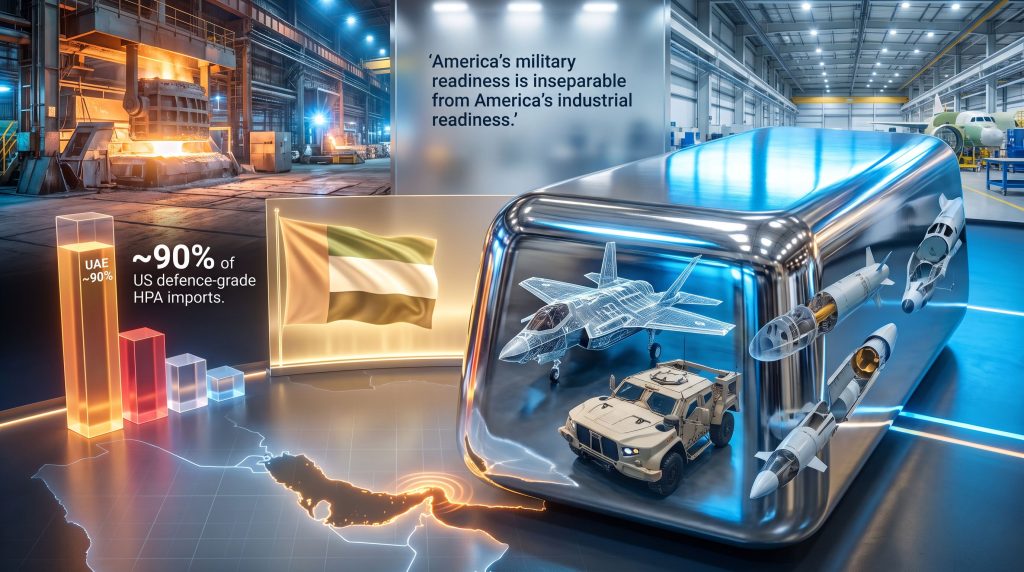
| Primary import feedstock | UAE (Emirates Global Aluminium) | Critical — estimated 90% of US defence-grade HPA imports |
| Defence manufacturing end-use | Aerospace OEMs, armoured vehicle manufacturers | Fully dependent on upstream concentration |
Century Aluminum's Hawesville, Kentucky facility remains one of the few domestic production nodes capable of producing primary aluminium approaching the purity levels required for defence feedstock, with output achievable around the 99.9% threshold that can serve as a starting point for further refining. However, the facility operates under significant energy cost pressure, and its capacity does not represent a complete substitute for the ultra-refined grades that defence processors actually require.
Downstream, companies including Arconic, Kaiser Aluminum, and Constellium perform the conversion work that transforms refined aluminium ingot into finished defence alloy products. Critically, not every aluminium processor can step into this role. Defence-grade qualification involves extensive certification, material traceability requirements, and process controls that take years to establish. The Arconic Davenport Works facility in Iowa has received support under the Defense Production Act Title III framework, which authorises the federal government to encourage expansion of domestically critical production capabilities. This represents targeted support for an existing processing facility, not a resolution to the upstream smelting capacity gap.
The UAE Dependency: How 90 Percent Became the Number That Haunts Pentagon Planners
Emirates Global Aluminium and the Concentration Problem
Estimates from industry sources indicate that the UAE accounts for approximately 90% of high-purity aluminium imports channelled into US defence-related manufacturing. Emirates Global Aluminium emerged as the dominant supplier to US processors not through deliberate strategic planning by Washington, but through a set of commercial and industrial advantages that made UAE-sourced HPA the most cost-competitive option available. These include access to subsidised energy, large-scale smelting infrastructure, and the metallurgical capability to produce refinery-grade aluminium output that meets defence feedstock specifications.
Material sourced from EGA flows to US processors including Kaiser Aluminum, Constellium, and Arconic, where it is converted into the specific alloy products used by defence manufacturers. The chain is functional under normal conditions. However, the problem is its concentration: a single foreign supply node feeding the majority of a nation's defence-critical material requirements.
The March 2026 Strike: When the Theoretical Became Real
On March 28, 2026, Iranian missile strikes targeted aluminium infrastructure in the Gulf region, hitting facilities operated by Emirates Global Aluminium and Aluminium Bahrain. While repairs proceeded ahead of initial projections and some production resumed, the episode exposed exactly the scenario that defence planners had been modelling. The Strait of Hormuz, through which Gulf aluminium exports transit, represents a geographic chokepoint that concentrates freight risk and creates insurance cost escalation during regional conflict periods.
A sustained multi-month disruption to EGA's production capacity would leave US defence processors facing a supply gap with no domestic alternative capable of substituting at equivalent scale or purity grade. This is not a hypothetical scenario — it is a risk that materialised in partial form during the March 2026 strikes and was then compounded by Hormuz transit uncertainty.
In addition, the US aluminium tariffs landscape adds further complexity to an already strained procurement environment, creating additional cost pressures across the supply chain.
The 2022 Closure: The Structural Gap That Predates the Crisis
The present vulnerability was significantly deepened by an event that received limited public attention at the time. In 2022, the United States effectively lost its last major large-scale domestic producer of high-purity aluminium when the facility ceased operations due to uncompetitive energy costs. Aluminium smelting is among the most energy-intensive industrial processes in existence, and rising US power costs eroded the economics of maintaining domestic HPA production at a competitive price point.
The closure was not sudden. It reflected a multi-year trend of energy cost disadvantage against Gulf producers who access power at structurally lower rates. What the 2022 closure removed was the domestic buffer that would have provided US defence manufacturers with a fallback supply source during precisely the kind of geopolitical disruption that occurred in March 2026.
Rebuilding this capacity from a standing start is not a near-term proposition. Industry analysis consistently points to development timelines of seven to ten or more years for new HPA-capable smelting capacity, combined with capital investment requirements measured in billions of dollars and the fundamental need to resolve the energy cost disadvantage that drove the original closures.
What the Pentagon War Game Actually Found
The July 2025 Institute for Defense Analyses Simulation
The two-day war game exercise held in July 2025, overseen by the Institute for Defense Analyses, constructed a scenario combining simultaneous import disruption during large-scale geopolitical conflict with domestic production outages. Participants were asked to assess how the US aluminium industrial base could respond under those conditions. High-purity aluminium emerged as one of the most exposed segments of the entire defence supply chain assessment.
The four critical vulnerabilities that participants identified were:
- Import concentration risk — near-total dependence on a single foreign supply region for defence-grade HPA feedstock
- Domestic capacity gap — the absence of scalable US-based HPA production following the 2022 closure
- Energy cost structural barrier — aluminium smelting economics that make domestic restarts commercially unviable at current power prices without significant structural intervention
- Sub-tier supplier opacity — limited visibility into the lower-tier suppliers supporting defence aluminium processing operations
Bill Greenwalt, a Senior Fellow at the American Enterprise Institute and a former Deputy Undersecretary of Defense for Industrial Policy, characterised the situation as a significant alert for defence departments to rigorously examine supply chains worldwide to identify points of potential vulnerability to attack or deliberate disruption. His framing captures the shift in how this issue is now being treated: from an abstract procurement consideration to an active strategic risk.
Uday Patel, Senior Research Manager for global aluminium markets at Wood Mackenzie, offered a particularly sobering assessment of near-term options, indicating that the market is currently without a ready solution and that outcomes will depend heavily on the volume of material that remains in existing inventory pipelines. This insight underscores a point not widely appreciated outside specialist circles: the US defence HPA supply situation is currently being managed through pipeline inventory, not through structural supply security.
Charles Johnson, President and CEO of the Aluminum Association, reinforced the connection between industrial capability and national defence readiness, reflecting the association's sustained advocacy for strengthening domestic aluminium production and processing infrastructure.
Policy Responses: What Is Being Done and Where the Gaps Remain
Defense Production Act Title III and Its Limits
The most concrete policy instrument currently in use is the Defense Production Act Title III mechanism, which has been deployed to support expanded HPA processing capacity at Arconic's Davenport Works in Iowa. This represents a meaningful near-term action, but it operates on the downstream processing side of the supply chain rather than addressing the upstream smelting gap. Processing expansion is valuable, but if the high-purity feedstock feeding those processors remains overwhelmingly imported from a single country, the fundamental concentration risk persists.
Tariff Policy: A Price Signal Without a Complete Solution
Elevated US aluminium import tariffs create a price floor that theoretically improves the economics of domestic production. In practice, the gap between a better price signal and the actual capital commitment and energy infrastructure required to establish new HPA-grade smelting capacity is substantial. Industry observers across multiple analytical frameworks have reached a consistent conclusion: tariff intervention alone cannot restore competitive domestic HPA production without accompanying solutions to the energy cost problem that drove the 2022 closures.
Strategic Reserve Proposals: A Bridge, Not a Fix
War game participants recommended constructing strategic reserves of high-purity aluminium as a disruption buffer. This approach, modelled conceptually on frameworks used for other critical materials, would provide a 12 to 24-month supply cushion during which longer-term capacity solutions could be developed. The limitations are real: aluminium stockpiling involves storage logistics, inventory management considerations, and the fact that reserves address disruption timing rather than structural supply security.
The next major ASX story will hit our subscribers first
Comparing HPA Risk Against the Broader Critical Minerals Landscape
| Critical Material | Primary Import Dependency | Domestic Capacity Status | Strategic Reserve Exists? |
|---|---|---|---|
| High-purity aluminium | UAE (~90% of defence imports) | Minimal post-2022 | Under discussion |
| Rare earth elements | China (dominant) | Limited but growing | Partial |
| Gallium and Germanium | China (dominant) | Very limited | Limited |
| Titanium sponge | Japan, Kazakhstan | Limited domestic | Yes (partial) |
The structural parallel between high-purity aluminium and rare earth supply chains is instructive. Both involve materials that are not globally scarce in their commodity form, but where the processing qualification and purity requirements create concentration bottlenecks. The key difference is that the rare earth supply conversation has received sustained public and policy attention for over a decade, while the HPA vulnerability operated largely below the public radar until conflict events in 2026 forced it into sharper focus.
This reflects what might be described as a commodity perception trap: because aluminium is globally abundant and widely produced, policymakers historically underweighted the defence-specific purity and qualification requirements that transform a commodity metal into a strategic material. The 2022 closure happened without triggering the kind of strategic alarm that a comparable loss of domestic rare earth processing capacity would have generated.
Long-Term Pathways to Supply Security
Scenario Comparison: Four Potential Trajectories
Managed diversification involves maintaining the UAE supply relationship while developing secondary import sources from allied producers in Canada, Australia, and Norway. This reduces single-source concentration without requiring the multi-year capital investment of domestic capacity reconstruction, but it does not address the fundamental absence of domestic production capability.
Domestic capacity rebuild would combine DPA Title III support, energy cost intervention, and long-term defence procurement contracts to incentivise new smelting investment. Emerging low-carbon aluminium smelting technologies, which reduce energy intensity and offer environmental co-benefits, could play a role in shifting the green metals economics of domestic production over a longer horizon. The realistic timeline for this pathway remains seven to ten or more years even with full policy commitment.
Strategic reserve construction provides a transitional buffer measured in months of supply security rather than structural resilience, but it could be implemented on a faster timeline than capacity rebuilding and would protect against near-term disruption scenarios while longer-term solutions are pursued.
Allied industrial base integration represents perhaps the most underexplored option. Leveraging Five Eyes and NATO allied aluminium production capacity through formal defence industrial base agreements could provide supply diversification at a qualified, defence-grade specification level without requiring equivalent domestic capital investment. According to the Aerospace Industries Association, no formal allied HPA supply agreement at defence-grade specification currently exists, representing a genuine policy gap.
Frequently Asked Questions: US High-Purity Aluminium Supply Chain for Defence
What makes high-purity aluminium different from standard aluminium?
High-purity aluminium is refined to remove iron and silicon impurities to exceptionally low concentrations, typically achieving 99.99% or 99.999% purity. These grades enable the production of specialised alloys with the structural, fatigue, and corrosion performance required for military aircraft, armoured vehicles, missiles, and space systems.
Why is approximately 90% of US defence-grade HPA imported from the UAE?
The UAE, primarily through Emirates Global Aluminium, offers a combination of subsidised energy access, large-scale smelting infrastructure, and the metallurgical capability to produce refinery-grade aluminium that meets defence feedstock specifications at commercially competitive prices. These advantages accumulated over time as US domestic energy costs made equivalent domestic production uneconomical.
What happened to US domestic high-purity aluminium production?
The United States effectively lost large-scale domestic HPA production in 2022 when its last major producer ceased operations due to rising energy costs. Century Aluminum's Hawesville, Kentucky facility continues to produce primary aluminium approaching relevant purity thresholds, but does not represent a complete substitute for the scale and grade of the capacity that was lost.
How does the Defense Production Act Title III apply to HPA?
DPA Title III authorises the federal government to support expansion of domestically critical production capabilities. It has been used to back expanded HPA processing at Arconic's Davenport Works in Iowa. This supports downstream conversion capacity but does not resolve the upstream smelting gap.
Can aluminium tariffs alone restore domestic HPA capacity?
Industry analysis consistently indicates that tariffs improve price economics for domestic producers but are insufficient on their own to overcome the capital investment requirements, energy cost disadvantages, and multi-year development timelines associated with new HPA-grade smelting capacity in the United States.
The Strategic Imperative: What Needs to Change
The US high-purity aluminium supply chain for defence presents a concentrated and structurally fragile risk profile that is now operating in an environment of demonstrated geopolitical disruption rather than theoretical planning. Several conclusions emerge clearly from the combined weight of the July 2025 war game findings and the March 2026 Gulf strike events:
- Near-total dependence on a single foreign supply region for approximately 90% of defence-grade HPA imports represents a systemic vulnerability that commodity-level aluminium production statistics cannot mask
- The 2022 domestic production closure removed the buffer that would have provided resilience during precisely the disruption scenarios that subsequently materialised
- Current policy responses including DPA Title III support and tariff measures address specific segments of the problem without resolving the fundamental domestic capacity gap
- The most realistic near-term path to improved supply security involves a combination of allied industrial base agreements, strategic reserve construction, and downstream processing expansion, pursued in parallel while longer-term domestic capacity investments are developed
- The timeline for full domestic HPA capacity restoration is measured in years and decades, not months, making interim measures critically important
This article is intended for informational and analytical purposes only. It does not constitute investment, financial, or procurement advice. Forward-looking assessments regarding supply chain timelines, policy outcomes, and geopolitical scenarios involve inherent uncertainty and should not be treated as definitive forecasts.
Want to Stay Ahead of Critical Mineral Supply Shifts Affecting ASX Markets?
Discovery Alert's proprietary Discovery IQ model delivers real-time alerts on significant ASX mineral discoveries — including those tied to critical and strategic materials like high-purity aluminium and rare earths — cutting through complex data to surface actionable opportunities the moment they emerge. Explore historic discoveries and their market returns to understand the scale of opportunity, then begin your 14-day free trial to position yourself ahead of the broader market.