August 24, 2026
The Chokepoint That Controls the World's Energy Pulse
Every few years, a single body of water reminds the global economy of its own fragility. The Strait of Hormuz, a narrow passage barely 33 kilometres wide at its tightest point, carries the weight of roughly 20% of all oil and LNG traded globally. It connects the Persian Gulf's vast hydrocarbon reserves to refineries and power stations across Asia, Europe, and beyond. When that corridor functions smoothly, markets barely notice it. When it doesn't, the consequences ripple through fuel prices, inflation rates, and shipping contracts on every continent.
The current standoff between the United States and Iran has placed Hormuz squarely back at the centre of global energy risk. Iran blacklists 45 tankers transiting the strait, and this marks a structural shift in how Tehran is choosing to exercise leverage, moving from periodic threats to an institutionalised regulatory mechanism with real enforcement teeth. Understanding what this means requires looking beyond the headline number and examining the architecture of what Iran has built, who it targets, and why the market response extends well beyond crude oil price trends.
When big ASX news breaks, our subscribers know first
Iran Blacklists 45 Tankers: The Mechanics of a Maritime Power Play
What the Blacklist Actually Contains
Iran's newly established Persian Gulf Strait Authority issued the list of 45 vessels, asserting that each had violated its rules governing transit through the strait. Those rules require ships to obtain Iranian clearance before passage and to pay for navigation and security services that Tehran has unilaterally declared mandatory. The vessels on the list span the full spectrum of hydrocarbon cargo:
- Oil tankers carrying crude
- LNG carriers transporting liquefied natural gas
- LPG tankers moving liquefied petroleum gas
- Refined product vessels carrying processed fuels
Threatened penalties for listed vessels include financial fines, physical detention within the strait, and outright confiscation of cargo. Perhaps more consequential is the secondary mechanism: any vessel conducting a ship-to-ship transfer with a blacklisted tanker risks being added to the list itself.
This secondary targeting is not an accident. Ship-to-ship transfers are the operational backbone of shadow tanker networks that have historically been used to move sanctioned crude around conventional tracking and enforcement systems. By explicitly threatening to extend the blacklist to STS counterparties, according to the Times of Israel, Iran is effectively attempting to quarantine entire vessel ecosystems, not just individual ships.
The Shipping Companies Caught in the Crosshairs
What makes this blacklist geopolitically significant beyond the Iran-U.S. bilateral dynamic is who appears on it. Vessels linked to Gulf Arab state energy producers, historically adversaries of Tehran, are reportedly named alongside Western-affiliated carriers.
| Shipping Entity | Regional Affiliation | Reported Connection |
|---|---|---|
| Bahri | Saudi Arabia | Vessels reportedly named on the list |
| ADNOC Logistics & Services | UAE / Abu Dhabi | Vessels reportedly named on the list |
| Navig8 Tankers | ADNOC subsidiary | Vessels reportedly named on the list |
The inclusion of ADNOC-linked entities alongside Saudi Arabia's Bahri creates a multi-directional pressure environment. Iran is not simply targeting Western shipping; it is placing state-linked vessels from its regional rivals directly in the enforcement crosshairs. For the UAE, this creates a painful dual exposure: ADNOC-linked vessels face blacklisting while the country simultaneously depends on Hormuz for the overwhelming majority of its export capacity.
The Legal Fault Line Beneath the Dispute
Under international maritime law, specifically the United Nations Convention on the Law of the Sea (UNCLOS) Article 38, all vessels enjoy the right of transit passage through international straits used for navigation. This right is explicitly designed to be unimpeded and non-suspendable. Iran's domestic regulatory overlay, requiring prior clearance and service payments, directly contradicts this framework.
Furthermore, as detailed in the Strait of Hormuz overview, the waterway's strategic importance has long made it a focal point for competing territorial and legal claims between Iran and the international community.
The creation of the Persian Gulf Strait Authority is not merely an administrative act. It represents Iran's attempt to transform a previously ad hoc enforcement posture into a formalised institutional claim over one of the world's most legally contested maritime corridors.
The tension between Tehran's domestic legal claims and internationally recognised transit rights is unlikely to be resolved through any near-term legal process. What matters in the short term is whether Iran enforces the blacklist physically, not whether its legal argument prevails in an international tribunal.
Hormuz Traffic Collapse: Reading the Data Carefully
The Numbers Tell a Fragmented Story
Traffic data emerging from the standoff presents a striking divergence depending on the measurement methodology used.
| Metric | Data Point | Source |
|---|---|---|
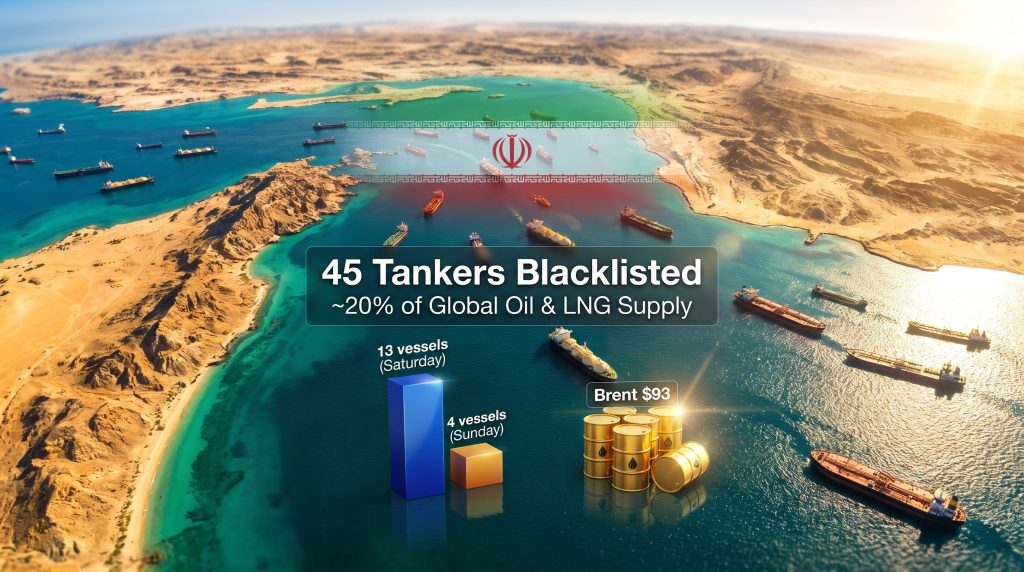
| Commodity vessel crossings (Sunday) | 4 vessels | Kpler / Reuters |
| Commodity vessel crossings (Saturday) | 13 vessels | Kpler / Reuters |
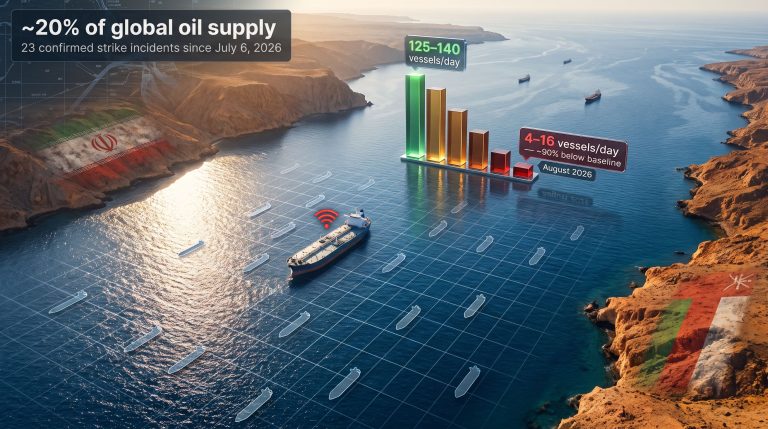
| AIS-detected traffic vs. pre-conflict levels | Approximately 90% below normal | UK Maritime Trade Operations |
| Seven-day average oil outflow (U.S. estimate) | Above 8 million barrels per day | U.S. Energy Secretary Chris Wright |
| Pre-crisis Hormuz share of global oil and LNG supply | Approximately 20% | Industry baseline |
The gap between AIS-detected traffic figures and the U.S. government's stated outflow volume of over 8 million barrels per day is substantial and deserves scrutiny. AIS tracking relies on vessels broadcasting their position data. Vessels operating without transponders, those deliberately disabling their AIS systems, and ships using alternative identification approaches will not appear in those counts. This is precisely how shadow fleet operations function.
The 4-Million-Bpd Shadow Highway
Reporting has identified a significant volume of crude moving through Hormuz via vessels operating entirely outside conventional tracking infrastructure. Estimates suggest this shadow corridor accounts for roughly 4 million barrels per day of throughput, a parallel system that has grown substantially as sanctions regimes have tightened over recent years.
This shadow infrastructure represents a fascinating and underappreciated dimension of the Hormuz crisis. Iran's blacklist mechanism, by targeting STS transfers specifically, is designed to disrupt not just visible, commercially conventional shipping but the informal networks that have quietly sustained large crude volumes through the strait. The blacklist is, in effect, a regulatory attack on the shadow fleet's operating model, adding fresh urgency to the broader trade war oil impact that has already been reshaping energy markets throughout 2025.
Iranian Crude Supply: A Market Already Adjusting Before the Announcement
Pre-Emptive Buyer Behaviour
One of the more revealing dynamics of the current standoff is how quickly Asian buyers moved to reduce Iranian crude exposure before any formal announcement of Washington's next sanctions round. Bloomberg reported that Iranian crude shipments to Asian buyers had already collapsed in the period leading up to the expected U.S. measures, a pattern that reflects sophisticated risk management by refiners rather than panic selling.
Chinese independent refiners, commonly referred to as teapots, have historically absorbed large volumes of discounted Iranian crude that larger, compliance-constrained buyers avoided. Their pivot away from Iranian barrels signals that even the most price-sensitive segment of the Asian refining market has concluded that the supply risk now outweighs the discount advantage.
The Supply Reshuffling Playing Out in Real Time
The displacement of Iranian barrels is triggering a complex multi-directional reshuffle across global supply chains:
- Chinese teapot refiners are actively securing Iraqi and Russian crude as substitutes, contributing to increased competition for those barrels
- India faces intensifying competitive pressure from Chinese buyers in the Russian crude market, complicating its own energy diversification calculus
- Tajikistan has pivoted toward Iranian supply as Russian fuel availability has contracted, adding a Central Asian dimension that rarely features in mainstream Hormuz analysis
- European refiners are absorbing Saudi crude rerouted through Mediterranean corridors as producers seek alternatives to Red Sea and Hormuz transit routes
If Iranian crude exports were to fall to near-zero for a sustained 90-day period, global spare capacity held by OPEC+ members would need to absorb approximately 1.5 to 2 million barrels per day of displaced supply. That scenario would test Saudi Arabia's and the UAE's ability to ramp output rapidly without triggering deeper confrontation at the very chokepoint their exports depend upon.
Disclaimer: The above scenario is speculative and intended to illustrate potential market dynamics. Actual outcomes will depend on geopolitical developments, OPEC+ decisions, and market conditions that cannot be predicted with certainty.
Market Consequences: Beyond the Crude Price Headline
Oil Benchmarks and the Risk Premium Architecture
Benchmark prices have responded to the sustained uncertainty at Hormuz with a persistent geopolitical risk premium layered on top of fundamental supply-demand dynamics. Consequently, WTI and Brent futures have both reflected the escalating tension through sustained price elevation:
- Brent crude topped $93 per barrel amid the U.S.-Iran impasse, reflecting sustained risk premium accumulation
- WTI crude traded in the $85 to $87 per barrel range with elevated volatility directly tied to Hormuz developments
- Murban crude, the UAE's benchmark, reached four-month highs as ADNOC curbed supply to Asian buyers
- Supertanker day rates hit record highs as vessel scarcity intensified across Gulf operational zones
Shipping and Insurance Markets Under Structural Pressure
The blacklist's legal architecture creates a new category of commercial risk that insurance markets have not previously been required to price at this scale. War risk premiums for Gulf-transiting vessels have surged considerably. The secondary listing mechanism, threatening vessels that conduct STS transfers with blacklisted tankers, means underwriters must now assess not just a vessel's own status but the entire counterparty ecosystem it operates within.
Lloyd's of London and specialist marine insurers face a compounding exposure problem: the longer the standoff persists, the broader the potential quarantine zone becomes as STS counterparties accumulate.
Consumer Energy Costs: The Downstream Impact
| Country or Region | Exposure Channel | Near-Term Risk |
|---|---|---|
| Japan | High Gulf crude dependence; imports at all-time highs | Elevated import costs and inflation pressure |
| United Kingdom | Energy bill projections linked to Iran conflict scenario | Consumer bills rising toward a 3-year high |
| India | Iranian supply disruption plus Russian crude competition | Supply diversification urgency intensifying |
| China | Teapot refiner supply gap; substitution costs rising | Refining margin compression |
| Europe | Saudi crude rerouted via Mediterranean to avoid Houthis | Increased freight costs passed through to refiners |
Gulf Producer Responses: Adaptation Under Pressure
Rerouting and Export Diversification
Gulf producers are responding to the Hormuz uncertainty with a combination of logistics adaptation and aggressive export activity. Saudi Arabia has significantly increased crude shipments via Mediterranean routes, using shuttle tanker networks moving northward to bypass Houthi-controlled Red Sea corridors. Saudi Aramco has provided full September oil allocations to three European refiners, reinforcing its commitment to supply reliability during a period of regional instability.
ADNOC has issued nine spot crude tenders since June, a pace that signals an aggressive effort to maintain export volumes despite the regional operational environment. In addition, the disruption is also placing renewed scrutiny on global LNG supply chains, given how significantly Hormuz features in LNG transit volumes for key Asian importers.
UAE's Acute Dual Exposure
The UAE's position in this crisis is uniquely uncomfortable. Iranian missiles falling near its coastline prompted Abu Dhabi to freeze trade with Tehran bilaterally, adding a diplomatic dimension to the shipping confrontation. Simultaneously, ADNOC-linked vessels appearing on Iran's blacklist creates direct commercial risk for the state energy infrastructure of a country that cannot practically reroute the bulk of its crude exports away from Hormuz.
The next major ASX story will hit our subscribers first
Three Scenarios for the Next 90 Days
Scenario A: Contained Regulatory Standoff
Iran administers the blacklist through fines and official communications but stops short of physically detaining vessels. Shipping companies accept new transit cost structures or seek Iranian clearance. Brent stabilises in the $90 to $95 range with a persistent but manageable risk premium.
Scenario B: Kinetic Escalation
Iran boards or detains a blacklisted vessel. A U.S. or allied naval response follows. Hormuz traffic declines further and LNG spot prices spike sharply. Marine insurance markets effectively price Gulf transits as uninsurable at standard commercial rates.
Scenario C: Diplomatic Resolution
Back-channel negotiations between Washington and Tehran produce a temporary transit framework. Oman, which has historically served as a discreet mediation channel between the two governments, facilitates a face-saving arrangement. The Persian Gulf Strait Authority suspends active enforcement and tanker traffic gradually recovers over four to six weeks, compressing risk premiums.
The Structural Lesson Hormuz Is Teaching Energy Markets
The current standoff is accelerating a conversation that has been building for years about the systemic vulnerability of a global energy system that remains deeply dependent on a single maritime passage roughly 33 kilometres wide. The crisis is creating genuine commercial urgency around investment in alternative pipeline infrastructure, overland export routes, and diversified logistics chains.
Gulf producers are being forced to treat export logistics as a strategic variable rather than an operational assumption. However, the episode also reinforces that an oil price rally driven by geopolitical disruption carries fundamentally different market dynamics than one driven by demand growth. For energy markets globally, the episode reinforces that geopolitical risk premiums are not temporary distortions to be discounted; they are a structural feature of a world where one-fifth of all oil and LNG supply moves through a waterway that any regional power with sufficient maritime capability can contest.
This article is intended for informational purposes only and does not constitute financial, investment, or trading advice. Energy market conditions and geopolitical developments evolve rapidly. Readers should conduct their own research and consult qualified advisers before making any investment decisions.
Want to Stay Ahead of ASX Mineral Discoveries Amid Shifting Energy Markets?
Discovery Alert's proprietary Discovery IQ model delivers real-time alerts on significant ASX mineral discoveries, instantly translating complex data across more than 30 commodities into clear, actionable insights for both short-term traders and long-term investors — explore Discovery Alert's discoveries page to see how historic finds have generated substantial returns, and begin your 14-day free trial today to secure a market-leading edge.