
August 6, 2026
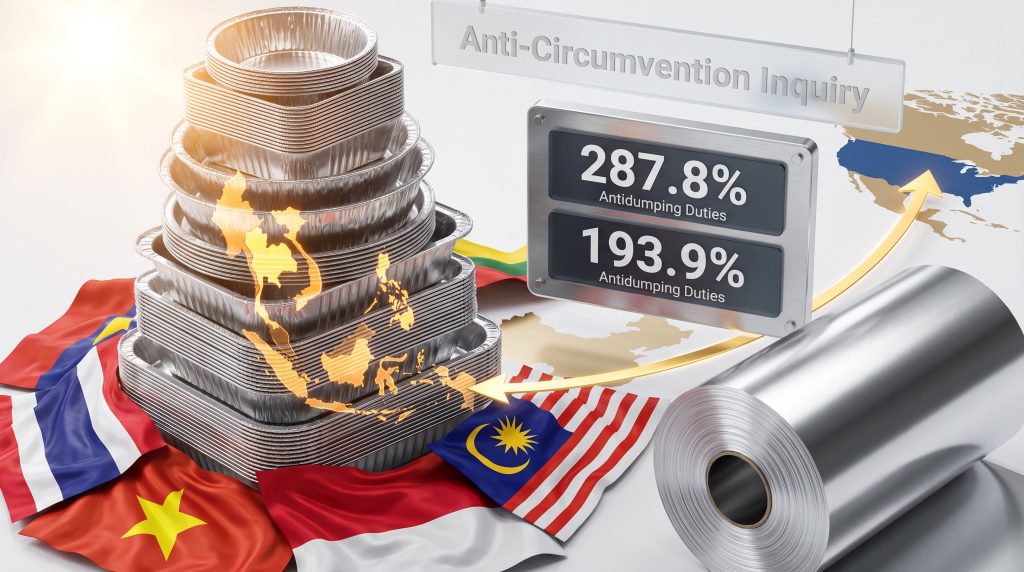
When Trade Walls Go Up, Supply Chains Find New Doors
Global trade enforcement has rarely operated in a straight line. History shows that every time a significant tariff barrier is erected around a product category, the commercial incentive to route production through lower-tariff jurisdictions intensifies almost immediately. This dynamic is not unique to aluminium, but the speed and geographic breadth with which it has unfolded across the disposable aluminium container sector offers a compelling case study in how modern trade circumvention works, and how enforcement agencies are scrambling to keep pace.
The US anti-circumvention inquiry into aluminium containers made with Chinese foil, now extended to Indonesia and Malaysia, represents the fourth distinct enforcement action in a sequence that began in 2024. Understanding why this escalation was structurally inevitable, and what it means for importers, manufacturers, and supply chain operators, requires looking beneath the tariff numbers to the underlying economic logic driving production relocation decisions. Furthermore, the broader implications of tariff-driven supply chain shifts are now reshaping how global producers plan their sourcing strategies.
When big ASX news breaks, our subscribers know first
Why Duty Rates of This Magnitude Create Circumvention Pressure
When the US Department of Commerce finalised antidumping duty rates against Chinese disposable aluminium container producers in March 2025, the figures imposed were not marginal. Unspecified Chinese entities were assigned a rate of 287.8%, while more than 20 named Chinese companies faced duties of 193.9%. At these levels, the landed cost of Chinese-origin containers becomes commercially unviable for most US importers almost overnight.
The arithmetic is straightforward. A product with a factory gate price of $1.00 per unit, once subjected to a 287.8% antidumping duty, carries a duty burden of $2.88 before any additional countervailing or customs charges are applied. For high-volume, price-sensitive consumer packaging, margins cannot absorb a cost structure of that kind.
"Duty rates approaching 200% to 300% do not simply discourage trade, they redirect it. The financial incentive to relocate assembly operations to a duty-free third country becomes larger than the cost of establishing an entirely new manufacturing base, making anti-circumvention enforcement a near-inevitable follow-on to any trade order of this magnitude."
This is precisely the economic environment that makes third-country transshipment so commercially attractive and so difficult to contain. In addition, US aluminium tariffs have compounded these pressures significantly across downstream product categories.
The Legal Mechanism: How Anti-Circumvention Inquiries Function
What US Trade Law Actually Permits Commerce to Investigate
Under US trade law, the Department of Commerce holds authority to determine whether goods assembled or processed in a third country using inputs originating from a country subject to antidumping or countervailing duty orders should be treated as if they were directly exported from that country. The statutory basis sits within the Tariff Act of 1930, as amended, and gives Commerce latitude to extend the scope of existing trade orders when it finds that third-country processing is minor or insignificant relative to the total manufacturing process.
The critical legal test is whether the transformation occurring outside China constitutes genuine manufacturing or merely cosmetic processing designed to alter the product's country-of-origin designation on paper.
The Five-Factor Assessment Commerce Applies
Commerce does not apply a single threshold test. Instead, it evaluates a constellation of factors before reaching a circumvention finding:
| Assessment Factor | What Commerce Examines |
|---|---|
| Capital investment levels | Scale of manufacturing infrastructure in the third country |
| Research and development activity | Whether meaningful product development occurs locally |
| Value-added proportion | Share of total product value contributed outside China |
| Nature of processing | Assembly, stamping, and rebranding versus substantive transformation |
| Origin of inputs | Source of raw materials, tooling, and intellectual property |
A critical and often underappreciated element of this assessment is the intellectual property dimension. When the IP framework governing product design, tooling specifications, and manufacturing processes remains anchored to Chinese operations, it signals to Commerce that the third-country facility is operating as an extension of the Chinese production model rather than as an independent manufacturer.
Retroactive Duty Application: The Enforcement Deterrent Most Importers Overlook
One of the more consequential, and less publicly discussed, aspects of US anti-circumvention enforcement is the retroactive duty provision. Commerce has indicated for the Indonesia and Malaysia inquiries that duties may be applied to shipments that entered the US before the formal announcement of the investigation. The Aluminum Foil Container Manufacturers Association (AFCMA) has actively urged Commerce to deploy this provision to discourage what the industry refers to as pre-announcement surge shipping, where importers accelerate shipments once they anticipate an inquiry is imminent.
For importers currently holding inventory sourced from Indonesian or Malaysian facilities using Chinese-origin aluminium foil, this retroactive exposure represents a material financial risk that balance sheet planning may not yet reflect.
A Chronological Map of Escalating Enforcement
The geographic progression of anti-circumvention enforcement in this product category follows a recognisable pattern that trade compliance specialists sometimes describe as whack-a-mole enforcement dynamics. Each new inquiry prompts production relocation to the next available low-duty jurisdiction, which in turn triggers another enforcement action.
| Milestone | Date | Significance |
|---|---|---|
| Original Chinese container AD/CVD orders | 2024 | Established duty framework and created circumvention incentives |
| Antidumping duty rates imposed | March 2025 | 193.9% to 287.8% applied to Chinese producers |
| First anti-circumvention inquiry (Thailand and Vietnam) | July 11, 2025 | Third-country assembly using Chinese foil confirmed as enforcement target |
| Second inquiry wave | February 2026 | Enforcement net extended to additional manufacturing locations |
| Indonesia and Malaysia country-wide inquiries opened | August 6, 2026 | Broadest geographic scope to date; country-wide rather than company-specific |
| Expected preliminary determinations | Early 2027 | First formal findings on Indonesia and Malaysia allegations |
| Expected final rulings | Mid-2027 | Definitive duty liability determination for affected supply chains |
The shift from company-specific probes to country-wide investigations for Indonesia and Malaysia is a significant procedural escalation. Rather than targeting individual facilities that may have come to Commerce's attention, a country-wide inquiry casts a net over all producers in those jurisdictions, placing the compliance burden on any exporter to demonstrate that their production is outside the inquiry's scope.
What the Indonesia and Malaysia Inquiries Specifically Allege
The Alleged Operational Model Under Scrutiny
The circumvention allegations filed by AFCMA on July 1, 2026, describe a production model in which the substantive manufacturing decisions, inputs, and intellectual property all originate in China, while physical assembly occurs in Southeast Asia to obtain a non-Chinese origin designation. The alleged model involves the following structure:
- Raw material inputs: Chinese-origin aluminium jumbo rolls serving as the primary feedstock
- Equipment and tooling: Container-forming machinery sourced from Chinese manufacturers
- Intellectual property: Product design and process IP tied to Chinese parent operations
- Local activity: Limited to assembly, stamping, and rebranding of finished containers
- Export destination: Finished disposable aluminium containers shipped to the US market
Under this alleged arrangement, the value-add occurring within Indonesia or Malaysia would be minimal relative to the total product value, and the nature of local processing would not constitute substantive transformation under Commerce's legal framework.
Why Country-Wide Scope Matters
The decision to open country-wide rather than company-specific investigations into Indonesia and Malaysia carries strategic significance beyond the immediate case. A country-wide investigation creates a presumption that all exports of the covered product from those countries are subject to scrutiny, shifting the burden of proof. Consequently, producers in Indonesia and Malaysia who wish to demonstrate that their operations fall outside the inquiry's scope must actively engage with Commerce's questionnaire process, submit detailed production data, and accept verification procedures.
This procedural design increases the cost and complexity of compliance for all exporters in the targeted countries, not just those operating alleged circumvention models.
Step-by-Step: How the Anti-Circumvention Inquiry Process Works
Understanding the procedural timeline helps importers and supply chain operators plan around enforcement milestones:
-
Petition filing and review: AFCMA and member companies submit circumvention allegations with supporting evidence. Commerce reviews for regulatory sufficiency.
-
Formal inquiry initiation: Commerce publishes notice in the Federal Register, formally opening the country-wide investigation and triggering the statutory clock.
-
Customs data collection: Within five days of formal opening, Commerce obtains US Customs and Border Protection import data to identify companies for questionnaire distribution.
-
Respondent selection and questionnaire distribution: Commerce selects representative respondents and issues detailed production questionnaires requesting cost, sourcing, and process data.
-
Suspension of liquidation: All relevant entries are placed in suspension, meaning final duty liability cannot be determined until Commerce reaches its determination.
-
Preliminary determination: Required within 150 days of Federal Register publication. For the August 2026 Indonesia and Malaysia inquiries, this places preliminary findings in early 2027.
-
Final determination: Required within 300 days of Federal Register publication, placing final rulings approximately mid-2027. Cash deposit rates apply immediately upon a positive circumvention finding.
The next major ASX story will hit our subscribers first
The Broader Transshipment Challenge Across Aluminium Product Categories
The disposable container enforcement sequence does not exist in isolation. It reflects a wider pattern of Chinese aluminium products seeking US market access through intermediary manufacturing steps in third countries across multiple product categories. The US-China trade war impacts have accelerated this dynamic considerably, pushing producers to seek creative routing arrangements that regulators are increasingly primed to challenge.
The Aluminum Association has separately raised concerns about Chinese aluminium sheet being routed into the US through Mexican production facilities engaged in beverage-can and beer container manufacturing. This parallel enforcement concern signals that US trade authorities and domestic industry groups are examining transshipment risks across the full spectrum of aluminium downstream products, not only the container segment.
The geographic progression observed in the container sector follows a trajectory that trade enforcement specialists view as structurally predictable:
China (Original Orders) → Thailand & Vietnam (July 2025)
→ Second Wave Countries (February 2026) → Indonesia & Malaysia (August 2026)
→ Taiwan (Potential Next Target)
Industry counsel for AFCMA signalled publicly in 2025 that the association intended to push Commerce toward aggressive anti-circumvention enforcement targeting any third-country location being used as a transit hub, specifically naming Indonesia, Malaysia, and Taiwan as jurisdictions of concern. The August 2026 inquiries are consistent with that publicly stated enforcement posture.
Supply Chain Risk Assessment: What Importers Need to Evaluate Now
For businesses currently sourcing disposable aluminium containers from Indonesian or Malaysian facilities, the practical risk calculus involves several distinct exposure categories:
| Scenario | Likely Outcome | Duty Exposure |
|---|---|---|
| Third-country assembly using Chinese foil, minimal local value-add | Circumvention finding likely | 193.9% to 287.8% AD duties |
| Third-country production with substantial local transformation | Circumvention finding unlikely | No additional duty liability |
| Shipments entered before inquiry announcement | Retroactive duty application possible | Subject to Commerce discretion |
| Products using non-Chinese aluminium foil inputs | Outside scope of inquiry | No duty exposure from this action |
The most critical supply chain variable for importers to examine is the origin of aluminium foil inputs. Products manufactured in Indonesia or Malaysia using non-Chinese aluminium foil are structurally outside the scope of these specific inquiries. However, importers should be cautious about relying on supplier representations regarding input origin without independent verification, given the enforcement environment.
The Aluminium Market Context: Volatility Compounds Compliance Pressure
These enforcement actions are unfolding against a backdrop of elevated volatility in global aluminium markets. Furthermore, the broader effects of tariffs on metals imports have added another layer of uncertainty for producers navigating international procurement decisions. Shipping disruptions connected to Middle East naval activity have reintroduced supply chain uncertainty for producers dependent on international freight routes.
Aluminium foil manufacturers sourcing from multiple origin points face compounding cost pressures from both commodity price fluctuations and the trade compliance overhead now associated with Southeast Asian production.
For domestic US container manufacturers, the combination of high import duties on Chinese product and active anti-circumvention enforcement in Southeast Asia represents the most protective trade environment the sector has experienced in decades. However, the practical benefit depends on the speed and outcome of enforcement proceedings, and the mid-2027 timeline for final rulings means that uncertainty persists throughout the period.
Frequently Asked Questions: US Anti-Circumvention Inquiry Into Aluminium Containers Made With Chinese Foil
What products are covered by these inquiries?
The investigations cover disposable aluminium containers, pans, trays, and lids manufactured from flat-rolled aluminium, regardless of shape, size, or surface finish. The defining eligibility factor is whether Chinese-origin aluminium foil is used as the primary input in third-country assembly operations.
Which countries are currently under investigation?
As of August 2026, active inquiries cover Thailand, Vietnam, and the newly opened country-wide investigations into Indonesia and Malaysia. Taiwan has been publicly identified by industry as a potential future enforcement target.
What antidumping duty rates currently apply to Chinese producers?
The Department of Commerce imposed antidumping duties of 287.8% on unspecified Chinese entities and 193.9% on more than 20 named Chinese companies, following material injury investigations completed by March 2025.
Can duties apply retroactively to existing shipments?
Yes. Commerce has indicated that duties may be applied retroactively to shipments that entered the US before the formal announcement of the inquiry. AFCMA has advocated for active use of this provision to deter pre-announcement surge shipping.
How long does the inquiry process take?
Preliminary determinations are required within 150 days of Federal Register publication, and final determinations within 300 days. For the August 2026 Indonesia and Malaysia inquiries, preliminary findings are expected in early 2027 and final rulings around mid-2027.
Who filed the circumvention allegations?
AFCMA, together with member companies Reynolds Consumer Products, Durable Packaging International, and D&W Fine Pack, filed the formal circumvention allegations on July 1, 2026.
Looking Ahead: Enforcement Trajectory Through Mid-2027 and Beyond
The structural question hanging over the entire US anti-circumvention inquiry into aluminium containers made with Chinese foil is whether enforcement can keep pace with production mobility. Each new country-wide investigation adds compliance complexity for importers and raises sourcing costs for distributors, but also creates a window of enforcement lag during which new circumvention pathways may be established in jurisdictions not yet under scrutiny.
"The trajectory of enforcement across this product category suggests that any third-country production model relying on Chinese aluminium foil as its primary input will face sustained regulatory scrutiny regardless of geographic location. The procedural tools Commerce has deployed, particularly country-wide scope and retroactive duty provisions, are designed to reduce the commercial attractiveness of serial relocation strategies."
For investors and supply chain operators, the key monitoring milestones over the next 12 to 18 months are the preliminary determinations expected in early 2027 and the final rulings anticipated by mid-2027. A positive circumvention finding for Indonesia and Malaysia would effectively close two of the remaining low-tariff pathways for Chinese-origin aluminium containers reaching US consumers.
A negative finding, however, would invite immediate reassessment of the enforcement framework's limitations. The interplay between tariffs and commodity markets will remain a defining variable in how US Customs and Border Protection and Commerce calibrate their enforcement posture going forward.
The domestic US industry, represented by AFCMA and its member companies, has invested significant legal and organisational resources in building a comprehensive enforcement perimeter. Whether that perimeter holds, or whether production continues migrating to jurisdictions outside the current inquiry scope, will determine the long-term structure of the US disposable aluminium container import market through the remainder of the decade. Importers and trade counsel would be well advised to monitor the Federal Register closely for formal Commerce determinations as the 2027 milestones approach.
This article is intended for informational purposes only and does not constitute legal or financial advice. Readers with specific trade compliance questions related to antidumping, countervailing duty, or anti-circumvention proceedings should consult qualified legal counsel. Duty rate references and procedural timelines are based on publicly available information current as of the date of publication and are subject to change following formal Department of Commerce determinations.
Want To Know Which Commodity Discoveries Could Reshape Supply Chains Next?
While trade enforcement actions continue to redraw the map for aluminium and other critical materials, Discovery Alert's proprietary Discovery IQ model delivers real-time alerts on significant ASX mineral discoveries, translating complex commodity data into actionable investment insights the moment they hit the market. Explore historic discoveries and their returns to understand the scale of opportunity, then start your 14-day free trial at Discovery Alert to position yourself ahead of the next major find.