
August 7, 2026
The Hidden Complexity Reshaping Modern Gold Mining
The story of gold extraction over the past century is, in many ways, a story of diminishing simplicity. The earliest large-scale operations targeted ore bodies where gold sat in a relatively free state, amenable to straightforward crush-grind-leach processing. Those deposits are not gone entirely, but the pipeline of new, high-grade, easily processable discoveries has thinned considerably. What remains in abundance are ore bodies of a fundamentally different character: sulphide-hosted, mineralogically complex, and stubbornly resistant to conventional recovery methods.
This structural shift is not a temporary anomaly. It reflects a long-term geological reality that the global mining industry is now navigating in earnest. The response from project developers and technology providers is defining the next chapter of gold production, and the Albion Process at Rox Resources' Youanmi Gold Project in Western Australia is one of the clearest illustrations of where that chapter is heading. Understanding the mineral exploration importance of such technological decisions helps contextualise why this project commands serious attention.
When big ASX news breaks, our subscribers know first
Why Refractory Gold Has Long Been Left in the Ground
The Mineralogical Lock-Up Problem
To understand why certain gold deposits resist conventional processing, it helps to understand how gold occurs within sulphide minerals. In refractory ores, gold particles are physically encapsulated within the crystal lattice of minerals such as pyrite and arsenopyrite. These grains can be extraordinarily fine, sometimes measured in nanometres, meaning that even aggressive grinding cannot expose them sufficiently for cyanide leaching to work efficiently.
The cyanide molecule, which forms the backbone of conventional gold leaching, cannot penetrate the sulphide mineral matrix in any practical sense. Without prior destruction of that matrix through an oxidative process, a large proportion of the gold simply passes through the circuit unrecovered. In semi-refractory ore systems, where a portion of the gold is accessible via standard leaching but a significant fraction is locked within sulphides, applying conventional cyanidation alone leaves substantial value on the table.
A meaningful portion of the world's identified gold resource base falls into the refractory or semi-refractory category. Many of these deposits remain undeveloped not because of insufficient grade, but because the perceived capital intensity and operational complexity of treatment options have historically made them difficult to finance and justify.
The Youanmi Ore System: A Mixed-Character Challenge
The Youanmi Gold Project, located in the Murchison region of Western Australia, hosts both free-milling and sulphide-hosted gold mineralisation. The free-milling component can be treated conventionally, but the sulphide-hosted, semi-refractory fraction requires a fundamentally different approach before cyanide leaching can extract gold at commercially meaningful recovery rates.
This kind of dual-character ore system is more common than many investors appreciate. The challenge for project developers is not simply choosing a technology for one ore type, but designing a processing flowsheet that handles both effectively without the capital and operating costs ballooning to uneconomic levels. The selection process at Youanmi involved comprehensive metallurgical testwork across multiple processing routes before the Albion Process and IsaMill combination was identified as the preferred solution.
What the Albion Process Actually Does: A Technical Framework
Two-Stage Architecture and Why It Works
The Albion Process is an atmospheric oxidative leaching technology developed to unlock refractory sulphide concentrates without the need for high-pressure processing infrastructure. Its effectiveness rests on a two-stage architecture that addresses the fundamental challenge of sulphide encapsulation through a sequence of physical and chemical actions.
| Stage | Technology | Core Function |
|---|---|---|
| Stage 1 | IsaMill Ultrafine Grinding | Reduces flotation concentrate to approximately 10-12 µm particle size |
| Stage 2 | Atmospheric Oxidative Leaching | Oxidises sulphide minerals at atmospheric pressure, liberating encapsulated gold |
| Stage 3 | Conventional CIL Recovery | Extracts and recovers liberated gold using standard carbon-in-leach processing |
The IsaMill is a horizontally oriented, stirred-media grinding device that produces a tightly controlled and narrow particle size distribution. This precision matters enormously. When concentrate particles are ground to approximately 10-12 micrometres, the reactive surface area of the sulphide material increases by orders of magnitude compared to conventionally ground material. It is this dramatically expanded surface area that makes atmospheric oxidation viable.
The Atmospheric Pressure Advantage: More Than a Cost Story
The ability to conduct oxidative leaching at atmospheric pressure rather than in a pressurised autoclave system is the defining commercial differentiator of the Albion Process. Pressure oxidation (POX) systems must withstand operating temperatures exceeding 200 degrees Celsius and pressures above 2,000 kilopascals. The engineering requirements for those conditions translate directly into higher capital expenditure, more complex construction programmes, extended commissioning timelines, and ongoing operational demands that require highly specialised expertise.
| Evaluation Criterion | Albion Process | Pressure Oxidation (POX) |
|---|---|---|
| Operating Pressure | Atmospheric | High pressure (>2,000 kPa) |
| Capital Cost | Lower | Significantly higher |
| Construction Complexity | Moderate | High |
| Ramp-Up Speed | Rapid | Extended |
| Partial Oxidation Flexibility | Yes | Limited |
| Operational Risk Profile | Lower | Higher |
| Commercial Track Record | Established globally | Established globally |
Partial Oxidation: The Underappreciated Efficiency Lever
One of the less widely understood capabilities of the Albion Process is its ability to apply partial oxidation, treating only as much of the sulphide content as is necessary to achieve target gold liberation. Fixed-intensity oxidation systems, by contrast, tend to apply a uniform level of treatment regardless of ore variability, which can result in over-processing and unnecessarily elevated reagent and energy consumption.
In an ore system like Youanmi, where mineralogical composition shifts across different mining zones, the ability to adjust oxidation intensity to match incoming ore characteristics provides a meaningful operational flexibility advantage. This dial-in capability directly manages operating costs without sacrificing gold recovery performance — a combination that significantly improves the economics of processing variable ore. Furthermore, interpreting gold drill results from variable ore systems underscores precisely why this flexibility is so commercially valuable.
The Youanmi Flowsheet: From Ore to Gold
Step-by-Step Processing Sequence
-
Mining and primary comminution — Ore is mined and undergoes crushing and initial grinding to liberate sulphide mineral particles from the host rock.
-
Froth flotation — Sulphide-hosted gold mineralisation is concentrated via flotation, producing a high-grade sulphide concentrate while the free-milling fraction proceeds separately to conventional processing.
-
IsaMill ultrafine grinding — The flotation concentrate is fed into the IsaMill, which reduces particle size to approximately 10-12 µm, massively increasing reactive surface area.
-
Atmospheric oxidative leaching — The ultrafine ground concentrate enters the Albion Process oxidation reactors, where sulphide minerals are broken down at atmospheric pressure, physically exposing encapsulated gold to subsequent leaching.
-
Carbon-in-leach (CIL) gold recovery — The oxidised slurry is processed through a standard CIL circuit where cyanide leaching followed by activated carbon adsorption extracts and concentrates the now-liberated gold.
What the Metallurgical Numbers Show
The testwork programme conducted ahead of technology selection delivered results that provided strong confidence in the Albion Process approach at Youanmi. In addition, the consistency of these outcomes across multiple testwork phases reinforced the technical soundness of the flowsheet design.
| Testwork Phase | Gold Extraction Result |
|---|---|
| Initial Metallurgical Testwork | 92.2% average gold extraction |
| Bulk Sample Testwork | Up to 95.8% gold extraction |
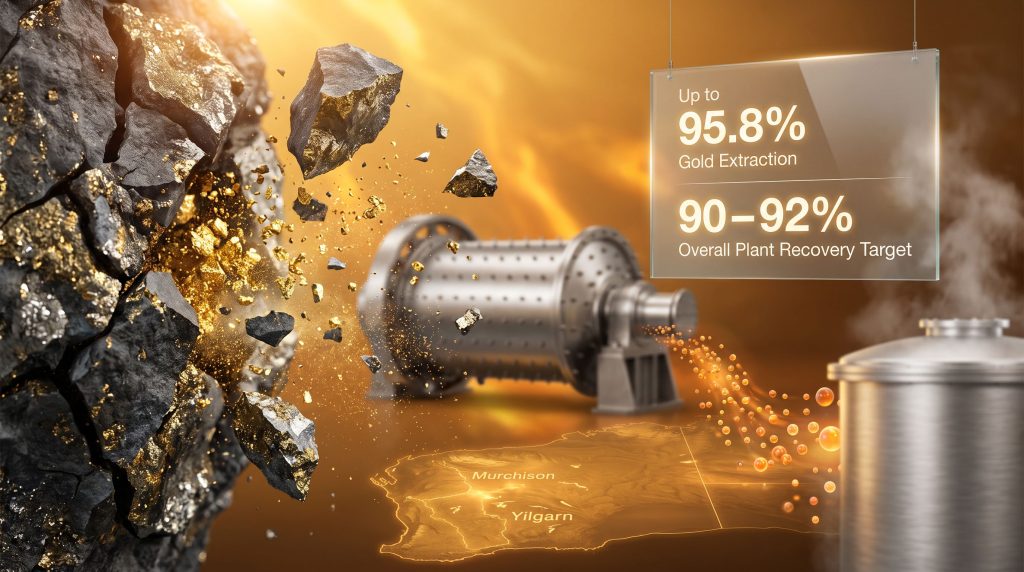
| Overall Plant Recovery Target | 90-92% |
These figures represent a substantial step-change in performance compared to what conventional cyanidation alone could achieve on the semi-refractory fraction of the Youanmi ore system. The consistency of results across both initial and bulk sample testwork phases gave the project team technical confidence that the technology selection was sound across the range of ore variability expected in the deposit.
Why This Technology Selection Matters Beyond Youanmi
A Large and Underleveraged Resource Opportunity
The commercial significance of the Albion Process at Rox Resources' Youanmi Gold Project extends well beyond the specifics of a single Western Australian operation. A substantial inventory of gold deposits globally remains stranded in undeveloped status specifically because their refractory character has historically made them economically marginal under conventional processing assumptions.
The economic threshold for developing refractory gold is being recalibrated by lower-capital, lower-complexity processing technologies. Projects that were previously archived as technically feasible but economically uninviting are being reassessed as these processing solutions mature and establish commercial track records. Consequently, the broader gold exploration trends point firmly toward refractory deposits becoming an increasingly central focus for developers worldwide.
The gap between identified refractory gold resources and economically developed refractory gold projects represents one of the most significant latent value pools within the broader gold sector. Practical, scalable, and financeable processing solutions are the critical missing variable separating resource from reserve.
Western Australia's Structural Advantage in Refractory Gold Development
Western Australia, and particularly the Murchison and broader Yilgarn geological provinces, hosts a significant concentration of sulphide-hosted and refractory gold mineralisation. The state's combination of established mining infrastructure, a deep pool of technical expertise, and a well-understood regulatory environment makes it a logical hub for demonstrating next-generation refractory processing technologies at commercial scale.
Successful operations in this jurisdiction carry disproportionate reference value. When a technology demonstrates consistent metallurgical performance and operational reliability in Western Australia, the signal that sends to developers and financiers considering comparable deposits in other jurisdictions is significant. Youanmi has the potential to serve exactly that function for the Albion Process. The gold sector challenges associated with financing refractory projects make this kind of reference-point operation particularly important.
Ramp-Up Speed as a Financial Variable
One aspect of the Albion Process that deserves specific attention from a project economics perspective is the speed with which the technology can be commissioned and ramped to nameplate production. The atmospheric operating conditions and comparatively straightforward process design mean that the path from commissioning completion to steady-state production can be compressed relative to more complex pressure-based systems.
For project developers, this is not merely an operational convenience. Every day between commissioning completion and nameplate production represents financing costs accumulating against a project not yet generating full revenue. A faster ramp-up directly improves project net present value and reduces the period of maximum financial exposure — factors that carry real weight in investment committee assessments. The definitive feasibility study process for Youanmi, furthermore, validated these ramp-up projections within a rigorous engineering framework.
Frequently Asked Questions: Albion Process at Youanmi
What types of ore does the Albion Process treat at Youanmi?
The Albion Process at Youanmi is specifically configured to treat the sulphide-hosted, semi-refractory component of the project's ore system. This is the fraction where gold is encapsulated within sulphide minerals and cannot be efficiently recovered by conventional cyanide leaching without prior oxidative treatment.
What gold recovery rates has testwork demonstrated?
Metallurgical testwork has produced gold extraction results of 92.2% in initial programmes, with bulk sample testing reaching up to 95.8%. The overall plant recovery target for the operation is set at approximately 90-92%. The PFS for Youanmi further confirmed the high-grade potential underpinning these recovery targets.
How does the Albion Process differ from pressure oxidation?
The Albion Process combines ultrafine grinding with atmospheric oxidative leaching, eliminating the requirement for high-pressure, high-temperature autoclave infrastructure. This results in materially lower capital costs, reduced operational complexity, faster commissioning, and more flexible partial oxidation capability compared to pressure oxidation systems.
What particle size does the IsaMill achieve at Youanmi?
The IsaMill grinds flotation concentrate to approximately 10-12 µm, with the broader target range sitting between 8-20 µm depending on ore characteristics. This particle size is necessary to generate sufficient reactive surface area for efficient atmospheric oxidation.
Is the Albion Process a proven commercial technology?
The Albion Process has been successfully deployed at multiple commercial operations globally, spanning gold, zinc, and polymetallic projects. Its commercial track record provides a level of technical de-risking that is significant for project financing and investor confidence.
The next major ASX story will hit our subscribers first
Key Takeaways
-
The Youanmi Gold Project contains a meaningful semi-refractory sulphide ore component requiring oxidative pre-treatment before conventional gold recovery methods can operate efficiently.
-
The Albion Process, combining IsaMill ultrafine grinding with atmospheric oxidative leaching, was selected following extensive metallurgical testwork and a multi-route processing evaluation.
-
Testwork has demonstrated gold extraction rates of up to 95.8%, with an overall plant recovery target of 90-92%.
-
The technology's atmospheric operating conditions, lower capital cost profile, flexible partial oxidation capability, and rapid commissioning characteristics were decisive factors in the selection.
-
The Albion Process at Rox Resources' Youanmi Gold Project reflects a broader industry inflection point: the progressive recalibration of what constitutes an economically developable refractory gold asset, driven by the maturation of practical, lower-complexity processing technologies.
-
This article contains references to forward-looking metallurgical performance targets and project development timelines. These are based on testwork results and technical assessments and are subject to change as the project progresses through further engineering and development stages. Nothing in this article constitutes financial advice.
Ready to Invest in the Next Major Gold Discovery?
Discovery Alert's proprietary Discovery IQ model delivers real-time alerts the moment significant ASX mineral discoveries are announced, transforming complex geological data into actionable investment insights for both short-term traders and long-term investors — explore Discovery Alert's dedicated discoveries page to understand how historic mineral discoveries have generated substantial returns, and begin a 14-day free trial to position yourself ahead of the broader market.