
June 12, 2026
The Hidden Fault Lines Beneath a Weather Event
When a cyclone makes landfall, the immediate story is one of wind speeds and infrastructure damage. But for globally integrated commodity supply chains, the more consequential story unfolds in the weeks and quarters that follow, as operational disruptions at critical processing nodes ripple outward through pricing, contracts, and market confidence. The alumina industry offers a particularly instructive case study in how physical vulnerabilities, structural cost pressures, and geopolitical forces can converge simultaneously to stress-test even the largest producers in the world.
Alcoa lower Australian alumina shipments after Cyclone Narelle has become one of the more closely watched supply-side developments in the base metals space, and for good reason. What appears on the surface as a weather-driven setback reveals, under closer examination, a web of pre-existing structural challenges that the cyclone simply forced into the open.
When big ASX news breaks, our subscribers know first
Why Western Australia's Alumina Sector Sits at a Global Crossroads
The Anatomy of a Critical Supply Node
Australia is not merely a significant alumina producer. It is the backbone of global supply. The country accounts for a substantial share of the world's refined alumina output, and Western Australia hosts several of the largest refining operations on the planet. Among these, Alcoa's Pinjarra facility stands out as one of the highest-capacity alumina refineries in operation globally, with a nameplate processing capacity of 4.7 million metric tons per year.
Alumina, or aluminum oxide, is the essential intermediate product in the aluminum value chain. Produced from bauxite ore through the Bayer process, it serves as the direct feedstock for aluminum smelters, which use electrolytic reduction via the Hall-Heroult process to extract primary aluminum metal. The conversion ratio is significant: approximately two tonnes of alumina are required to produce one tonne of primary aluminum, meaning any meaningful disruption at the refining stage creates disproportionate pressure on downstream smelter operations.
The sensitivity is amplified further when examining third-party alumina sales, the volumes sold to external smelter customers rather than consumed internally. These external shipments function as the clearest real-time signal of operational health. When they fall, the market notices immediately. Furthermore, understanding the role of bauxite production leaders helps contextualise just how critical Australia's position is within the global supply hierarchy.
What Makes Alumina Refining So Operationally Fragile
Alumina refining is among the most energy-intensive industrial processes in existence. The Bayer process requires large volumes of steam, heat, and chemical reagents to dissolve bauxite ore, precipitate aluminum hydroxide, and calcine it into alumina. This energy dependency creates a structural exposure that most other manufacturing industries simply do not face to the same degree.
In practical terms, this means that any interruption to a refinery's primary energy supply, whether from infrastructure failure, weather events, or fuel market disruptions, does not simply reduce output proportionally. It triggers a cascading sequence of cost escalations:
- Emergency procurement of alternative fuel sources at spot prices
- Reduced throughput efficiency as process temperatures and pressures fluctuate
- Increased wear on process equipment from non-standard operating conditions
- Potential contractual penalties linked to delivery shortfalls with smelter customers
- Elevated reagent consumption as process chemistry becomes less stable
This cost structure is precisely why the cyclone's impact on WA gas supply generated such a significant financial impact at Pinjarra in a relatively short timeframe.
Cyclone Narelle: Quantifying the Damage Beyond the Headlines
From Weather Event to Supply Shock
Cyclone Narelle struck Western Australia in March, and its most consequential operational effect on Pinjarra was not direct physical damage to the refinery itself, but the severing of LNG supply infrastructure that the plant depends on for its energy operations. This distinction matters considerably for understanding the nature of the disruption.
LNG-dependent refineries carry a structural single-point-of-failure risk. Unlike facilities with diversified energy inputs or on-site fuel storage capable of bridging extended supply interruptions, refineries reliant on pipeline or terminal-based LNG delivery are exposed to upstream infrastructure vulnerability. When that infrastructure is compromised, the downstream processing operation cannot simply switch fuels overnight.
The quantified impact at Pinjarra was substantial:
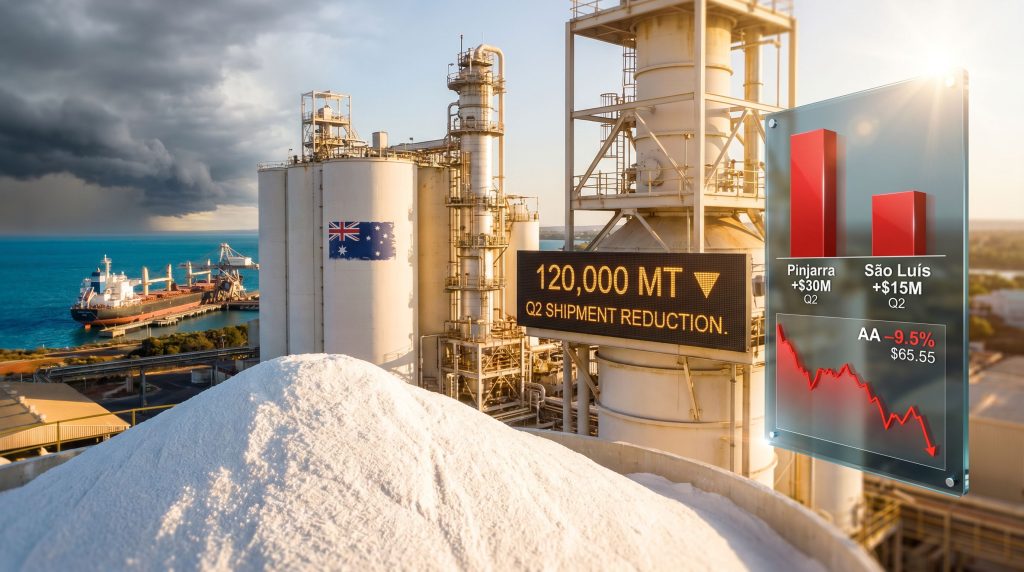
- Approximately 120,000 metric tons of reduced alumina shipments in the second quarter compared to the first quarter
- An estimated $30 million increase in second-quarter production costs attributable directly to the disruption
To contextualise that cost figure: at current alumina spot prices, which have remained at levels that compress refinery margins, a $30 million cost spike at a single facility in a single quarter represents a severe deterioration in contribution margins. For operations already operating in low-margin or loss-making territory, this kind of cost shock pushes the segment deeper into negative financial territory rather than merely reducing profitability.
The Brazil Dimension: A Separate Cost Pressure From a Different Origin
Concurrent with the Australian disruption, Alcoa's Sao Luis alumina refinery in Brazil faced its own cost escalation. Conflict-driven disruptions in the Middle East tightened regional energy markets, flowing through into elevated fuel costs at the Brazilian operation. The estimated additional fuel cost burden at Sao Luis reached approximately $15 million for the second quarter.
Unlike the Pinjarra situation, Sao Luis remained operationally profitable through this period. However, the margin buffer is narrowing, and the dual pressure of rising energy costs and weak alumina pricing creates a compressing dynamic that limits the facility's ability to absorb further shocks.
The table below summarises the concurrent disruption factors affecting Alcoa's refining operations:
| Disruption Factor | Location Affected | Estimated Q2 Cost Impact | Nature of Risk |
|---|---|---|---|
| Cyclone Narelle (LNG supply cut) | Pinjarra, Western Australia | +$30 million | Weather-driven, temporary |
| Middle East conflict (fuel costs) | Sao Luis, Brazil | +$15 million | Geopolitical, ongoing |
| Bauxite quality degradation | Western Australia | Structural cost inflation | Long-term, unresolved |
| Low alumina spot prices | Global (all refineries) | Margin compression | Market cycle, uncertain duration |
The Structural Headwinds That Predate the Cyclone
Declining Bauxite Quality: The Slower-Moving Crisis
While Cyclone Narelle generated the most visible short-term cost impact, it would be analytically incomplete to treat it as the primary problem facing Alcoa's Western Australian operations. Beneath the weather narrative lies a more persistent and structurally significant challenge: deteriorating bauxite feed quality.
Bauxite ore quality is measured primarily by its available alumina content, its reactive silica levels, and its moisture profile. As higher-grade ore zones within established mining areas become depleted, refineries are increasingly processing lower-quality feed material. This creates a compounding cost burden across multiple dimensions:
- Higher chemical reagent consumption, particularly caustic soda (sodium hydroxide), which is used to dissolve aluminum-bearing minerals from the ore
- Increased energy requirements to process lower-grade material through the digestion and clarification stages
- Greater volumes of residue (bauxite residue, commonly known as red mud) generated per tonne of alumina produced, increasing disposal costs and environmental management complexity
- Reduced overall process efficiency, meaning more input is required to produce the same output volume
This structural degradation in feed quality is a long-term profitability concern that cannot be resolved by weather normalisation or short-term operational adjustments. It represents a fundamental shift in the cost economics of established refinery operations as their associated mining areas mature.
The Alumina Price Environment: Timing Could Not Be Worse
The intersection of rising input costs and a weak alumina price environment is the core financial tension in this situation. Alumina spot prices have remained at levels that leave limited margin for cost absorption, particularly for operations with above-average cost structures.
When a segment-level CFO publicly describes a business unit as positioned to be loss-making at the current operating environment, it carries significant signalling weight in commodity-sector equities. In cyclical industries, management language around segment profitability often precedes formal strategic reviews, asset rationalisation decisions, or accelerated cost-reduction programs. The characterisation of Western Australian refineries as deeply challenged amid this combination of pressures was not interpreted by markets as routine operational commentary. Consequently, analysts tracking aluminum and alumina markets have noted the broader implications for sector valuations.
China as the Swing Buyer: A Structural Pattern With Long-Term Consequences
How Middle East Disruptions Redirected Alumina Flows Toward China
One of the more strategically significant aspects of the current situation is the redirection of alumina cargoes originally contracted for Middle East aluminum smelters. Conflict-related production constraints at those smelting operations have reduced their near-term alumina requirements, creating a cargo displacement problem for producers with contracted volumes they need to place elsewhere.
Alcoa's response has been to facilitate the redirection of these cargoes primarily toward Chinese buyers. This is operationally pragmatic given China's structural position as the world's largest aluminum producer and its well-established role as an absorber of spot and diverted alumina supply. However, the strategic implication extends beyond near-term logistics management. In addition, China commodity demand patterns continue to reshape how producers structure their long-term supply agreements.
Each time cargo redirection to China occurs at scale, it reinforces China's pricing leverage within the global alumina market. The more frequently China acts as the buyer of last resort for displaced supply, the more its demand signals influence benchmark pricing and trade flow structures over time.
China's aluminium smelting sector has undergone significant capacity expansion, creating a structural demand base that enables it to absorb supply dislocations without the same price sensitivity that smaller markets would exhibit. This dynamic benefits Chinese buyers in price negotiations and weakens the bargaining position of producers seeking alternative destinations for diverted cargoes.
Market Reaction and Investor Signalling
Interpreting a 9.5% Single-Day Decline
Alcoa's share price fell 9.5% to $65.55 on the day these disclosures were presented at the Wells Fargo Industrials & Materials Conference. The scale of the decline warrants examination beyond the surface-level explanation of negative news.
In commodity-sector equities, equity markets do not simply respond to reported figures. They discount forward earnings expectations based on management language, guidance revisions, and the perceived probability that short-term headwinds are symptoms of longer-term structural impairment rather than temporary operational noise.
The disclosure event combined several elements that markets find particularly difficult to price with confidence:
- A quantified volume shortfall at a flagship facility
- A significant cost escalation with both near-term and potentially recurring components
- Management language describing the segment as likely to operate at a loss
- The simultaneous emergence of a separate cost pressure at a second refinery in a different geography
- An unresolved structural challenge (bauxite quality) with no near-term resolution pathway
When multiple negative signals arrive simultaneously in a single disclosure event, the market's response tends to be disproportionate to any individual element. Investors price in not just the known costs but the uncertainty premium associated with a business environment that is generating surprises from multiple directions at once.
Commodity Cyclicals and the Psychology of Structural Impairment
In cyclical commodity equities, there is a meaningful psychological distinction between a temporary disruption narrative and a structural impairment narrative. Temporary disruptions are absorbed and eventually fade from valuation models. Structural impairments, by contrast, trigger re-rating events where the market assigns a permanently higher cost of capital to the affected assets.
The Cyclone Narelle disclosure moved uncomfortably close to structural impairment language because it arrived in the context of already-acknowledged challenges around bauxite quality, alumina pricing, and segment profitability. The cyclone was not the cause of the problem. It was a catalyst that made an existing problem much more visible. Indeed, aluminium industry leaders have faced similar re-rating pressures when structural cost challenges align with operational disruptions.
The next major ASX story will hit our subscribers first
Frequently Asked Questions
What is alumina and why does it matter for aluminum production?
Alumina is refined aluminum oxide, produced from bauxite ore through the Bayer chemical process, and it functions as the direct feedstock for aluminum smelters. Without a continuous and adequate alumina supply, primary aluminum production cannot occur. The roughly two-to-one conversion ratio between alumina input and aluminum output means that refinery disruptions translate directly into smelter supply constraints.
How did Cyclone Narelle affect Alcoa's Pinjarra refinery specifically?
The cyclone severed LNG supply infrastructure serving the Pinjarra refinery, reducing the energy availability required to sustain normal refining operations. The direct consequences included an estimated 120,000 metric ton reduction in second-quarter alumina shipments compared to the first quarter, and an additional $30 million in production costs for the quarter.
Will Alcoa's full-year alumina output be permanently reduced?
Based on guidance provided at the Wells Fargo Industrials and Materials Conference, Alcoa's full-year production and shipment targets remain unchanged. The expectation is that the Q2 volume shortfall will be recovered in subsequent quarters as LNG supply normalises. However, this recovery scenario is contingent on no further infrastructure disruptions and continued improvement in operating conditions.
Why is the Western Australian refinery portfolio described as deeply challenged?
The characterisation reflects the convergence of three independent pressures: alumina spot prices that are too low to support adequate margins, declining bauxite feed quality that is increasing per-tonne processing costs, and the cyclone-driven energy disruption that has added a significant one-quarter cost burden. None of these three factors is directly caused by the others, making the combination particularly difficult to manage simultaneously.
How does the Middle East conflict affect alumina trade flows?
Regional conflict has constrained production at Middle East aluminum smelters, reducing their near-term alumina intake. This has prompted Alcoa to redirect contracted alumina cargoes, primarily toward Chinese buyers, to avoid accumulated inventory and maintain operational throughput. A separate but related effect has been the transmission of Middle East energy market volatility into fuel costs at Alcoa's Brazilian refinery.
The Deeper Lesson: Resilience Gaps in a Critical Supply Chain
When Infrastructure Vulnerability Meets Structural Cost Pressure
The Cyclone Narelle episode is most usefully understood not as a weather disruption story but as a stress test that exposed pre-existing vulnerabilities in how large-scale alumina refining operations are structured from an energy supply perspective. Single-source LNG dependency at a facility of Pinjarra's scale represents a significant operational risk that weather events, infrastructure failures, or supply market disruptions can activate with limited warning.
The geographic concentration of global alumina refining capacity in Western Australia amplifies the systemic significance of individual facility disruptions. When a region that supplies a disproportionate share of world alumina output experiences operational stress across multiple refineries simultaneously, the effects on spot market availability, contract fulfilment, and pricing cannot be easily buffered by production elsewhere.
The Energy Transition Paradox for Refinery Operations
There is a broader structural irony embedded in the LNG dependency story. Alumina refining is one of the most energy-intensive industrial processes in the global economy. The industry faces growing pressure to reduce its carbon footprint, which ultimately requires transitioning away from fossil fuel-based energy sources. Yet the Cyclone Narelle disruption demonstrated precisely how operationally critical, and therefore difficult to replace quickly, those fossil fuel energy inputs remain.
The path toward lower-carbon alumina refining is both economically necessary over the long term and operationally risky in the near term. Any transition introduces new supply dependencies, technology execution risks, and capital requirements that must be balanced against the very real cost pressures that are already challenging the viability of existing operations. For instance, ongoing efforts around aluminium energy transition illustrate both the ambition and the complexity of decarbonising heavy industrial refining at scale.
Readers seeking further context on global alumina and aluminum supply chain dynamics, base metals pricing, and mining sector developments can explore ongoing coverage available through Kitco News, which provides reporting on commodity markets relevant to the topics discussed in this article. Additionally, reporting on Alcoa's production disruptions offers further detail on the operational and financial consequences examined throughout this analysis.
Want To Catch the Next Major Mineral Discovery Before the Market Does?
Discovery Alert's proprietary Discovery IQ model scans ASX announcements in real time, delivering instant alerts on significant mineral discoveries across more than 30 commodities — turning complex data into clear, actionable opportunities for investors at every level. Explore Discovery Alert's discoveries page to understand how historic finds have generated substantial returns, and begin your 14-day free trial today to position yourself ahead of the broader market.