May 12, 2026
The Structural Realignment Redefining Europe's Aluminium Supply Chain
The aluminium industry is undergoing a quiet but profound bifurcation. On one side sits undifferentiated commodity-grade metal, increasingly exposed to carbon pricing pressure, regulatory scrutiny, and procurement de-prioritisation. On the other stands a rapidly growing premium tier of certified low-carbon, recycled-content aluminium that European manufacturers are actively seeking to lock into long-term supply agreements. Understanding which producers are positioning themselves on which side of that divide is becoming one of the more consequential questions in European industrial strategy.
Norway's hydropower-rich industrial corridor has emerged as a natural home for the premium tier. The physics are straightforward: aluminium smelting is extraordinarily energy-intensive, and the carbon credentials of the finished metal are largely determined by the electricity source powering the reduction process. Norwegian smelters, operating on a grid dominated by renewable hydropower, begin with a structural carbon advantage that coal or gas-fired competitors simply cannot replicate through incremental efficiency improvements alone.
When post-consumer recycled aluminium is layered into that equation, the carbon intensity gap between Norwegian production and the global primary average widens further still. Norway climate-efficient metals have increasingly attracted capital precisely because of this structural advantage, reinforcing the country's position as a destination of choice for low-carbon industrial investment.
It is within this context that Alcoa's latest capital commitment at its Mosjøen facility in Northern Norway deserves careful analysis, not merely as a project announcement, but as a signal of where the competitive centre of gravity in European aluminium supply is heading.
When big ASX news breaks, our subscribers know first
Breaking Down the Alcoa Mosjøen $65 Million Investment in Recycled Aluminium
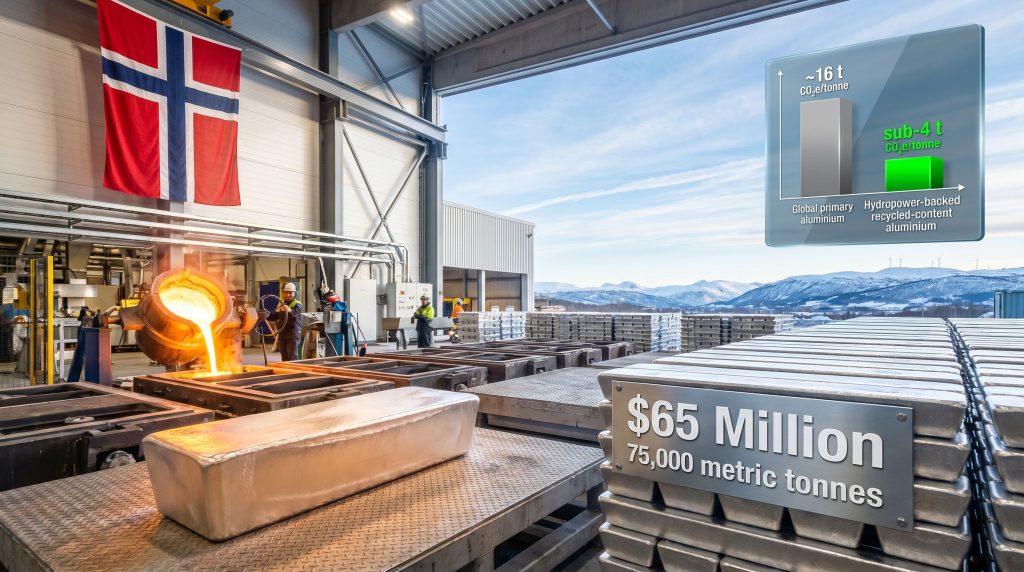
Alcoa low-carbon aluminium has been a consistent strategic priority across multiple facilities, and the Mosjøen commitment represents one of the most concentrated expressions of that ambition. Alcoa Corporation confirmed on 11 May 2026 that it will commit USD $65 million to expand and upgrade the casthouse at its Mosjøen aluminium smelter. The Alcoa Mosjøen $65 million investment in recycled aluminium represents the single largest tranche in a capital programme that has now reached approximately USD $180 million in cumulative spend at the site since 2020, making Mosjøen one of the most consistently funded smelter assets in Alcoa's global portfolio over the past six years.
The practical outputs of this commitment are both infrastructural and operational:
- A new open mold foundry casting line will be installed, enabling greater flexibility in ingot geometry and format
- New melting furnaces will be deployed, configured to handle the variable alloy chemistry that comes with processing post-consumer scrap feedstock
- The facility will introduce post-consumer recycled aluminium integration for the first time in Mosjøen's operational history
- The expanded foundry alloy portfolio will accommodate a wider range of alloy specifications, multiple ingot sizes, and certified recycled-content products
| Investment Parameter | Detail |
|---|---|
| New Capital Commitment | USD $65 million |
| Cumulative Mosjøen Investment Since 2020 | ~USD $180 million |
| Production Capacity Addition | Up to 75,000 metric tonnes per annum |
| Key New Infrastructure | Open mold foundry casting line, melting furnaces |
| First-Time Capability | Post-consumer recycled aluminium integration |
| Target End Markets | Automotive, packaging, broader European industrial |
| Phased Commissioning Completion | Through 2028 |
| Direct Employment at Mosjøen | ~700 direct jobs (with additional roles anticipated) |
The phased commissioning timeline extending through 2028 reflects the genuine engineering complexity involved. Integrating post-consumer scrap into a primary smelter casthouse is not simply a feedstock substitution exercise. Post-consumer aluminium arrives with variable alloy chemistry, contamination profiles, and traceability characteristics that differ substantially from primary metal or clean industrial offcuts.
New furnace configurations must reliably homogenise these inputs to produce certified alloy specifications that automotive and packaging customers will stake their own compliance records on. According to Alcoa's official announcement, the investment is designed to meet rising demand for low-carbon, recycled-content aluminium across European markets.
"The ability to certifiably blend primary and post-consumer recycled aluminium within a single casthouse, while maintaining documented alloy specifications for tier-one customers, is a technically demanding undertaking that should not be underestimated as a differentiator."
Why Post-Consumer Scrap Integration Is the Critical Capability Unlock
Within the aluminium industry, a meaningful distinction exists between different grades of recycled feedstock that is rarely well understood outside specialist circles.
Production scrap (also called process scrap or new scrap) is the metal generated during manufacturing, such as offcuts, trimmings, and rejected billets. It is clean, chemically predictable, and relatively easy to reintegrate.
Post-consumer scrap (or old scrap) is recovered from end-of-life products: vehicles at the end of their service life, demolished buildings, discarded packaging, and consumer electronics. It is chemically heterogeneous, may carry surface coatings, lacquers, or paint, and requires significantly more sophisticated processing to recover and certify.
The commercial significance of this distinction is growing sharply. European regulatory frameworks, including evolving recycled-content mandates in packaging and the automotive sector's lifecycle carbon accounting requirements, increasingly specify that recycled content must be traceable to post-consumer sources to qualify for compliance credit. Production scrap, while technically recycled, is not treated equivalently under an expanding set of procurement and regulatory standards.
Mosjøen's new capability to process and certify post-consumer recycled aluminium therefore represents a genuine market access unlock, not an incremental efficiency improvement. It opens the facility to procurement contracts that are structurally unavailable to smelters processing only primary metal or production scrap.
The Alloy Certification Challenge: A Hidden Timeline Risk
One operational reality that industry participants understand well, but that rarely surfaces in investment announcements, is the length of time required for automotive-grade foundry alloy qualification. When a smelter introduces a new production process, such as a dual-feedstock casthouse blending primary and post-consumer inputs, automotive OEMs typically require an independent qualification process before approving the material for use in structural or safety-relevant components.
This qualification process commonly spans 12 to 24 months of materials testing, process audits, and trial production runs before a formal supplier approval is granted. Consequently, even if Mosjøen's new casthouse infrastructure is commissioned and operational ahead of the 2028 schedule, the commercial ramp into automotive supply contracts may trail the physical commissioning date by a meaningful margin. Investors and industry observers should factor this qualification lead time into their assessment of how quickly the expanded capacity translates into contracted revenue.
Demand-Side Architecture: Who Needs What Mosjøen Will Produce
The Automotive Sector's Aluminium Transition
European automotive manufacturers are simultaneously navigating two structural pressures that make certified low-carbon aluminium an increasingly non-negotiable procurement requirement.
The first is lifecycle carbon accounting. Under EU vehicle emissions regulations and corporate sustainability commitments, OEMs are increasingly required or incentivised to report and reduce Scope 3 emissions, which include the carbon embedded in the materials used to build their vehicles. Aluminium, as one of the most carbon-intensive materials by production process, is a priority target for Scope 3 reduction, and suppliers able to provide certified low-carbon aluminium with documented carbon intensity data gain a structural procurement advantage.
The second is lightweighting for electric vehicle platforms. Electric vehicles carry substantially heavier battery systems than equivalent internal combustion engine vehicles, creating a strong engineering incentive to reduce weight elsewhere in the vehicle structure. Aluminium foundry alloys are central to this strategy, appearing in structural castings, suspension components, and increasingly in EV battery housing and thermal management systems.
The intersection of lightweighting demand and sustainability requirements creates a particularly strong pull for exactly the product profile that Mosjøen's expanded casthouse will be calibrated to produce.
The Packaging Sector's Regulatory Compliance Driver
The European packaging industry faces its own structural shift. EU packaging regulations are progressively incorporating minimum recycled-content thresholds for aluminium packaging materials, with Extended Producer Responsibility (EPR) frameworks adding financial incentives for brands to source verifiably recycled aluminium.
For packaging manufacturers and the brands they supply, securing long-term contracts with smelters capable of certifying post-consumer recycled-content aluminium is becoming a compliance infrastructure decision, not merely a sustainability preference. Mosjøen's expanded alloy portfolio will position it to serve both rolled products feedstock supply and direct packaging-grade ingot supply, broadening its addressable customer base within the packaging value chain.
Mosjøen Within the Broader Competitive Landscape
The aluminium industry's decarbonisation toolkit is wider than a single facility strategy, and contextualising Mosjøen's approach against the full range of competing methods is instructive.
| Decarbonisation Strategy | Carbon Reduction Mechanism | Recycled Content Capability | Commercial Readiness |
|---|---|---|---|
| Hydropower + Post-Consumer Scrap Integration (Mosjøen model) | Renewable electricity + post-consumer feedstock | High, newly established | Commissioning through 2028 |
| Inert Anode Smelting (ELYSIS approach) | Eliminates carbon anode entirely | Primary metal only | Early commercial demonstration |
| Green Hydrogen Reduction | Hydrogen replaces carbon in smelting | Primary metal only | Pre-commercial pilot stage |
| Scrap-Only Secondary Smelting | Scrap melting, no primary reduction | Very high | Constrained by scrap supply quality |
| Carbon Offset Primary Production | Offset purchasing against grid emissions | Low to none | Commercially available but credibility challenged |
The Mosjøen model occupies a strategically distinctive position in this matrix. It combines an established renewable electricity advantage with a newly built post-consumer scrap integration capability, delivering both the carbon intensity reduction and the recycled-content traceability that the most demanding European procurement standards require. The inert anode and green hydrogen approaches, while potentially more transformative in the long run, remain years from commercial scale and do not yet provide the recycled-content credentials that an expanding set of regulations specifically mandate.
Alcoa's Multi-Site Decarbonisation Architecture
The Mosjøen investment does not exist in isolation within Alcoa's capital allocation strategy. The company is concurrently deploying decarbonisation capital across multiple facilities and technology programmes, suggesting a deliberate portfolio approach to positioning across different phases of the industry's transition.
The USD $60 million anode furnace rebuild at Massena, New York, targets carbon intensity reduction at the primary smelting stage through improved anode technology. Separately, the ELYSIS joint venture with Rio Tinto represents Alcoa's commitment to the longer-term carbon-free smelting frontier, with its inert anode technology demonstration backed by notable commercial partners including Apple.
Furthermore, Rio Tinto aluminium decarbonisation efforts at facilities such as Gladstone illustrate how the broader industry is pursuing parallel capital-intensive pathways to reduce carbon intensity across primary smelting operations. Each investment addresses a different layer of the decarbonisation challenge: Mosjøen builds the recycled-content integration and low-carbon product certification capability needed for the current European market; Massena reduces primary production carbon intensity; ELYSIS explores the post-carbon smelting paradigm that could redefine the industry in the 2030s.
Norway as a Structural Investment Destination for Low-Carbon Aluminium Capital
Norway's attractiveness as a location for aluminium decarbonisation investment is not accidental. The combination of factors that makes Mosjøen investable at scale is worth examining individually.
Renewable electricity infrastructure: Norway's power grid is dominated by hydropower, providing a low-carbon electricity baseline that no amount of grid-based renewable purchasing can fully replicate in markets where coal or gas generation remains part of the generation mix. For an industry where electricity accounts for a dominant share of operating costs and carbon footprint simultaneously, this is a foundational competitive input.
Long-term power pricing stability: Mosjøen's operational competitiveness is supported by competitive long-term power agreements that provide cost predictability across multi-year investment horizons. Aluminium smelting is a capital-intensive, decades-long business, and the ability to underwrite energy cost assumptions over 10 to 15-year periods is a precondition for large capital commitments.
Regulatory predictability: The Mosjøen investment announcement highlights that the facility benefits from stable and predictable operating conditions. For industrial capital allocation decisions measured in USD tens of millions and planned over five-year horizons, regulatory certainty functions as a form of risk-adjusted return improvement.
Proximity to EU demand centres: Norway's geographic position provides logistical access to the European automotive and packaging manufacturing clusters that represent the primary demand base for low-carbon, recycled-content aluminium. The EU market is Mosjøen's primary sales destination, and physical proximity reduces logistics cost and lead time relative to competing supply sources.
In addition, European industrial decarbonisation initiatives across multiple sectors are creating a broader structural pull for low-carbon materials that further reinforces the commercial case for investments like the one at Mosjøen.
The next major ASX story will hit our subscribers first
Regional Economic Significance and the Helgeland Industrial Anchor
Beyond the strategic and commercial dimensions, the Mosjøen investment carries significant weight for the Helgeland region of Northern Norway. The smelter already supports nearly 700 direct jobs, making it one of the largest single industrial employers in that part of the country.
The expansion is expected to generate additional direct employment and broader supply chain activity across local suppliers and service providers. For a region with limited industrial diversification options, a long-term capital commitment of this scale from a major global corporation represents a meaningful economic stabilisation signal, reinforcing the smelter's role as a durable anchor for regional economic activity well into the 2030s. As High North News reports, local stakeholders have broadly welcomed the announcement as a signal of long-term industrial commitment to the region.
Scenario Analysis: Pathways to Commercial Outcomes
The investment's ultimate returns will be shaped by how several interacting variables evolve over the commissioning and ramp-up period through 2028 and beyond.
Scenario 1: Accelerated Demand Realisation
EU recycled-content mandates tighten ahead of schedule. Automotive OEMs, facing Scope 3 reporting obligations under the Corporate Sustainability Reporting Directive (CSRD), accelerate procurement shifts toward certified low-carbon aluminium. Post-consumer scrap supply chains in Europe consolidate, reducing feedstock variability and enabling faster OEM qualification timelines. Mosjøen reaches full utilisation of the 75,000-tonne capacity addition ahead of the 2028 commissioning completion.
Scenario 2: Base Case Trajectory
Phased commissioning proceeds on schedule. OEM qualification processes run on standard 12 to 24-month timelines following initial commissioning. Mosjøen establishes certified supply relationships with a core group of European automotive and packaging customers by 2029 to 2030. The expanded facility operates at increasing capacity utilisation as customer qualifications complete progressively.
Scenario 3: Execution and Market Headwinds
Post-consumer scrap supply chain fragmentation in Europe limits consistent feedstock availability. OEM qualification complexity delays commercial ramp beyond anticipated timelines. European industrial demand softens under macroeconomic pressure, reducing near-term pricing premiums for low-carbon aluminium. The investment delivers its projected returns, but over a longer horizon than initially modelled.
Disclaimer: The scenario analysis presented above is illustrative and based on structural industry factors. It does not constitute financial advice or a forecast of Alcoa Corporation's financial performance. Investors should conduct independent due diligence and consult qualified financial advisers before making investment decisions.
Key Risks Worth Monitoring Beyond the Headline Numbers
Three structural risk factors merit particular attention from industry observers tracking the investment's progress.
Post-consumer scrap supply availability and quality consistency: European post-consumer aluminium scrap markets remain relatively fragmented compared to the consolidated industrial scrap market. Securing sufficient volumes of consistently graded, chemically characterised post-consumer feedstock at the scale required to meaningfully support 75,000 tonnes of expanded capacity is a non-trivial supply chain management challenge that will test Mosjøen's procurement and metallurgical capabilities simultaneously.
Alloy qualification lead times with automotive customers: As discussed, the standard automotive supplier qualification process for new production processes typically runs 12 to 24 months. This creates a natural lag between physical commissioning and contracted commercial volume that investors and analysts tracking utilisation rates should factor into their expectations.
European industrial demand trajectory: The macro environment for European manufacturing remains uncertain. Softness in automotive production volumes, driven by EV transition economics or broader demand weakness, could delay the commercial ramp even if Mosjøen's own capabilities are delivered on schedule.
What the $180 Million Commitment Pattern Reveals About Long-Term Strategy
Perhaps the most analytically significant aspect of the Alcoa Mosjøen story is not any individual capital commitment, but the pattern of sustained, sequenced investment over six years. The cumulative USD $180 million deployed at Mosjøen since 2020 represents a strategic architecture built incrementally: each tranche addressing a different capability gap and building on the infrastructure established by prior phases.
This pattern is inconsistent with opportunistic capital deployment responding to short-term market conditions. It reflects a deliberate, long-horizon repositioning of Mosjøen as a European low-carbon aluminium anchor asset. Each investment has added another layer to the facility's competitive differentiation, moving it progressively from a competitive primary smelter to a certified low-carbon, recycled-content aluminium producer capable of serving the most demanding European procurement standards.
The Alcoa Mosjøen $65 million investment in recycled aluminium completes a critical capability layer in that architecture by introducing the post-consumer recycled-content integration that the current regulatory and procurement environment increasingly demands as a baseline, not a premium. Furthermore, among the global aluminium producers pursuing decarbonisation at scale, this sustained multi-year commitment to a single facility is relatively uncommon and merits recognition as a long-term strategic signal.
Frequently Asked Questions: Alcoa Mosjøen $65 Million Investment
What does the Alcoa Mosjøen $65 million investment involve?
Alcoa Corporation confirmed in May 2026 that it will invest USD $65 million to expand and upgrade the casthouse at its Mosjøen smelter in Northern Norway. The project introduces post-consumer recycled aluminium processing for the first time at the facility, installs a new open mold foundry casting line and melting furnaces, and adds up to 75,000 metric tonnes of annual production capacity. Commissioning is structured in phases, with completion expected through 2028.
Why is Alcoa integrating post-consumer recycled aluminium at Mosjøen specifically?
The decision reflects the growing commercial distinction between post-consumer recycled-content aluminium and production scrap or primary metal. European regulatory frameworks for packaging recycled-content mandates and automotive Scope 3 emissions accounting increasingly require post-consumer source traceability to qualify for compliance credit. Mosjøen's hydropower-backed renewable electricity position makes it an ideal site to combine a low-carbon electricity advantage with certified recycled-content capability.
How much has Alcoa invested at Mosjøen in total?
Since 2020, Alcoa has committed approximately USD $180 million in cumulative capital investment at Mosjøen. The USD $65 million casthouse expansion announced in May 2026 is the most recent and largest single allocation within that programme.
How will the Mosjøen expansion affect production volumes?
The casthouse upgrade will add up to 75,000 metric tonnes of annual production capacity, building on the facility's existing primary aluminium output of approximately 214,000 metric tonnes per year established through prior capacity upgrades.
What employment impact is expected from the expansion?
Mosjøen currently supports nearly 700 direct jobs in the Helgeland region of Northern Norway. The USD $65 million expansion is expected to generate additional direct employment and broader supply chain activity, though specific job creation numbers beyond this have not been publicly quantified.
What is the completion timeline for the Mosjøen casthouse expansion?
The project is structured as a phased programme. Commissioning and production ramp-up are expected to continue through 2028.
What aluminium products will the upgraded Mosjøen casthouse produce?
The expanded facility will produce a diversified foundry alloy portfolio including a wider range of alloy specifications, multiple ingot sizes and formats, and aluminium products incorporating certified post-consumer recycled content. Target end markets include European automotive manufacturers, packaging producers, and broader industrial customers.
Want to Track the Next Major Mineral Discovery Before the Market Does?
Discovery Alert's proprietary Discovery IQ model scans ASX announcements in real time, instantly identifying significant mineral discoveries and turning complex data into actionable investment insights — the same structural advantage that has historically rewarded early movers in major discoveries. Explore Discovery Alert's discoveries page to see the kind of historic returns that early discovery positions have generated, and begin your 14-day free trial today to position yourself ahead of the broader market.