June 20, 2026
The Industrial Heart of a Precious Metal: Why Platinum Futures Are Different
Most commodities occupy a clear category. They are either raw materials feeding industrial processes or financial instruments attracting speculative capital. Platinum defies this neat division. It functions simultaneously as a critical manufacturing input, a store of value, and a globally traded financial derivative. Understanding this dual identity is not merely academic; it is the foundation for grasping why platinum futures behave so differently from contracts tied to gold, crude oil, or agricultural products.
The pricing dynamics of platinum are rooted in real-world consumption rather than sentiment alone. When automotive production expands, demand for platinum group metals rises to meet catalytic converter manufacturing requirements. When global manufacturing contracts, platinum consumption follows. This industrial anchor creates both opportunity and complexity for anyone approaching this platinum futures guide with serious intent.
When big ASX news breaks, our subscribers know first
Why Platinum Occupies a Unique Space in Commodities Markets
Platinum's Dual Identity: Industrial Metal and Investment Asset
The distinction between platinum and other precious metals becomes clear when examining where demand actually comes from. Gold derives the vast majority of its investment appeal from monetary traditions, central bank reserve holdings, and inflation hedging behaviour. Furthermore, when reviewing the broader precious metals market, platinum's demand profile is structurally different. According to World Platinum Investment Council data, the automotive sector has historically represented the single largest category of platinum consumption, with catalytic converter production consuming the majority of this allocation year after year.
Beyond automotive applications, platinum serves critical roles across:
- Electronics manufacturing, where its electrical conductivity and corrosion resistance are essential
- Medical device production, including surgical instruments and dental applications
- Petroleum refining, where it functions as a catalyst in reforming processes
- Chemical synthesis operations requiring high-temperature resistant materials
- Glass manufacturing, particularly for fiberglass and LCD screen production
This breadth of industrial application means platinum demand exhibits sensitivity to global manufacturing cycles that simply does not apply to gold. During periods of economic contraction, automotive production volumes fall, dragging platinum consumption downward. During expansion phases, manufacturing activity accelerates and industrial platinum demand typically follows. Investor demand, while meaningful, competes with and is often subordinated to these structural industrial drivers, creating a pricing environment that rewards traders who monitor economic data as closely as financial market sentiment.
How Platinum's Supply Chain Shapes Market Volatility
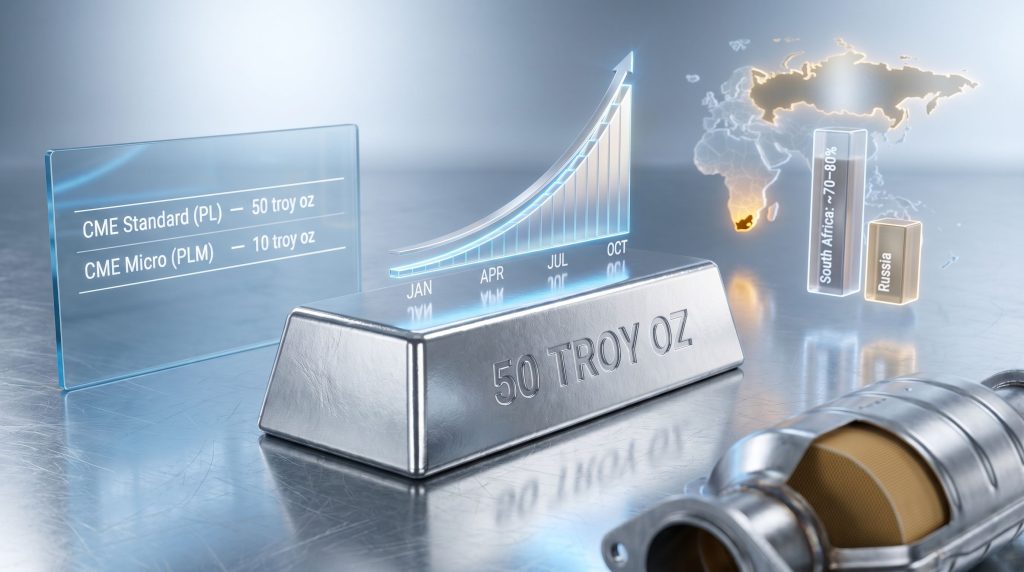
Platinum supply is concentrated to a degree unusual even among critical minerals. South Africa accounts for roughly 70 to 80% of annual global mined output, according to U.S. Geological Survey Mineral Commodity Summaries data, with Russia functioning as the second-largest producing nation. This geographic concentration has direct implications for anyone trading platinum futures: supply shocks originating in Johannesburg or the Norilsk basin transmit rapidly and forcefully into derivatives pricing.
The structural reasons for this concentration matter. The Bushveld Igneous Complex in South Africa hosts the world's largest known platinum group metals reserves, a geological formation that has no equivalent deposit of comparable scale elsewhere on the planet. This is not a resource that can be quickly replicated by new mine development in alternative jurisdictions. New platinum mine construction timelines are measured in years, typically a decade or more from discovery through permitting, development, and first production.
Key supply-side risk factors include:
- Power grid instability in South Africa, where Eskom's load-shedding policies have intermittently disrupted deep-level mining operations
- Labour relations dynamics in the South African platinum mining sector, where large-scale industrial actions have historically caused sharp short-term supply contractions
- Currency movements in the South African rand, which affect production costs denominated in local currency versus revenues received in U.S. dollars
- Geopolitical developments affecting Russian production and export capabilities
In addition, the platinum and palladium dynamics of both metals are deeply intertwined through shared supply chains, meaning disruptions to one market can quickly reverberate into the other.
"Unlike base metals with diversified global production footprints, platinum's supply vulnerability is structurally embedded in the geology of two countries. Futures traders ignoring South African mining news are trading with incomplete information."
What Are Platinum Futures and How Do They Actually Work?
The Core Mechanics of a Futures Contract
A platinum futures contract is a standardised, legally binding agreement to transact a defined quantity of platinum at a price locked in today, with settlement or physical delivery occurring at a specified future date. These contracts trade on regulated commodities exchanges, with the NYMEX division of CME Group in the United States serving as the dominant global venue for platinum derivatives price discovery.
The standardisation of these contracts across quantity, quality specifications, acceptable delivery forms, and expiration dates enables genuine price discovery. Thousands of participants with opposing views on future platinum prices can transact through a single, transparent marketplace because the terms of every contract are identical. This infrastructure also dramatically reduces counterparty risk compared to bilateral over-the-counter agreements.
Futures prices and spot prices are related but distinct. Spot prices reflect the cost of platinum available for immediate delivery. Futures prices incorporate the spot price plus the theoretical cost of carrying the metal forward in time, including storage, insurance, and financing costs, a relationship known as the cost of carry. In normal market conditions, futures prices sit at a premium to spot prices, a structure known as contango. When near-term supply is acutely tight or immediate demand is exceptionally strong, this relationship can invert into backwardation, with prompt contracts trading at a premium to later-dated ones.
The Role of Leverage and Margin in Platinum Futures
Leverage is the defining structural feature separating futures from most other investment instruments. Traders post only a fraction of the total contract value as an initial margin deposit to open a position. The remainder is effectively financed by the exchange clearing mechanism.
This capital efficiency creates powerful asymmetry. A 5% move in platinum prices on a standard 50-troy-ounce contract, assuming typical margin requirements, can translate into a return or loss many times the initial deposit. This amplification operates equally in both directions.
The margin framework operates through two thresholds:
- Initial margin: The amount required to open a new position, set by the exchange and subject to revision during volatile periods
- Maintenance margin: The minimum account balance required to keep a position open; falling below this triggers a margin call
When a margin call is issued, the trader must deposit additional funds within a specified timeframe or face forced liquidation of the position, potentially at a substantial loss. Margin requirements are not static; during periods of elevated market volatility, exchanges routinely increase margin requirements to reflect heightened risk, meaning positions that were adequately capitalised yesterday may be undercapitalised today.
Risk Warning: Leverage in platinum futures markets means losses can exceed the initial margin deposit. These instruments are not appropriate for inexperienced investors without a clear understanding of commodities market mechanics, margin management, and disciplined position sizing. For those weighing up alternatives, understanding how CFDs work alongside futures can help clarify which instrument better suits a given risk profile.
A Technical Breakdown of Platinum Futures Contract Specifications
Standard vs. Micro Contracts: Choosing the Right Instrument
CME Group offers two platinum futures contracts suited to different participant profiles. The standard contract (ticker: PL) represents 50 troy ounces of platinum, making each $1.00 per ounce price move worth $50.00 per contract. The micro contract (ticker: PLM) represents 10 troy ounces, with each $1.00 per ounce move worth $10.00, providing access to platinum futures exposure with proportionally lower capital requirements.
| Specification | CME Standard Platinum (PL) | CME Micro Platinum (PLM) |
|---|---|---|
| Contract Size | 50 troy ounces | 10 troy ounces |
| Minimum Price Tick | $0.10 per troy oz | $0.10 per troy oz |
| Dollar Value Per Tick | $5.00 per contract | $1.00 per contract |
| Contract Months | 3 consecutive + Jan, Apr, Jul, Oct (within 36 months) | 3 consecutive + Jan, Apr, Jul, Oct (within 12 months) |
| Expiration | Third-last business day of contract month | Third-last business day of contract month |
| Settlement | Physical delivery | Physical delivery |
| Trading Hours | Sunday to Friday, near 24-hour access | Sunday to Friday, near 24-hour access |
The micro contract's reduced dollar-per-tick exposure makes it particularly useful for traders developing systematic strategies, testing position sizing approaches, or implementing hedges on smaller portfolio values. Both contracts share the same expiration mechanics and delivery specifications, differing only in scale.
Understanding Physical Delivery Requirements
Both CME platinum contracts are physically settled, meaning parties who do not close or roll their positions before expiration face actual delivery obligations. Per the NYMEX rulebook, acceptable delivery forms include either a standard unit of 50 troy ounces (with a weight tolerance of 10% above or below) or a larger platinum unit covering quantities between 55 and 192.904 troy ounces, equivalent to approximately 6 kilograms.
Delivered platinum must meet purity requirements, typically a minimum of 99.95% fine platinum, and must be in the form of homogeneous cast plate or ingot from an approved refiner. This is not a minor operational detail: the logistics and costs associated with receiving, insuring, assaying, and storing physical platinum are substantial. Consequently, the overwhelming majority of retail and speculative traders close or roll positions before expiration, never engaging the delivery mechanism.
Contract Rollover: The Hidden Ongoing Cost
A dimension of futures trading that receives insufficient attention in introductory discussions is the roll. As a contract approaches its expiration date, traders maintaining ongoing exposure must sell the expiring contract and simultaneously buy a later-dated contract, a process called rolling. This transaction involves two bid-ask spread costs plus the potential for roll yield, either positive or negative depending on the shape of the futures curve.
In a contango market, rolling from a lower-priced near-term contract into a higher-priced far-dated contract typically generates a small cost. In backwardation, the opposite dynamic can produce a roll benefit. Across a year of continuous exposure with quarterly rolls, these cumulative effects can materially impact total returns relative to simply tracking spot prices.
How International Platinum Futures Markets Compare
CME Group vs. Japan Exchange Group: A Cross-Market Comparison
| Feature | CME Standard (PL) | CME Micro (PLM) | JPX Pocket Platinum 100 |
|---|---|---|---|
| Exchange | NYMEX / CME Group | NYMEX / CME Group | Japan Exchange Group (Osaka) |
| Contract Size | 50 troy oz | 10 troy oz | 100 grams |
| Settlement Type | Physical delivery | Physical delivery | Cash-settled |
| Contract Cycle | Multiple monthly contracts | Multiple monthly contracts | Single annual December contract |
| Trading Window | Continuous throughout year | Continuous throughout year | Opens late October prior year (~14 months) |
| Primary Participants | Global retail, institutional, commercial | Global retail, institutional | Japanese institutional and commercial |
What Makes the JPX Pocket Platinum 100 Futures Distinct
The JPX Pocket Platinum 100 contract differs from its CME counterparts in several structurally important ways beyond just contract size. First, it is denominated in grams rather than troy ounces, reflecting Japan's domestic market conventions for precious metals trading. At 100 grams per contract, this instrument allows participation with a notional value substantially smaller than either CME contract at prevailing platinum prices.
Second, cash settlement eliminates physical delivery obligations entirely. Rather than transferring actual platinum, positions outstanding at expiration are resolved based on the difference between the final settlement price determined by the exchange and the original contract price. This simplifies the instrument for participants who want price exposure without logistics complexity.
Third, access is restricted. Trading on the Osaka Exchange derivatives market is limited to Financial Instruments Business Operators and Transaction-at-Exchange Operators, effectively creating a barrier to individual retail participation outside Japan. Non-Japanese participants require a broker specifically authorised to access foreign boards of trade. This regulatory structure means the JPX market primarily functions as a domestic hedging and institutional trading venue rather than a broad retail market.
The single annual December maturity creates a concentrated liquidity structure, with the trading window typically opening in late October of the prior year and running for approximately 14 months. This contrasts sharply with CME's multi-month contract calendar, which provides continuous liquid markets across numerous expiration dates simultaneously.
What Drives Platinum Prices and Why It Matters for Futures Traders
The Four Primary Price Catalysts
1. Automotive and Emissions Regulation Demand
Catalytic converter production remains the single largest end-use for platinum globally. The connection between vehicle emissions regulation and platinum demand is direct and measurable: stricter emissions standards require higher platinum loadings per catalytic converter unit, while looser standards or slower new vehicle sales reduce consumption pressure. Regulatory tightening cycles in the European Union, China, and emerging markets have historically supported structural platinum demand independent of macroeconomic conditions.
An emerging but speculative long-term catalyst deserves acknowledgment: hydrogen fuel cell vehicle technology requires platinum as a catalyst in the fuel cell membrane electrode assembly. If hydrogen vehicle adoption accelerates meaningfully, this represents an incremental demand source layered on top of existing internal combustion engine catalytic converter consumption. However, current hydrogen vehicle production volumes remain small relative to total platinum demand, and the commercialisation timeline for mass-market hydrogen transport remains uncertain.
2. Supply Concentration and Structural Production Risk
South Africa's geological dominance in platinum group metals production means that supply constraints are not merely cyclical possibilities but structural characteristics of the market. The depth of South African platinum mines, many of which operate at two to four kilometres below surface, creates energy-intensive operating environments particularly vulnerable to power supply disruptions. Load-shedding events affecting South African mining operations have repeatedly created observable supply tightness in physical platinum markets, with effects transmitted directly into futures pricing.
Russia's contribution as the world's second-largest platinum producer adds a geopolitical dimension to supply analysis. Russian platinum production is largely byproduct output from nickel and palladium mining operations in the Norilsk region, meaning production volumes are partly dependent on demand dynamics for these co-products rather than platinum price signals alone.
3. Macroeconomic and Monetary Policy Conditions
As a U.S. dollar-denominated commodity, platinum prices exhibit inverse sensitivity to dollar strength. When the dollar appreciates against other currencies, platinum becomes more expensive for non-U.S. buyers in local currency terms, typically suppressing global demand at the margin. When the dollar weakens, platinum becomes relatively cheaper internationally, supporting consumption.
Interest rate environments influence platinum through the opportunity cost mechanism. Higher real interest rates increase the cost of holding non-yielding physical metal relative to interest-bearing alternatives, reducing speculative demand. Purchasing Managers' Index data for global manufacturing serves as a leading indicator of industrial platinum demand, with readings above 50 signalling expanding manufacturing activity and below 50 signalling contraction.
4. Speculative Positioning and Investor Sentiment
The U.S. Commodity Futures Trading Commission publishes weekly Commitment of Traders reports, which provide visibility into how commercial hedgers and speculative participants are currently positioned in platinum futures. When speculative net long positioning reaches historically extreme levels, this can signal elevated reversal risk as the pool of potential new buyers becomes exhausted. Conversely, extreme net short positioning by speculative traders can identify potential squeeze dynamics when supply tightness forces position covering.
Exchange-traded commodities and ETF flows in platinum-backed products also influence physical and futures market dynamics. Large ETF creation activity signals rising retail and institutional investment demand, while sustained ETF redemptions suggest declining investor appetite.
"Sophisticated platinum futures participants monitor both the industrial cycle (automotive production data, emissions regulatory updates, manufacturing PMIs) and the financial cycle (dollar index, interest rate expectations, CFTC positioning reports) simultaneously, recognising that each set of factors can dominate at different points in the market cycle."
The next major ASX story will hit our subscribers first
Platinum Futures Trading Strategies: From Hedging to Speculation
Strategic Approaches by Participant Type
Commercial Hedgers
Automotive manufacturers and industrial platinum consumers use futures to establish forward price certainty on future metal purchases. A manufacturer budgeting for platinum input costs over a production cycle can lock in today's futures price for delivery in three or six months, eliminating the risk of adverse price moves disrupting cost assumptions. Mining companies take the opposite position, using short futures positions to secure revenue certainty on anticipated production volumes before the metal has been refined and sold into the spot market.
This commercial hedging activity provides a structural liquidity foundation in platinum futures markets. Commercial hedgers are motivated by operational necessity rather than speculative return, creating consistent participation regardless of market conditions.
Speculative Directional Strategies
- Long positions: Traders anticipating rising platinum prices establish long futures positions, profiting if prices increase before expiration
- Short positions: Traders expecting price declines take short positions, profiting from falling platinum prices through mark-to-market gains as the contract value decreases
- Calendar spreads: Simultaneously holding a long position in one contract month and a short position in a different contract month, capturing the relative price differential between near-term and deferred contracts without full directional exposure to outright price moves
- Seasonal spread strategies: Exploiting historically recurring supply and demand patterns that create predictable price differentials across specific contract months
Technical and Quantitative Approaches
Chart pattern analysis, momentum indicator overlays, and support-resistance identification are extensively applied to platinum futures price data by technically oriented traders. The commodity's historical tendency to exhibit extended trending behaviour, driven by multi-year automotive demand and supply cycles, makes trend-following approaches particularly relevant. For a broader perspective on platinum futures trading strategies, reviewing how experienced commodities participants approach this market can provide additional context.
Risk Management Essentials
Active management of risk is not optional in leveraged futures markets. The following practices represent baseline risk management for platinum futures participants:
- Predefined stop-loss levels: Establishing maximum acceptable loss thresholds before entering any position, with automatic exit orders placed accordingly
- Position sizing discipline: Calibrating the number of contracts to total account capital such that a single adverse move cannot cause catastrophic loss
- Margin buffer maintenance: Keeping account balances meaningfully above minimum maintenance margins to withstand short-term adverse price moves without forced liquidation
- Rollover calendar management: Tracking approaching expiration dates well in advance to avoid unexpected delivery obligations or forced exit at unfavourable prices
- Correlation awareness: Recognising that platinum often exhibits positive correlation with palladium and partial correlation with gold, meaning a portfolio long multiple precious metals futures is not as diversified as it might appear
Platinum Futures vs. Alternative Platinum Investment Instruments
Comparing the Full Spectrum of Platinum Exposure Options
| Investment Vehicle | Leverage | Physical Ownership | Expiration Risk | Liquidity | Suitable For |
|---|---|---|---|---|---|
| Standard Futures (PL) | High | No (unless delivered) | Yes | High | Active traders, commercial hedgers |
| Micro Futures (PLM) | High (smaller scale) | No (unless delivered) | Yes | Moderate to High | Newer futures traders |
| Platinum ETFs | None | No (fund holds metal) | No | High | Passive investors |
| Physical Bullion | None | Yes | No | Moderate | Long-term wealth preservation |
| CFDs | High | No | Varies | High | Short-term traders (note: not available in U.S.) |
| Mining Equities | Indirect operational leverage | No | No | Variable | Equity investors seeking sector exposure |
When Futures Make Sense and When They Do Not
Platinum futures are well suited to specific participant profiles and investment objectives, but poorly suited to others. Understanding the difference between physical vs ETFs and futures prevents misalignment between instrument and intent.
Futures may be appropriate when:
- An investor has a defined short-to-medium-term directional view on platinum prices with a clear catalyst and timeframe
- A commercial entity requires forward price certainty on future platinum purchases or anticipated production revenues
- A trader seeks to implement spread or relative value strategies across contract months without full directional exposure
- Portfolio-level hedging against existing commodity or equity sector exposure is the primary objective
- The participant has sufficient experience with margin management and expiration logistics to operate independently
Physical bullion may be more appropriate when:
- An investor prioritises tangible asset ownership and multi-year wealth preservation objectives
- The investment horizon extends substantially beyond typical futures contract cycles
- The investor prefers to avoid margin requirements, rollover costs, and expiration management complexity
- Simplicity and reduced active oversight requirements are genuine priorities
Mining equities occupy a distinct risk profile, offering indirect leverage to platinum prices amplified by company-specific operational and financial factors. A platinum miner's equity often moves more than the platinum price itself in both directions, as operating leverage magnifies the impact of price changes on earnings. This makes equities suitable for investors seeking amplified exposure while accepting company-specific risk.
Frequently Asked Questions: Platinum Futures
What capital is required to begin trading platinum futures?
Minimum capital requirements depend on the exchange-set initial margin for each specific contract. Micro platinum futures (PLM) require proportionally less capital than standard contracts due to their smaller size (10 troy ounces versus 50 troy ounces). Beyond meeting the minimum initial margin, prudent traders maintain a meaningful buffer above this threshold to absorb short-term adverse price movements without triggering margin calls.
How do futures prices relate to spot platinum prices?
Futures prices typically sit above spot prices in normal market conditions (contango), reflecting storage, insurance, and financing costs over the period until delivery. When supply is acutely tight relative to immediate demand, this relationship can invert into backwardation, where near-dated contracts trade at a premium to later-dated ones. The degree of contango or backwardation provides useful signals about current physical market conditions.
What happens if a futures contract expires without being closed?
Contracts reaching expiration without being closed or rolled are subject to physical delivery obligations for CME standard and micro platinum contracts. The seller delivers approved platinum meeting purity and form specifications to an approved warehouse; the buyer takes delivery and pays the full contract value. Most retail participants avoid this by closing positions or rolling into subsequent contract months well before expiration.
How do platinum futures differ from platinum ETFs?
Platinum futures require active management, involve leverage and margin exposure, and carry expiration dates requiring ongoing attention. Platinum ETFs, by contrast, are passively held exchange-traded securities tracking platinum prices without leverage, margin requirements, or expiration risk. ETFs are generally more accessible for investors seeking price exposure without the operational complexity and capital management demands of this platinum futures guide's core subject matter.
Can retail investors access international platinum futures?
Yes, though with varying accessibility. CME Group contracts are available through U.S. futures brokers registered with the CFTC. JPX contracts in Japan require a broker specifically authorised to access foreign boards of trade, and participation is restricted to specific categories of eligible trading operators, consequently limiting retail access outside Japan.
Key Takeaways: What Every Platinum Futures Participant Should Understand
Platinum futures represent one of the more sophisticated instruments available for commodity market participation. Before approaching them, the following foundational points warrant clear understanding:
- Platinum's pricing reflects a genuine tug of war between industrial consumption cycles and financial market forces, making both macroeconomic and monetary policy analysis relevant
- Supply concentration in South Africa and Russia is not merely a talking point; it is a structural source of volatility embedded in every platinum futures contract's risk profile
- CME Group offers both standard 50-troy-ounce (PL) and micro 10-troy-ounce (PLM) physically settled contracts, providing scalable access across participant types
- The JPX Pocket Platinum 100 provides an alternative cash-settled structure, but access for non-Japanese participants is practically limited by regulatory requirements
- Leverage amplifies outcomes in both directions with equal force; robust margin management is a prerequisite, not an afterthought
- Rollover costs, spread costs, and potential roll yield effects accumulate over time and should be factored into realistic return expectations
- Multiple strategic frameworks exist, from directional speculation and commercial hedging to calendar spreads and technical overlay strategies, each suited to different risk appetites and market views
- Physical platinum ownership remains a structurally simpler alternative for investors whose objectives align with long-term wealth preservation rather than active trading
This article is intended for educational and informational purposes only and does not constitute financial, investment, or trading advice. Futures markets involve substantial risk of loss. Readers should conduct independent research and consult a qualified financial professional before engaging in any futures trading or making investment decisions based on this content.
Want To Catch the Next Major ASX Mineral Discovery the Moment It Hits the Market?
Discovery Alert's proprietary Discovery IQ model scans ASX announcements in real time, delivering instant alerts on significant mineral discoveries across more than 30 commodities — turning complex data into clear, actionable opportunities for both traders and long-term investors. Start your 14-day free trial today and explore historic discoveries that have generated extraordinary returns to see what early positioning can mean for your portfolio.