June 24, 2026
When Geopolitical Hope Becomes a Sell Signal: Understanding Aluminium's Mid-2026 Correction
Commodity markets have a long history of pricing in fear faster than they price in resolution. When conflict disrupts a critical supply corridor, risk premiums inflate rapidly as traders scramble to model worst-case scenarios. But when diplomatic signals emerge suggesting those disruptions may ease, the same logic works in reverse with equal speed. The aluminium market in mid-2026 is a textbook example of this dynamic, and Alcoa shares drop as aluminium market cools on Middle East supply hopes has become one of the defining investment narratives of the year's first half.
Understanding why this correction happened, how deep it may go, and what it means for investors requires looking beyond the headlines and into the structural mechanics of global aluminium supply chains.
When big ASX news breaks, our subscribers know first
The Strait of Hormuz as an Aluminium Choke Point
Most investors associate the Strait of Hormuz with oil. Fewer appreciate its critical role in global aluminium supply chains. The Gulf region contributes roughly 9% of global primary aluminium production, and every tonne of that metal depends on seaborne imports of bauxite and alumina from suppliers in Australia, Guinea, and elsewhere. The Strait functions as both an inbound raw materials corridor and an outbound finished metal route simultaneously.
This dual dependency creates an amplified sensitivity to any disruption. Furthermore, when conflict risk escalates in the region, the alumina market impact extends well beyond simple logistics delays:
- Incoming alumina and bauxite cargoes face potential delays or rerouting costs
- Outbound primary aluminium shipments encounter buyer uncertainty and logistics premiums
- Smelters face the compounding pressure of constrained inputs and constrained offtake simultaneously
When geopolitical tension peaks, aluminium markets embed a substantial risk premium into spot and forward prices. When tension recedes, even partially, that premium deflates. This is precisely the mechanism driving the current correction.
Mapping the Price Reversal: Four-Year Highs to Three-Month Lows
The speed of the aluminium price retreat in June 2026 has been striking. The following table captures the key price milestones and the forces behind each move:
| Period | LME Aluminium Cash Price | Primary Driver |
|---|---|---|
| April to May 2026 | Four-year highs recorded | Hormuz closure fears escalate |
| 2 June 2026 | ~USD 3,855/tonne (cycle peak) | Peak supply disruption anxiety |
| Pre-correction session | USD 3,405/tonne | Partial diplomatic optimism emerging |
| Late June 2026 | USD 3,263.5/tonne | Supply recovery signals, Asian output surge |
| Year-to-date position | Approximately +11% | Structural deficit still underpins market |
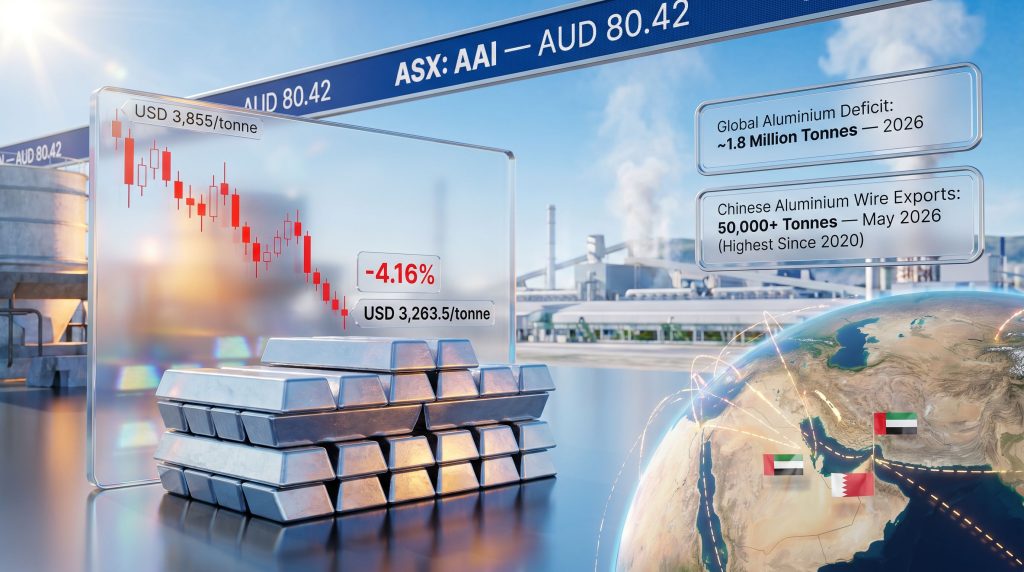
A single session on the London Metal Exchange saw aluminium cash prices fall 4.16% to a three-month low of USD 3,263.5 per tonne. This kind of intraday move is not characteristic of fundamental supply-demand rebalancing; it is the signature of risk premium deflation, where sentiment repositions faster than physical conditions can justify.
Key Distinction: A risk premium deflation event and a structural bear market are not the same thing. Conflating the two is one of the most common errors in commodity investment analysis during geopolitical de-escalation phases.
The Supply Forces Behind the Sentiment Shift
Gulf Shipping Lanes: A Perception of Normalisation
Shipping activity through the Strait of Hormuz has reportedly shown improvement, allowing Gulf-based smelters to begin rebuilding raw material stockpiles that had been drawn down during the height of the conflict. The critical word here is reportedly. Markets are trading on signals of improved logistics, not on confirmed full restoration of physical throughput volumes. This distinction matters because it creates the conditions for a potential reassessment if shipping data disappoints.
For aluminium smelters, raw material inventory levels are a leading indicator of production stability. When alumina stockpiles at a smelter drop below a threshold level, production curtailments become necessary even before the alumina supply is fully interrupted. The rebuilding of these buffers is therefore genuinely constructive for supply continuity, however, the pace of rebuilding remains uncertain.
China and Indonesia: The Asian Output Offset
Beyond Gulf dynamics, Asian producers have materially increased output. In addition, China industrial demand patterns have shifted considerably, with two key developments standing out:
- Chinese aluminium producers aggressively ramped production capacity throughout the first half of 2026, capitalising on elevated global prices
- Chinese aluminium wire exports surpassed 50,000 tonnes in May 2026, the highest monthly volume recorded since 2020, reflecting a combination of strong export incentives and elevated international price arbitrage
Indonesian production has also accelerated, adding a secondary buffer against Gulf shortfalls. Together, these Asian supply increases have reduced the acute tightness that pushed prices to cycle highs, providing a fundamental basis for some price normalisation rather than just pure sentiment-driven selling.
Why Physical Reality Lags Market Sentiment by Months
Here is where the aluminium story in 2026 becomes genuinely complex. Futures and equity markets respond to diplomatic signals within hours. Physical aluminium production infrastructure, however, recovers over a timeframe measured in months to years.
EGA and Alba: Damage That Diplomacy Cannot Repair Quickly
Following Iranian drone and missile strikes on Gulf facilities, Emirates Global Aluminium was forced to shut down approximately 60% of its primary production capacity. EGA's own recovery timeline indicates full production restoration could take up to 12 months. Aluminium Bahrain sustained facility damage as well, further constraining Gulf output.
These are not disruptions that resolve when a ceasefire is announced. Smelter restarts require:
- Physical repair of damaged infrastructure
- Restoration of power and utility supply to facilities
- Rebuilding of raw material inventories to minimum operational levels
- Gradual electrolytic cell restarts, which cannot be rushed without risking further equipment damage
- Recommissioning quality checks before commercial production resumes
Each of these steps takes time, and they are largely sequential rather than parallel. The 12-month recovery timeline EGA has indicated is not conservative; it reflects the genuine engineering complexity of restarting potline operations.
Qatalum: The Energy Constraint Problem
Qatalum, Qatar's primary aluminium smelter, faces a different but equally binding constraint. The facility has been operating at just 60% of nameplate production capacity due to conflict-related reductions in natural gas availability. Aluminium smelting is extraordinarily energy-intensive, consuming approximately 14 to 16 megawatt-hours of electricity per tonne of aluminium produced. Gulf smelters are powered primarily by gas-fired generation, meaning gas supply availability directly determines their production ceiling.
Diplomatic agreements can open shipping lanes. They cannot, however, instantly restore gas field output or pipeline infrastructure that has been disrupted. This energy dependency represents a structural lag between geopolitical resolution and physical production recovery that markets appear to be underweighting.
Alcoa's Operational and Financial Position in Mid-2026
Q1 2026: Quantifying the Headwinds
The challenging macro environment has translated directly into Alcoa's financial results. First-quarter 2026 profit declined by approximately 22% year-on-year, while alumina shipments fell by around 31% year-on-year as logistics bottlenecks constrained the company's ability to move product efficiently through disrupted trade lanes.
These figures reflect something important about Alcoa's business model that is sometimes underappreciated by equity investors. As a vertically integrated producer spanning bauxite mining, alumina refining, and primary aluminium smelting, Alcoa's earnings are sensitive to disruptions at multiple points along the supply chain simultaneously, not just at the final metal price level. The broader commodity price impacts on integrated producers such as Alcoa illustrate precisely this vulnerability.
Strategic Repositioning: Where Alcoa Is Finding Value
In response to the disrupted trade environment, Alcoa has been actively redirecting inventory flows toward North American and European markets, where regional premiums above the LME benchmark remain comparatively attractive. This commercial agility, leveraging existing relationships and logistical capabilities in less disrupted markets, provides some buffer against spot price weakness.
Simultaneously, the company is progressing debottlenecking programmes and efficiency upgrades across its North American and Canadian smelting operations, targeting unit cost reductions that would preserve margin if LME prices remain under pressure in the near term.
Share Price Performance and Analyst Positioning
Alcoa's ASX-listed shares (ASX: AAI) fell 4.17% in a single session to close at AUD 80.42 (approximately USD 55.48). Over the preceding three weeks, the stock has declined approximately 30%, erasing the gains accumulated during the peak of the supply disruption panic.
Despite this correction, major investment banks including UBS have upgraded Alcoa to a Buy rating, with the thesis centred on the company's ability to capture new order flow from buyers diversifying away from disrupted Gulf suppliers. The structural deficit in global aluminium supply remains the central pillar of the bullish investment case.
Investor Context: A 30% drawdown in three weeks on a commodity producer stock, occurring against a backdrop of still-elevated year-to-date aluminium prices and analyst upgrades, is a scenario that historically attracts value-oriented institutional accumulation rather than continued retail panic selling.
The next major ASX story will hit our subscribers first
The Structural Deficit That Persists Beneath the Noise
Despite near-term price softening, the medium-term aluminium supply picture has not fundamentally changed. Industry analysis projects a global aluminium deficit of approximately 1.8 million tonnes in 2026. This deficit does not evaporate because shipping lanes partially normalise or because Chinese wire exports hit a monthly record.
The deficit is structural, driven by:
- Long-term underinvestment in new smelting capacity outside China
- Rising energy costs constraining Western smelter expansions
- Permanent closure of high-cost European smelter capacity in prior years
- Accelerating demand growth from the energy transition
Analyst price targets clustered in the USD 3,700 to 3,800 per tonne range for coming months reflect confidence that the deficit will reassert itself as the dominant price driver once the current risk premium washout stabilises. Consequently, the top aluminium producers with diversified supply chains are best positioned to benefit from this anticipated recovery.
Two Forces That Will Determine H2 2026 Price Direction
Force 1: The Pace of Gulf Production Recovery
The market consensus assumes a relatively smooth restoration of Gulf smelter output. If that restoration encounters setbacks, whether from ongoing energy constraints at Qatalum, delays in infrastructure repair at EGA, or further geopolitical instability, the risk premium could rebuild rapidly. Conversely, faster-than-expected recovery adds supply tonnage that the market has not fully priced in.
Force 2: Chinese Production and Export Policy Trajectory
China's aluminium sector is not a monolith. Production decisions are influenced by:
- Provincial energy availability and hydropower variability
- Domestic environmental compliance enforcement intensity
- Export tax and rebate structures that shift the economics of international versus domestic sales
- State guidance on strategic stockpiling versus commercial export
If Chinese authorities tighten export incentives or redirect output toward domestic infrastructure programmes, the supply offset that has been dampening global prices could diminish more quickly than consensus expects. In addition, the broader context of US aluminium tariffs continues to shape trade flows and redirect metal into alternative markets.
Demand Fundamentals: The Long-Term Floor
| Demand Driver | Aluminium Application | Time Horizon |
|---|---|---|
| Electric vehicle manufacturing | Lightweight structural components, battery enclosures | Medium to long-term |
| Renewable energy infrastructure | Solar frames, wind turbine components, grid cabling | Long-term |
| Sustainable packaging transition | Replacement of single-use plastics in FMCG | Medium-term |
| Grid modernisation investment | High-voltage transmission conductors | Long-term |
| Defence and aerospace programmes | Structural alloys, aerospace-grade sheet | Near to long-term |
These demand drivers are not cycle-dependent. They represent structural consumption growth that continues regardless of whether the Middle East situation improves or deteriorates in the near term. This is the foundation beneath the volatility.
FAQ: Alcoa Shares and the Aluminium Market Correction
Why have Alcoa shares dropped so sharply in June 2026?
Alcoa shares drop as aluminium market cools on Middle East supply hopes reflects the rapid unwinding of the geopolitical risk premium embedded in aluminium prices. As diplomatic signals suggested improved shipping through the Strait of Hormuz and potential Gulf supply chain normalisation, futures markets sold off aggressively, pulling producer equities lower in parallel. The ASX-listed shares declined approximately 30% over three weeks.
Does the price correction signal a bearish fundamental outlook for aluminium?
No. The correction is a sentiment-driven risk premium deflation event, not evidence of demand destruction. A projected global deficit of approximately 1.8 million tonnes in 2026 continues to support the medium-term price outlook, with analyst consensus targets remaining in the USD 3,700 to 3,800 per tonne range.
How long will Gulf aluminium production remain physically disrupted?
Physical recovery timelines significantly exceed what market pricing implies. EGA has indicated full production restoration could take up to 12 months, while Qatalum continues operating at 60% capacity due to energy supply constraints. These are engineering and infrastructure constraints that diplomatic agreements alone cannot resolve quickly.
What is the key risk to a near-term aluminium price recovery scenario?
The primary risk is that physical Gulf production recovery proceeds faster than the 12-month EGA timeline suggests, combined with sustained high Chinese output. This combination would shift the global aluminium balance from deficit toward equilibrium more rapidly, removing the supply-side support for prices above USD 3,500 per tonne.
What is Alcoa doing to protect margins during the current weakness?
Alcoa is redirecting product flows toward North American and European markets where regional premiums are more attractive, while simultaneously pursuing operational efficiency improvements across its smelting network to lower unit cost structures during a period of softer spot pricing.
Reading the Signal Correctly: Correction or Reversal?
The aluminium market is experiencing a sentiment-driven recalibration, not a structural inflection point. The divergence between market pricing, which is reflecting diplomatic optimism and Asian supply normalisation, and physical production reality, where Gulf infrastructure damage will constrain output for up to 12 months regardless of peace agreements, creates a meaningful asymmetry.
If Gulf recovery proceeds as diplomatically hoped, the market has already priced in much of that upside through its correction. If recovery stalls, if energy constraints at Qatalum persist longer than anticipated, or if Chinese export policy tightens, the deficit dynamics that drove aluminium to four-year highs earlier in 2026 could reassert themselves with limited warning.
For investors monitoring Alcoa shares drop as aluminium market cools on Middle East supply hopes, the current environment rewards careful attention to the gap between what futures markets are pricing and what smelter engineers are actually able to deliver.
Disclaimer: This article is intended for informational purposes only and does not constitute financial advice. All financial projections, price targets, and analyst estimates referenced are sourced from publicly available industry reporting and are subject to change. Past performance of commodity prices and equities is not a reliable indicator of future results. Readers should conduct their own due diligence before making any investment decisions.
Want to Stay Ahead of Major ASX Mineral Discoveries Before the Broader Market?
Discovery Alert's proprietary Discovery IQ model delivers real-time alerts on significant ASX mineral discoveries, transforming complex mineral data into actionable investment insights for both short-term traders and long-term investors. Explore why historic discoveries have generated substantial returns by visiting Discovery Alert's dedicated discoveries page, and begin your 14-day free trial today to position yourself ahead of the market.