June 24, 2026
The Financing Architecture Behind Europe's Green Steel Ambition
Few industrial transformations carry the weight of both economic and environmental consequence quite like the decarbonisation of steelmaking. Steel underpins virtually every major sector of the modern economy, from construction and automotive manufacturing to defence and infrastructure. Yet its production remains one of the most carbon-intensive industrial processes on earth, accounting for roughly 7–9% of global CO₂ emissions annually, according to the World Steel Association. The challenge of replacing a process refined over centuries with something fundamentally cleaner is not merely technological — it is financial, institutional, and structural. Solving the capital problem is, in many ways, the prerequisite for solving the climate problem in this sector.
Against that backdrop, the Stegra low-carbon steel plant funding milestone achieved in June 2026 deserves to be understood not as a corporate finance event, but as a stress test of whether green industrial capital markets have matured enough to back genuinely transformational projects at scale.
When big ASX news breaks, our subscribers know first
The Green Steel Capital Problem: Why This Financing Is So Hard to Replicate
Conventional steelmaking, built around blast furnaces and coking coal, benefits from decades of infrastructure amortisation, mature supply chains, and well-understood operational risk profiles. Lenders and equity investors can price these projects with reasonable confidence. Hydrogen-based steelmaking, however, offers none of those advantages.
It involves novel process chemistry, unproven electrolyser scale-up, dependence on renewable electricity pricing, and capital expenditure requirements that dwarf traditional mills on a per-tonne basis. Furthermore, green steel pricing dynamics remain volatile, complicating long-term revenue forecasting for lenders.
The so-called green premium is real and quantifiable. Independent analysis consistently places the production cost of green steel at a significant premium to conventionally produced steel, with estimates ranging from $150 to $400 per tonne above market rates depending on green hydrogen input costs and power prices. Bridging this gap requires a financing model that blends patient long-term equity, concessional public capital, and commercially structured debt in ways that traditional project finance templates are not designed to accommodate.
This is precisely why the architecture of Stegra's capital stack matters as much as its total size.
What Is the Stegra Low-Carbon Steel Plant and Why Does It Matter?
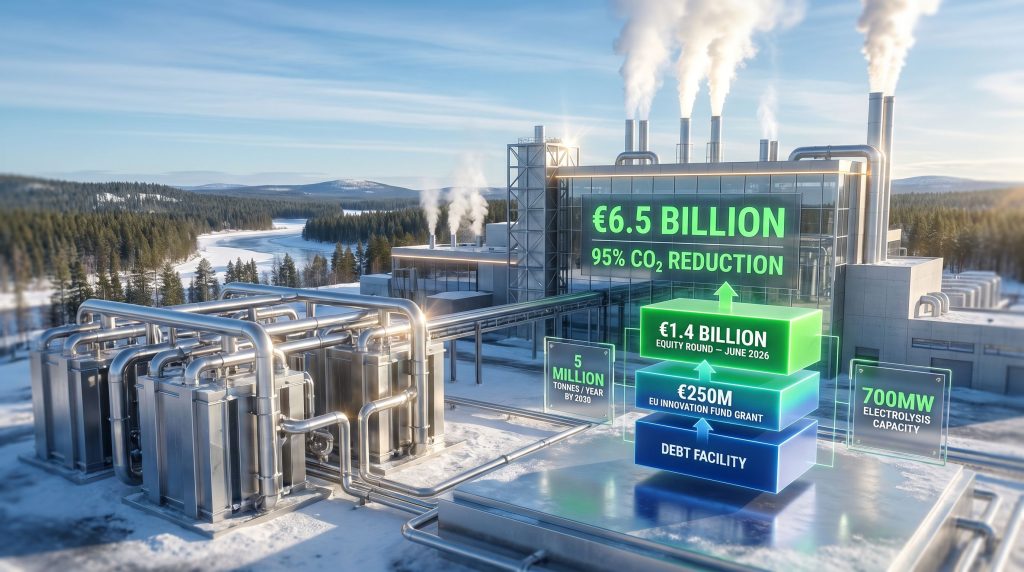
Featured Snapshot: Stegra's facility under construction in Boden, northern Sweden, is Europe's first greenfield steel mill in more than 50 years. Designed to replace coking coal with green hydrogen as the primary reductant, it targets production of 5 million tonnes of low-carbon steel annually by 2030, with projected CO₂ emission reductions of up to 95% compared to conventional blast furnace steelmaking.
The company was formerly known as H2 Green Steel before rebranding as Stegra, a name change that reflects a deliberate repositioning around the broader industrial decarbonisation thesis rather than a singular focus on hydrogen technology. This distinction matters for investor framing: Stegra is not positioning itself primarily as a hydrogen company but as a vertically integrated low-carbon steel producer that happens to produce its own hydrogen on-site.
Why Boden, Sweden Is the Right Location
The choice of Boden in northern Sweden is not incidental. The region offers a convergence of enabling conditions that are difficult to replicate elsewhere in Europe:
- Access to hydroelectric power at some of the lowest and most stable electricity prices in Europe, which is critical given that green hydrogen production via electrolysis is highly electricity-cost-sensitive
- Proximity to Swedish iron ore deposits in the Kiruna and Gällivare mining districts, reducing raw material logistics complexity
- Industrial infrastructure including rail and port access suitable for steel product export
- A permissive regulatory environment for large-scale industrial development relative to many other European jurisdictions
Phase one of the plant targets annual production of 2.5 million tonnes, with a pathway to doubling capacity in subsequent phases. At full build-out, the facility would represent one of the largest green steel operations globally.
Breaking Down the €1.4 Billion Funding Architecture
The €1.4 billion ($1.6 billion) equity financing round that formally closed in June 2026 completed a raise first announced in principle in April 2026. What distinguishes this round is not simply its size but the diversity and strategic intent of its participants.
| Investor / Stakeholder | Type | Strategic Role |
|---|---|---|
| Wallenberg Investments | Lead Consortium | Long-term Swedish industrial capital |
| Temasek (Singapore) | Sovereign Wealth Fund | Global green infrastructure mandate |
| Bolero and SEB-Stiftelsen | Swedish Institutional | Domestic industrial alignment |
| IMAS Foundation | Foundation Capital | Mission-aligned patient capital |
| Altor | Private Equity | Existing shareholder, growth equity |
| Hy24 | Hydrogen-Focused Fund | Clean hydrogen investment thesis |
| Just Climate | Climate Investment Platform | Decarbonisation-aligned equity |
| AIP Management (+ second-lien lenders) | Debt-to-Equity Conversion | Institutional confidence signal |
Why Lender-to-Equity Conversion Is the Most Important Signal
Among all the structural features of this round, the decision by a group of second-lien lenders — led by AIP Management — to convert their debt positions into equity is arguably the most telling. Second-lien lenders hold subordinated claims on assets in the event of default, meaning they carry more risk than senior debt holders.
Their willingness to convert that position into equity rather than exit signals a strong internal conviction that the project will reach completion and generate sufficient returns to justify the switch. This is not a decision made under duress — it is a forward-looking bet on project viability.
Additionally, Stegra confirmed that its existing lender group approved continued access to the debt facilities established under the 2024 financing package, meaning the project retains a functioning debt structure alongside the new equity injection. This continuity removes one of the more significant tail risks in large infrastructure projects: mid-construction refinancing pressure.
How the €1.4 Billion Round Fits Into a €6.5 Billion Capital Stack
Key Statistic: With the June 2026 round included, Stegra has assembled close to €6.5 billion in total committed funding across equity, debt, and public grant instruments, representing one of the largest individual capital mobilisations ever recorded for a single green industrial facility in Europe.
The composition of that €6.5 billion is what makes the Stegra financing model instructive for the broader sector. It includes a €250 million grant from the EU Innovation Fund, one of Europe's primary instruments for supporting breakthrough clean technology deployment. This public grant component performs a specific function in the capital stack: it absorbs a portion of the technology risk that commercial investors cannot price efficiently, thereby enabling private capital to engage at more favourable terms.
This blended finance model — combining concessional public grants, commercial debt, and diverse equity — is emerging as the template for hard-to-abate sector decarbonisation. It is not unique to Stegra, but Stegra is currently the most advanced proof point for whether the model actually works at this scale. Consequently, the EU steel action plan framework provides an important policy backdrop against which this blended finance model is being validated.
What 700MW of Electrolysis Capacity Actually Means
The hydrogen production system at the heart of Stegra's steelmaking process relies on over 700 megawatts of electrolysis capacity, supplied by German industrial technology company Thyssenkrupp Nucera. Understanding what this number means in context requires a brief explanation of the underlying process.
The H-DRI Process Explained
Traditional blast furnace steelmaking uses coke derived from coking coal to chemically reduce iron ore, stripping oxygen from iron oxide to produce metallic iron. The carbon in the coke bonds with the oxygen to produce CO₂, which is the primary emission source. Hydrogen iron ore reduction replaces carbon with hydrogen as the reductant — when hydrogen strips oxygen from iron ore, the reaction produces water rather than CO₂, eliminating the primary emission source.
The resulting material, called direct reduced iron or DRI, is then processed in an electric arc furnace (EAF) to produce steel. The critical dependency is the hydrogen supply. Stegra's on-site electrolysers split water into hydrogen and oxygen using electricity. Because the electricity source is renewable, the hydrogen produced is classified as green hydrogen, and the entire steelmaking chain becomes near-zero carbon.
Contextualising 700MW Against Global Electrolyser Deployment
Stegra's commitment sits against a sobering global backdrop. According to the International Energy Agency's Global Hydrogen Review 2026, global electrolyser manufacturing capacity reached approximately 58 GW per year by end of 2025, up from 46 GW/yr a year earlier. Yet actual electrolyser output in 2025 came in at less than 5 GW, implying a capacity utilisation rate of roughly 9%. The sector is experiencing acute overcapacity against chronically weak project pipelines.
In this context, Stegra's 700MW commitment functions as a meaningful anchor demand signal. For Thyssenkrupp Nucera, securing a large-scale single-project order of this magnitude provides factory utilisation, revenue visibility, and a critical reference project at a moment when many electrolyser manufacturers are reassessing business strategies or, in some cases, exiting the market entirely. The IEA noted that US engine manufacturer Cummins halted electrolyser sales after completing existing orders, illustrating the fragility of commercial momentum in the sector.
Market Context: China holds approximately 60% of global electrolyser manufacturing capacity, with European manufacturers accounting for around 20%. Installation costs for Chinese-made systems in China ranged from $500–1,100 per kilowatt in 2025, compared to $1,900–2,500 per kilowatt for systems manufactured outside China. This cost differential remains a structural challenge for European green hydrogen economics.
Stegra's decision to source electrolysers from a European manufacturer carries implicit cost implications that are partially offset by avoiding Chinese supply chain dependencies and aligning with European industrial content objectives.
The next major ASX story will hit our subscribers first
Is the Stegra Project Timeline on Track? Three Scenarios
With construction exceeding 60% completion, Stegra is meaningfully advanced. However, the company's disclosure that its project timeline is under review warrants careful interpretation. The previously stated target of 2027 operational commencement may shift, but a revised timeline is not inherently a distress signal.
Scenario Analysis
Scenario A: Accelerated Delivery (2026–2027)
- Construction milestones maintained on current trajectory
- Electrolyser commissioning proceeds without significant delay
- First commercial tonnes reach European buyers by late 2027
- Green steel price premium absorbed by early-mover offtake agreements secured during construction phase
Scenario B: Managed Delay With Financial Buffer Intact (2027–2028)
- Timeline extends by 12–18 months, consistent with the review disclosure
- Additional scope adjustments add cost but improve execution control
- Existing debt covenants remain intact with buffer provided by the new equity round
- Commercial operations begin in 2028 without structural capital issues
Scenario C: Structural Headwinds Scenario (Post-2028)
- Renewable energy cost volatility or grid capacity constraints delay commissioning
- Green hydrogen production economics deteriorate relative to natural gas-based alternatives
- Requires additional equity injection or partial asset monetisation to sustain construction
- Material risk to first-mover positioning in European green steel certification markets
The new equity capital is specifically framed as providing a financial buffer through commissioning, which suggests management is not planning to the most optimistic scenario. That is prudent risk management rather than a warning sign.
European Green Steel Competitive Landscape
Stegra does not operate in a competitive vacuum. Several other European steelmakers are pursuing hydrogen-based decarbonisation pathways, though at varying scales and stages of development.
| Project | Country | Technology | Target Capacity | Status |
|---|---|---|---|---|
| Stegra (Boden) | Sweden | H-DRI + EAF | 5 Mt/yr by 2030 | Construction >60% complete |
| SSAB HYBRIT | Sweden | H-DRI | Pilot to commercial | Pilot phase |
| ArcelorMittal Dunkirk | France | DRI + EAF | 2.5 Mt/yr | Final investment decision stage |
| Salzgitter SALCOS | Germany | H-DRI | Phased ramp | Phase 1 underway |
| thyssenkrupp tkH2Steel | Germany | H-DRI | 1.3 Mt/yr Phase 1 | Under construction |
What fundamentally separates Stegra from most of this peer group is its greenfield origin. Brownfield decarbonisation projects, which adapt existing conventional steel facilities, benefit from existing infrastructure, established workforces, and operational cashflow during transition. However, they also inherit legacy asset constraints and must manage operational continuity while simultaneously rebuilding process chemistry.
Stegra, building entirely from the ground up, avoids these compromises and can design for optimal hydrogen process efficiency from inception. This greenfield premium in capability comes at a cost, however: the capital intensity is substantially higher and there is no operational revenue during construction to soften the balance sheet burden.
Broader Implications for European Industrial Decarbonisation
Steel's significance in European decarbonisation extends well beyond its direct emissions. As a critical input material for construction, automotive manufacturing, renewable energy infrastructure, and defence production, steel sits within the Scope 3 emissions calculations of thousands of downstream European companies with net-zero commitments.
The EU's Carbon Border Adjustment Mechanism (CBAM), which entered its definitive phase in 2026, creates a structural pricing advantage for low-carbon steel producers serving European markets. Importers of steel from higher-carbon jurisdictions must now purchase CBAM certificates corresponding to the carbon price that would have been paid under EU carbon pricing rules. This effectively closes the cost arbitrage that conventional, lower-cost imported steel previously enjoyed.
Intersecting Transitions: The European automotive sector's shift toward electric vehicle production is creating parallel demand for verified low-carbon steel in EV body structures and battery housing enclosures. Automakers with aggressive Scope 3 reduction targets are increasingly seeking long-term offtake agreements with green steel producers. Stegra sits at the intersection of the steel decarbonisation transition and the EV manufacturing transition simultaneously — a positioning that could prove decisive in securing premium offtake contracts.
One material risk to this thesis deserves acknowledgment: the durability of carbon pricing policy. If EU Emissions Trading System prices were to weaken materially, or if CBAM implementation faced political rollback, the economic rationale for paying a green premium for low-carbon steel would diminish. Long-duration infrastructure projects like Stegra must price in some probability of policy discontinuity, which is partly why the diversity and patient-capital orientation of its investor base matters so much.
Furthermore, shifts in China steel and iron ore markets could indirectly influence global steel pricing benchmarks, adding an additional layer of complexity to Stegra's long-term commercial planning.
What the Investor Consortium Signals About Green Capital Markets
The composition of Stegra's investor group reveals something important about how green industrial financing coalitions are evolving. Three structural features stand out.
First, the inclusion of Temasek, Singapore's sovereign wealth fund, signals that Asian institutional capital is increasingly willing to take long-duration equity positions in European green infrastructure. This geographic diversification of the investor base reduces dependence on European institutional appetite, which has faced its own constraints from rising interest rates and capital allocation competition.
Second, the participation of Hy24, a hydrogen-focused investment manager, illustrates the emergence of thematic funds as anchor investors in hard-to-abate sectors. These funds have mandates that require them to deploy capital into hydrogen-adjacent infrastructure, meaning their investment rationale is structurally different from generalist private equity. They provide stability of commitment that generalist investors may not.
Third, the presence of mission-aligned vehicles including Just Climate and IMAS Foundation introduces patient capital with return expectations calibrated to long-duration infrastructure rather than typical private equity holding periods. This matters for project governance: investors who require early liquidity create pressure for premature asset monetisation or rushed commissioning. Patient capital investors do not. In addition, the broader steel decarbonization partnership model emerging across the industry suggests that collaborative capital structures are becoming the norm rather than the exception for projects of this scale.
Frequently Asked Questions: Stegra Low-Carbon Steel Plant Funding
What is the Stegra low-carbon steel plant?
Stegra is constructing Europe's first greenfield steel mill in more than 50 years in Boden, northern Sweden. The facility uses green hydrogen to replace coking coal in the steelmaking process, targeting a CO₂ reduction of up to 95% versus conventional methods and an annual production capacity of 5 million tonnes by 2030.
How much has Stegra raised in total?
Stegra has secured close to €6.5 billion in total committed funding across equity, debt, and public grants, including a €250 million EU Innovation Fund grant and the recently closed €1.4 billion equity round. The EU Innovation Fund's featured project profile provides further detail on how this public grant instrument supports breakthrough clean technology deployment.
Who led the €1.4 billion equity round?
The round was anchored by a consortium led by Wallenberg Investments, with participation from Temasek, Bolero, SEB-Stiftelsen, IMAS Foundation, Altor, Hy24, Just Climate, and a group of second-lien lenders led by AIP Management who converted their debt positions to equity.
When will the plant begin producing steel?
Stegra previously targeted 2027 for operational commencement, but the timeline is currently under review. Construction has passed 60% completion, and the new capital is intended to fund remaining construction and provide a commissioning buffer.
What technology does the plant use?
The facility uses hydrogen-based direct reduction of iron ore (H-DRI) powered by more than 700MW of electrolysis capacity from Thyssenkrupp Nucera, followed by processing in an electric arc furnace.
Key Takeaways at a Glance
- €1.4 billion equity round closed June 2026, converting an April 2026 in-principle announcement into a completed capital raise
- Total committed project funding approaches €6.5 billion, including a €250 million EU Innovation Fund grant
- Phase one targets 2.5 million tonnes per year of low-carbon steel, with full build-out aimed at 5 million tonnes by 2030
- 700MW of green hydrogen electrolysis capacity supplied by Thyssenkrupp Nucera forms the production backbone
- Projected CO₂ reductions of up to 95% versus conventional blast furnace steelmaking
- Project timeline is under review from the previously stated 2027 target, with construction exceeding 60% completion
- Second-lien lender conversion to equity, led by AIP Management, represents a structural confidence signal in project completion
From Capital Closure to Commercial Proof: What Comes Next
Closing the financing is the prerequisite, not the outcome. What will define Stegra's legacy in European industrial decarbonisation is what happens next: the commissioning sequence, the first commercial tonne of certified low-carbon steel, the performance of the electrolysis system at scale, and ultimately whether the green premium embedded in offtake agreements holds in a competitive market.
If Stegra successfully commissions on anything approaching its revised timeline, it will fundamentally alter the investment case for hydrogen-based steelmaking across the continent. It will demonstrate that the H-DRI process is not merely technically viable in pilot conditions but commercially operable at multi-million-tonne scale. That proof point is what the rest of Europe's hard-to-abate industrial sector is waiting for.
The deeper question is whether Stegra's financing model — blending sovereign wealth, patient foundation capital, thematic hydrogen funds, and public grants alongside commercial debt — can be replicated for other hard-to-abate sectors including cement, chemicals, and aluminium. Each of those industries presents its own technical and economic challenges. However, the structural financing template that Stegra has assembled could well serve as the architectural blueprint for the next generation of European green industrial investment.
This article contains forward-looking analysis and scenario projections intended for informational purposes only. They do not constitute financial or investment advice. Readers should conduct independent due diligence before making investment decisions related to any companies, technologies, or markets discussed.
Want to Spot the Next Major Mineral Discovery Before the Market Does?
While Europe's green steel revolution is reshaping demand for iron ore and critical minerals, Discovery Alert's proprietary Discovery IQ model scans ASX announcements in real time, delivering instant alerts on significant mineral discoveries directly to subscribers — visit the Discovery Alert discoveries page to see the historic returns major finds have generated, and begin your 14-day free trial to position yourself ahead of the market.