
June 24, 2026
Africa's Newest Financial Frontier: Why the DRC Kinshasa Stock Exchange Changes Everything
Across the African continent, a quiet but consequential transformation is reshaping how resource-rich economies think about capital. For decades, the dominant model was straightforward: extract minerals, export raw materials, and depend on foreign financing structures to fund whatever development happened next. That model is now being questioned from Addis Ababa to Kinshasa, as governments increasingly recognise that sovereign wealth without domestic financial infrastructure is a fragile foundation. The proposed DRC Kinshasa Stock Exchange sits at the centre of this continental reckoning.
When big ASX news breaks, our subscribers know first
The Paradox That Makes This Story Extraordinary
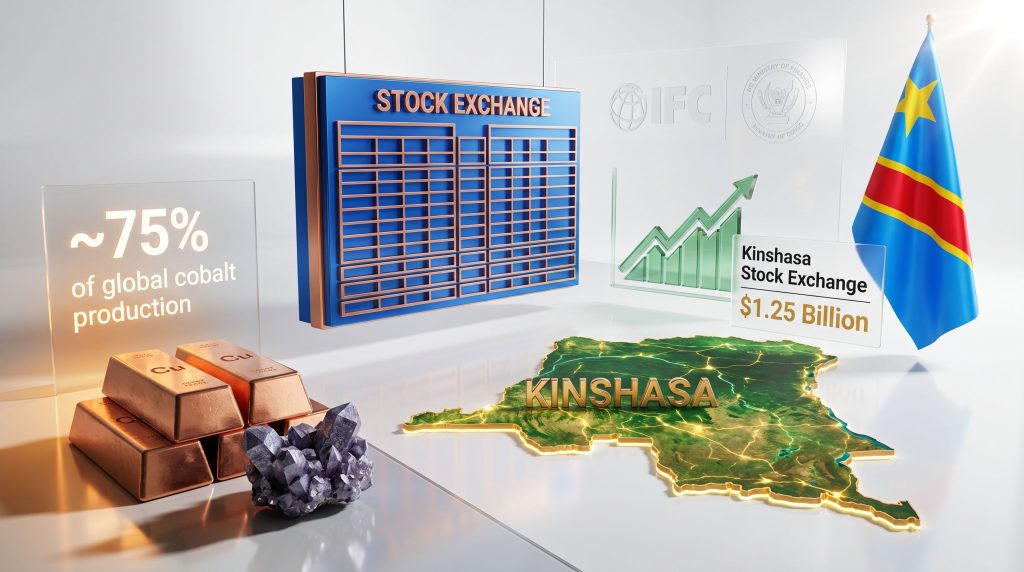
Few economies in the world present a contradiction as stark as the Democratic Republic of Congo. The country accounts for approximately 75% of global cobalt production and ranks among the world's leading copper-producing nations. It holds significant deposits of lithium, tin, gold, and coltan — and the DRC natural resources picture is one of the most remarkable on earth. These are not peripheral resources; they sit at the core of electric vehicle battery manufacturing, grid-scale energy storage, and the broader global electrification agenda.
Yet the DRC has never operated a formal stock exchange. Capital market activity has been confined to treasury bonds, corporate bonds, and private placements, overseen by the Central Bank of the Congo (BCC) and the Ministry of Finance. Institutions designed for monetary policy and fiscal oversight, not securities regulation, have been carrying the entire weight of a capital market function that simply does not yet exist in any modern sense.
The human dimension of this paradox is equally striking:
| Economic Indicator | DRC Status |
|---|---|
| Share of global cobalt production | ~75% (2024) |
| Population living below poverty line | More than 70% |
| Adults holding formal bank accounts | Fewer than 40% (World Bank) |
| Operational stock exchanges | Zero |
| Current capital market instruments | Treasury bonds, corporate bonds, private placements |
This is not simply a development story. It is a structural anomaly in the global economy, one that the DRC Kinshasa Stock Exchange project is specifically designed to begin addressing.
What the IFC Partnership Actually Means
On 18 June 2026, the DRC Ministry of Finance formalised a cooperation agreement with the International Finance Corporation (IFC), the private-sector lending arm of the World Bank Group, to support the development of the Kinshasa Stock Exchange. Finance Minister Doudou Fwamba Likunde Li-Botayi signed the agreement alongside IFC Country Director Malick Fall in Kinshasa.
The partnership is not a funding commitment or a construction contract. It is a technical and institutional framework organised around six operational pillars:
- Designing the legal architecture for securities issuance and trading
- Building the technical infrastructure required for exchange operations
- Upskilling regulators, brokers, and financial intermediaries
- Importing best practices from established African and global exchanges
- Attracting both domestic retail investors and international institutional capital
- Providing stabilisation support during the KSE's early operational years
Each of these pillars represents a distinct institutional challenge. Regulatory design alone typically takes years in frontier market contexts, requiring the drafting of primary legislation, secondary regulations, enforcement protocols, and dispute resolution mechanisms. The IFC's involvement signals that this process will be anchored to international standards from the outset, which matters enormously for investor confidence.
The Legislative Pathway: Where Things Stand
A draft financial markets law has cleared both Cabinet and the National Assembly and currently awaits Senate consideration. If enacted, it would create five core institutional pillars:
| Institution | Function |
|---|---|
| Kinshasa Stock Exchange (KSE) | Primary equity and debt trading platform |
| Commodities Exchange | Agricultural, mining, and industrial product trading |
| Capital Markets Authority | Independent regulatory and supervisory body |
| Central Securities Depository | Centralised record-keeping for securities ownership |
| Settlement Institutions | Post-trade clearing and settlement infrastructure |
Senate deliberations have surfaced concerns that carry genuine analytical weight. Senator Will Mosubu Bussa raised formal objections regarding private sector readiness, specifically questioning whether the scale of the DRC's informal economy and the governance standards of local firms are compatible with public listing requirements. These are not obstructionist concerns. They reflect a challenge that has constrained exchange development across multiple African markets.
Critical Context: In many frontier economies, the pipeline problem is more limiting than the regulatory problem. Even well-designed exchanges struggle when the available pool of companies capable of meeting disclosure, auditing, and governance standards is thin. The DRC's informal sector dominance makes this a live risk for the KSE from day one.
Three specific legislative concerns have been identified:
- The dominance of informal economic activity and its structural incompatibility with exchange transparency requirements
- Whether domestic businesses can realistically meet auditing, reporting, and governance thresholds required for listing
- The absence of a developed secondary market to provide post-listing liquidity and prevent price stagnation
The Eurobond Signal: Why Timing Matters
Earlier in 2026, the DRC completed its debut Eurobond issuance, raising $1.25 billion on international capital markets. This was the country's first-ever sovereign borrowing from global bond investors, and its reception carried significant informational value.
International investors priced and absorbed DRC sovereign risk. That is a non-trivial outcome for a country with the DRC's historical profile. Policymakers read the Eurobond's successful close as evidence that a broader financial architecture, including an equity exchange, is now a credible institutional ambition rather than a distant aspiration.
The Eurobond also matters for a more technical reason. It established an international yield benchmark for DRC sovereign debt, creating a reference rate against which future domestic capital market instruments can be priced. Without that benchmark, domestic securities pricing would operate in an informational vacuum, making it harder to attract institutional investors who rely on comparative pricing frameworks.
Alongside the Eurobond debut, a parallel banking sector expansion has been underway. Access Holdings, FirstHoldCo, Ecobank, Equity Group, KCB Group, and CRDB Bank have all extended their DRC presence in recent years. Their collective strategic bet reflects confidence in a market of more than 100 million people, low banking penetration, and sustained resource-linked economic activity. This banking sector deepening is directly relevant to exchange development: it creates the institutional intermediary layer — comprising brokers, custodians, and market makers — that a functioning stock exchange depends upon.
Where the KSE Fits in Africa's Exchange Landscape
The DRC's initiative is part of a broader continental pattern. The Ethiopian Securities Exchange launched in January 2025, ending more than five decades without a formal equity market in Africa's second-most-populous nation. Ethiopia's experience offers the DRC a near-term case study in early-stage exchange development, including the challenges of building a listing pipeline in an economy where state-owned enterprises dominate and private sector governance remains uneven. Furthermore, a broader look at African stock exchanges reveals just how varied the continent's capital market development has been.
| Exchange | Country | Established | Scale |
|---|---|---|---|
| Johannesburg Stock Exchange | South Africa | 1887 | ~350 listed companies |
| Nigerian Exchange Group | Nigeria | 1960 | ~155 listed companies |
| Nairobi Securities Exchange | Kenya | 1954 | ~65 listed companies |
| Ethiopian Securities Exchange | Ethiopia | 2025 | Early-stage |
| Kinshasa Stock Exchange | DRC | Proposed | Pre-launch |
What differentiates the DRC from Ethiopia, Nigeria, or Kenya in this context is the specific nature of its economic assets. The mineral endowment that makes the DRC central to global supply chains is the same endowment that could anchor early-stage KSE listings in mining, resource processing, and infrastructure. If large mining-linked companies are eventually required or incentivised to list locally, the exchange would bypass the thin-pipeline problem that has plagued other frontier market bourses.
Speculative Perspective: One underexplored possibility is that the KSE could become a specialist destination for critical mineral equity instruments, allowing investors to gain regulated, exchange-listed exposure to cobalt and copper production without navigating the opacity of private financing arrangements. This would be structurally differentiated from any other African exchange currently in operation.
The next major ASX story will hit our subscribers first
The Four Economic Objectives Driving This Project
Beyond the mechanics of exchange operations, the KSE's advocates have articulated four transformational economic goals:
- Mobilising dormant domestic savings into productive investment vehicles rather than informal or offshore holdings
- Diversifying corporate financing away from bank debt and foreign direct investment toward equity-based capital
- Enabling citizen participation in the ownership of companies operating in strategically important sectors
- Elevating corporate governance standards by using listing requirements as an accountability mechanism across the private sector
The fourth objective is often underappreciated. Exchange listing requirements function as a form of governance infrastructure. The obligation to publish audited financial statements, disclose material events, and maintain independent boards imposes accountability standards that extend far beyond the exchange itself, gradually reshaping norms across the broader business environment.
Five Structural Barriers That Must Be Overcome
Optimism about the KSE's potential must be balanced against a clear-eyed assessment of what stands between the current cooperation agreement and a functioning exchange. Capital market development specialists consistently identify the following non-negotiable preconditions for exchange viability in frontier economies:
- A credible, independent supervisory authority with enforcement powers and institutional legitimacy
- Anchor listing companies with established revenue profiles and investor recognition
- A functioning secondary market that provides post-listing liquidity and prevents the exchange from becoming a one-way issuance mechanism
- A professional services ecosystem covering accounting, auditing, legal, and brokerage functions
- Structured investor education programs embedded across financial literacy curricula at both retail and institutional levels
The DRC currently lacks most of these in their fully developed form. The proposed Capital Markets Authority does not yet exist. The listing pipeline is undetermined. Secondary market infrastructure is absent. Professional services capacity in securities law and exchange-grade auditing is limited. Each of these gaps represents a multi-year construction project, not a procedural checkbox.
What This Means for Global Critical Mineral Investors
For investors tracking the intersection of African capital markets and clean energy supply chains, the DRC Kinshasa Stock Exchange represents something genuinely new. The DRC's position in global cobalt and copper supply chains is structurally irreplaceable in the near to medium term. However, it is worth noting that the DRC cobalt export ban has added further complexity to an already intricate supply chain picture. Demand for both commodities is forecast to remain elevated as electrification investment accelerates worldwide.
In addition, the cobalt export impact on global pricing has underscored just how central the DRC's policy decisions are to international markets. Meanwhile, the Congolese cobalt rivalry between major powers continues to shape the geopolitical backdrop against which exchange development is unfolding. Consequently, the US-Congo mining partnership signals that Western capital is increasingly looking for structured, regulated access points to Congolese assets — precisely what a functioning KSE could one day provide.
A listed exchange in Kinshasa could eventually provide:
- Direct equity exposure to Congolese mining, banking, telecom, and infrastructure operators
- A regulated frontier market gateway for emerging market fund managers seeking differentiated access to critical mineral economies
- Potential for commodity-linked equity instruments connecting global clean energy demand to DRC-based production assets
Investors should note that all projections regarding KSE operations, listing timelines, and potential instruments are speculative at this stage. No launch date has been confirmed, and the enabling legislation has not yet received Senate approval.
Frequently Asked Questions: DRC Kinshasa Stock Exchange
Does the DRC Currently Have a Stock Exchange?
No. As of mid-2026, the DRC does not operate any formal stock exchange. Capital market activity is limited to treasury bonds, corporate bonds, and private placements, overseen by the Central Bank of the Congo and the Ministry of Finance.
When Will the Kinshasa Stock Exchange Open?
No official launch date has been confirmed. The enabling legislation is currently before the Senate. Full operationalisation requires legislative approval, establishment of the Capital Markets Authority, construction of trading infrastructure, and completion of investor readiness programs. For further context, groundwork for the exchange has been a subject of considerable academic and policy scrutiny in recent years.
What Role Is the IFC Playing?
The IFC is providing technical assistance across six areas: regulatory framework design, market infrastructure development, capacity building, knowledge transfer, investor base expansion, and early-stage market support.
How Does the Eurobond Connect to the Exchange?
The DRC's $1.25 billion debut Eurobond in early 2026 demonstrated the country's ability to access international capital markets and established an international sovereign yield benchmark, creating credibility and momentum for broader financial infrastructure development, including the KSE.
Which African Countries Have Recently Launched New Exchanges?
Ethiopia launched the Ethiopian Securities Exchange in January 2025, becoming one of the most recent African nations to establish a formal securities market. The DRC's KSE, if approved and operationalised, would follow as one of the continent's newest and most strategically significant exchanges.
From Extraction Economy to Capital Market Participant
The Kinshasa Stock Exchange project represents something more significant than a financial infrastructure upgrade. It reflects a deliberate attempt to reframe the DRC's position in the global economy. A country long defined by what lies beneath its soil is taking concrete steps to build the institutions that govern what happens above ground.
The IFC partnership, the Eurobond debut, the expanding banking sector presence, and the pending capital markets legislation form the most coherent financial modernisation framework the DRC has yet assembled. The risks are real and the timelines are long. But the directional shift is unambiguous, and for investors, analysts, and policymakers watching African capital markets evolve, the DRC Kinshasa Stock Exchange is now a development worth watching with serious attention.
Want to Stay Ahead of Major Mineral Discoveries Linked to Africa's Critical Mineral Boom?
Discovery Alert's proprietary Discovery IQ model delivers real-time alerts on significant ASX mineral discoveries — including those tied to cobalt, copper, and the critical minerals at the heart of global electrification — instantly translating complex data into actionable investment opportunities. Explore how historic discoveries have generated substantial returns on Discovery Alert's dedicated discoveries page, and begin your 14-day free trial today to position yourself ahead of the market.