June 24, 2026
The Capital Paradox at the Heart of Industrial Decarbonisation
The steel industry is responsible for roughly 8% of global carbon dioxide emissions, making it one of the most significant and hardest-to-abate sectors in the global economy. Decarbonising it requires not just new technology, but an entirely new financial architecture, one capable of sustaining capital-intensive projects across multi-year construction timelines where commercial returns remain distant and execution risk remains high.
This is the fundamental tension that defines the green steel investment landscape: the projects most critical to long-term climate and industrial goals are precisely the ones that carry the most complex risk profiles for conventional project finance. Understanding this paradox is essential to grasping why the Stegra $1.6bn financing round, formally closed on June 24, 2026, represents something considerably more significant than a single company securing construction capital.
When big ASX news breaks, our subscribers know first
Why Green Steel Financing Is Structurally Different From Conventional Project Finance
The Upfront Capital Burden of Hydrogen-Based Steelmaking
Traditional blast furnace steelmaking, while carbon-intensive, benefits from decades of operational data, established supply chains, and well-understood cost curves. Green hydrogen-based steelmaking, by contrast, requires investors to commit billions of dollars to infrastructure that has no direct commercial precedent at scale.
The core technology involves a process called direct reduction of iron ore (DRI), in which hydrogen gas reacts with iron ore to produce metallic iron, releasing water vapour rather than carbon dioxide. Hydrogen iron ore reduction at this scale, when powered by renewable electricity, yields steel carrying near-zero embodied carbon. The chemistry is proven at smaller scales; the challenge lies in engineering and financing it at industrial volumes.
Several cost layers compound simultaneously in projects of this nature:
- Electrolyser procurement and installation at gigawatt-scale capacity
- Dedicated renewable energy infrastructure or long-term power purchase agreements
- DRI shaft furnace construction and commissioning
- Electric arc furnace integration for final steel production
- Grid connection, water supply, and ancillary industrial utilities
- Working capital to bridge the gap between commissioning and first commercial revenue
Each of these elements carries its own procurement timeline, supply chain dependencies, and cost uncertainty, creating a compounding risk profile that most traditional project finance lenders approach with significant caution.
The Northvolt Effect: How One Collapse Reshaped Nordic Green Capital Markets
The bankruptcy of Swedish battery manufacturer Northvolt in November 2024 sent a structural shock through European green industrial financing. Northvolt had been positioned as a flagship proof-of-concept for large-scale green manufacturing in the Nordic region, attracting billions in institutional and corporate investment before encountering severe operational and quality control difficulties.
The fallout extended well beyond Northvolt itself. Institutional investors applied substantially more rigorous due diligence frameworks to comparable projects, particularly those sharing several characteristics with Northvolt: first-of-kind technology at commercial scale, Nordic location, heavy public-interest framing, and multi-billion euro capital requirements. Stegra, formerly known as H2 Green Steel, shared all of these characteristics.
The lesson the market drew from Northvolt was not that green industrial transformation is impossible, but that strategic importance does not automatically translate into commercial survival. Execution discipline, cost control, and realistic commissioning timelines became the metrics investors scrutinised most carefully in the aftermath.
Breaking Down the Stegra $1.6bn Financing Round
Capital Structure and Timeline
| Capital Component | Detail |
|---|---|
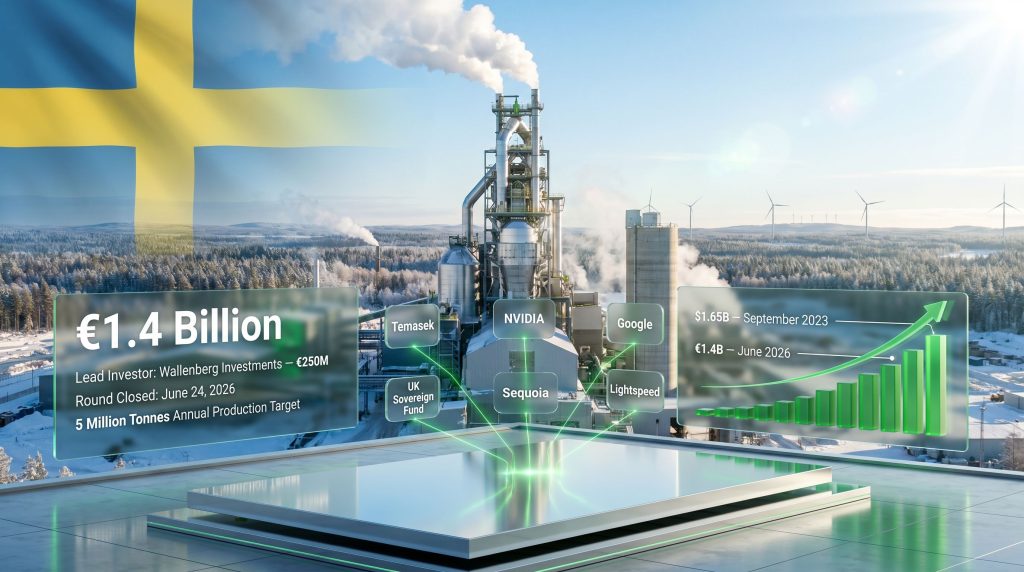
| Total Round Size | €1.4 billion (~$1.59 billion) |
| Lead Investor | Wallenberg Investments consortium |
| Wallenberg Equity Contribution | €250 million |
| Expected Ownership Outcome | Consortium positioned for majority stake |
| Lender Group Approval | 100% of existing Stegra lenders |
| Round Announced | April 2026 |
| Formally Closed | June 24, 2026 |
| Previous Major Raise | $1.65 billion, September 2023 |
The two-and-a-half-year gap between Stegra's 2023 capital raise and this 2026 round captures the full arc of the Nordic green capital contraction. The company maintained construction momentum through one of the most difficult financing environments for green industrial projects in recent memory, ultimately securing fresh capital from a notably diverse investor consortium.
The Wallenberg Consortium: Industrial Dynasty Meets Green Transition
The Wallenberg family's involvement in Swedish industrial history stretches back over 150 years, encompassing foundational investments in companies including Ericsson, ABB, and Saab. Wallenberg Investments' decision to lead the Stegra round with a €250 million equity contribution carries weight that extends beyond the financial figure itself.
Marcus Wallenberg, Chair of Wallenberg Investments, publicly characterised the project as having clear importance to Sweden while explicitly conditioning the success of that investment on disciplined execution quality. This framing is significant because it reflects a sophisticated investor posture that distinguishes between the strategic rationale for a project and any guarantee of its financial outcome.
The broader consortium assembled around this round is arguably its most analytically interesting feature:
- Temasek (Singapore's sovereign wealth fund) brings cross-border institutional confidence in European green steel economics
- Sequoia and Lightspeed, both primarily known as technology venture capital firms, reflect the convergence of deep-tech and industrial investment theses in next-generation manufacturing
- NVIDIA and Google as corporate strategic investors signal the data-driven and energy-intensive dimensions of hydrogen-based industrial production
- UK Sovereign Fund and British Business Bank provide public-sector capital that creates a blended finance architecture reducing the risk profile for private participants
- IMA rounds out the consortium alongside these anchor investors
- Existing shareholders Altor, Hy24, and Just Climate maintained their positions, providing continuity of institutional conviction from the original capital raise
The participation of technology-sector investors like NVIDIA and Google is particularly noteworthy. It suggests that the strategic logic of securing access to large-scale, near-zero emission industrial production is compelling enough to attract capital from sectors with no traditional exposure to the steel and iron ore market.
What Stegra Is Actually Building: The Boden Facility
Operational Design and Production Targets
Stegra's facility is located in Boden, northern Sweden, a site chosen deliberately for its proximity to abundant renewable energy resources, specifically hydropower and wind, and its access to Scandinavian iron ore supply chains. The facility is designed to produce up to 5 million tonnes of near-zero emission steel annually using green hydrogen as the primary reducing agent.
To contextualise that production target:
- European steel consumption runs at approximately 150 to 160 million tonnes per year
- A fully operational Boden facility would represent roughly 3% of total European demand from a single green source
- At that throughput, the facility would rank among the largest single-site green iron production operations globally
- The scale is sufficient to underpin long-term offtake agreements with major automotive, construction, and industrial manufacturing customers seeking to reduce their Scope 3 emissions
The Green Hydrogen Supply Chain: The Critical Bottleneck
Perhaps the least visible risk in Stegra's project economics is the hydrogen supply chain itself. Producing 5 million tonnes of steel via DRI requires enormous volumes of hydrogen, which in turn requires massive quantities of renewable electricity and large-scale electrolyser capacity.
Green hydrogen production at the volumes required for industrial-scale steelmaking represents one of the most logistically complex infrastructure challenges in European industrial history. The electrolyser capacity required, combined with dedicated renewable power supply, effectively means Stegra must coordinate the development of what amounts to a parallel energy infrastructure project alongside the steel plant itself.
Northern Sweden's renewable energy abundance provides a structural locational advantage. However, the electrolyser manufacturing supply chain globally remains constrained relative to the cumulative demand from multiple sectors competing simultaneously for capacity, including steel, shipping, aviation, and chemicals.
The 100% Lender Approval Signal: What It Tells Sophisticated Investors
One of the most analytically significant details in the Stegra $1.6bn financing round is the unanimous approval received from the company's existing lender group. In the world of large-scale project finance, this outcome deserves careful examination.
Lenders to first-of-kind industrial projects typically hold significant leverage at refinancing or restructuring events. When a project faces capital gaps, lenders must decide whether continued exposure at potentially improved terms is preferable to restructuring, debt-for-equity swaps, or exit. A 100% approval rate signals that every existing debt holder conducted an independent reassessment and concluded that the project's completion pathway was credible enough to justify continued commitment.
This outcome carries several implications:
- It substantially reduces refinancing risk during the next phase of construction and commissioning
- It provides an independent validation of project viability that complements the equity investor consortium's participation
- It signals that the project's revised construction plan and capital structure addressed the key concerns that had previously created the funding gap
- It reduces the probability of a distressed capital event during the critical commissioning phase
Risks That Still Demand Investor Attention
Construction Execution at Unprecedented Scale
Hydrogen-based steelmaking at 5 million tonnes per annum has no direct operational blueprint at this scale. Stegra's construction and engineering teams are solving problems without the benefit of a comparable facility to reference. Cost overruns in analogous green industrial megaprojects have historically ranged from 20% to 50% above initial estimates, driven by supply chain volatility, specialist labour shortages, and the inherent unpredictability of commissioning novel process technology.
The electrolyser supply chain dependency is particularly acute. Delays in electrolyser delivery or performance shortfalls during ramp-up could compress the facility's early operating economics significantly, as the green hydrogen production cost represents one of the largest variable inputs in the production process.
The CBAM Factor: Policy Tailwind With Execution Uncertainty
The European Union's Carbon Border Adjustment Mechanism (CBAM) creates a structural pricing advantage for near-zero emission steel by imposing carbon costs on imports from regions without equivalent carbon pricing. For Stegra, CBAM represents a meaningful long-term competitive tailwind because it narrows the cost premium associated with green steel pricing over conventional blast furnace production.
However, CBAM implementation has proceeded in phases, and the precise timing of full sectoral coverage for steel introduces policy risk into Stegra's financial modelling. If CBAM scope adjustments delay the full pricing advantage, the competitive economics of green steel versus conventional imports may remain less favourable during the critical early production years when the facility needs maximum revenue to service its capital structure.
The next major ASX story will hit our subscribers first
Three Structural Implications for European Green Manufacturing
The Stegra $1.6bn financing round is not simply a company-level capital event. It carries structural implications for how European green industrial projects will be financed over the next decade.
1. Blended capital models are becoming the template
The combination of sovereign wealth, institutional equity, corporate strategic capital, venture investment, and public-sector participation in a single industrial financing round reflects the maturation of green infrastructure as an asset class. No single investor category can carry the full risk of projects at this scale; multi-stakeholder capital architecture is becoming the necessary structural response.
2. First-mover survival carries disproportionate strategic value
As competing European green steel projects have been curtailed or abandoned due to the same capital and hydrogen scaling challenges that tested Stegra, the competitive landscape has concentrated. A successfully commissioned Boden facility would establish a reference plant that substantially de-risks subsequent investment across the entire sector. Furthermore, green iron production in Australia and other regions is watching closely, as European first-mover outcomes will shape global investment appetite for comparable projects.
3. Execution quality will determine whether this financing becomes a market catalyst or a cautionary tale
The explicit conditioning of commercial success on execution quality, reflected in the Wallenberg consortium's public framing, articulates what the broader market already understands: capital is necessary but not sufficient for first-of-kind industrial transformation. The Stegra story will ultimately be judged not on the sophistication of its financing structure, but on whether tonnes of near-zero emission steel actually reach customers on schedule and within budget.
Frequently Asked Questions: Stegra $1.6bn Financing Round
What is Stegra and what does it produce?
Stegra, formerly known as H2 Green Steel, is a Swedish green steel company developing Europe's first commercial-scale hydrogen-based steel plant in Boden, Sweden. The facility is designed to produce up to 5 million tonnes of near-zero emission steel annually using green hydrogen as the primary iron-reducing agent, replacing the coal used in conventional blast furnace steelmaking.
Who led the Stegra $1.6bn financing round?
The round was led by Wallenberg Investments, representing Sweden's Wallenberg family, which contributed €250 million in equity. The wider consortium includes Temasek, IMA, Sequoia, Lightspeed, NVIDIA, Google, the UK Sovereign Fund, and the British Business Bank, alongside existing shareholders Altor, Hy24, and Just Climate.
When was the Stegra financing round completed?
The round was announced in April 2026 and formally closed on June 24, 2026, with 100% approval from Stegra's existing lender group confirming the complete capital structure.
How much did Stegra raise previously?
Stegra raised $1.65 billion in September 2023. The 2026 round of €1.4 billion represents a subsequent capital injection required to maintain construction momentum and achieve a fully funded path to completion of the Boden facility.
Why is green hydrogen steel significant for European industry?
Green iron production eliminates the carbon dioxide emissions associated with conventional coal-based blast furnace steelmaking by using hydrogen generated from renewable electricity to chemically reduce iron ore. At commercial scale, it represents one of the most viable industrial-scale pathways to decarbonising a sector responsible for approximately 8% of global emissions, making it critical to European industrial competitiveness under tightening carbon pricing regimes.
This article contains forward-looking statements and analysis related to green steel market dynamics, project economics, and regulatory frameworks. These involve inherent uncertainties and should not be construed as financial advice. Investors should conduct independent research and seek professional guidance before making investment decisions related to any company or project referenced in this article.
Ready to Identify the Next Major ASX Resource Discovery Before the Market Moves?
Discovery Alert's proprietary Discovery IQ model scans ASX announcements in real time, delivering instant alerts on significant mineral discoveries — including the iron ore and critical minerals sectors driving green industrial transformation — so subscribers can act on actionable opportunities ahead of the broader market. Explore Discovery Alert's discoveries page to understand how historic ASX discoveries have generated substantial returns, and begin your 14-day free trial today.