
June 24, 2026
When Majors Exit and Specialists Enter: Decoding the Ithaca Resources Vitrinite Assets Deal
Australia's metallurgical coal sector is undergoing a quiet but consequential ownership transformation. Over the past decade, the companies that built the Bowen Basin into one of the world's premier coking coal provinces have been methodically reducing their exposure, transferring assets to a new generation of specialist operators. The Ithaca Resources Vitrinite assets deal is the latest and perhaps most instructive chapter in this ongoing structural shift.
Understanding what this transaction reveals requires looking beyond the headline figure and examining what it tells us about the geology, economics, and community dynamics of Queensland's most productive coal corridor. Furthermore, the coal supply challenges reshaping the broader market add important context to how this deal came about.
When big ASX news breaks, our subscribers know first
What Metallurgical Coal Actually Is and Why It Remains Strategically Different
Not all coal is equal, and conflating metallurgical coal with thermal coal is one of the most persistent errors in mainstream coverage of the industry. Thermal coal is burned to generate electricity and faces genuine long-term structural demand headwinds as renewable energy capacity expands globally. Metallurgical coal, by contrast, is used to produce the coke that fuels blast furnaces in steelmaking. There is currently no commercially scalable alternative to coking coal in the production of primary steel at the volumes the global economy demands.
Premium hard coking coal, the grade produced at the Vulcan site, sits at the top of the quality hierarchy within the metallurgical coal category. It is characterised by:
- High carbon content and low ash and sulphur concentrations
- Superior coke strength after reaction (CSR), a key industrial performance metric
- Strong coking properties that command significant price premiums over lower-ranked thermal or semi-soft coking coals
- Concentrated global supply, with Australia and Canada accounting for the overwhelming majority of seaborne exports
Australia exports approximately 170 million tonnes of metallurgical coal annually, retaining its position as the world's largest seaborne supplier of the product. The Bowen Basin in Queensland is the geographic centre of that export capability, making any significant transaction within the basin worthy of close analysis.
The Vulcan Asset Package: What Ithaca Resources Actually Purchased
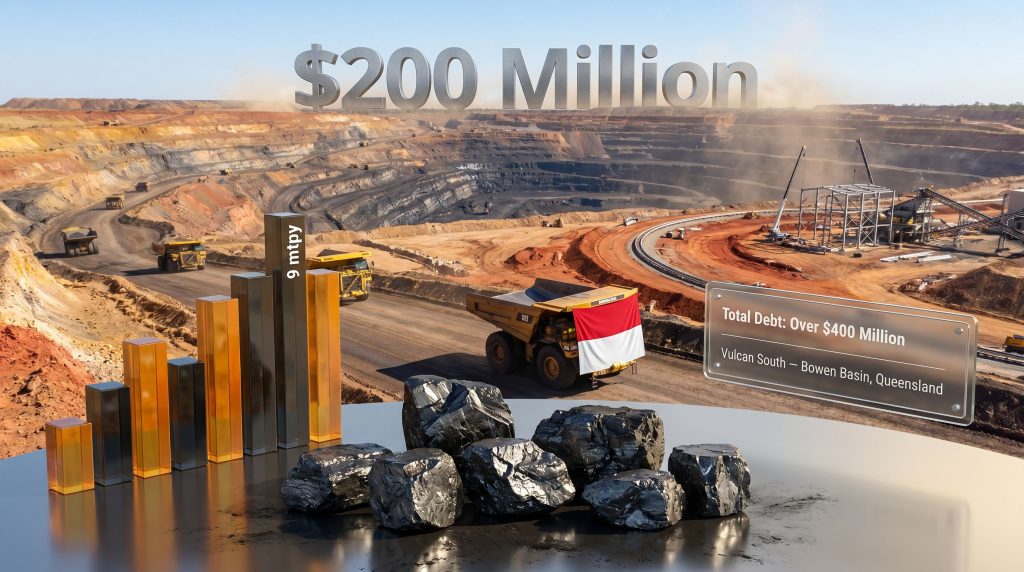
The Ithaca Resources Vitrinite assets deal centres on the Vulcan South open-cut metallurgical coal operation, positioned between the mining towns of Moranbah and Dysart in the Bowen Basin. The transaction, completed through receivership managers KordaMentha, was valued at more than $200 million.
| Asset Component | Detail |
|---|---|
| Mine Type | Open-cut metallurgical coal operation |
| Location | Between Moranbah and Dysart, Bowen Basin, Queensland |
| Projected Annual Output | Up to 9 million metric tons per year |
| Coal Grade | Premium hard coking coal |
| Transaction Value | More than $200 million (AUD) |
| Planned Infrastructure | Dedicated rail loop and wash plant |
| Future Expansion | Second mining lease approval pending |
The inclusion of infrastructure development plans within the deal is particularly significant. A dedicated rail loop would reduce dependence on shared corridor capacity and potentially lower per-tonne logistics costs at scale. The planned coal wash plant, or preparation plant, would allow Vulcan to process run-of-mine coal on site, separating the saleable product from waste material and enabling Ithaca to deliver specification-grade product directly to export customers without relying on third-party processing facilities.
These infrastructure ambitions signal that Ithaca is not approaching this as a short-term extraction play. Building a wash plant and rail loop requires substantial capital commitment and a multi-year production outlook to justify the expenditure. The pending approval of a second mining lease, if secured, would further extend the operational footprint and potentially increase the recoverable reserve base beyond the currently defined Vulcan South area.
Vitrinite's Collapse: Understanding the Financial Architecture of Failure
To properly assess the Ithaca Resources Vitrinite assets deal, it is necessary to understand how Vitrinite reached insolvency in the first place. The administrator's report compiled by Cor Cordis identified the effective insolvency date as 30 September 2025, driven by two compounding pressures: elevated operational costs and sustained weakness in metallurgical coal prices. In addition, the broader metallurgical coal price update for 2025 confirms that price weakness was a sector-wide phenomenon, not an isolated company issue.
Key Financial Snapshot: Vitrinite's Insolvency Profile
- Effective insolvency date: 30 September 2025
- Total debt at collapse: Over $400 million
- Employee entitlements owed: $16 million
- Debt to commodities trading house: $177 million
- Debt to other creditors: $265.9 million
- Vulcan mine placed into care and maintenance: 27 February 2026
- Receivers appointed: KordaMentha
Several factors made Vitrinite's position particularly precarious. Open-cut coal operations carry high fixed cost structures, with large mining fleets, overburden removal contracts, and haulage obligations that continue accruing regardless of prevailing coal prices. When metallurgical coal spot prices declined significantly after the Vulcan mine commenced operations, the margin between Vitrinite's cost of production and achievable revenue compressed rapidly.
The $177 million liability to a commodities trading counterparty is a detail that warrants particular attention. Prepayment or streaming arrangements with commodities traders are a common financing mechanism for smaller mining companies that cannot access conventional corporate debt markets at competitive rates. These arrangements effectively monetise future production in advance, but they create rigid financial obligations that become extremely difficult to service when output is disrupted or prices fall below modelled assumptions.
This financing structure likely constrained Vitrinite's ability to respond flexibly to deteriorating market conditions, accelerating the path toward receivership once liquidity tightened.
What the $200 Million Price Says About Asset Value and Market Sentiment
The sale price of more than $200 million against a total debt burden exceeding $400 million represents a significant discount to Vitrinite's liability stack, but this framing can be misleading. Distressed asset pricing reflects current liquidation value and restart risk, not the long-term economic potential of the resource itself.
Several dimensions of the deal structure actually suggest strong underlying buyer conviction:
- Speed of transaction: The four-month period from receivership to confirmed sale is relatively compressed for an asset of this complexity. Extended marketing periods typically indicate buyer hesitation or structural complications.
- Commitment to employee entitlements: Ithaca's agreement to settle outstanding worker entitlements as part of the transaction is not a standard feature of distressed asset purchases. It adds to the headline cost and signals an intent to re-engage the workforce rather than operate with a clean-slate labour strategy.
- Infrastructure investment signals: The commitment to developing a dedicated rail loop and wash plant indicates that Ithaca has modelled a multi-decade production scenario, not simply a value extraction play.
- First international acquisition: For Ithaca Resources, founded in 2007 and operating exclusively within Indonesian jurisdiction for nearly two decades, the Vulcan South project represents its first step outside Indonesia. Companies rarely select a distressed offshore acquisition as their international debut unless they have considerable conviction about the underlying asset quality.
As regional economics expert Professor John Rolfe of Central Queensland University has observed, the rapid turnaround in finding a buyer for the Vulcan assets reflects genuine market confidence in the long-run economics of Bowen Basin operations, even amid an environment of significant corporate-level upheaval across the sector. (Source: ABC News, June 2026)
The Ownership Transformation of Australian Coal: A Structural Pattern
The Ithaca Resources Vitrinite assets deal does not exist in isolation. It is part of a clearly identifiable pattern of asset transfer from large, diversified, publicly listed miners to smaller, specialist operators, many of them privately held and domiciled outside Australia. Consequently, the mining industry consolidation underway across the sector provides a useful framework for understanding why these deals keep emerging.
| Transaction | Acquirer | Asset Type | Approximate Value |
|---|---|---|---|
| Vitrinite (Vulcan South) | Ithaca Resources (Indonesia) | Metallurgical coal, distressed sale | ~$200 million+ |
| Anglo American CQ mines | Dhilmar Ltd (United Kingdom) | Five steelmaking coal mines | Up to $5.43 billion |
| Blackwater and Daunia mines | Whitehaven Coal (Australia) | Metallurgical coal | Multi-billion dollar |
| Mitsui Coal stake | Various | Metallurgical coal | Not fully disclosed |
| Mt Arthur coal mine | Wind-down announced | Thermal coal | By 2030 |
The drivers behind major miner divestment are well documented. As Professor Rolfe has noted, large diversified companies with broad investor bases have faced sustained shareholder pressure around fossil fuel exposure, particularly from institutional investors with formal ESG mandates. Rather than contest those pressures, companies like BHP and Anglo American have elected to reallocate capital toward critical minerals, copper, nickel, and other commodities aligned with electrification and decarbonisation supply chains.
This creates a structural arbitrage opportunity for operators who remain committed to metallurgical coal as a long-term business. When majors sell, they often do so at prices that reflect their internal cost of capital and reputational considerations rather than the fundamental value of the resource. Specialist buyers, unencumbered by ESG-driven divestment pressure, can acquire these assets at attractive entry points.
The next major ASX story will hit our subscribers first
Risk Concentration and the Community Resilience Question
The ownership transformation underway in the Bowen Basin carries genuine risks that should not be minimised in any honest assessment of the Ithaca Resources Vitrinite assets deal's broader implications.
Large, diversified mining companies have historically cross-subsidised their community investment commitments, infrastructure contributions, and workforce stability programs from portfolio-level cash flows. A price downturn at one asset could be buffered by stronger performance elsewhere. Specialist operators with single-asset or narrow-portfolio structures do not have this flexibility.
As Professor Rolfe has pointed out publicly, the key unresolved question is whether incoming specialist operators can maintain their support for regional communities through periods of commodity price weakness, and whether the frequency of ownership changes will itself become a source of disruption for towns like Moranbah and Dysart. (Source: ABC News, June 2026)
The case of one Dysart-based automotive services business illustrates the vulnerability of local supply chains:
- The business invested approximately $750,000 in dedicated facilities to service Vitrinite's haulage road train fleet in 2025, described by its owner as the single largest customer commitment in the company's 15-year history
- Within seven months, overdue invoices had accumulated into the hundreds of thousands of dollars
- The business recovered its outstanding debt prior to the formal receivership appointment, placing it among the more fortunate creditors in what was a complex liability stack
- Many other suppliers and creditors did not recover their full entitlements
This episode highlights a structural vulnerability that is easily overlooked in high-level transaction analysis. Regional businesses that make capital investments to service mining customers carry asymmetric risk exposure. Their upfront costs are fixed, their customer concentration is often high, and their ability to recover funds from an insolvent mining company through formal processes is uncertain and time-consuming. The resources sector economic contribution to regional communities underscores just how much is at stake when these supply chain relationships break down.
The Path to Restart: Operational Milestones for Ithaca at Vulcan South
What Are the Key Steps Before Production Resumes?
With the Ithaca Resources Vitrinite assets deal confirmed, attention turns to the restart timeline. Several sequential milestones must be completed before the first tonne of coal is extracted under new ownership:
- Completion of the creditors' meeting scheduled for 29 June 2026
- Formal transfer of asset ownership from KordaMentha to Ithaca Resources
- Regulatory approvals for the second mining lease expansion
- Detailed engineering and procurement planning for the rail loop and wash plant
- Workforce recruitment, re-engagement, and site recommissioning
- Progressive return to open-cut mining operations
The sequencing matters because each stage has dependencies. Regulatory lease approvals, in particular, can introduce timing uncertainty that affects downstream investment planning. Ithaca's commitment to settling employee entitlements is likely to assist workforce re-engagement, as former Vitrinite employees will have a clearer sense of their financial standing before deciding whether to return to site.
At full production of 9 million metric tons per year, the Vulcan operation would represent a meaningful contribution to Queensland's metallurgical coal export volumes and a significant employment base for the surrounding communities.
The Internationalisation of Australian Coal Ownership
One dimension of the Ithaca Resources Vitrinite assets deal that deserves specific attention is the nationality of the buyer. Indonesian capital entering the Australian coal sector reflects a broader internationalisation of resource asset ownership that has accelerated as Australian and European majors have divested.
Does Indonesian Expertise Translate to the Bowen Basin?
Indonesian coal producers have deep experience managing large-scale thermal coal operations in Kalimantan and Sumatra. However, the technical requirements of premium hard coking coal mining differ substantially from thermal coal operations. Coking coal demands tighter geological selectivity, more precise blending of different seam sections to hit product specifications, and more sophisticated coal preparation infrastructure to achieve the ash, sulphur, and coking property targets that steelmakers specify in their purchasing contracts.
The planned wash plant at Vulcan South is therefore not simply a capital expenditure decision but a technical necessity. Without on-site preparation capability at the required throughput, delivering a consistent premium hard coking coal product to export customers at the volumes and specifications that command top-tier pricing would be extremely difficult.
This technical complexity reinforces the importance of experienced operational management on the ground at Vulcan, regardless of who holds equity ownership at the corporate level. Furthermore, the China steel market dynamics will play a significant role in shaping the long-term demand outlook for exactly the grade of coal Vulcan produces.
What the Bowen Basin's Contested Future Means for Investors and Communities
The Ithaca Resources Vitrinite assets deal encapsulates a tension at the heart of Australia's coal sector: an asset class that global capital markets are progressively repricing downward continues to attract committed specialist buyers because the physical demand for premium metallurgical coal in steelmaking remains robust.
For investors, the key analytical distinction is between thermal and metallurgical coal demand trajectories, and between the ESG-driven capital market repricing of coal equities and the actual physical market dynamics for coking coal in Asia's steel industry. These two forces are frequently conflated in public discourse but operate on very different timeframes and are driven by very different variables.
For communities in Central Queensland, the more immediate question is whether the incoming generation of specialist operators, including Ithaca at Vulcan, will demonstrate the kind of long-term regional commitment that has historically characterised the major miners. Ithaca's early signals, including its willingness to settle employee entitlements and its stated intention to restart operations, are constructive. However, whether those commitments translate into sustained community investment over the full commodity cycle remains an open question.
Local business operators in the Dysart region have called on incoming mining operators to prioritise regional labour and local supply contracts as a tangible demonstration of genuine long-term commitment to the communities that host their operations. (Source: ABC News, June 2026)
The Bowen Basin is not short of buyers, but it is entering a period where the profile of those buyers is fundamentally different from the companies that built its infrastructure. Whether that transition proves beneficial or disruptive for the people who live and work there will depend less on the deal economics and more on the operational culture and financial resilience of the new owners who now hold those assets.
Disclaimer: This article contains forward-looking statements and projections based on publicly available information. It does not constitute financial advice. Readers should conduct their own due diligence before making any investment decisions. Commodity markets are subject to significant volatility, and past performance of assets or companies is not indicative of future results.
Want to Catch the Next Major Mineral Discovery Before the Broader Market Does?
Discovery Alert's proprietary Discovery IQ model delivers real-time alerts on significant ASX mineral discoveries, transforming complex geological and commodity data into actionable investment insights for both short-term traders and long-term investors — explore historic examples of major discovery returns to understand the scale of opportunity, then begin your 14-day free trial today to position yourself ahead of the market.