
June 24, 2026
The Global Energy System's Most Vulnerable Chokepoint Is Getting a Governance Framework
Every major disruption to global oil supply over the past four decades has, at some point, involved a single question: what happens if the Strait of Hormuz closes? That question has never required a practical answer because the strait has never fully closed. But the absence of a formal, legally grounded navigation governance framework has meant that the threat alone has been enough to move oil markets, destabilise shipping insurance rates, and reshape military postures across two hemispheres.
That is now beginning to change, and the mechanism driving that change is the formal commitment to Oman toll-free passage through the Strait of Hormuz, paired with the establishment of a joint Omani-Iranian navigation management team.
This is not simply a diplomatic gesture. It represents the first structured attempt to codify navigation rights within the strait under a bilateral framework anchored in international law, with material consequences for global energy pricing, shipping economics, and the geopolitical leverage of every nation that depends on Gulf crude. Understanding these developments is essential for tracking crude oil price trends over the coming months.
When big ASX news breaks, our subscribers know first
Why the Strait of Hormuz Carries Disproportionate Strategic Weight
At its narrowest point, the Strait of Hormuz spans approximately 33 kilometres, with navigable shipping lanes that are far more constrained than that figure suggests. Yet this narrow corridor serves as the sole maritime exit for crude oil and liquefied natural gas exports from Saudi Arabia, Iraq, Kuwait, the United Arab Emirates, Qatar, and Bahrain combined.
The numbers attached to this geography are staggering:
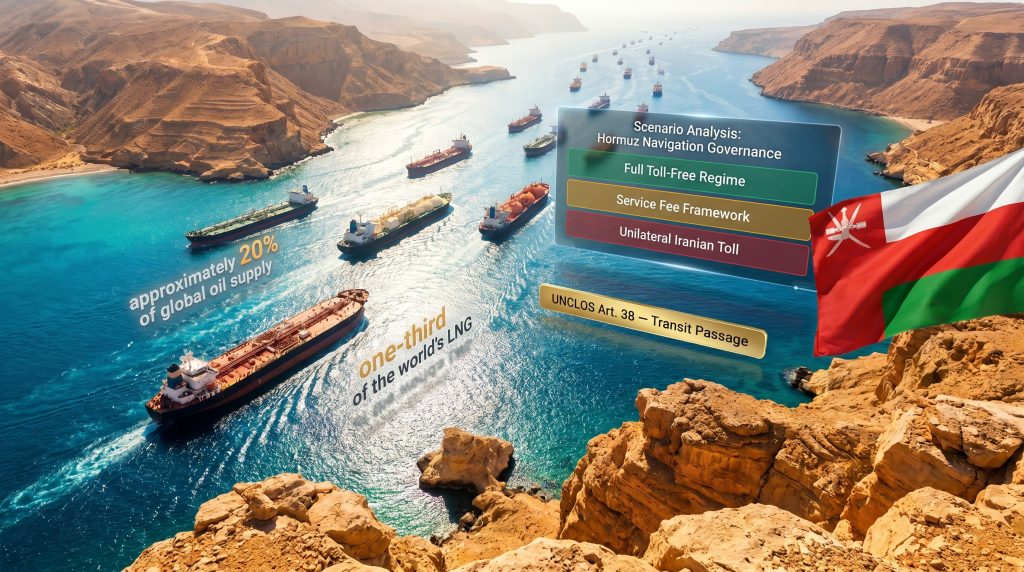
- Approximately 20% of global oil supply transits the strait on a daily basis, according to the U.S. Energy Information Administration (EIA)
- Roughly one-third of the world's LNG trade passes through this corridor annually
- On peak trading days, the strait handles as many as 21 million barrels per day of oil and petroleum products
- The waterway is flanked by Iranian territorial waters to the north and Omani territorial waters to the south, making it a shared sovereign corridor with no fully neutral zone
What makes this geography so consequential is the absence of scalable alternatives. Saudi Arabia operates the East-West Pipeline, which can carry crude from the Eastern Province to Yanbu on the Red Sea, bypassing the strait entirely. The UAE has developed the Habshan-Fujairah pipeline for a similar purpose. However, the combined capacity of these alternative routes falls dramatically short of replacing full Hormuz throughput. For most Gulf exporters, Hormuz is not merely the preferred route — it is the only viable route at the volumes required.
Furthermore, the LNG supply outlook for major Asian importers is directly tied to uninterrupted Hormuz access, adding another layer of urgency to any governance framework that emerges.
"The Strait of Hormuz is the single most concentrated point of vulnerability in the global energy supply chain. No other chokepoint combines this level of volume concentration with this degree of geopolitical uncertainty."
Nations With the Highest Hormuz Exposure
| Country | Nature of Exposure | Alternative Supply Options |
|---|---|---|
| India | Major crude importer, significant Gulf sourcing | Partial diversification to US, Russia, Africa |
| China | World's largest crude importer, heavy Gulf dependency | Strategic reserves, pipeline alternatives limited |
| Japan | Near-total Gulf crude dependency | Strategic reserves; limited supplier diversification |
| South Korea | High Gulf crude reliance | Some diversification; no full alternative |
| European importers | Partial Gulf LNG dependency | US LNG, Norwegian pipeline gas |
Understanding Oman's Legal Authority to Make This Commitment
Oman's assurance of toll-free passage is not a diplomatic courtesy extended from a distance. It is a statement made by a co-sovereign state whose territorial waters form the southern boundary of the strait's navigable lanes. This geographic reality gives Muscat a legally grounded standing that few nations can replicate in this context.
The legal architecture underpinning this commitment is the United Nations Convention on the Law of the Sea (UNCLOS), to which both Oman and Iran are parties. The relevant provisions are precise and unambiguous:
- UNCLOS Article 38 establishes the right of transit passage through international straits used for international navigation, applying to all vessels regardless of flag state
- UNCLOS Article 26 explicitly prohibits coastal states from levying charges on foreign vessels solely for exercising their right of transit passage
- The right of transit passage is broader and less restrictive than innocent passage, which applies in territorial seas but not in international straits of this classification
The practical implication is straightforward: any unilateral imposition of a transit toll by either Iran or Oman would constitute a violation of a treaty both nations have ratified. Oman's public pledge therefore functions simultaneously as a reaffirmation of its own treaty obligations and as a constraint on any Iranian ambition to monetise Hormuz access through a blanket fee structure.
The Legal Distinction That Makes or Breaks the Debate
| Legal Concept | Definition | Application to Hormuz |
|---|---|---|
| Transit Passage (Art. 38) | Right of continuous, expeditious passage through international straits | Guaranteed for all vessels transiting Hormuz |
| Innocent Passage | More restricted right; applies in territorial seas | Does not govern strait transit |
| Toll Prohibition (Art. 26) | Ban on charges solely for passage | Directly constrains any blanket Iranian toll proposal |
| Service-Based Charges | Fees for specific navigational services rendered | Legally permissible; the operative distinction |
The critical boundary between a prohibited transit toll and a permissible service fee is not merely semantic. It is the legal fault line along which Iran's future revenue ambitions and international maritime law will collide or coexist. Service charges must be transparent, non-discriminatory, and directly proportionate to the services rendered. They cannot be structured as a de facto toll dressed in service-fee language.
The Diplomatic Chain That Produced Oman's Assurance
The sequence of events that led to Oman's formal commitment reveals the layered diplomatic architecture now governing Hormuz discussions. A US-Iran memorandum of understanding reached in Switzerland contained a discrete provision specifically addressing Strait of Hormuz navigation, signalling that Washington treated free passage through the strait as a non-negotiable element of any broader understanding with Tehran.
Almost immediately after those Switzerland talks concluded, Iranian Parliament Speaker Mohammad Bagher Qalibaf and Foreign Minister Abbas Araghchi travelled to Muscat. The explicit focus of their Omani engagements was the Hormuz paragraph of the MoU. Following those high-level discussions, Omani Foreign Minister Badr Albusaidi announced Muscat's formal commitment to international law and toll-free safe passage through the strait.
This sequence is diplomatically revealing for several reasons:
- The speed of the Muscat visit suggests Iran views Oman as a necessary co-architect of any navigation governance framework, not merely an observer
- Oman's response was not passive endorsement but an active, sovereign commitment with legal weight
- The explicit reference to the Hormuz paragraph indicates both sides understand that the MoU created an internationally visible benchmark against which future Iranian actions will be measured
Why Oman Occupies a Structurally Unique Role
Oman's capacity to function as an effective interlocutor in this context is not accidental. Muscat has historically served as a back-channel facilitator in US-Iran relations, including during negotiations that preceded earlier nuclear frameworks. This track record of discrete engagement with both Washington and Tehran simultaneously places Oman in a position no other Gulf state currently occupies.
Crucially, Oman is not a member of any military alliance that would compromise its neutrality. It maintains functional diplomatic and economic relationships with Iran while simultaneously holding longstanding strategic partnerships with the United States, United Kingdom, and India. This triangulated positioning makes Muscat's commitments credible to all parties in a way that commitments from Saudi Arabia, the UAE, or Qatar could not be.
The Joint Navigation Framework: What Is Actually Being Built
Beyond the diplomatic optics, the substantive outcome of the Muscat consultations is the establishment of a joint Omani-Iranian working team charged with developing a comprehensive navigation management framework for the strait. The mandate of this working team covers three distinct areas:
- Navigation management protocols: Defining the operational rules governing vessel traffic through the strait, including traffic separation schemes, communication requirements, and emergency procedures
- Service definitions: Identifying what specific navigational services will be offered to transiting vessels, potentially including vessel traffic services (VTS), pilotage, and marine safety communications
- Cost structures: Establishing fee schedules for those services in alignment with international maritime standards, with both nations committed to consulting other coastal states and regional parties before finalising any framework
The reference to international maritime standards points toward benchmarks established by the International Maritime Organization (IMO), particularly its guidelines on vessel traffic services. Comparable frameworks operate in other strategically significant straits globally, providing reference models:
- The Turkish Straits (Bosphorus and Dardanelles) operate under the 1936 Montreux Convention, with Turkey providing compulsory pilotage and navigation services for a fee
- The Strait of Malacca is managed through a tripartite cooperative framework involving Indonesia, Malaysia, and Singapore, with IMO engagement and internationally recognised service charge structures
- The Dover Strait operates under a UK-France joint traffic separation scheme with IMO endorsement
None of these frameworks involve transit tolls in the UNCLOS-prohibited sense. All involve service-based charges tied to specific, documented navigational assistance. The Hormuz framework, if successfully developed, would follow this model.
Iran's Contradictory Signals and the Scenario Spectrum
The joint framework's credibility faces a significant complicating factor: prior statements from Iranian officials suggesting that while the strait would remain open, access could be subject to new conditions including fees. This position directly contradicts both UNCLOS obligations and Oman's public assurance, and drew explicit warnings from Washington against any toll-based access regime.
Legal experts broadly agree that converting the Strait of Hormuz into a permission-based or fee-for-passage corridor would constitute a violation of customary international law. The joint working team framework may represent Iran's attempt to pursue legitimate cost recovery for navigation services without formally crossing that legal line. Nevertheless, the tension between Tehran's revenue ambitions and its treaty obligations remains unresolved — a dynamic that mirrors broader geopolitical trade tensions reshaping maritime commerce more widely.
Three Navigation Governance Scenarios
| Scenario | Description | Likelihood | Market Impact |
|---|---|---|---|
| Full Toll-Free Regime | UNCLOS-compliant passage; no charges for transit itself | High, given Oman's commitment and US pressure | Stabilising for oil markets |
| Service Fee Framework | Transparent charges tied to specific maritime services | Moderate to high | Modest shipping cost increase; manageable |
| Unilateral Iranian Toll | Fee imposed regardless of services rendered | Low; legally contested, diplomatically isolated | Significant oil price spike; legal challenges |
The next major ASX story will hit our subscribers first
India's Strategic Stake in the Hormuz Outcome
No nation outside the Gulf region has more to gain from a durable, toll-free Hormuz framework than India. The country ranks among the world's largest crude oil importers, with a substantial portion of its supply originating from Gulf producers for whom the Strait of Hormuz is the only viable export route. Any access restriction or commercial burden on Hormuz transit translates directly into higher energy import costs for Indian refiners and, ultimately, for Indian consumers.
India's policy position has consistently opposed any toll or fee regime on international maritime passages, a stance that aligns precisely with Oman's public assurance. New Delhi's relationship with Muscat provides a privileged channel of diplomatic influence that other large importers cannot replicate. Oman is described as India's oldest strategic partner in the Gulf, a relationship that carries practical weight in navigation governance discussions.
"For Indian energy security planners, Oman's commitment to toll-free passage functions as a material economic guarantee, not merely a diplomatic signal. The cost differential between free transit and even a modest service fee regime, applied across the volume of crude India sources from the Gulf, would represent a meaningful addition to the nation's import bill."
India's exposure also has a longer-term dimension. As the country pursues its energy transition, affordable Gulf crude remains central to its near-term energy mix. The economics of that transition planning depend partly on imported fossil fuels remaining accessible and competitively priced, making Hormuz stability a structural input into India's broader energy policy calculus. Monitoring current crude oil prices will be essential for assessing how this situation unfolds for Indian importers.
What the MoU's Hormuz Paragraph Signals About Great-Power Diplomacy
The decision to include a Strait of Hormuz provision within the US-Iran MoU represents a significant conceptual shift in how the strait's navigation rights are being managed at the international level. By embedding passage rights within a bilateral diplomatic framework, Washington effectively elevated Hormuz from a regional maritime governance issue to a variable within great-power negotiation architecture.
The precedent implications are substantial. If the Hormuz paragraph holds and the joint working team produces a framework that commands broad acceptance, it establishes a template for anchoring maritime freedom-of-navigation principles within bilateral or multilateral diplomatic agreements. This could influence how similar disputes in other strategically sensitive waterways are approached in future negotiations.
For Gulf Cooperation Council states, the US-Iran understanding introduces a recalibrated regional security calculus. The practical question for Riyadh, Abu Dhabi, Doha, and Kuwait City is whether the framework being built around Hormuz will be genuinely inclusive of their interests, given that the joint working team is currently structured as a bilateral Oman-Iran mechanism. In addition, the trade war economic impact on global shipping already adds pressure for these states to seek stable energy transit conditions.
Forward Indicators for Energy Market Participants
For analysts and investors monitoring Hormuz as a risk variable, the key signals to track in the coming months include:
- Outputs from the joint Oman-Iran navigation working team, particularly any draft framework documents or interim agreements on service definitions and cost structures
- IMO engagement or endorsement, which would significantly legitimise the framework under international maritime governance norms
- Statements from other Gulf coastal states (UAE, Qatar, Kuwait) regarding their participation in the consultations both nations have committed to conducting
- US diplomatic posture toward the evolving framework, particularly whether Washington views the service-fee structure as UNCLOS-compliant or as a de facto toll in disguise
- Iranian domestic political dynamics, which will influence the consistency and durability of Tehran's adherence to any negotiated framework
The broader structural question facing energy market participants is whether the formalisation of a navigation management framework ultimately reduces Hormuz as a geopolitical risk variable or entrenches it by creating a new set of compliance, monitoring, and enforcement disputes. The answer will depend heavily on whether the joint working team produces a framework that is credible, transparent, and broadly accepted by the international shipping community.
Frequently Asked Questions: Hormuz, Toll-Free Passage, and the New Governance Framework
What does toll-free passage through the Strait of Hormuz actually mean?
Toll-free passage means that vessels exercising their right of transit through the strait are not charged a fee simply for passing through the waterway. Under UNCLOS Article 26, this is not a concession but a legal obligation. The distinction being actively negotiated is between prohibited transit tolls and permissible service fees tied to specific navigational assistance. Oman toll-free passage through the Strait of Hormuz is therefore a reaffirmation of existing international law, not the creation of new rights.
Why can Oman make a binding commitment about Hormuz navigation?
Oman's territorial waters form the southern boundary of the strait's navigable shipping lanes, making Muscat a co-sovereign coastal state with direct jurisdiction over a portion of the corridor. Its commitment to UNCLOS-compliant, toll-free passage therefore carries both legal authority and operational relevance that statements from non-coastal nations cannot replicate.
What is the joint Oman-Iran navigation working team tasked with?
The working team is charged with developing a comprehensive navigation management framework covering three areas: future navigation protocols, definitions of services to be provided to transiting vessels, and associated cost structures aligned with international maritime standards. Both nations have committed to consulting other regional coastal states and relevant parties before any framework is finalised.
How does this affect global oil prices?
The formalisation of a toll-free, UNCLOS-compliant passage framework would be stabilising for oil markets by reducing the geopolitical risk premium embedded in Gulf crude pricing. A service-fee framework, if modest and transparent, would add marginal shipping costs but remain manageable. A unilateral Iranian toll, however, while considered unlikely given legal and diplomatic constraints, would likely trigger a significant oil price spike and legal challenges across multiple jurisdictions.
What role does the US-Iran MoU play in this process?
The MoU reached in Switzerland included a specific provision addressing Strait of Hormuz navigation, effectively internationalising the strait's passage rights by embedding them within a bilateral US-Iran diplomatic framework. This elevated Hormuz from a regional maritime issue to a variable within great-power negotiation, increasing the diplomatic cost to Iran of any unilateral action that contradicts the framework's principles.
Want to Stay Ahead of Energy Market Shifts Driven by Geopolitical Developments Like Hormuz?
Discovery Alert's proprietary Discovery IQ model delivers real-time alerts on significant ASX mineral discoveries, translating complex market dynamics into actionable investment insights — explore historic discoveries and their returns to see how major finds have rewarded early investors, then begin your 14-day free trial to position yourself ahead of the broader market.