June 24, 2026
The Hidden Architecture of South Africa's Energy Cost Crisis
Few industrial risks evolve as quietly as energy cost inflation. Unlike a sudden supply shock or a currency collapse, tariff escalation works through a supply chain the way rising water works through a basement: slowly, persistently, and often only noticed once structural damage has already occurred. South Africa energy tariffs and supply chain risk fit this pattern precisely. While international attention has largely moved on from the peak loadshedding era, the underlying cost architecture for businesses operating in and through South African supply chains has become progressively more punishing, and the compounding pressures heading into 2027 demand a fundamentally different strategic response.
When big ASX news breaks, our subscribers know first
Decoding the 2026/27 Tariff Decisions: What NERSA Approved and Why It Matters
In March 2026, the National Energy Regulator of South Africa (NERSA) confirmed electricity tariff increases that crystallised what many procurement analysts had feared: above-inflation cost escalation was not a temporary correction but a structural feature of the South African energy landscape.
The approved increases broke down as follows:
| Tariff Milestone | Increase Approved | Effective Date | Customer Segment |
|---|---|---|---|
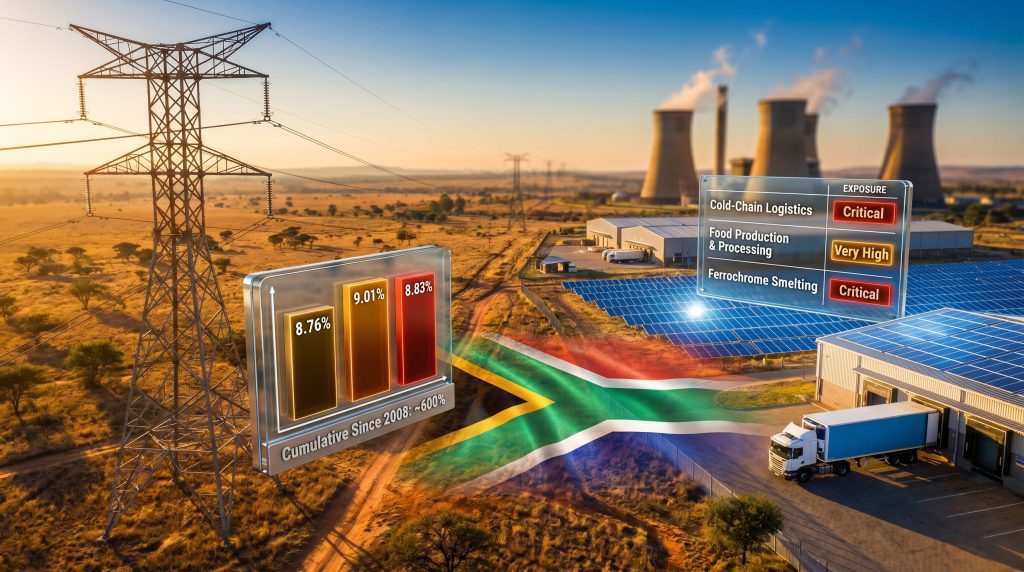
| 2025/26 Determination | 8.76% | 1 April 2026 | Eskom Direct |
| 2025/26 Municipal Uplift | ~9.01% | 1 July 2025 | Municipal Customers |
| 2026/27 Forward Approval | 8.83% | 1 April 2027 | Eskom Direct |
| Cumulative Since 2008 | ~600% | Rolling | All Segments |
What makes this regulatory outcome particularly significant for supply chain planning is not any single figure in isolation. It is the directional consistency. NERSA revised its original proposals upward, having identified calculation errors in prior determinations. This is not a minor administrative detail. It is a signal that the regulatory framework itself carries embedded estimation risk, meaning organisations that base multi-year procurement models on official forward guidance may be systematically underestimating their energy cost exposure.
The municipal customer tier deserves particular attention. Businesses supplied through municipal distribution networks face a compounding disadvantage: the municipal markup sits on top of the Eskom base tariff increase, infrastructure quality is less standardised, and billing reliability varies significantly across different municipalities.
For supply chains with nodes spread across multiple provinces, this creates an uneven and often unpredictable cost burden that resists straightforward financial modelling. Furthermore, according to energy uncertainty analysis from Mining Weekly, slow grid reform is compounding the pressure on supply chains already stretched by persistent above-inflation tariff movements.
A cumulative tariff increase of approximately 600% since 2008 means South African electricity pricing has outpaced consumer price inflation by a substantial margin across nearly two decades, fundamentally altering the cost structure of energy-intensive industries.
Why South Africa's Energy Risk Profile Has Fundamentally Changed
From Scheduled Disruption to Structural Cost Pressure
The period of sustained loadshedding that peaked in 2022 and 2023 before easing through 2024 created a particular kind of operational challenge: predictable, scheduled, and manageable through backup infrastructure. Generators, UPS systems, and operational rescheduling became standard tools for business continuity.
The risk environment in 2026 is structurally different. The primary threat is no longer scheduled downtime. It is the combination of:
- Persistent above-inflation tariff escalation eroding margin across the entire value chain
- Municipal grid fragility creating localised, unplanned outages that are significantly harder to plan around than scheduled loadshedding
- Multiple Eskom generating units operating below 60% of rated capacity, keeping systemic reserve margins thin
- Ageing transmission and distribution infrastructure with substantial maintenance backlogs accumulating at both national and municipal level
The operational implication is counterintuitive. A supply chain that successfully built resilience against loadshedding through diesel backup generation and operational flexibility may now face a more insidious risk: the cost of running that backup infrastructure has risen sharply, the tariff for grid power has compounded, and the unpredictability of localised failures has increased. Resilience infrastructure built for one risk profile is now generating its own cost burden under a different one.
South Africa's Fuel Import Dependency: A Systemic Amplifier
One of the least publicly discussed dimensions of South African supply chain energy risk is the country's growing dependence on imported fuel. The closure of domestic refinery capacity has pushed South Africa's fuel import dependency from approximately 40% of domestic demand in 2019 to around 60% by the mid-2020s.
This matters enormously across three interconnected supply chain dimensions:
- Backup generation costs rise directly with diesel import prices, creating a link between oil price volatility and domestic operational continuity expenses
- Road freight and logistics networks face sustained fuel cost pressure, making delivery pricing more volatile and harder to contract on a fixed-price basis
- Agricultural supply chains, which depend heavily on diesel-powered equipment and cold-chain logistics, face compounding exposure across multiple cost vectors simultaneously
Labour disruption and infrastructure security risks at fuel storage and distribution facilities add a further layer of vulnerability that is difficult to price into standard procurement contracts. In addition, trade war oil impacts are amplifying this exposure as global energy markets remain unsettled.
Water Scarcity as an Underappreciated Compounding Variable
Water stress in South Africa is frequently analysed as a separate infrastructure challenge from energy, but for supply chain risk purposes, this separation is analytically misleading. The provinces facing the most persistent water stress, including Eastern Cape, Gauteng, and KwaZulu-Natal, are also among the most industrially significant in the country.
Water shortages directly affect energy generation capacity, mine operations, food processing, and chemical manufacturing simultaneously. For supply chain planners, this means that water risk events in key provinces can trigger energy-related disruptions rather than simply representing a parallel infrastructure failure. The two systems are more interdependent than standard risk frameworks typically acknowledge.
How South Africa Energy Tariffs and Supply Chain Risk Translate Into Commercial Pressure
The Double Cost Compression Mechanism
Understanding how electricity tariff increases flow through a supply chain requires tracing a multi-stage transmission mechanism that most procurement frameworks are not currently designed to capture:
- Supplier energy cost increases compress production margins at the manufacturing and processing level
- Logistics and transport cost escalation driven by diesel price exposure adds a second layer of cost inflation across the physical movement of goods
- Procurement pricing volatility emerges as suppliers request contract renegotiations, submit force majeure notices, or simply increase quoted prices at renewal
- Consumer price pass-through occurs as the accumulated cost pressure moves downstream, contributing to broader inflationary dynamics in end markets
Above-inflation tariff increases create what analysts describe as asymmetric risk: energy-intensive procurement categories absorb disproportionately larger cost shocks relative to their weight in a typical procurement portfolio, while the mechanisms for hedging or offsetting this exposure remain limited for most organisations.
Sector Vulnerability: Which Industries Face the Greatest Exposure?
Not all supply chain participants face equal exposure to South Africa's energy cost trajectory. The following comparative framework illustrates the differential risk profile across key sectors:
| Sector | Primary Energy Risk Driver | Exposure Level |
|---|---|---|
| Heavy Manufacturing | Direct electricity consumption | Very High |
| Food Production and Processing | Refrigeration, cold-chain continuity | Very High |
| Cold-Chain Logistics | Temperature-controlled storage, diesel backup | Very High |
| Mining Operations | Continuous power demand, ventilation systems | High |
| Chemicals and Water Infrastructure | Process energy intensity | High |
| Ferrochrome Smelting | Ultra-high electricity intensity | Critical |
Ferrochrome smelting represents perhaps the most acute case study in tariff-driven industrial viability risk. South Africa holds the world's largest chromite ore reserves, but ferrochrome production is extraordinarily electricity-intensive. When tariff increases compound above inflation over extended periods, the economics of maintaining smelting operations in South Africa versus relocating processing capacity to lower-cost energy jurisdictions becomes an increasingly live strategic question.
The absorption ceiling is not a theoretical construct. Many manufacturers have already deployed efficiency improvements and operational adjustments to internalise cost increases. The strategic question for 2026 and beyond is not whether costs will pass through the value chain but at what velocity.
The Solar Expansion Paradox: Rising Module Costs vs. Grid Independence Imperative
One of the more nuanced dynamics shaping South African energy strategy in 2026 is the simultaneous pressure toward renewable energy adoption and rising capital costs for solar infrastructure. China's decision to reduce production volumes and withdraw export VAT rebates on solar modules is projected to push module prices up by approximately 9%, creating a direct tension between the strategic imperative to reduce grid dependency and the financial reality of installing the infrastructure required to do so.
This dynamic does not invalidate the business case for renewable investment. Long-term cost predictability through Power Purchase Agreements (PPAs) and embedded generation remains compelling against a backdrop of near-certain continued tariff escalation. However, it does alter the break-even calculus for new installations and may accelerate interest in locally assembled or regionally sourced solar components as a cost management strategy. Progress in renewable energy in South Africa demonstrates that momentum toward grid independence continues despite these cost headwinds.
Procurement Strategy Under Chronic Energy Pressure
Rethinking the Role of Procurement
The Chartered Institute of Procurement and Supply (CIPS) Southern Africa has emphasised that the discipline of procurement is undergoing a fundamental repositioning in the South African context. Energy risk is increasingly embedded in supplier selection criteria alongside the traditional evaluation metrics of quality, delivery performance, and price competitiveness. Consequently, supply chain resilience strategies outlined by CIPS are gaining wider adoption across energy-exposed sectors.
The emerging procurement resilience toolkit for energy-volatile environments includes:
- Supplier diversification and multi-source strategies to reduce single-node exposure
- Nearshoring and regional sourcing to minimise logistics energy intensity
- Scenario planning with energy-adjusted cost models built into category strategy
- Enhanced supplier financial health monitoring to identify energy-stress casualties before they become supply disruptions
Contract Architecture for Energy-Volatile Markets
Standard fixed-price contracts are structurally ill-suited to an operating environment characterised by above-inflation tariff escalation and unpredictable localised grid failures. The following contractual mechanisms are gaining traction as tools for managing energy-linked cost volatility:
| Contract Mechanism | Function | Risk Benefit |
|---|---|---|
| Energy-Linked Escalation Clauses | Ties pricing adjustments to verified tariff movements | Prevents unilateral supplier price shocks |
| Agreed Pricing Thresholds | Sets pre-negotiated cost ceiling and floor bands | Provides budget predictability |
| Open-Book Costing Models | Full cost transparency between buyer and supplier | Enables collaborative cost management |
| Risk-Sharing Mechanisms | Distributes energy cost burden across both parties | Reduces adversarial renegotiation |
| Structured Review Periods | Scheduled contract reassessment points | Allows proactive adjustment before crises emerge |
The objective of these mechanisms is not to eliminate energy cost risk from commercial relationships. It is to ensure that risk is visible, allocated fairly, and managed through structured collaboration rather than periodic adversarial renegotiation.
The next major ASX story will hit our subscribers first
Renewable Energy as a Supply Chain Resilience Strategy
The strategic framing around renewable energy adoption in South Africa has shifted materially. For many organisations, the investment case is no longer primarily anchored in ESG commitments or sustainability reporting requirements. It is driven by operational continuity and long-term cost predictability. Furthermore, renewable energy solutions are increasingly being adopted as core components of supply chain risk management rather than peripheral sustainability initiatives.
The four primary renewable energy models being adopted by supply chain-exposed businesses are:
- Power Purchase Agreements (PPAs): Long-term electricity supply contracts that lock in pricing independent of Eskom tariff cycles, providing procurement-equivalent cost certainty for energy-intensive facilities
- Embedded solar generation: On-site photovoltaic capacity that reduces grid dependency for manufacturing plants, cold storage facilities, and logistics hubs
- Battery storage systems: Energy buffering infrastructure that smooths supply disruptions and reduces peak-demand tariff exposure
- Hybrid energy models: Combinations of solar, storage, and grid access designed to maintain operational continuity across variable conditions
When modelled against the confirmed tariff trajectory through April 2027 and plausible continued escalation beyond that date, hybrid renewable models show increasingly compelling five-year cost advantages compared to grid-only operations, even accounting for the projected rise in solar module pricing.
Strategic Scenario Planning for 2027 and Beyond
Organisations with South African supply chain exposure should be building strategy around at least three distinct scenarios:
Scenario 1: Continued Tariff Escalation With Slow Grid Reform. NERSA approvals maintain their above-inflation trajectory; municipal infrastructure degradation continues unaddressed. Supply chain implications include sustained margin compression, accelerated supplier consolidation, and increased nearshoring pressure. Recommended response: prioritise embedded renewable investment and aggressive contract mechanism adoption.
Scenario 2: Accelerated Grid Modernisation and Private Sector Energy Entry. Transmission reform advances; independent power producers expand capacity; competitive pressure gradually moderates the tariff escalation rate. Supply chain implications include improved predictability for long-range procurement planning. Recommended response: structure PPAs to capture competitive pricing windows during the reform transition period.
Scenario 3: Compounding Infrastructure Failure and Fuel Supply Disruption. Municipal grid failures intensify; fuel import dependency triggers a supply shock; water scarcity compounds across mining and food production regions. Supply chain implications include potential force majeure events across multiple sectors simultaneously. Recommended response: emergency supply diversification, diesel inventory buffering, and crisis-grade supplier communication protocols.
Immediate and Long-Term Priorities for Supply Chain Leaders
Short-Term Actions (0 to 12 Months)
- Conduct comprehensive energy-risk exposure mapping across the full supplier network, including tier-two suppliers
- Identify and prioritise high-vulnerability procurement categories for immediate contract mechanism review
- Strengthen early-warning communication systems with key suppliers to detect energy-related financial stress before it causes supply disruption
- Update business continuity plans to reflect municipal grid instability as a primary scenario, not a secondary one
Long-Term Strategic Imperatives (1 to 3 Years)
- Embed energy risk as a permanent dimension of category strategy and supplier evaluation frameworks, not a periodic add-on exercise
- Build structured supplier partnerships capable of sharing and absorbing energy cost volatility collaboratively
- Align procurement capital investment decisions with the organisation's broader energy transition objectives, particularly those driving African mining decarbonisation
- Develop internal capability in energy cost modelling, tariff trajectory forecasting, and renewable energy procurement structuring
Frequently Asked Questions: South Africa Energy Tariffs and Supply Chain Risk
What electricity tariff increases has NERSA approved for 2026 and 2027?
NERSA approved an 8.76% increase for Eskom direct customers effective 1 April 2026 and an 8.83% increase effective 1 April 2027. Municipal customers face an approximately 9.01% uplift applied through the municipal distribution layer.
Why are municipal electricity customers at greater risk than Eskom direct customers?
Municipal distribution adds a cost markup on top of the base Eskom tariff increase. Infrastructure quality, billing reliability, and supply consistency vary considerably across municipalities, creating an additional layer of unpredictability that Eskom direct customers do not face.
How does South Africa's fuel import dependency amplify supply chain risk?
With approximately 60% of domestic fuel now imported, compared to around 40% in 2019, any global oil market disruption, geopolitical event, or domestic refinery issue directly threatens diesel availability for backup generation and freight logistics simultaneously.
Is loadshedding still a supply chain risk in 2026?
Sustained scheduled loadshedding has eased significantly since March 2024. However, systemic fragility remains, with multiple generating units operating below 60% of rated capacity. Localised unplanned outages through municipal networks have increased in frequency and are operationally more disruptive than their scheduled equivalents because they cannot be planned around.
What contract mechanisms best protect procurement budgets from energy tariff volatility?
Energy-linked escalation clauses, open-book costing arrangements, agreed pricing thresholds, structured review periods, and risk-sharing mechanisms provide the most robust contractual protection available in high-tariff operating environments.
How are businesses using renewable energy to manage supply chain energy risk?
Through PPAs, embedded solar generation, battery storage systems, and hybrid energy models. The primary investment rationale has shifted from sustainability compliance toward operational continuity and long-term cost predictability against a confirmed above-inflation tariff trajectory.
Embedding Energy Resilience as a Core Supply Chain Competency
South Africa energy tariffs and supply chain risk have passed through multiple phases: the construction crisis of the 2000s, the loadshedding escalation of the 2010s and early 2020s, and now a sustained cost inflation phase that operates with less visibility but no less commercial consequence. For supply chain leaders, each phase has demanded a different response capability.
The current phase demands something more architecturally sophisticated than operational workarounds. It requires embedding energy risk into procurement decisions, supplier evaluation frameworks, contract structures, and capital investment planning as a permanent feature of strategic operations rather than a temporary response to a passing crisis.
The broader macroeconomic stakes reinforce this imperative. Energy cost inflation and grid instability have measurably constrained South Africa's GDP growth trajectory across multiple years. Supply chains that build genuine energy resilience are not simply protecting their own margins. They are contributing to the operational stability of an economy whose recovery trajectory matters to the entire southern African region.
This article draws on publicly available information from industry sources including Mining Weekly and Engineering News. Tariff figures referenced reflect NERSA determinations as reported through June 2026. Forward-looking statements, scenario projections, and financial modelling references represent analytical frameworks for planning purposes and should not be relied upon as financial advice. Procurement decisions should be made in consultation with qualified commercial and legal advisors.
Want to Stay Ahead of the Resource Discoveries Driving South Africa's Energy Transition?
As South Africa's supply chains adapt to structural energy cost pressures, the minerals underpinning grid modernisation, renewable infrastructure, and industrial resilience are generating significant ASX discovery activity — and Discovery Alert's proprietary Discovery IQ model delivers real-time alerts the moment significant mineral discoveries hit the ASX, ensuring subscribers can act on actionable opportunities ahead of the broader market. Explore historic discovery returns to understand what major mineral finds have delivered, and begin your 14-day free trial today to position yourself at the forefront of the next transformative discovery.