June 24, 2026
The Hidden Economics of Federal Land Drilling: Why Cost Structure Matters More Than Price
Every oil and gas producer operating in the United States understands that not all acreage is created equal. The economic viability of a well depends not just on what lies beneath the surface, but on the layered cost architecture surrounding the drilling decision itself. Nowhere is this more apparent than on federally managed public lands, where a decades-long accumulation of regulatory obligations has created a structural cost disadvantage relative to private acreage in basins like the Permian or Eagle Ford.
The Trump admin oil and gas drilling costs agenda targets this cost architecture directly, overhauling Bureau of Land Management rules governing bonding requirements, methane compliance, and leasing timelines. Understanding why these changes were considered necessary requires a close look at the regulatory burden that preceded them and what role that burden has played in suppressing federal land drilling economics.
When big ASX news breaks, our subscribers know first
Why Federal Land Drilling Has Always Carried a Premium Cost Burden
Federal acreage has historically imposed a multi-layered compliance cost on operators that simply does not exist at the same scale on private lands. The cost differential emerges from several distinct categories:
- Financial assurance obligations requiring operators to post bonds covering potential well cleanup costs, regardless of the operator's financial standing or the well's production status
- Methane monitoring and reporting mandates embedded in daily field operations, creating recurring compliance expenses across entire drilling programs
- Lengthy permitting and public participation windows that extend project timelines and increase administrative overhead per lease
- Expression of interest reviews adding an additional bureaucratic layer before acreage can be accessed
The practical effect of this regulatory stack is a two-tier drilling market in which federal acreage, despite sometimes containing comparable or superior resource quality, carries a structurally higher cost basis than equivalent private land operations. For smaller and mid-sized independent producers with constrained balance sheets, these costs have historically been prohibitive enough to redirect capital toward private acreage entirely.
The Biden-Era Framework and Its Capital Allocation Impact
The previous administration's approach to federal land energy policy systematically widened this cost gap. The statewide bonding threshold for well cleanup obligations was set at $500,000 per state, a figure that functioned less as a proportionate financial safeguard and more as a de facto capital barrier. Smaller operators seeking access to federal acreage were effectively required to tie up significant working capital in bonding arrangements before a single drill bit turned.
The actual cost of plugging an idled well has been independently estimated at approximately $20,000, making the $500,000 bonding requirement roughly 25 times the underlying cleanup liability it was intended to secure. Critics of the prior framework argued this disproportion reflected a policy preference against fossil fuel development on public lands rather than a calibrated financial risk management tool.
Alongside the bonding burden, methane tracking regulations required ongoing monitoring, reporting, and mitigation activities at the field level, embedding a recurring compliance cost into operational budgets across the upstream sector.
The Specific Regulatory Changes the Interior Department Is Implementing
The Interior Department's revised framework targets each of these cost categories with specific rule changes. The package represents one of the most significant structural resets of federal land drilling economics in recent memory. Furthermore, these changes must be understood alongside the broader context of streamlined permitting reforms that have reshaped resource access across multiple sectors.
Bonding Requirements: A 95% Reduction
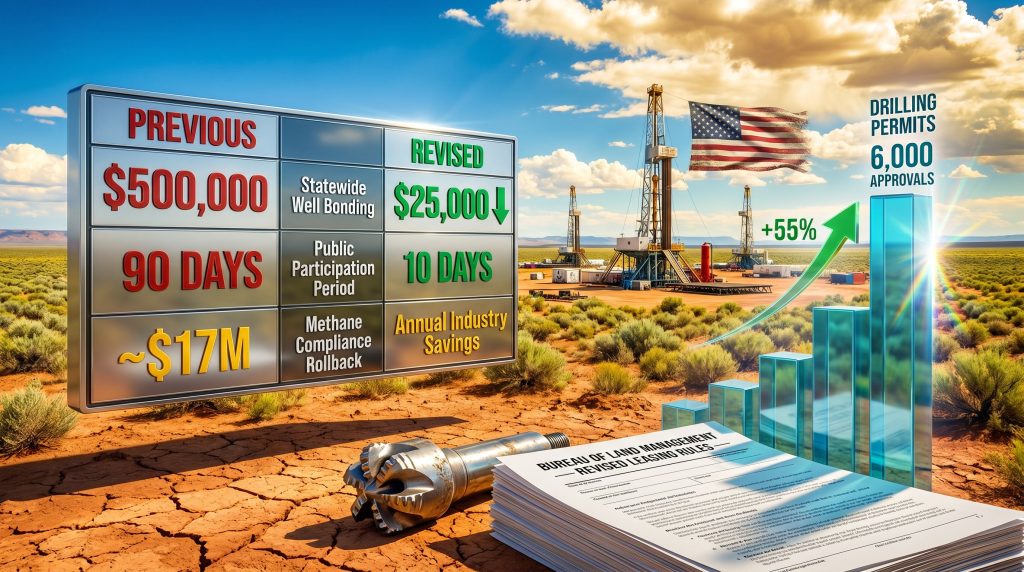
The most immediately visible change is the reduction of the statewide well cleanup bonding threshold from $500,000 to $25,000, a 95% reduction in the upfront capital obligation for federal land operators. At $25,000, the new threshold sits just above the estimated per-well plugging cost of $20,000, providing a narrow but operationally grounded financial buffer.
For smaller producers, this change has meaningful capital allocation implications. Bonding requirements previously consumed working capital that could otherwise fund drilling programs, lease acquisitions, or operational expenditures. Reducing this obligation by 95% effectively frees up significant balance sheet capacity, particularly for companies managing multiple federal leases across a single state.
The prior $500,000 bonding standard was widely viewed within the industry as a policy instrument rather than a proportionate risk management tool, given that it exceeded the actual cost of well remediation by an order of magnitude.
Methane Compliance Rollback: $17 Million in Annual Industry Savings
The administration has also moved to roll back methane tracking and waste prevention regulations that formed a cornerstone of the prior administration's emissions management framework. The Interior Department estimates this rollback will generate approximately $17 million in annual savings across the industry.
In practice, methane compliance under the prior framework required operators to conduct regular leak detection surveys, maintain detailed emissions inventories, and implement mitigation measures for identified methane releases. These activities, while relatively modest on a per-well basis, accumulated into a significant ongoing expense across large federal land drilling programs.
It is worth noting that methane carries a short-term atmospheric warming potential significantly greater than carbon dioxide, which means the environmental implications of reducing monitoring requirements extend beyond direct operational emissions. How reduced federal methane oversight interacts with broader U.S. climate commitments remains an open policy question, as explored further in reporting on the U.S. drilling policy shift that has unfolded across multiple jurisdictions.
Permitting Timeline Compression and Leasing Process Reforms
Beyond bonding and methane changes, the revised framework compresses the public participation review period for oil and gas leasing decisions from 90 days to 10 days, an 89% reduction in the administrative review window. Additional reforms include:
- Removal of the expression of interest leasing preference review
- Lease suspension approvals capped at one year to create greater planning certainty for operators
- Replacement lease sales offered whenever prior leasing rounds are cancelled or delayed
Summary of Trump Administration Regulatory Changes vs. Prior Framework
| Policy Category | Previous Requirement | Revised Standard | Estimated Impact |
|---|---|---|---|
| Statewide Well Bonding | $500,000 per state | $25,000 per state | 95% reduction in upfront capital obligation |
| Methane Compliance Costs | Strict monitoring mandates | Reduced requirements | ~$17M in annual industry savings |
| Public Participation Period | 90 days | 10 days | Faster leasing approvals, reduced administrative lag |
| Lease Suspension Duration | Variable | Capped at 1 year | Greater operator certainty |
| Expression of Interest Review | Required | Removed | Streamlined federal acreage access |
The Energy Dominance Framework: Where Deregulation Fits
These regulatory changes do not exist in isolation. They sit within the Trump administration's broader energy policy framework, which positions expanded domestic fossil fuel production as both an economic growth driver and a geopolitical strategic asset. The Bureau of Land Management functions as one of the primary regulatory levers through which this agenda is operationalised, given that federal lands account for a significant share of total U.S. oil and gas production capacity.
The Interior Department has framed these reforms as consistent with responsible stewardship and American energy leadership, positioning reduced regulatory overhead not as an abandonment of environmental obligation but as a recalibration of what constitutes proportionate oversight. However, the Trump policy impact on resources extends well beyond the energy sector and continues to draw considerable scrutiny from analysts and industry observers alike.
The Transmission Mechanism: From Cost Reduction to Drilling Decisions
The theoretical pathway from regulatory cost reduction to increased drilling activity runs through well-level economics. Lower bonding requirements reduce the capital tied up before production begins. Reduced methane compliance costs lower the ongoing operational expense per well. Faster permitting compresses the lead time between lease acquisition and first production, improving the internal rate of return calculation for marginal drilling decisions.
The permit approval data suggests the administrative machinery is already responding. Drilling permits on public lands have reportedly surged by approximately 55%, with around 6,000 permits approved within a single year, a pace that significantly outstrips the prior administration's approvals trajectory.
A 55% surge in drilling permits on public lands signals that the administrative pathway has been cleared, but whether producers follow permits with rigs depends on factors that regulatory reform alone cannot control.
Why Industry Executives Are Not Rushing to Deploy Rigs
Here is where the analysis becomes more nuanced, and where understanding the gap between policy intent and operator behaviour becomes critical for anyone monitoring U.S. energy supply dynamics.
Despite the regulatory relief package, industry leadership has signalled measured caution rather than accelerated drilling commitment. The Dallas Federal Reserve's energy sector survey, published during the early stages of the Middle East supply disruption when oil prices were rising sharply, revealed a striking disconnect between commodity price signals and operator intent.
The survey findings are instructive:
- Approximately half of surveyed executives indicated no plans to increase drilling activity beyond what was already scheduled
- Only 21% indicated plans to drill slightly more than previously planned
- The majority of respondents showed no material response to both rising prices and an increasingly favourable regulatory environment
The Policy Certainty Problem
One of the most underappreciated constraints on federal land capital deployment is not cost at all — it is the structural uncertainty created by the U.S. regulatory cycle itself. Operators making multi-year capital commitments to federal acreage are acutely aware that the regulatory framework governing those investments can be materially reversed within a single presidential transition.
This creates a rational reluctance to build long-term business models around policy conditions that carry an effective two-year horizon risk. The pattern has repeated across multiple administration cycles: regulatory tightening under one administration, deregulatory relief under the next, followed by renewed tightening. Each cycle reduces the confidence operators can place in any single policy configuration lasting long enough to justify major capital commitments.
Capital Discipline as the Overriding Constraint
Beyond policy uncertainty, the U.S. shale sector has undergone a fundamental cultural shift in its relationship with capital allocation. Following years of investor criticism over growth-at-any-cost strategies that destroyed shareholder value, the industry rebuilt its credibility by committing to production growth within cash flow, prioritising dividends and buybacks over volume maximisation.
Regulatory cost reductions, while operationally welcome, do not override the board-level mandates that U.S. producers have made to institutional investors. The constraint is not regulatory, it is structural.
This dynamic fundamentally limits the extent to which any deregulatory package can drive a step-change in drilling activity. For the largest producers, rig count decisions are driven primarily by commodity price thresholds, investor return mandates, and hedging positions, not regulatory cost structures that move the economics at the margin. In addition, these decisions are compounded by broader U.S. economic pressures including inflation, debt dynamics, and ongoing tariff uncertainty.
The Financial and Environmental Trade-Offs: A Dual Assessment
Taxpayer Exposure and the Orphaned Well Problem
Reducing the statewide bonding requirement to $25,000 when actual well-plugging costs are estimated at approximately $20,000 leaves a financial buffer of only about $5,000 above baseline remediation costs. This is a meaningful concern when considered against the existing inventory of orphaned and idled wells on federal lands.
If an operator enters bankruptcy or simply abandons marginal operations, a $25,000 bond may prove insufficient to cover full remediation costs, particularly where environmental complications arise. In such scenarios, liability risk flows to federal agencies and ultimately to taxpayers. The prior administration's $500,000 threshold, while arguably disproportionate, was designed to create a substantial financial cushion against exactly this outcome.
The industry has a documented history of well abandonment events, particularly among smaller producers during commodity price downturns. Reducing the financial backstop during a deregulatory cycle that is also encouraging smaller operators back into federal acreage creates a scenario worth monitoring closely. For further context, analyses of energy pricing outcomes suggest that increased access to federal lands does not automatically translate into lower energy costs for consumers.
Methane, Climate Commitments, and Downstream Costs
Reducing methane monitoring requirements generates near-term operational savings but carries longer-term implications that are difficult to quantify. Methane's short-term warming potential is substantially greater than that of carbon dioxide, making emissions from upstream oil and gas operations a significant variable in U.S. climate accounting.
Reduced monitoring does not eliminate emissions — it reduces visibility into their scale. This distinction matters for domestic air quality standards, international climate framework commitments, and the long-term social cost calculations that future administrations will likely revisit. Consequently, questions about government intervention in resources and where the regulatory threshold should be drawn remain fiercely contested across policy, industry, and environmental circles.
The next major ASX story will hit our subscribers first
How This Deregulatory Cycle Compares Historically
Federal land drilling policy has moved through recognisable expansion and contraction cycles tied to both commodity price environments and the political preferences of successive administrations. The regulatory tightening that followed major environmental incidents created frameworks that subsequent administrations then partially dismantled during commodity price downturns or following energy supply concerns.
What distinguishes the current package is its magnitude. A 95% reduction in bonding requirements and an 89% compression of the public participation window are not incremental adjustments. They represent a near-complete reversal of the prior framework's cost architecture in two of its most significant dimensions.
Whether this constitutes a durable structural reset or simply the latest swing of a regulatory pendulum that will reverse again with the next administration remains the central question for operators evaluating long-term federal acreage strategies. Industry observers noting the pace of change have pointed to concerns about offshore drilling backlash as a further indicator of how contested this deregulatory agenda has become.
Frequently Asked Questions: Trump Admin Oil and Gas Drilling Costs
What is the Trump administration doing to reduce oil and gas drilling costs?
The Interior Department has revised Bureau of Land Management rules to reduce the statewide well cleanup bonding requirement from $500,000 to $25,000, rolled back methane compliance mandates estimated to cost the industry approximately $17 million annually, and shortened the public participation review period for leasing decisions from 90 days to 10 days.
How much could these changes save oil and gas producers?
The methane rollback alone is estimated to generate approximately $17 million in annual savings across the industry. The bonding reduction frees up significant upfront capital, particularly for smaller independent operators managing multiple federal leases.
Will these changes lead to more drilling on federal lands?
The evidence so far is mixed. Permit approvals have surged by approximately 55%, with around 6,000 permits approved within a single year. However, executive surveys indicate that most operators are not planning significant increases in actual drilling activity, citing market uncertainty and investor capital discipline mandates.
What are the risks of lowering bonding requirements?
With actual plugging costs estimated at roughly $20,000 per well and the new bond threshold set at $25,000, the financial buffer above baseline remediation costs is minimal. Operator bankruptcies or abandonments could leave the federal government, and by extension taxpayers, exposed to remediation costs the bond does not fully cover.
How does the permitting timeline change affect producers?
Reducing the public participation window from 90 days to 10 days significantly accelerates the leasing process, lowering administrative cost per lease and reducing the time between application and operational approval. For producers managing capital deployment timelines, faster permitting improves trump admin oil and gas drilling costs economics at the margins.
This article is intended for informational purposes only and does not constitute financial, legal, or investment advice. Forecasts, regulatory outcomes, and industry response projections involve inherent uncertainty and should not be relied upon as predictions of future events.
Want to Track the Next Major Resource Discovery Before the Market Moves?
Discovery Alert's proprietary Discovery IQ model scans ASX announcements in real time, instantly converting complex mineral data across 30+ commodities into clear, actionable opportunities — explore the historic returns major discoveries have delivered and begin your 14-day free trial to secure a market-leading edge before the broader market catches on.