June 24, 2026
The Quiet Conquest: How Capital Is Redrawing Central Asia's Power Map
Few geopolitical transformations unfold as visibly as military conflict, yet some of the most consequential shifts in regional power happen through balance sheets, construction contracts, and cultural exchange programmes. Across the five sovereign states of Central Asia, a systematic reorientation is underway, driven not by force but by the compounding weight of China investment in Central Asia. The scale, diversity, and institutional depth of Beijing's regional engagement now constitutes one of the defining geopolitical stories of the 2020s, and its implications extend well beyond the Eurasian landmass.
When big ASX news breaks, our subscribers know first
Why Central Asia Has Become Beijing's Most Important Strategic Frontier
Central Asia occupies a position of extraordinary geographic importance for China's long-term economic architecture. The five nations, Kazakhstan, Uzbekistan, Turkmenistan, Kyrgyzstan, and Tajikistan, form the terrestrial spine of overland trade corridors linking Chinese manufacturing centres to European markets and Middle Eastern energy hubs. For Beijing, securing reliable access to this corridor is not merely a commercial consideration but a fundamental component of supply chain sovereignty.
The timing of China's accelerated engagement is also significant. Mounting Western scrutiny of Chinese supply chains, export controls on advanced semiconductors, and the broader decoupling narrative have incentivised Beijing to deepen alternative resource and manufacturing partnerships. Central Asia's abundant reserves of uranium, gold, copper, and natural gas offer precisely the kind of upstream access that reduces Beijing's exposure to Western-controlled supply networks.
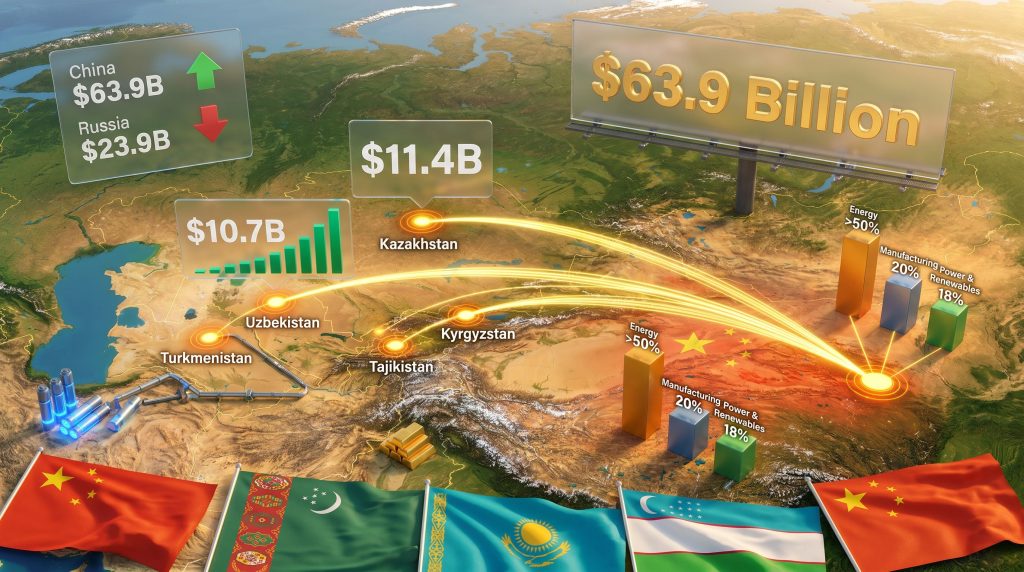
Cumulative Chinese direct investment in Central Asia reached $63.9 billion by the time of the 2023 Xi'an Summit, where China committed approximately $3.7 billion (equivalent to 26 billion yuan) toward the region's sustainable development. By mid-2025, FDI stock had grown further to $35.9 billion, reflecting actual capital deployed rather than pledged commitments, a distinction that matters enormously when assessing the credibility of bilateral investment announcements. Between 2022 and 2023, China formally overtook Russia as the region's primary trading partner, a transition that would have seemed improbable a decade earlier.
The displacement of Russia as Central Asia's dominant economic partner represents one of the most consequential shifts in post-Soviet Eurasia, achieved entirely through sustained capital deployment rather than military or political coercion.
Country-by-Country: Where Chinese Capital Is Flowing and Why
Understanding the texture of China's regional strategy requires examining each bilateral relationship individually. The sectoral priorities, investment volumes, and strategic rationale differ meaningfully across the five nations.
| Country | FDI Stock (Mid-2025) | Primary Sector Focus | Growth Trajectory |
|---|---|---|---|
| Kazakhstan | $11.4 billion | Nuclear energy, oil and gas, logistics | Steady, diversifying |
| Uzbekistan | $10.7 billion | Mining, manufacturing, renewables | Fastest-growing (5x since 2020) |
| Turkmenistan | $9.5 billion | Gas development, pipeline infrastructure | Concentrated, energy-dominant |
| Kyrgyzstan | Emerging | Gold mining, EV infrastructure, cultural exchange | Accelerating |
| Tajikistan | Emerging | Education, institutional capacity-building | Early-stage, soft-power led |
Kazakhstan: Competing Nuclear Powers in the Same Sandbox
Kazakhstan's energy sector has become an arena where Beijing and Moscow operate simultaneously, a dynamic with few precedents in post-Soviet geopolitics. China's National Nuclear Corporation has been contracted to build two large-scale reactors within Kazakhstan, while Russia's Rosatom is separately contracted to construct the country's first nuclear power plant on the shores of Lake Balkhash. The inaugural Kazakhstan-China Joint Working Group on Civil Nuclear Energy Cooperation has been formally established, with a protocol defining the framework for ongoing collaboration.
This dual contracting arrangement is not accidental. Astana has deliberately avoided aligning exclusively with either Beijing or Moscow, preferring a managed competition model that extracts maximum leverage from both relationships. It is a strategy that smaller resource-rich nations have historically deployed with mixed results, though Kazakhstan's vast uranium market dynamics and hydrocarbon endowments give it unusually strong negotiating power.
Beyond nuclear energy, Chinese appliance manufacturer Midea Group has established a representative office in Almaty, transitioning from third-party distribution arrangements to direct market operations, with stated plans for a logistics hub designed to serve the broader Central Asian consumer market. Separately, a dedicated Jiangsu Province Center for Central Asia has been launched in Astana, functioning as a unified service platform for Chinese enterprises operating across the region. Agricultural export agreements formalised at the same forum now incorporate Kazakh wheat, meat, and honey into bilateral trade diversification arrangements with Jiangsu Province.
Uzbekistan: The $2 Billion Mining Commitment and a Technology Transfer Ambition
Uzbekistan represents the most dynamic frontier in China investment in Central Asia. A single Chinese enterprise, Zhongjin Guantai Industrial Development Co., Ltd., has signalled intent to deploy $2 billion into Uzbekistan's mining sector, alongside $1 billion in advanced energy projects and a further $300-500 million across infrastructure and tourism. That a single company is prepared to commit this volume of capital to one country's mining sector alone illustrates the scale of Beijing's appetite for Central Asian resource access.
The uranium dimension deserves particular attention. Uzbekistan's state uranium producer, Navoiyuran, has entered a working group arrangement with China's State Nuclear Uranium Resources Development Co., Ltd. to pursue joint geological exploration, specifically including unconventional uranium deposit development. Unconventional uranium refers to in-situ leaching and other extraction techniques applicable to lower-grade mineralisation, a category that significantly expands the inventory of economically viable deposits under favourable uranium pricing conditions. Furthermore, the Ukrainian-US minerals deal has added urgency to how competing powers frame their own upstream resource strategies.
Alongside resource extraction, an MoU between Uzeltekhsanoat Association and China's Electronics Enterprises Association targets what both parties describe as Physical AI technology development and home appliance component manufacturing. Physical AI refers to artificial intelligence embedded in robotic and automated physical systems rather than purely digital applications, a field with significant implications for manufacturing automation. This signals China's intent to embed advanced technology transfer alongside resource extraction, creating a deeper form of industrial interdependency than raw commodity deals alone would produce.
Agricultural and irrigation agreements were also formalised at a Tashkent roundtable convened by Uzbekistan's Cabinet of Ministers. A Chinese firm, Yinchuan Wolsenn Modern Irrigation Co., Ltd., will supply water-saving irrigation technologies to Uzbekistan, addressing one of the country's most pressing environmental constraints. The breadth of these simultaneous agreements across mining, uranium, AI, agriculture, and irrigation reflects a deliberate government-led strategy to maximise Chinese capital inflows while distributing sectoral exposure.
Kyrgyzstan and Tajikistan: Gold, Green Transport, and the Long Game of Soft Power
In Kyrgyzstan, China's Nerin Engineering Co., Ltd. has been appointed chief contractor for the Togolok gold deposit, overseeing construction of a processing plant, tailings storage facility, and rotational worker accommodation. Gold processing infrastructure of this kind creates long-duration operational relationships that extend well beyond the initial construction phase, embedding Chinese technical and operational presence for potentially decades.
A partnership between the Kyrgyz National Investment Fund and Shenzhen Wuyou Technology Co., Ltd. will introduce a modern electric scooter fleet alongside a network of EV charging stations. This relatively modest initiative carries strategic significance disproportionate to its immediate scale. By establishing EV charging infrastructure at an early stage, Chinese firms position themselves as the preferred technology standard for Kyrgyzstan's clean transport future.
The cultural dimension of China's Kyrgyz engagement was underscored when Nobel Prize-winning author Mo Yan led a writers' delegation to Bishkek, resulting in a formal cooperation agreement between Chinese and Kyrgyz writers' associations covering joint projects, translation programmes, and reciprocal author visits. Cultural diplomacy of this calibre is rarely coincidental.
In Tajikistan, Dangara State University has agreed to establish a Confucius Institute in partnership with Shenyang Normal University and the International Foundation for Chinese Language Studies. Tajikistan is often overlooked in analyses of Central Asian geopolitics given its relatively small economy and limited resource base, yet its geographic position adjacent to Afghanistan and its growing Chinese institutional presence make it a strategically significant node in Beijing's long-term regional architecture.
The Sectoral Anatomy of China's Central Asia Strategy
The composition of Chinese investment reveals a strategy that has evolved considerably from its early Belt and Road phase, when infrastructure lending dominated the agenda. According to research published by the Foreign Policy Research Institute, the next chapter of Chinese investment in Central Asia reflects a meaningful shift toward debt-plus-development hybrid models.
-
Energy and Resources (over 50% of declared investment): Oil, gas, uranium, and gold extraction remain foundational, securing upstream access that feeds Chinese industrial demand and reduces dependence on seaborne commodity flows. The growing critical minerals demand driven by the global energy transition reinforces the strategic value of these upstream positions.
-
Manufacturing (approximately 20%): Projects such as the Exeed automobile plant in Uzbekistan's Syrdarya region reflect an effort to relocate production capacity into tariff-advantaged jurisdictions while cultivating regional consumer markets for Chinese brands.
-
Power and Renewables (approximately 18%): Solar installations and clean energy infrastructure serve dual purposes. They reduce host nation energy deficits while positioning Chinese technology firms as the preferred suppliers for future capacity expansion.
-
Logistics and Agribusiness: Emerging as the next growth frontier, with formalised bilateral agreements now incorporating agricultural commodity exports from Central Asian nations into Chinese provincial trade networks.
-
Soft Power and Institutional Infrastructure: Confucius Institutes, parliamentary seminars, and literary exchange programmes represent a non-commercial investment layer. Chinese-led legislative seminars for Central Asian MPs, as discussed during ambassador-level meetings in Ashgabat, extend Beijing's institutional influence beyond the commercial domain into the architecture of governance itself.
The structural shift toward manufacturing and renewables signals a transition from a pure resource extraction model toward a regional industrial partnership framework. This deepens host nation dependencies while simultaneously creating genuine economic development pathways, a combination that is considerably harder for competing powers to displace.
China Versus Russia: A Quantitative Reckoning
The erosion of Russian economic primacy in Central Asia is measurable and accelerating.
| Metric | China | Russia |
|---|---|---|
| Cumulative Investment (2023) | $63.9 billion | $23.9 billion |
| Primary Trade Partner Status | Achieved 2022-2023 | Lost 2022-2023 |
| Nuclear Projects in Kazakhstan | 2 reactors (CNNC) | 1 plant (Rosatom) |
| Soft Power Mechanisms | Confucius Institutes, cultural delegations, legislative seminars | Russian language institutions, CSTO military framework |
| Infrastructure Modality | BRI-aligned, capital-intensive, new-build | Legacy Soviet infrastructure, pipeline dependency |
Russia's structural weakening in the region reflects both the diversion of economic resources toward the Ukraine conflict and a fundamental asymmetry in what each power can offer. China brings technology transfer, manufacturing partnerships, educational institution-building, and substantial new capital. Russia's engagement remains anchored to legacy Soviet infrastructure relationships and the CSTO military framework, neither of which generates the economic development dividends that Central Asian governments increasingly demand from external partners.
The Risk Landscape: Debt, Sovereignty, and Great Power Competition
Structural Tensions in the Investment Model
Critics of Chinese infrastructure financing in developing economies consistently raise the question of asymmetric loan structures and the potential for long-term fiscal obligations to compromise host nation sovereignty. Central Asian nations have generally maintained stronger negotiating positions than some other Belt and Road recipients, primarily because their resource leverage, particularly in uranium, natural gas, and gold, provides genuine bargaining power. However, as Chinese institutional presence deepens across legal, educational, and parliamentary frameworks, the nature of dependency evolves beyond simple debt relationships.
The Multi-Polar Competition Intensifying
The United States, the European Union, and India have all signalled growing interest in Central Asian connectivity and critical mineral partnerships. Western supply chain diversification strategies, driven by concerns over single-source dependencies for uranium, copper, and rare earth elements, are beginning to target the same resource base that China has been systematically securing for over a decade. The geopolitical landscape for metals and mining has consequently become far more contested across this region.
The critical difference is that China's first-mover advantage is not merely financial. It is institutional, infrastructural, and increasingly cultural, creating layers of integration that take considerable time and capital to displace. In addition, China's rare earth trade strategy further illustrates how Beijing weaves resource control into broader geopolitical leverage, a pattern very much replicated across Central Asia.
Kazakhstan's simultaneous engagement with Chinese and Russian nuclear contractors encapsulates the region's deliberate hedging posture. These governments are not passive recipients of external capital. They are active managers of competing great power interests, extracting concessions and diversifying partnerships with considerable strategic sophistication.
The next major ASX story will hit our subscribers first
FAQ: China Investment in Central Asia
What is the total value of China's investment in Central Asia?
Cumulative Chinese direct investment reached $63.9 billion by the 2023 Xi'an Summit, with FDI stock growing to $35.9 billion by mid-2025.
Which Central Asian country receives the most Chinese investment?
Kazakhstan holds the largest FDI stock at $11.4 billion. However, Uzbekistan is the fastest-growing destination, having expanded approximately fivefold since 2020 to reach $10.7 billion.
What sectors does China prioritise in Central Asia?
Energy and resources account for over 50% of declared investment, followed by manufacturing at approximately 20% and power and renewables at around 18%. Logistics, agribusiness, and soft power infrastructure are emerging growth areas.
Has China overtaken Russia as Central Asia's dominant economic partner?
China surpassed Russia as the region's primary trading partner between 2022 and 2023. China's cumulative investment of $63.9 billion significantly exceeds Russia's $23.9 billion over the same period.
What is Physical AI and why does it matter in this context?
Physical AI refers to artificial intelligence systems embedded within robotic and automated physical machinery, as distinct from purely software-based AI applications. China's push to co-develop Physical AI technologies with Uzbekistan suggests an ambition to embed advanced industrial automation frameworks alongside traditional resource extraction deals, creating deeper manufacturing interdependencies.
What was agreed at the 2023 Xi'an Summit?
China committed approximately $3.7 billion toward Central Asia's sustainable development at the Xi'an Summit. The specific allocation of these funds across countries and sectors has not been fully disclosed in publicly available documentation.
The Strategic Verdict: What This Means for the Global Resource Order
China investment in Central Asia is not a single initiative or a collection of bilateral deals. It is a multi-layered, multi-sectoral, multi-decade integration strategy that combines resource extraction, manufacturing relocation, clean energy infrastructure, technology transfer, institutional capacity-building, and cultural diplomacy into a coherent framework. The $2 billion Uzbek mining commitment from a single firm, set alongside simultaneous uranium, Physical AI, agricultural, and irrigation agreements within the same country, illustrates the extraordinary breadth of Beijing's ambitions.
As Western governments accelerate critical mineral diversification strategies targeting Central Asian uranium, copper, and other strategic materials, they will encounter a regional landscape already deeply shaped by Chinese capital, Chinese institutions, and Chinese cultural presence. The competitive disadvantage this creates is not insurmountable, but it is substantial, and it will require considerably more than financial commitments alone to address. Furthermore, independent reporting from Eurasianet, which specialises in South Caucasus and Central Asian affairs, continues to track how China's trade dominance is reinforced even where official figures diverge from on-the-ground realities.
This article contains forward-looking assessments based on publicly available information and analytical frameworks. It does not constitute financial or investment advice. Readers should conduct independent research before making any investment or policy decisions.
Want To Stay Ahead of Major Mineral Discoveries Reshaping the Global Resource Order?
As China's systematic acquisition of Central Asian uranium, gold, and copper assets intensifies competition for critical minerals worldwide, Discovery Alert's proprietary Discovery IQ model instantly identifies significant ASX mineral discoveries — converting complex data across 30+ commodities into clear, actionable insights for both traders and long-term investors. Explore how historic mineral discoveries have generated substantial returns and begin your 14-day free trial at Discovery Alert to secure your market-leading edge before the broader market moves.