
June 24, 2026
The Regulatory Arithmetic Behind Mining Capital Allocation
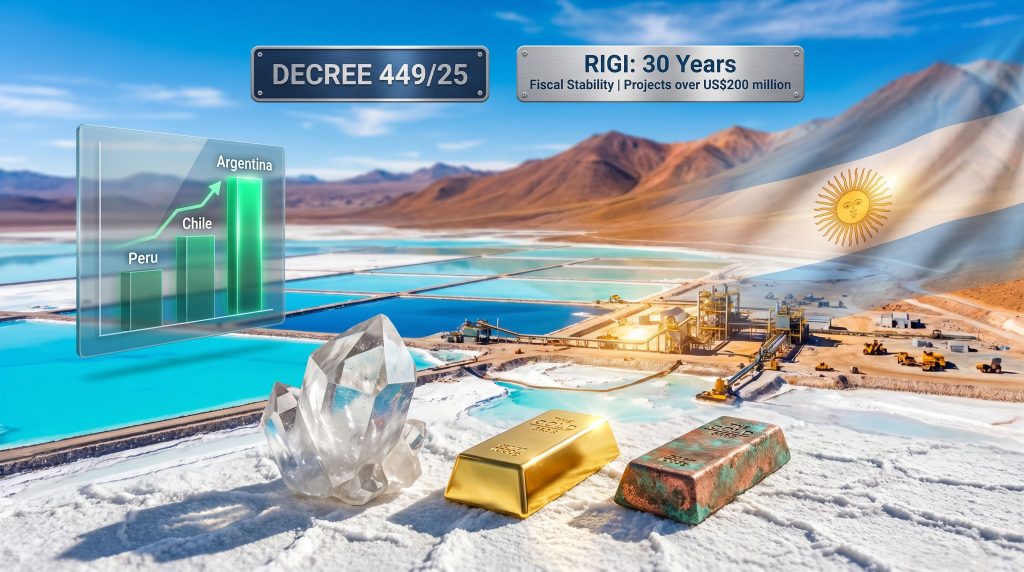
Every experienced mining investor understands that geological endowment is only half the equation. The other half is the regulatory and fiscal environment that determines whether a world-class deposit can actually be converted into a bankable project. Argentina has long suffered a paradox familiar to resource economists: extraordinary mineral wealth sitting beneath one of the more administratively complex investment environments in Latin America. The Argentina mining investments law update, embodied in Decree 449/25, represents a deliberate effort to close that gap, amending two foundational laws that govern how mining capital enters, operates, and achieves fiscal certainty within Argentine territory.
Understanding what this reform actually changes, and what it leaves unresolved, requires examining the structural mechanics of mining investment law, not just the headlines.
When big ASX news breaks, our subscribers know first
Why Argentina's Mining Regulatory Framework Was Overdue for Reform
The Friction Points That Suppressed Capital Deployment
Argentina's mining sector operates under a dual-track regulatory architecture. Federal law establishes the overarching investment framework through Law 24.196 (the Mining Investment Law), while provincial governments retain constitutional authority over the natural resources within their territories. This creates a layered approval environment where federal permitting efficiency and provincial administrative capacity must both perform simultaneously for a project to advance.
Historically, the federal layer introduced its own friction through the investment validation process. Companies seeking to register mining investments were required to complete submission forms containing more than 1,000 individual data fields, many of which lacked a clear statutory basis under the laws they were supposed to support. For a junior exploration company operating on tight capital budgets, this was not a minor inconvenience. It represented a material compliance cost that consumed both financial and management resources at the most capital-constrained stage of the project lifecycle.
The fiscal stability certification process compounded the problem. To secure protection against future tax increases, a critical bankability requirement for project financing, companies were required to enumerate every applicable tax obligation across national, provincial, and municipal jurisdictions. For projects spanning multiple Argentine provinces, this was a legally intensive exercise that could generate significant professional fees and timeline delays before a single financing conversation could meaningfully begin.
Argentina's Position in the Global Critical Minerals Contest
The urgency behind the Argentina mining investments law update cannot be understood outside of the broader geopolitical contest for critical mineral supply chains. Argentina sits within the Lithium Triangle, a geological zone shared with Chile and Bolivia that contains an estimated 55–60% of the world's known lithium resources. The country's Puna plateau, spanning the high-altitude provinces of Jujuy, Salta, and Catamarca, hosts some of the highest-grade Argentina lithium brines operations globally.
Beyond lithium, Argentina's mineral endowment includes significant copper, gold, and silver deposits — commodities that sit at the intersection of energy transition demand and traditional precious metals investment. The critical minerals demand driven by electrification infrastructure, from grid expansion to electric vehicle manufacturing, has elevated copper's strategic importance in ways that were not fully priced into Argentina's resource story even a decade ago.
The competitive pressure from Chile and Peru was mounting. Furthermore, both jurisdictions, while carrying their own political risks, offered more predictable permitting timelines and more established mining investment frameworks. For capital allocation committees at major mining houses and institutional investors, Argentina's administrative complexity was a measurable discount factor in project valuations.
What Decree 449/25 Actually Changes: A Mechanism-Level Analysis
From Form-Filling to Professional Certification
The most operationally significant change introduced by Decree 449/25 is the replacement of the 1,000-plus field submission form with a consolidated technical report prepared by an independent professional. This is not merely a formatting change. It represents a fundamental shift in the liability and accountability model for investment validation.
Under the old system, the administrative burden of validating investment data sat largely with government agencies, creating bottlenecks whenever institutional capacity was constrained. Under the new framework, accountability transfers to the independent professional who certifies the report. This mirrors standard practice in many mature mining jurisdictions, where qualified person frameworks place professional responsibility on credentialed experts rather than bureaucratic processes.
| Dimension | Previous Framework | Post-Reform Framework |
|---|---|---|
| Submission format | 1,000+ data field forms | Consolidated technical report |
| Statutory basis | Many fields legally unsupported | Report grounded in professional certification |
| Accountability | Government validation burden | Independent professional liability |
| Impact on junior explorers | High relative compliance cost | Materially reduced administrative burden |
Fiscal Stability: Anchoring Certainty to the Feasibility Date
The reform to fiscal stability certification is arguably the most commercially significant change for project financing. Under the previous mechanism, companies had to catalogue every applicable tax across three jurisdictional levels when applying for stability protection. This exercise was not only time-consuming but also legally exposed, because any omission could create uncertainty about whether a particular tax obligation was actually covered by the stability certificate.
Decree 449/25 replaces this approach by anchoring fiscal stability to the date of feasibility study submission. This single change eliminates the multi-jurisdictional tax enumeration requirement and provides a cleaner, more defensible legal foundation for the stability guarantee. For lenders and equity investors conducting project due diligence, a feasibility-date anchored stability certificate is significantly easier to underwrite than a document assembled through an exhaustive and potentially incomplete tax inventory.
Investor Framework: In project finance structures, fiscal stability guarantees directly influence the risk premium applied to a project's discount rate. Cleaner, more legally robust stability certificates reduce the information asymmetry between borrowers and lenders, with the potential to meaningfully reduce the cost of debt capital for qualifying projects.
Centralising Geological Data Under SEGEMAR
The third pillar of the reform transfers geological data governance from the Mining Secretariat to SEGEMAR (the Argentine Geological Mining Service). For exploration geologists and technical teams, this change matters more than it might appear from a policy summary.
Fragmented geological data held across multiple agencies creates real exploration inefficiencies. When historical drilling data, geophysical surveys, and geochemical databases are distributed across institutions with different data standards and access protocols, exploration companies spend disproportionate time on data reconciliation rather than geological interpretation. Centralisation under a single technically focused agency improves data quality, standardises access, and reduces the time from exploration licence grant to meaningful geological targeting.
SEGEMAR's expanded mandate also creates an opportunity for Argentina to build a more comprehensive national geological information system, which would consequently enhance the country's attractiveness for grassroots exploration by reducing the baseline information risk that deters early-stage capital.
The RIGI Framework and Decree 449/25: Understanding the Layered Architecture
Decree 449/25 does not operate in isolation. It sits alongside Argentina's RIGI framework (Régimen de Incentivo para Grandes Inversiones), enacted in April 2024, which provides 30 years of fiscal stability for projects committing investments above US$200 million. The two instruments address different dimensions of the investment problem.
| Policy Instrument | Year | Primary Benefit | Investment Threshold |
|---|---|---|---|
| RIGI | 2024 | 30-year fiscal stability + incentives | Over US$200 million |
| Decree 449/25 | 2025 | Streamlined permitting and data governance | All mining investment projects |
RIGI targets the largest capital allocations — the kind of multi-billion dollar copper or lithium projects that require decade-long financing structures and where sovereign risk pricing has an outsized impact on project economics. Decree 449/25 addresses the procedural layer that affects all projects regardless of scale, including the junior explorers and mid-tier developers who generate the pipeline of discoveries that eventually become RIGI-qualifying projects.
The combination creates a more complete investment proposition than either instrument alone. A company advancing a lithium brine project through exploration and into feasibility benefits from Decree 449/25's simplified compliance framework, and, if the resource justifies it, can access RIGI's long-duration fiscal stability when the project crosses the investment threshold.
Environmental Regulation: The Complicating Variable
Any balanced assessment of Argentina's mining regulatory evolution must acknowledge the controversy surrounding recent amendments to the country's glacier protection legislation. Argentina's Glacier Protection Law had historically restricted certain mining activities in high-altitude zones, which overlap significantly with the Puna plateau where many lithium and copper deposits are located.
Recent relaxation of these restrictions has generated legal challenges and opposition in affected provinces. For institutional investors with ESG mandates, this creates a genuine dilemma: procedural improvements delivered by Decree 449/25 and RIGI's fiscal incentives are attractive, but the reputational and legal risk associated with environmental litigation adds a layer of project-specific risk that due diligence teams must carefully evaluate.
This tension is not unique to Argentina. However, jurisdictions across Latin America are navigating the same fundamental conflict between resource development ambitions and increasingly sophisticated environmental and indigenous rights frameworks. What distinguishes Argentina's situation is the speed of change, with regulatory shifts in multiple directions occurring within a compressed timeframe.
Benchmarking Argentina Against Regional Competitors
| Jurisdiction | Fiscal Stability | Permitting Complexity | Key Commodities |
|---|---|---|---|
| Argentina (post-reform) | Feasibility-date anchored + RIGI 30-year | Reduced via Decree 449/25 | Lithium, copper, gold, silver |
| Chile | Royalty-based agreements | Moderate | Lithium, copper |
| Peru | Stability agreements (12 years) | High | Copper, gold, silver |
On fiscal stability duration alone, Argentina's RIGI framework outcompetes Peru's 12-year agreements and offers a more durable guarantee than Chile's royalty-based stability mechanisms. The practical question is whether Argentina's macroeconomic track record allows investors to assign full credibility to that guarantee, which brings into focus the residual risks that no decree can resolve.
In addition, understanding the Argentina copper potential alongside lithium assets further strengthens the case for evaluating the country's resource story in a broader commodity context.
The next major ASX story will hit our subscribers first
Key Risks That Remain Unresolved
Structural and Macroeconomic Vulnerabilities
No regulatory reform, however well designed, can fully offset Argentina's macroeconomic risk profile. Several persistent concerns remain central to investor due diligence:
- Currency controls and repatriation risk: Argentina's history of restricting foreign currency access and capital repatriation remains a top-tier concern for foreign investors, particularly those managing returns in USD or EUR.
- Sovereign debt and fiscal credibility: Argentina has experienced multiple debt restructurings, and the credibility of long-term fiscal stability guarantees is inevitably viewed through this historical lens.
- Provincial regulatory variability: Decree 449/25 operates at the federal level, but provincial governments retain significant independent authority over mining approvals, environmental licensing, and royalty structures. Consistency of application across Jujuy, Salta, Catamarca, and other mining provinces cannot be assumed.
- Social licence complexity: Community and indigenous consultation requirements are project-specific obligations that procedural streamlining at the federal level cannot address. In several provinces, indigenous communities hold veto-equivalent power over exploration and development activities under international frameworks that Argentina has ratified.
Implementation Gap: The Distance Between Policy and Practice
Argentina's regulatory history contains numerous examples of well-intentioned legal reforms that encountered significant implementation friction. The shift to independent professional certification is only as effective as the professional accreditation and liability framework that supports it. If the market for qualified certifying professionals is shallow, or if liability standards are unclear, the practical benefit of the reform may be diluted.
Similarly, SEGEMAR's expanded geological data mandate requires institutional capacity, technology investment, and data standardisation efforts that take time to materialise. The quality improvement in geological data access that the reform promises is, consequently, a medium-term outcome rather than an immediate operational change.
Frequently Asked Questions: Argentina Mining Investments Law Update
What laws does Decree 449/25 amend?
Decree 449/25 amends two foundational Argentine laws: Law 24.196 (the Mining Investment Law) and Law 24.466 (governing the National Geological Information Bank). The changes affect investment validation procedures, fiscal stability certification, and geological data governance.
Does the reform apply to projects already in development?
Yes. One of the most commercially important features of Decree 449/25 is its immediate applicability to all pending procedures and active projects. Companies already in the approval pipeline do not need to restart processes under the new framework; they benefit from the simplified requirements going forward.
How does Decree 449/25 interact with the RIGI framework?
The two instruments are complementary. RIGI targets large-scale investments above US$200 million with 30-year fiscal stability, while Decree 449/25 reduces procedural complexity across all mining investment projects. Together they address both the regulatory and fiscal dimensions of investment attractiveness.
Which commodities benefit most from these reforms?
Lithium carbonate, copper, gold, and silver are the primary beneficiaries, reflecting Argentina's existing resource endowment and the alignment of these commodities with the global lithium market and global electrification demand trajectories.
Strategic Assessment: A Framework for Evaluating the Investment Thesis
The Argentina mining investments law update represents a genuine improvement in the country's investment proposition, but it should be evaluated within a three-scenario framework rather than as a binary positive or negative development:
- Bull case: Simplified permitting, feasibility-anchored fiscal stability, centralised geological data, and RIGI's 30-year guarantee combine to materially accelerate project development timelines. Argentina captures a larger share of global lithium and copper investment, compressing the gap with Chile and Peru over a 5–10 year horizon.
- Bear case: Macroeconomic instability, currency controls, environmental legal uncertainty, and provincial regulatory inconsistency continue to impose a meaningful risk discount. Furthermore, implementation gaps limit the practical benefit of the reform, and institutional investors remain underweight Argentine mining assets relative to the country's geological endowment.
- Base case: Argentina moves meaningfully up regional mining attractiveness rankings, attracting increased exploration capital and accelerating feasibility timelines for projects already in the development pipeline. The most significant near-term beneficiaries are mid-tier operators with projects in advanced exploration or pre-feasibility stages, for whom the compliance cost reduction and cleaner fiscal stability certification deliver tangible value. The copper supply crunch adds further urgency to unlocking Argentina's untapped copper endowment under this improved regulatory environment.
This article is intended for informational purposes only and does not constitute financial or investment advice. Mining investment involves significant risks including, but not limited to, commodity price volatility, geopolitical risk, and regulatory change. Readers should conduct independent due diligence and consult qualified advisors before making investment decisions.
Want to Stay Ahead of the Next Major Mineral Discovery?
Discovery Alert's proprietary Discovery IQ model scans ASX announcements in real time, instantly identifying significant mineral discoveries across lithium, copper, gold, and silver — the very commodities at the heart of Argentina's evolving resource story — and delivers actionable alerts directly to subscribers. Explore historic discoveries and their market-moving returns or start your 14-day free trial today to position yourself ahead of the broader market.