
June 24, 2026
Resource Nationalism in the Age of Critical Minerals
The global energy transition has quietly redistributed geopolitical leverage. Nations sitting atop reserves of cobalt, copper, and lithium no longer occupy a passive role in commodity markets. As demand from electric vehicle manufacturers, grid storage developers, and defence contractors accelerates, resource-rich governments are increasingly converting geological endowment into political capital. The result is a wave of ownership mandates, local content requirements, and equity reservation rules that are fundamentally reshaping the terms under which multinational miners operate across the developing world.
Few jurisdictions illustrate this shift more sharply than the Democratic Republic of Congo. Accounting for roughly 70% of global cobalt supply and ranking as the world's second-largest copper producer, the DRC sits at the intersection of every major critical mineral supply chain on Earth. The natural resources of the DRC underscore why the country's ongoing effort to enforce long-dormant legislation requiring mining companies to allocate Congo mine workers equity stakes, including a dedicated worker ownership component, is not simply a domestic labour policy. It is a structural recalibration of how one of the most consequential mining jurisdictions on the planet distributes the financial rewards of extraction.
When big ASX news breaks, our subscribers know first
The 10% Equity Rule: What the Law Actually Requires
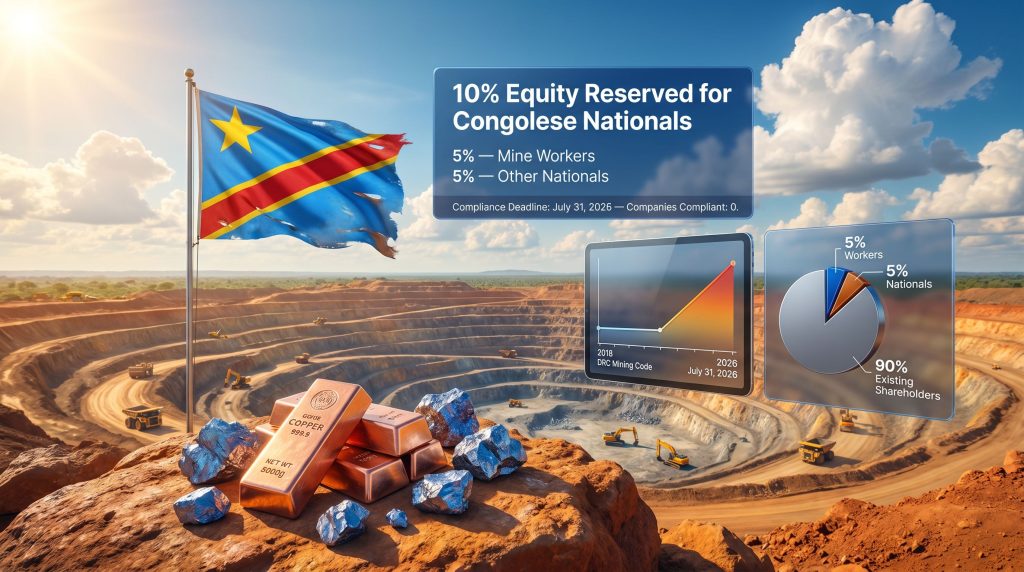
The DRC's mandatory equity framework originates from the country's 2018 Mining Code, a sweeping revision of national mining law that introduced new royalty structures, increased state participation rights, and established the Congolese nationals ownership mandate. The rule requires mining companies to reserve 10% of their equity for Congolese nationals, structured across two distinct tiers:
- 5% reserved specifically for Congolese employees working at the mining operation
- 5% reserved for other Congolese nationals, held through locally incorporated companies or public social security institutions
Despite being embedded in statute for eight years, not a single mining company had achieved formal compliance as of June 2026. The provision existed on paper but lacked any implementing decree to establish how equity should be valued, transferred, or financed. That changed in January 2026, when the Congolese mines ministry issued a circular instructing operators to demonstrate compliance by July 31, 2026, with sanctions threatened against those that failed to act.
| Policy Dimension | Detail |
|---|---|
| Total equity reserved for Congolese nationals | 10% |
| Worker-specific allocation | 5% |
| Other Congolese nationals' allocation | 5% |
| Compliance deadline | July 31, 2026 |
| Companies compliant as of June 2026 | 0 |
| Legal basis | 2018 DRC Mining Code |
| Prior informal worker schemes | ~3% (limited transparency) |
The eight-year gap between legislative intent and enforcement action reflects a pattern common to resource nationalism in frontier jurisdictions: laws are passed to signal political ambition, but implementation stalls in the absence of technical frameworks, administrative capacity, or sufficient commodity price incentive. The 2026 enforcement push coincides with a period of elevated copper and cobalt prices, giving the government considerably more negotiating leverage than it held in prior years.
How the Credit-Backed Cooperative Model Would Function
The mechanism proposed in the draft decree circulated by Congo's mines ministry represents a structurally inventive solution to the fundamental problem of worker equity programmes in low-wage mining economies: workers rarely have the capital to purchase shares in the companies they work for.
The proposed framework resolves this through a self-liquidating credit model. Here is how the process would work in practice:
- Share designation: The mining company sets aside 5% of its equity for allocation to an employee cooperative
- Cooperative formation: Workers collectively participate through a registered pooled ownership vehicle, reducing individual entry barriers
- Credit extension: The company extends interest-free credit to the cooperative to fund the share acquisition at the outset
- Dividend withholding: Up to 80% of annual dividends generated by the worker-held shares are withheld and applied against the outstanding credit balance
- Progressive debt retirement: The process continues year-over-year until the full acquisition cost is recovered by the company
- Unencumbered transfer: Once the credit is fully repaid, the cooperative holds its equity stake without restriction
- Anti-dilution protection: Companies are explicitly prohibited from reducing the 10% Congolese allocation through future capital raises, regardless of the scale of those raises
The dividend-withholding repayment structure is a self-financing mechanism: workers acquire real equity stakes without requiring upfront capital, while the company recoups acquisition costs through the very income stream generated by the transferred shares. The state bears no fiscal cost. The worker bears no immediate cash burden. The financial weight falls on the operating company.
This design has meaningful precedent in development finance literature, where similar structures have been used in employee share ownership programmes (ESOPs) across various jurisdictions. Furthermore, the DRC model's novelty lies in applying this at a national, mandatory scale across a heavily capital-intensive extractive sector. Industry observers have noted the equity directive approach as one of the more technically sophisticated attempts to democratise mining wealth in sub-Saharan Africa.
Unresolved Legal and Structural Ambiguities
Despite the elegance of the proposed mechanism, significant operational and legal questions remain unanswered as of the July 2026 deadline. These ambiguities are not minor administrative details; they carry material financial consequences for every major operator in the DRC.
Share source: The most consequential unresolved question is whether compliant companies must transfer existing shares from current shareholders or issue new shares. Equity transfer reduces the proportional ownership of existing investors without compensation. New share issuance dilutes all shareholders equally but avoids a forced transfer mechanism. The distinction determines whether the mandate constitutes a wealth redistribution from existing shareholders or a dilution event.
Retroactivity: Whether the mandate applies to mining operations established before the 2018 code remains legally contested. Pre-existing concession holders may argue that their investment terms are governed by the regulatory framework at the time of project approval.
Valuation methodology: The draft decree does not specify whether shares must be transferred at market value, book value, or a negotiated discount. Each approach produces dramatically different acquisition costs for the cooperative and different recovery timelines under the dividend-withholding model.
Worker eligibility: It is unclear which categories of workers qualify for the 5% employee allocation. The distinction between permanent employees, contractors, and artisanal workers carries significant implications for both the size of the eligible pool and the governance structure of any cooperative.
Cooperative legality: What constitutes a compliant cooperative structure under Congolese corporate law has not been formally defined. Without a clear legal template, companies face uncertainty about whether any structure they establish will satisfy regulatory scrutiny.
How Major Operators Are Responding
The multinationals most directly exposed to the equity mandate include Glencore, Ivanhoe Mines, and CMOC, each of which operates significant copper and cobalt assets in the DRC's Katanga and Lualaba provinces. These companies face a structurally awkward position: the mandate is legally enforceable, noncompliance attracts sanctions, yet no compliant structure has been successfully modelled or approved.
The industry's collective response has centred on requesting a moratorium to allow structured consultation before the July 31 deadline. Consequently, Congo miners are seeking a delay to the 5% worker equity rule, reflecting both genuine operational complexity and an awareness that compliance frameworks established hastily under deadline pressure may create legal liabilities that outlast the immediate political moment.
Prior informal worker-linked schemes, which allocated approximately 3% of equity to workers through loosely structured programmes, have been widely criticised for lacking transparency, accountability, and genuine worker ownership. Labour groups have explicitly noted that these arrangements did not constitute meaningful wealth transfer and should not be treated as a baseline for compliance.
Investor Risk Scenario Framework:
Bear Case: Forced transfer of existing shares with no compensation mechanism, immediate reduction in foreign ownership proportions, and escalating political risk premium across all DRC-exposed assets
Base Case: Negotiated phased compliance through new share issuance, cooperative structures absorbing worker equity incrementally over 5 to 10 years, with formal decree providing legal clarity
Bull Case: Clear implementing regulations reduce long-term sovereign risk, improve social licence for operations, and attract development finance institutions that require community ownership structures as a disbursement condition
Labour's Perspective: Genuine Wealth Transfer or Symbolic Policy?
The organised labour position on the equity mandate is nuanced. Unions have broadly supported enforcement but have been explicit that the success of the policy depends entirely on how the financing structures are designed in the final decree.
The head of the Union for Social Peace, Juresse Lokosha, stated publicly following discussions with the mines ministry that acquiring shares would not be automatic for all workers. Participation would depend on each worker's capacity to mobilise financing, whether through private means or through access to the company-backed credit facility. Pooled cooperative structures are being actively promoted by authorities as the mechanism to make participation viable across different income levels within the workforce.
This is a critical design insight. Equity programmes in other jurisdictions have failed not because of legal deficiencies but because the financing structures were inaccessible to lower-income workers. South Africa's Black Economic Empowerment mining ownership targets, for instance, resulted in concentrated beneficial ownership among a small number of politically connected intermediaries rather than broad-based worker wealth accumulation. The DRC model's cooperative-credit hybrid is explicitly designed to avoid this outcome, though whether it succeeds will depend on the final decree's implementation specifics. In addition, the local ownership rules emerging across the region suggest the DRC is not alone in pursuing this structural shift.
The next major ASX story will hit our subscribers first
Comparing Global Resource Nationalism Models
The DRC's framework sits within a broader continuum of resource nationalism approaches across Sub-Saharan Africa and beyond. Each model reflects different state capacities, political histories, and commodity mixes.
| Country | Policy Mechanism | Worker Equity Component | Compliance Rate |
|---|---|---|---|
| DRC | Cooperative + interest-free credit | 5% direct worker allocation | 0% (as of 2026) |
| Zambia | Local content requirements | Indirect via employment targets | Partial |
| South Africa | BEE ownership targets | Sector-specific, 26%+ for mining | Mixed |
| Zimbabwe | Indigenization law | 51% historically (since relaxed) | Contested |
| Botswana | State equity participation | Government-led (Debswana model) | Structured |
The DRC model is structurally distinct from both the South African BEE framework and the Botswana state participation model. BEE created ownership obligations but largely relied on private financing markets that systematically excluded lower-income beneficiaries. The Botswana model concentrates ownership at the state level rather than distributing it to workers directly. The DRC's cooperative-credit hybrid represents a third path, attempting to democratise ownership within the workforce while placing the financing burden on the operating company rather than the state or individual workers.
Investment Implications for DRC-Exposed Mining Assets
For investors with exposure to DRC copper and cobalt assets, Congo mine workers equity stakes introduce a set of risks that cannot be hedged through conventional commodity price instruments. The political risk premium embedded in DRC-based assets has historically been priced at a discount to equivalent assets in more stable jurisdictions. The equity mandate, depending on its final structure, could either deepen that discount or, paradoxically, reduce long-term sovereign risk by improving the social licence under which operations function.
Several factors warrant close monitoring:
- Whether the final decree mandates equity transfer or new share issuance, which determines direct shareholder dilution impact
- How share valuation methodology is established and whether it reflects market reality or distorted book values
- The pace of cooperative formation and whether structures qualify under Congolese corporate law
- Whether project financing lenders to DRC operations incorporate the equity obligation into debt covenants, potentially constraining future capital raise strategies
- The enforceability and specificity of sanctions for non-compliance after the July 31 deadline
One factor that distinguishes the current enforcement moment from prior failed attempts is the commodity price environment. Elevated copper prices and continued cobalt demand from battery supply chains give the Congolese government considerably more leverage than it held in the lower-price environment of the early 2020s. Furthermore, the cobalt export ban has already demonstrated Kinshasa's willingness to use commodity leverage as a policy instrument. Companies cannot credibly threaten exit from a jurisdiction that produces more than two-thirds of the world's cobalt and hosts some of the planet's highest-grade copper deposits. The irreplaceability of DRC assets within global critical mineral supply chains is precisely why the government's enforcement credibility is higher in 2026 than at any prior point since the 2018 code was enacted.
This article contains forward-looking analysis and scenario modelling based on publicly available information as of June 2026. It does not constitute financial advice. Investors should conduct their own due diligence and consult qualified advisors before making investment decisions related to DRC-exposed mining assets.
Frequently Asked Questions: Congo Mine Workers Equity Stakes
What percentage of equity must DRC mining companies allocate to workers?
Under the proposed implementation framework derived from the 2018 Mining Code, 5% of company equity must be reserved specifically for Congolese employees, forming half of a broader 10% total allocation for Congolese nationals.
Has any mining company complied with the DRC worker equity rule?
As of June 2026, no mining company operating in the DRC has formally complied with the equity mandate, despite the statutory obligation existing since 2018.
How will workers finance the acquisition of their equity stakes?
The draft decree proposes an interest-free credit facility extended by the mining company itself, with repayment structured through the withholding of up to 80% of annual dividends generated by the worker-held shares until the outstanding debt is cleared.
What happens if mining companies miss the July 2026 deadline?
The Congolese government has indicated that sanctions will apply to non-compliant operators following the July 31 deadline, though the precise nature and severity of those sanctions have not been publicly detailed as of the time of publication.
Can mining companies dilute the Congolese equity allocation through future share issuances?
No. The draft decree explicitly prohibits companies from reducing the 10% Congolese national allocation regardless of the scale of any future capital increases.
The Path Forward: Compliance, Negotiation, or Continued Stalemate?
Assessing the realistic probability of the DRC's equity mandate achieving full compliance requires distinguishing between legal enforceability and practical implementation. The Congolese mining sector has a well-documented history of regulatory announcements that generate significant initial market reaction before resolving into negotiated accommodations between the state and major operators.
What is different in 2026 is the combination of factors: a formal implementing circular with a fixed deadline, an explicit sanctions threat, a detailed draft decree circulated for consultation, and a commodity price environment that reduces the government's incentive to grant extended grace periods. The cooperative-credit model also provides a technically viable compliance pathway that does not require state fiscal outlay, removing a common barrier to policy implementation in fiscally constrained jurisdictions.
The more likely near-term outcome is a phased negotiation in which the largest operators establish cooperative structures before the deadline while seeking formal extensions for the completion of share valuation and transfer mechanics. Full compliance across the industry, including smaller operators and junior miners, will take considerably longer and will require administrative enforcement capacity that the DRC mines ministry is still building. However, the global cobalt mining industry is watching closely, given the DRC's dominant position in battery-critical supply chains.
Whether the policy ultimately delivers genuine and broad-based wealth transfer to Congolese mine workers, or whether it becomes another entry in the long list of well-intentioned African resource nationalism frameworks that concentrated ownership among a narrow elite, will depend almost entirely on the final decree's financing accessibility provisions and the robustness of the cooperative governance structures established in its wake. The intersection of US-China rivalry over Congolese cobalt adds yet another dimension of geopolitical pressure that will shape how swiftly and effectively these ownership reforms are ultimately enforced.
Want to Stay Ahead of Major Mineral Discoveries Before the Broader Market Reacts?
As resource nationalism reshapes critical mineral supply chains across the DRC and beyond, Discovery Alert's proprietary Discovery IQ model delivers real-time ASX mineral discovery alerts, turning complex commodity data into actionable investment insights — explore how historic discoveries have generated substantial returns and begin your 14-day free trial at Discovery Alert to position yourself ahead of the market.