June 24, 2026
The Global Race for Critical Minerals Is Reshaping Where Capital Flows Next
The energy transition has fundamentally altered the strategic calculus of industrial investment. Governments and corporations across Europe are no longer simply asking where the cheapest minerals are located. They are asking where supply chains can be secured, where political risk is manageable, and where regulatory frameworks genuinely welcome foreign capital. That convergence of questions is pointing an increasing number of French and European investors toward one of the world's least-discussed mineral frontiers, making Saudi Arabia mining investment opportunities in France a topic of growing strategic relevance.
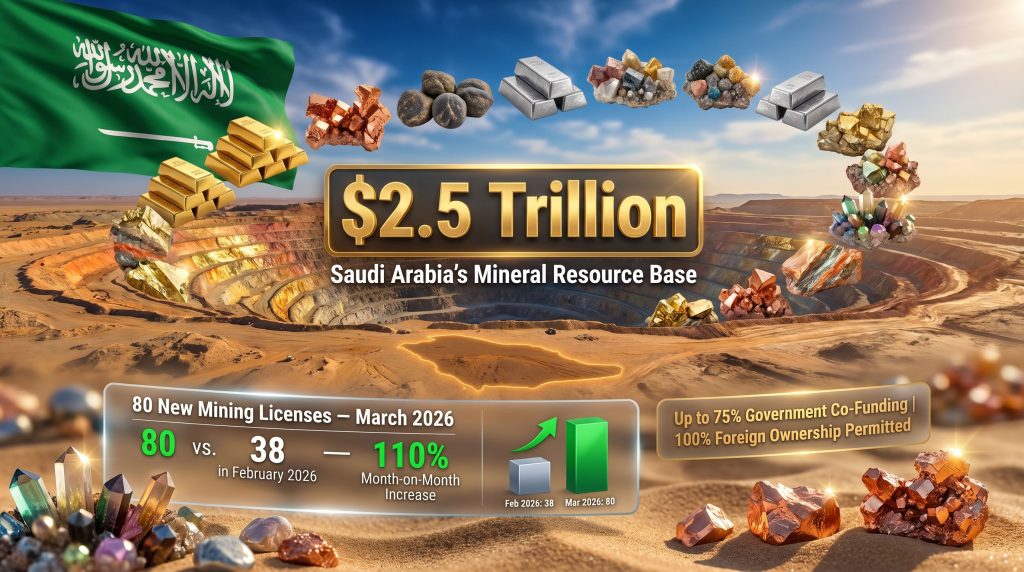
With an estimated $2.5 trillion in untapped mineral wealth, the Kingdom is no longer content to let its geological endowment remain a footnote in global commodity markets. A deliberate, multi-year effort to transform mining into a third economic pillar alongside hydrocarbons and manufacturing is now producing measurable momentum, and European industrial capital is taking notice.
When big ASX news breaks, our subscribers know first
Saudi Arabia's $2.5 Trillion Mineral Base: What's Actually Underground
Understanding Saudi Arabia's resource potential requires moving beyond the headline figure. The Kingdom's mineral wealth spans a geologically diverse portfolio that aligns with some of the most pressing supply chain priorities in global industry today.
| Mineral | Strategic Relevance | Primary Applications |
|---|---|---|
| Gold | High-value export commodity | Electronics, reserves, jewellery |
| Copper | Critical electrification metal | EVs, power grids, renewable infrastructure |
| Zinc | Industrial demand staple | Galvanisation, alloys, coatings |
| Phosphates | Agricultural security asset | Fertilisers, global food systems |
| Aluminium | Lightweight manufacturing metal | Aerospace, packaging, EV components |
| Rare Earth Elements | Green technology backbone | Wind turbine magnets, EV motors, defence |
What makes this portfolio particularly compelling is its breadth. Unlike some competing jurisdictions that offer depth in one or two commodities, Saudi Arabia's resource base cuts across nearly every category that European manufacturers and clean energy developers are scrambling to secure.
Is the Arabian Shield Geology the Key to Saudi Arabia's Upside?
Arabian Shield exploration covers the ancient Precambrian geological formation underlying much of western Saudi Arabia, hosting the majority of the Kingdom's metallic mineral deposits. This formation is geologically analogous to well-mineralised shields found in West Africa and parts of Canada, yet it remains dramatically under-explored relative to its peers.
Exploration intensity, measured by metres drilled per square kilometre, is a fraction of what comparable geological terrains in Australia or Canada have received over the past five decades. That gap represents both risk and significant upside for first-mover investors.
Rare Earths: The Least Understood Strategic Layer
While gold and copper attract the most immediate investor attention, Saudi Arabia's rare earth element (REE) endowment may carry the greatest long-term strategic weight. REEs are essential inputs for permanent magnets used in electric vehicle motors and offshore wind turbines. China currently controls approximately 60% of global rare earth mining and an even larger share of downstream processing capacity, according to the International Energy Agency.
For European manufacturers, understanding rare earth supply chains is increasingly a boardroom-level concern rather than a procurement afterthought. Furthermore, Saudi Arabia's geographic position bridging Asian manufacturing demand and European industrial consumption creates a structurally logical supply chain node that few other jurisdictions can replicate.
Saudi Arabia's rare earth deposits remain among the least characterised major REE occurrences globally, meaning that currently published resource estimates are likely conservative relative to what systematic exploration could ultimately define.
Vision 2030 and the Policy Architecture That Makes Investment Viable
Saudi Arabia's mining ambitions did not emerge in isolation. They are embedded within Vision 2030, the national economic diversification programme that has systematically dismantled barriers to foreign participation across multiple sectors. For mining specifically, the policy architecture rests on several reinforcing pillars.
The Mining Investment Law of 2020 serves as the cornerstone of foreign participation. Its key provisions include:
- 100% foreign ownership permitted across most mineral categories without mandatory local partnership requirements
- Up to 75% government co-funding of capital costs available through designated support mechanisms
- Tax exemptions for qualifying exploration and early development projects
- Early-stage financial support of approximately SAR 7.5 million (roughly $1.85 million USD) per qualifying project
- Reduced royalty structures designed to lower the financial threshold for junior and mid-tier exploration companies
These are not marginal incentives. The combination of full foreign ownership and meaningful capital co-funding is rare globally, particularly in a jurisdiction with Saudi Arabia's level of political stability and infrastructure development trajectory.
The National Industrial Development and Logistics Program (NIDLP) adds another dimension by integrating mining within a broader industrial strategy that connects mineral extraction to energy, manufacturing, and logistics within a unified national framework. Consequently, investors are not simply accessing a mining licence — they are entering an ecosystem designed to support the entire value chain from resource to refined product.
License Issuance Acceleration: Reading the Pipeline Signal
One of the clearest quantitative signals of momentum in Saudi Arabia's mining sector is the pace of licence issuance. In March 2026, the Kingdom issued 80 new mining licences, compared to 38 in February 2026. That represents a 110% month-on-month increase and reflects active government-led effort to accelerate the development pipeline.
Separately, 24 firms have been pre-qualified for new exploration licences as of mid-2026, and 162 new mining sites in the Madinah region have been opened to international investors. For context on the broader licensing framework, Saudi exploration licences have been evolving rapidly as part of this deliberate push to attract foreign capital.
A doubling of monthly licence issuances within a single reporting period is a meaningful signal for investors assessing deal flow velocity and regulatory intent. It suggests that bureaucratic throughput, historically a friction point in emerging mining jurisdictions, is being deliberately managed as a competitive variable.
The Madinah region deserves particular attention. Located within the broader Arabian Shield geology, this area encompasses prospective ground for gold and base metal mineralisation. The opening of 162 sites simultaneously creates an unusual concentration of early-stage opportunity that is rarely available in more mature mining jurisdictions.
The Gulf Vision 2026 Forum: Why Paris and Why Now
Saudi Arabia's decision to present its mining investment case at the Gulf Vision 2026 Forum in Paris was not incidental. France occupies a distinctive position in the European industrial landscape that makes it a logical entry point for Kingdom-level mining diplomacy.
French industrial history in mining engineering, metallurgy, and mineral processing is deep and internationally deployed. French corporate expertise has been embedded in African and Middle Eastern resource projects for decades, creating a workforce and institutional knowledge base that is directly transferable to Saudi operational contexts. French companies also serve as conduits into broader EU institutional capital networks and technology ecosystems.
At the Forum, 15 French companies from the mining and related industrial sectors engaged in structured bilateral meetings with Saudi government representatives. According to reporting from Arab News, the agenda centred on five key themes:
- Mineral exploration partnerships and co-investment structures
- Technology transfer agreements for advanced extraction and processing methodologies
- Joint venture frameworks spanning the full mineral value chain
- Sustainable mining practices aligned with European ESG compliance standards
- Localisation of mining technologies and development of Saudi national workforce competencies
The explicit emphasis on technology transfer and downstream value chain integration signals that Saudi Arabia is not simply seeking capital. It is seeking industrial knowledge that can be embedded within the Kingdom's own developing capabilities — a distinction that has significant implications for how partnership agreements are likely to be structured.
How Saudi Arabia Compares as a Mining Investment Destination
For European investors conducting comparative due diligence, positioning Saudi Arabia against competing jurisdictions reveals a differentiated risk-return profile.
| Factor | Saudi Arabia | Africa (Select Markets) | Australia | Latin America |
|---|---|---|---|---|
| Political Stability | High | Variable | High | Variable |
| Foreign Ownership | 100% permitted | Varies widely | 100% permitted | Varies widely |
| Government Co-Funding | Up to 75% capex | Rare | Limited | Rare |
| Infrastructure Maturity | Rapidly developing | Low to Medium | High | Medium |
| Critical Mineral Variety | Broad (REE, Cu, Au, Zn, P) | Broad | Broad | Copper-heavy |
| ESG Framework Maturity | Developing | Variable | Strong | Variable |
| Exploration Intensity | Low (high upside) | Variable | High (mature) | Medium |
The combination of high political stability, full foreign ownership, and meaningful government capital co-funding is unusual. Australia offers comparable stability and ownership rights but minimal co-funding. African markets may offer exploration upside but carry elevated political and infrastructure risk. Saudi Arabia's profile, however, occupies a distinct position that suits investors willing to accept earlier-stage geological uncertainty in exchange for regulatory and financial structure advantages.
The next major ASX story will hit our subscribers first
Structural Risks and Investor Considerations
A balanced assessment of Saudi Arabia mining investment opportunities in France and Europe requires honest engagement with the risk landscape.
Strategic mineral classification is a material consideration. Certain minerals may be designated as strategically sensitive by the Saudi government, which can introduce requirements for additional approvals or mandatory local partnership structures not applicable to non-strategic categories. Pre-entry regulatory mapping is essential to identify which minerals within a prospective licence area carry this classification risk.
Saudization compliance creates workforce structuring obligations. Saudi Arabia's national employment mandate requires mining operations to meet prescribed quotas for Saudi national employees across operational roles. This affects staffing models, training investment requirements, and operational cost structures in ways that European operators may not have encountered in their existing project portfolios.
ESG alignment is an evolving area. In addition, Saudi Arabia's mining sector ESG frameworks are still maturing relative to Australian or Canadian benchmarks. European institutional investors with strict ESG mandates should assess both current standards and the trajectory of regulatory development before committing capital. Understanding critical raw materials transition requirements under the EU's framework is equally relevant to these assessments.
Investors should engage specialist legal and regulatory advisors with direct experience in Saudi Arabian mining law before executing exploration or development agreements. The incentive structure is genuinely attractive, but its full benefit is only accessible to operators who understand the compliance obligations that accompany it.
Downstream Integration: Beyond the Mine Gate
Perhaps the most strategically differentiated aspect of Saudi Arabia's mining proposition is its explicit focus on integrated industrial value chains rather than raw material export. The Kingdom's ambition extends to mineral processing, refining, and advanced manufacturing, with Saudi giga-project infrastructure serving as a substantial anchor demand source for processed mineral outputs.
For French and European companies, this creates investment opportunities that extend well beyond exploration licences. Furthermore, Saudi mining licences now span mineral processing joint ventures, refinery technology licensing arrangements, and advanced manufacturing partnerships — all within the scope of what the Saudi Ministry of Industry and Mineral Resources is actively seeking to develop through bilateral engagement.
This downstream orientation also aligns with European industrial policy priorities. As detailed by Pinsent Masons, as EU manufacturers face increasing pressure to shorten and secure their critical mineral supply chains under the Critical Raw Materials Act framework, partnerships that deliver not just raw ores but processed intermediate materials carry substantially higher strategic value.
Frequently Asked Questions
What Minerals Are Accessible to French and European Investors in Saudi Arabia?
The accessible portfolio includes gold, copper, zinc, phosphates, aluminium, and rare earth elements across designated exploration zones, including 162 newly opened sites in the Madinah region.
Is 100% Foreign Ownership Genuinely Available?
Yes, under the 2020 Mining Investment Law, full foreign ownership is permitted for most mineral categories. Minerals classified as strategically sensitive may require additional approvals or local partnership structures.
What Financial Incentives Are Available?
Key incentives include up to 75% government co-funding of capital costs, tax exemptions for qualifying projects, early-stage support of approximately SAR 7.5 million (~$1.85M USD) per project, and reduced royalty structures for early entrants.
How Significant Is the Recent Licensing Acceleration?
The jump from 38 licences in February 2026 to 80 in March 2026 represents a 110% month-on-month increase — a statistically significant signal of deliberate pipeline acceleration rather than routine administrative variation.
What Role Does the NIDLP Play?
The National Industrial Development and Logistics Program integrates mining within a unified national strategy connecting industry, energy, logistics, and manufacturing, effectively providing investors with access to an ecosystem rather than an isolated licensing regime.
This article is intended for informational purposes only and does not constitute financial or investment advice. All forward-looking statements, projections, and market assessments involve inherent uncertainty. Readers should conduct independent due diligence and seek qualified professional advice before making any investment decisions related to the Saudi Arabian mining sector or any other jurisdiction.
Want to Stay Ahead of the Next Major Mineral Discovery?
While Saudi Arabia's mineral frontier captures global attention, Discovery Alert's proprietary Discovery IQ model delivers real-time alerts on significant ASX mineral discoveries — instantly translating complex geological data into actionable investment opportunities for both short-term traders and long-term investors. Explore how historic discoveries have generated extraordinary returns and begin your 14-day free trial today to position yourself ahead of the broader market.