June 24, 2026
The Commodity Cycle Trap: Why Lithium Valuations Are Harder Than They Look
Across the long history of commodity markets, one pattern repeats itself with uncomfortable regularity. When prices for a raw material surge, investor enthusiasm follows, and the market begins pricing equities as though elevated spot prices represent a permanent new normal rather than a cyclical phase. This behavioural dynamic, where sentiment overpowers structural analysis, is precisely the lens through which any serious examination of ASX lithium producers must begin in 2026.
Spodumene concentrate prices have recovered meaningfully from their multi-year lows, reigniting institutional and retail interest in hard-rock lithium operations listed on the ASX. However, the critical question for investors is not whether lithium demand will grow — it almost certainly will — but whether current market prices for ASX lithium equities already embed too optimistic an assumption about where lithium prices will sit over the next decade. For Pilbara Minerals (ASX: PLS), that tension sits at the very centre of an intensifying valuation debate, with many analysts now asking whether PLS is an overvalued ASX lithium producer at current share prices.
When big ASX news breaks, our subscribers know first
Where PLS Sits in the Global Lithium Supply Hierarchy
Understanding the valuation debate begins with appreciating what Pilbara Minerals actually owns. Pilgangoora, located in Western Australia's Pilbara region, is the world's second-largest hard-rock lithium operation by scale. That positioning matters enormously for cost economics. Larger operations spread fixed costs across greater volumes, driving down unit costs and enabling the mine to remain cash-generative even when spot prices retreat toward the lower end of historical ranges.
Pilgangoora operates through two processing facilities. The primary Pilgan plant handles the bulk of production and also generates tantalite as a byproduct — a commercially valuable co-product that provides an incremental revenue stream reducing the effective net cost of spodumene extraction. The smaller Ngungaju facility processes a separate section of the ore body and, while operationally viable above a certain price threshold, carries a higher unit cost than the Pilgan plant.
Key characteristics of the Pilgangoora operation include:
- Dual-plant configuration enabling operational flexibility based on prevailing market conditions
- Tantalite byproduct credits from the Pilgan plant that reduce the effective cash cost of spodumene production
- Scale advantages that support above-industry-average margins in most lithium price environments
- Brownfield expansion potential through the P2000 project, discussed in detail below
- Estimated 25 years of mine life remaining at the expanded production run rate, providing long-duration cash flow visibility
Pilgangoora's scale and low-cost structure give PLS a structural advantage over most ASX lithium peers. But scale alone does not justify any particular price-to-value ratio when the underlying commodity price assumption is itself uncertain.
How Do Analysts Actually Value PLS? A Multi-Framework Comparison
Intrinsic Valuation: What Discounted Cash Flow Models Suggest
The most striking feature of the current PLS valuation landscape is not disagreement about the company's operational quality — it is the extraordinary spread between different analysts' fair value conclusions. This divergence is almost entirely a function of one variable: the assumed long-run spodumene concentrate price.
| Valuation Source | Methodology | Fair Value Estimate | Current Market Price | Premium or Discount |
|---|---|---|---|---|
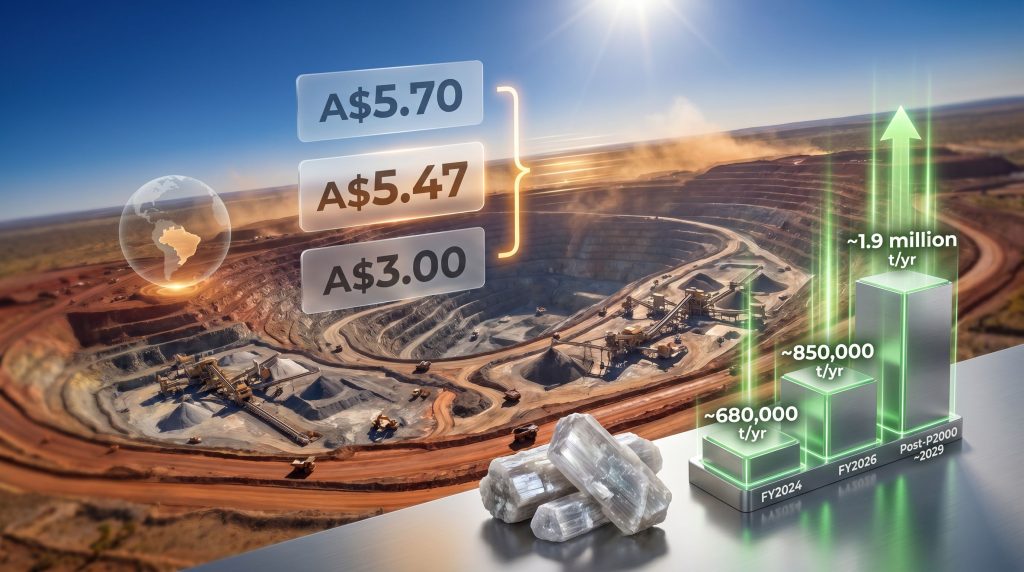
| Morningstar (Equity Research) | DCF, life-of-mine (~30 years) | A$3.00/share | ~A$5.47 | ~82% premium to fair value |
| Simply Wall St | Adjusted fair value model | A$5.70/share | ~A$5.47 | ~4% discount |
| Citi (Broker) | Price target, Neutral rating | A$5.25/share | ~A$5.47 | ~4% premium |
The Morningstar analysis, constructed over an approximately 30-year life-of-mine horizon and anchored to a long-run spodumene price assumption of USD 1,600 per metric tonne, arrives at a fair value of A$3.00 per share. At a prevailing market price of approximately A$5.47, that analysis implies the stock is trading at close to double its assessed intrinsic value. Morningstar's view, published in June 2026, reflects the position that the market is extrapolating current spot prices too aggressively into forward earnings projections.
At the other end of the spectrum, models anchored to near-term earnings momentum and growth expectations generate materially higher outputs, with one estimate reaching A$5.70 per share. The gap between A$3.00 and A$5.70 is not a minor modelling discrepancy. It represents a fundamentally different belief about commodity price mean reversion.
The Marginal Cost of Production Framework
In commodity economics, there is a gravitational force that analysts return to repeatedly: the marginal cost of production for the highest-cost producer needed to satisfy market demand. Over sufficiently long time horizons, spot prices tend to revert toward this level, because prices above marginal cost attract new supply, which compresses prices back down.
For spodumene concentrate, Morningstar's research forecasts that prices will converge toward the marginal cost of production by approximately 2034, implying a decline of roughly 32% from current spot levels. That single forecast, embedded into a multi-decade DCF model, is the primary driver of the A$3.00 fair value conclusion. Furthermore, the lithium market downturn that preceded the current recovery serves as a sobering reminder of how quickly supply-demand balances can shift.
When markets price cyclical commodity stocks using spot prices rather than long-run equilibrium prices, the error compounds across every year of a long-duration model. A 30-year mine life gives those early-year price assumptions enormous leverage over the final valuation output.
Forward P/E and Price-to-Sales: How PLS Compares to Sector Benchmarks
| Metric | PLS Estimate | ASX 200 Materials Sector | ASX 200 Broad Index |
|---|---|---|---|
| Forward P/E | ~8.3x | ~10x | ~15x |
| Price-to-Sales | Above sector average | Sector average | — |
A forward P/E of approximately 8.3x appears cheap relative to the broader ASX 200, trading near 15x earnings. However, this comparison is misleading in isolation. Cyclical commodity producers should trade at discount P/E multiples during earnings peaks, precisely because those elevated earnings are unsustainable. A mining company earning peak-cycle profits at a low P/E multiple may still be overvalued if those profits normalise sharply over the following years.
The price-to-sales comparison is similarly nuanced. PLS trading above its sector average on this metric suggests the market is attributing a premium to its growth story — specifically P2000 and the Latin Resources acquisition — rather than simply reflecting current cash generation.
What Is the P2000 Expansion and Does It Change the Valuation Equation?
Breaking Down the P2000 Project
P2000 represents the third processing plant planned for Pilgangoora, designed to lift total nameplate spodumene concentrate capacity to approximately 2 million metric tonnes per year. To contextualise that ambition:
- FY2024 nameplate capacity: approximately 680,000 metric tonnes per year from the Pilgan plant alone
- Post-P2000 average output: approximately 1.9 million metric tonnes per year across a 10-year operating window
- Implied capacity increase: nearly a tripling of throughput from FY2024 levels
- Expected production commencement: mid-2029, subject to completion of a full feasibility study
The 2024 prefeasibility study confirmed P2000 is NPV-positive at spodumene prices above USD 1,000 per metric tonne, with the project economics most compelling at USD 1,500 per tonne or above. Given that Morningstar's long-run price assumption sits at USD 1,600 per tonne, P2000 clears the value-creation threshold under the base case price deck.
The A$175 Million Capital Commitment
PLS has approved A$175 million in capital expenditure for long-lead procurement items ahead of the final feasibility study outcome. Long-lead items in mining typically refer to major equipment orders — such as ball mills, flotation cells, and processing infrastructure — that require extended manufacturing lead times and must be ordered well before construction commences.
Committing this capital before the feasibility study is complete carries binary risk. If the project is ultimately cancelled, that expenditure is unrecoverable. However, framed proportionally, A$175 million represents approximately 1% of PLS's market capitalisation, making it a relatively modest strategic bet in the context of the company's overall balance sheet.
Does P2000 Materially Alter the Long-Term Fair Value?
This is where an important and counterintuitive insight emerges from rigorous financial modelling. Accelerating P2000's production commencement by one year — from a prior estimate to mid-2029 — has a near-immaterial effect on a DCF model that spans approximately 30 years of mine life.
The mathematics of discounting explains why. Cash flows occurring in years 20 to 30 of a DCF model are already heavily discounted, so the contribution of one additional year of production at the front end becomes proportionally small within the total net present value calculation. Morningstar explicitly confirmed that P2000 commencing one year earlier than previously modelled was immaterial to its A$3.00 fair value estimate.
| Scenario | Spodumene Price Assumption | P2000 Value Contribution |
|---|---|---|
| Below threshold | Below USD 1,000/t | NPV-negative; project shelved |
| Minimum viability | USD 1,000/t to USD 1,500/t | Marginally NPV-positive |
| Optimal range | USD 1,500/t and above | Clearly value-accretive |
| Morningstar base case | USD 1,600/t (10-year average) | Value-accretive; supports project proceeding |
Is PLS Overvalued? The Bull and Bear Cases Examined Systematically
The Bear Case: Why Current Market Pricing May Be Unsustainable
- Spot price extrapolation risk: The most structurally significant concern is that forward earnings models anchored to current spot prices of approximately USD 1,867 per tonne realised will prove materially optimistic as the market reverts toward long-run equilibrium
- Demand growth dependency: Revenue and profit expansion in the medium term are heavily contingent on successful P2000 execution. Construction delays, cost overruns, or permitting complications could push commencement beyond mid-2029
- Ngungaju cost drag: The smaller Ngungaju plant, contributing roughly one-fifth of production capacity, operates at higher unit costs than Pilgan. At lower price environments, Ngungaju moves toward or below its operating cost threshold, introducing margin compression
- Geopolitical exposure from Latin Resources: The 2025 acquisition introduces exposure to Brazil's regulatory environment, including potential future changes to company tax rates and royalty frameworks that could alter the project's economics
- Valuation premium to intrinsic estimates: At approximately A$5.47, the stock trades at roughly 82% above Morningstar's assessed intrinsic value, representing a substantial margin of overvaluation on that framework
The Bull Case: Why Some Analysts See Structural Undervaluation
- Low-cost structural advantage: Pilgangoora's position as one of the world's lowest-cost spodumene operations means it generates returns above its weighted average cost of capital (estimated at 10%) across a wide range of price scenarios
- EV demand tailwind: High-double-digit annual growth in global lithium demand is projected as electric vehicle penetration continues to accelerate, providing a powerful structural backdrop for volume growth
- Balance sheet capacity: A strong financial position supports both the P2000 capital program and the integration of Latin Resources without requiring dilutive equity raises
- Latin Resources optionality value: The all-scrip acquisition of Latin Resources, completed in 2025 at a transaction value of approximately A$600 million, is estimated to carry an enterprise value exceeding A$1 billion using long-run lithium price assumptions. This contributes approximately A$0.40 per share to fair value, representing roughly 15% of Morningstar's A$3.00 estimate
- Operational execution track record: Recent production of 232,400 tonnes, up 12% year-on-year, alongside a 61% increase in realised prices to approximately USD 1,867 per tonne, demonstrates the operational capability underpinning expansion ambitions
Synthesising the Competing Views: A Structured Scenario Framework
| Scenario | Spodumene Price Assumption | Implied PLS Valuation Direction | Key Risk |
|---|---|---|---|
| Bear Case | Prices revert to marginal cost (~32% below spot by ~2034) | Materially overvalued at current market price | Demand growth disappointment; EV adoption lag |
| Base Case | Prices stabilise near USD 1,600/t long-run average | Broadly fairly valued to modestly overvalued | Execution risk on P2000; Latin Resources integration |
| Bull Case | Prices sustain above USD 1,800/t through 2030+ | Undervalued at current market price | Capital allocation discipline required |
What Does the Ngungaju Restart Tell Us About PLS's Operational Flexibility?
Reading Management Signals Through the Restart Decision
The planned restart of the Ngungaju plant from July 2026 carries more analytical significance than a simple production volume announcement. Management's willingness to recommission a higher-cost facility signals a clear view that current lithium prices have moved sustainably above Ngungaju's operating cost threshold. This is a deliberate capital allocation decision, not a passive one.
From a cost structure perspective, operating both plants simultaneously improves overall fixed-cost absorption across the Pilgangoora site. Shared infrastructure, management overhead, and site services are spread across a larger production base, reducing the per-unit cost contribution of those fixed items.
Production Capacity Progression: A Timeline View
| Period | Production Capacity (Spodumene Concentrate) | Key Driver |
|---|---|---|
| FY2024 Nameplate | ~680,000 metric tonnes/year | Pilgan plant only |
| FY2026 (Post-Ngungaju Restart) | ~850,000 metric tonnes/year (estimated) | Pilgan + Ngungaju |
| Post-P2000 (from ~2029) | ~1.9 million metric tonnes/year (10-year avg) | Pilgan + Ngungaju + P2000 plant |
An important operational complexity emerges when projecting beyond 2029. Running three processing facilities simultaneously at a single mine site demands sophisticated logistics, water and power infrastructure, and workforce scaling. These execution variables represent real, if manageable, risks that investors should factor into scenario analysis rather than treating expansion timelines as deterministic.
The next major ASX story will hit our subscribers first
How Should Investors Interpret the WACC and ROIC Framework for PLS?
Return on Invested Capital as the Fundamental Test
In mining, as in any capital-intensive industry, the central question for expansion decisions is whether the return on invested capital exceeds the weighted average cost of capital. When ROIC exceeds WACC, value is created. When ROIC falls below WACC, even nominally profitable projects destroy shareholder wealth in present-value terms.
Morningstar's analysis concludes that PLS's ROIC exceeds its 10% WACC estimate even at midcycle lithium prices, defined as a price environment where spodumene trades at the marginal cost of production. This finding is significant because it means the Pilgangoora operation does not require above-average commodity prices to generate value for shareholders. The asset's low-cost structure provides a genuine buffer.
For P2000 specifically, the brownfield nature of the expansion is a material advantage. Expanding an existing mine and processing complex carries substantially lower execution risk than building a greenfield operation. Existing infrastructure, regulatory approvals, workforce, and logistical networks can be leveraged, reducing both capital intensity per unit of new capacity and the probability of construction cost blowouts.
WACC Sensitivity and Its Interaction with Price Assumptions
A technically important but often overlooked dynamic in mining valuations is that commodity price assumptions typically dominate WACC sensitivity in the final fair value output. A 1 to 2 percentage point shift in WACC across a 30-year life-of-mine model will change the fair value estimate, but it will change it far less than a sustained USD 200 per tonne shift in the assumed long-run spodumene price.
This hierarchy of sensitivities has a practical implication for investors. Energy spent debating whether the correct WACC for PLS is 9.5% or 10.5% is largely academic. The more consequential analytical work lies in stress-testing the long-run price assumption: specifically, whether USD 1,600 per tonne is a realistic 10-year average or whether supply growth will compress margins more aggressively. In addition, understanding the broader lithium supply-demand dynamics at the carbonate and hydroxide level provides important context for any spodumene price projection.
In long-duration mining DCF models, the assumed commodity price trajectory is almost always the single largest driver of valuation outcomes. Investors who anchor to current spot prices effectively assume the cycle has ended and a new structural price floor has been established — a claim that requires extraordinary evidence to support.
The Latin Resources Acquisition: Geographic Diversification or Geopolitical Risk?
The completion of the Latin Resources acquisition in 2025 added a hard-rock lithium project in Brazil to PLS's portfolio. The transaction was structured as an all-scrip offer, valued at approximately A$600 million at completion, though Morningstar estimates the underlying enterprise value exceeds A$1 billion when applying its long-run lithium price assumptions.
The A$0.40 per share contribution to fair value from this asset represents meaningful optionality. Brazil hosts some of the world's most prospective hard-rock lithium geology, and a well-managed, long-life project in that jurisdiction could compound value significantly over time. However, several risk dimensions require careful consideration:
- Fiscal risk: Brazil's tax and royalty framework for mining is subject to periodic policy revision. Changes to corporate tax rates or mineral royalty structures could materially reduce the net present value of the asset.
- Operational integration risk: Absorbing a development-stage Brazilian asset while simultaneously managing a major expansion program at Pilgangoora creates management bandwidth demands.
- Currency exposure: Revenue from a Brazilian asset denominated in USD interacts with Brazilian real-denominated operating costs, adding a foreign exchange dimension to the financial model.
- Development timeline uncertainty: Hard-rock lithium projects in Brazil have historically faced permitting complexities and infrastructure challenges that can extend development timelines beyond initial estimates.
Frequently Asked Questions: PLS Valuation and ASX Lithium Market Dynamics
Is PLS currently overvalued on the ASX?
Whether PLS is an overvalued ASX lithium producer depends almost entirely on which long-run spodumene price assumption an investor accepts. Morningstar's institutional research places fair value at A$3.00 per share, implying the stock trades at approximately 82% above intrinsic value at around A$5.47. Other models, using different price deck assumptions, place fair value at or above the current market price. Investors should stress-test their own price assumptions before reaching a conclusion. Furthermore, a thorough Pilbara Minerals analysis in the context of broader ASX lithium peers is essential before drawing firm conclusions.
What is the fair value estimate for PLS shares?
Fair value estimates range from A$3.00 (based on a long-run USD 1,600/t spodumene price and a 30-year DCF model) to A$5.70 (based on near-term earnings momentum). The wide range reflects different assumptions about commodity price mean reversion rather than disagreement about PLS's operational quality.
What is the P2000 expansion project and when will it be completed?
P2000 is a planned third processing plant at Pilgangoora targeting approximately 2 million metric tonnes per year of spodumene concentrate capacity. Production is expected to commence from approximately mid-2029, subject to completion of a full feasibility study. PLS has approved A$175 million in capital expenditure for long-lead procurement items ahead of the final feasibility decision.
How does the Latin Resources acquisition affect PLS's valuation?
The 2025 all-scrip acquisition contributes an estimated A$0.40 per share to fair value using long-run lithium price assumptions, representing roughly 15% of Morningstar's A$3.00 fair value estimate. Key risks include Brazil's evolving fiscal framework and integration execution complexity.
Why do different analysts reach such different conclusions on PLS's valuation?
The primary driver is the assumed long-run spodumene price. Models anchored near current realised prices of approximately USD 1,867 per tonne generate materially higher fair values than models assuming reversion toward the marginal cost of production over the coming decade. Secondary factors include WACC inputs, mine-life assumptions, and the treatment of P2000 and Latin Resources in the model.
What is the Ngungaju plant and why is its restart significant?
Ngungaju is the smaller of PLS's two Pilgangoora processing facilities, contributing approximately one-fifth of current production capacity. Its planned restart from July 2026 signals management's view that lithium prices have moved sustainably above Ngungaju's operating cost threshold, while also improving overall fixed-cost absorption across the operation. Innovations such as direct lithium extraction are, consequently, reshaping how the broader industry thinks about processing costs, providing additional context for unit cost comparisons.
Key Takeaways: Framing the PLS Valuation Question for ASX Investors
The valuation debate surrounding PLS is not a debate about whether the company is well run. Pilgangoora is a world-class operation with genuine cost advantages, and the management team has demonstrated credible operational execution. The debate is about something more fundamental: where lithium prices will settle over the next decade, and whether the current market price of PLS shares accurately reflects that uncertainty.
Several conclusions emerge from a rigorous multi-framework analysis:
- The core valuation question for PLS is almost entirely a commodity price question, not an operational or management quality question
- A long-run spodumene price of USD 1,600/t supports a materially lower fair value than current market pricing implies, with Morningstar's model generating a A$3.00 fair value at that assumption
- P2000 is value-accretive under most scenarios above USD 1,000/t but its one-year acceleration in commencement timing does not materially alter a 30-year life-of-mine DCF
- Latin Resources adds optionality and geographic diversification at the cost of meaningful geopolitical and integration risk
- Ngungaju's restart provides incremental production and improved cost absorption but also introduces margin pressure at lower price environments given its higher unit cost structure
- Investors should treat the forward P/E discount to the broader ASX as a feature of cyclical earnings rather than evidence of structural undervaluation
The Kalkine commentary on PLS's record production and lithium price recovery reinforces the point that near-term momentum can be genuinely strong while longer-run mean reversion risk remains very much present. Commodity stocks are particularly susceptible to valuation errors when investors extrapolate cyclical price peaks into perpetuity. The historical pattern across resource cycles consistently shows that prices above long-run marginal cost attract new supply, compress margins, and eventually correct toward equilibrium. Rigorous valuation of any ASX lithium producer must account for this dynamic explicitly, rather than treating the current price environment as a permanent condition.
This article is intended for informational purposes only and does not constitute financial advice. Valuations, price targets, and forecasts referenced herein represent the views of independent research providers and are subject to change. Past performance and analytical models are not reliable indicators of future outcomes. Investors should conduct their own due diligence and consider seeking professional financial advice before making investment decisions. All figures are sourced from Morningstar equity research (Esther Holloway, 24 June 2026) and publicly available market data unless otherwise noted.
Want to Spot the Next Major ASX Mineral Discovery Before the Broader Market Does?
Discovery Alert's proprietary Discovery IQ model scans ASX announcements in real time, instantly identifying high-potential mineral discoveries across more than 30 commodities and translating complex data into clear, actionable insights — ideal for investors who understand that timing is everything in resource markets. Explore historic discoveries and their extraordinary returns, then begin your 14-day free trial at Discovery Alert to position yourself ahead of the next major find.