August 23, 2026
The Scarcity Economics Driving Indonesia's HPAL Land Grab
Battery materials investing has entered a phase where the most valuable asset is not ore in the ground or even processing capacity itself, but approved processing capacity. In Indonesia, the distinction matters enormously. The Indonesian government's moratorium on new High-Pressure Acid Leach (HPAL) project approvals has fundamentally altered the competitive landscape, transforming existing permitted slots into strategic moats. Understanding this regulatory backdrop is the essential starting point for evaluating the Nickel Industries Sampala CNE HPAL deal, because without it, the transaction's architecture looks unusual. With it, the logic becomes considerably sharper.
When big ASX news breaks, our subscribers know first
What the Nickel Industries Sampala CNE HPAL Deal Actually Involves
A Zero-Cash Equity Exchange With an Embedded Valuation Argument
The transaction is structurally unconventional by the standards of most ASX mining deals. Rather than acquiring a new asset through a capital raise or debt facility, Nickel Industries (ASX: NIC) is exchanging an ownership position in one part of the nickel value chain for a larger position further downstream. Specifically, the company is transferring an 18% effective interest in its Sampala nickel ore project in return for a 36% stake in CNE, a new HPAL processing plant being developed inside the Indonesia Morowali Industrial Park (IMIP).
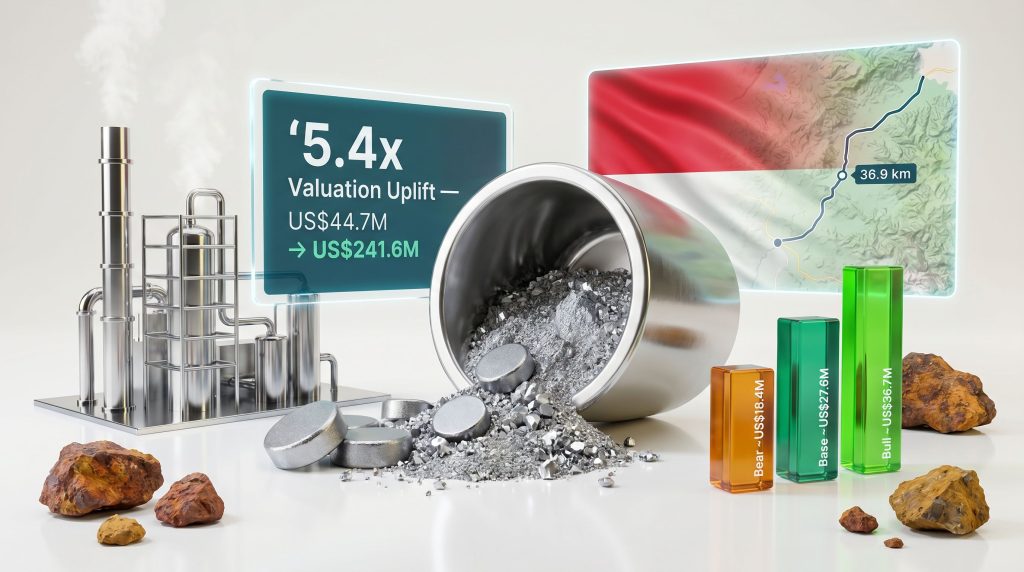
The implied valuations assigned to each side of the exchange are the headline figures that have attracted most investor attention. Sampala's equity going out is implied at US$44.7 million. The CNE equity coming back carries an implied value of US$241.6 million. The arithmetic produces a 5.4x valuation uplift on paper, with no cash changing hands in either direction.
Key Transaction Parameters at a Glance
| Deal Parameter | Detail |
|---|---|
| Asset Exchanged Out | 18% effective interest in Sampala nickel ore project |
| Asset Received | 36% stake in CNE HPAL processing plant |
| Implied Value of Sampala Equity | US$44.7 million |
| Implied Value of CNE Equity | US$241.6 million |
| Valuation Uplift Multiple | 5.4x |
| Cash Consideration | Nil |
| Attributable Annual Nickel Output (CNE) | ~10,208 tonnes at nameplate capacity |
| Target Commissioning Date | Mid-2027 |
| Ore Supply Agreement Duration | 15-year MOU |
| Sampala Annual Ore Supply Volume | Up to 14 million wet metric tonnes per annum |
| Sampala Distance from IMIP | 36.9 km |
The critical structural feature that makes this transaction capital-light is the role of JAYA, the Indonesian co-investor acquiring the Sampala equity. JAYA is responsible for funding CNE's construction costs and working capital requirements. Nickel Industries gains downstream HPAL exposure without committing balance sheet capital to plant construction, a material distinction at a point in the commodity cycle where preserving financial flexibility carries its own strategic premium.
How HPAL Technology Connects Indonesian Ore to EV Battery Supply Chains
The Chemistry Behind Class 1 Nickel Production
HPAL processing is the technical bridge between low-grade laterite ore and battery-grade nickel. The process works by dissolving ore in sulphuric acid at elevated temperatures and pressures, typically between 250 and 270 degrees Celsius, which selectively extracts nickel and cobalt while rejecting iron and other impurities. The output is a precipitate containing high concentrations of nickel and cobalt hydroxides.
What HPAL produces, and what conventional pyrometallurgical routes like rotary kiln electric furnace (RKEF) processing cannot, is Class 1 nickel: material with greater than 99.8% purity suitable for battery cathode manufacturing. The dominant intermediate product in the current market is mixed hydroxide precipitate (MHP), which battery cathode producers then refine into nickel sulphate for use in lithium-ion battery precursors. Furthermore, nickel in the energy transition is increasingly defined by this Class 1 pathway rather than conventional stainless steel feedstocks.
The distinction between Class 1 and Class 2 nickel is not semantic. RKEF processing, which dominates Indonesian production capacity, produces nickel pig iron (NPI) suited to stainless steel manufacturing rather than battery applications. The global EV supply chain, particularly cathode chemistry incorporating nickel-manganese-cobalt (NMC) formulations, requires Class 1 feedstock. HPAL is currently the primary pathway to produce Class 1 nickel from Indonesia's laterite ore base at scale.
Why Limonite Ore Is the HPAL Feedstock of Choice
Indonesian nickel laterite deposits typically contain two distinct ore zones: saprolite, which sits in the upper weathered layer and carries higher nickel grades but is generally processed via RKEF routes, and limonite, which lies deeper, has lower nickel grades, and has historically been considered waste or uneconomic. HPAL changes this economics entirely.
Limonite ore, with its lower magnesium content, is the preferred feedstock for HPAL because high magnesium concentrations increase acid consumption significantly, compressing plant economics. Sampala's ore body, which carries a JORC-compliant resource of 187 million dry metric tonnes at 1.2% nickel, has a limonite profile well-suited to HPAL processing requirements. The exploration target upside of 350 to 700 million dry metric tonnes adds a further dimension that makes Sampala's long-term ore supply value difficult to fully capture in a single implied valuation figure.
An additional technical dimension worth understanding is the planned use of slurry pipeline technology to transport ore from Sampala to the CNE plant, spanning 36.9 kilometres to the IMIP precinct. Slurry pipelines mix crushed ore with water to create a pumpable slurry, dramatically reducing the unit logistics cost versus haul truck transport. This matters particularly for lower-grade saprolite material that would otherwise be uneconomic to move. By blending limonite with saprolite through the pipeline, the recoverable ore base expands and plant throughput economics improve.
The HPAL Moratorium and Its Strategic Implications
Indonesia's decision to freeze new HPAL project approvals reflects the government's broader preference for managing downstream processing capacity to maximise value addition within the country. For existing holders of approved HPAL slots, the moratorium functions as a regulatory barrier that cannot be replicated through capital alone. Indonesian nickel prices and project valuations have consequently diverged from global benchmarks, reflecting this scarcity premium embedded in permitted assets.
For ASX-listed operators, CNE now represents one of the last remaining large-scale HPAL positions accessible at this stage of the cycle. The absence of new approvals means competition for future Class 1 nickel production capacity must flow through transactions involving existing permitted projects rather than greenfield development pathways.
This scarcity dimension materially reframes how the CNE stake should be valued. An HPAL asset in a jurisdiction with unconstrained approvals is worth its discounted cash flow. An HPAL asset in a jurisdiction with a moratorium carries an additional option value reflecting the regulatory barrier protecting its competitive position.
Sampala's Resource Profile and Its Role as the Exclusive Ore Supplier
Key Resource and Production Metrics
| Sampala Metric | Data Point |
|---|---|
| Acquisition Date | September 2024 |
| JORC-Compliant Resource | 187 million dry metric tonnes at 1.2% nickel |
| Exploration Target Upside | 350 to 700 million dry metric tonnes |
| Initial Mining Output | 6 million wmt per year |
| Target Ramp Rate | Up to 20 million wmt per year |
| First Production Target | H1 2026 |
The RKAB Advantage of Integrated Mine-to-Process Configurations
A less widely understood aspect of Indonesian nickel operations is the role of annual production quotas, known as RKAB allocations (Rencana Kerja dan Anggaran Biaya), which Indonesian regulators issue to mining operations each year. The volume of ore a company is permitted to mine and sell is governed by these quotas, and the methodology regulators use when setting them favours operations that can demonstrate an integrated downstream processing purpose for their ore supply.
Designating Sampala as the exclusive ore supplier to both CNE and the separate TMI HPAL plant converts it from a standalone mine into an anchor feedstock asset for two processing facilities. This integrated configuration strengthens the case for favourable RKAB quota treatment, which in turn underpins the 14 million wet metric tonnes per annum supply volume committed under the 15-year MOU. The Indonesia nickel industry has increasingly favoured these vertically integrated configurations as the government tightens oversight of ore export volumes.
The Hengjaya Mine-to-ENC slurry pipeline, already operational within Nickel Industries' portfolio, is the proven template for this model. Its successful implementation validates both the technical feasibility and the operational economics of the Sampala-to-CNE configuration.
Benchmarking CNE Against Nickel Industries' Existing HPAL Portfolio
HNC as the Internal Reference Case
The most relevant performance data point for evaluating CNE's potential contribution is HNC (Huayue Nickel Cobalt), in which Nickel Industries holds a stake and which has established the benchmark for HPAL economics within the group. HNC delivered an adjusted EBITDA margin of US$9,996 per tonne in the first quarter of 2026, a figure that reflects both strong operational execution and the leverage inherent in HPAL assets when running above design capacity. HNC's throughput has consistently run approximately 40% above nameplate capacity, demonstrating that well-managed HPAL plants can significantly outperform their stated production parameters.
CNE Attributable Cash Flow Scenarios
The table below models CNE's potential annual contribution to Nickel Industries under three margin scenarios benchmarked against HNC's Q1 2026 performance. These are illustrative projections only and should not be treated as forecasts. Actual outcomes will depend on MHP pricing, ore grade consistency, operational ramp trajectory, and broader nickel market conditions.
| Margin Scenario | EBITDA per Tonne Assumption | Attributable Annual Cash Flow (36% of 10,208t) |
|---|---|---|
| Bear Case (50% of HNC) | ~US$5,000/t | ~US$18.4 million |
| Base Case (75% of HNC) | ~US$7,500/t | ~US$27.6 million |
| Bull Case (HNC parity) | ~US$9,996/t | ~US$36.7 million |
These scenarios are illustrative only. Past performance of HNC is not indicative of CNE's future results. Investors should conduct their own analysis and seek independent financial advice before making investment decisions.
Acquisition Cost Per Tonne Versus Greenfield Development
| Metric | CNE (Implied Acquisition Cost) | Indonesian HPAL Greenfield Range |
|---|---|---|
| Cost per Nickel Tonne of Capacity | ~US$10,500/t | US$25,000 to US$35,000/t |
| Construction Capital Responsibility | JAYA (Indonesian co-investor) | Developer |
| Balance Sheet Impact | Nil | Significant capital raise required |
The implied cost per tonne of capacity for CNE sits at roughly US$10,500, calculated against the Sampala equity being exchanged. Comparable Indonesian HPAL projects have historically required between US$25,000 and US$35,000 per tonne of nameplate capacity to construct from scratch. Even allowing for the methodological limitations of using party-agreed implied valuations as the cost basis, the economic gap between this transaction and a greenfield alternative is substantial.
Structural Risks Investors Must Evaluate Before the EGM
The Related-Party Dimension and Independent Expert Scrutiny
JAYA's association with a sitting Nickel Industries board director activates ASX Listing Rule 10.1, which requires shareholder approval through an Extraordinary General Meeting (EGM) and the preparation of an Independent Expert Report. This process exists precisely to protect minority shareholders in transactions where the interests of associated parties may not perfectly align with those of the broader shareholder base.
The mechanics of an EGM in this context require the company to commission an independent expert who assesses whether the transaction is fair and reasonable to shareholders not associated with the counterparty. The expert's primary analytical task involves valuing the Sampala equity being transferred out and comparing it against the value of the CNE stake being received. Nickel Industries' full operational overview provides useful context on the group's asset base, against which both the Sampala and CNE positions can be assessed.
The 5.4x uplift framing is constructed from valuations agreed between the transacting parties, not from an arms-length market process. An independent expert applying different methodologies, particularly for a pre-revenue HPAL stake, may reach a materially different conclusion about the relative values on each side of the exchange. Investors should monitor the Independent Expert Report when it is published ahead of the EGM.
Conditions Precedent and the Path to Binding Agreement
Several conditions must be satisfied before the deal becomes legally binding. Investors tracking the share price between announcement and EGM should understand these milestones:
-
Definitive agreement execution between Nickel Industries and JAYA formalising all transaction terms
-
Indonesian regulatory approvals covering the transfer of the Sampala interest and CNE's processing operations
-
ASX Listing Rule 10.1 shareholder approval at the EGM
-
Confirmatory due diligence completion by both parties within agreed timeframes
None of these conditions are unusual for a transaction of this type and scale in Indonesia, but each represents a checkpoint at which the deal could be modified, delayed, or in extreme scenarios, not proceed.
The 2027 Commissioning Timeline and JAYA's Construction Risk
Mid-2027 is the target commissioning date for CNE. This creates roughly an 18-to-24 month window between deal completion and meaningful cash flow contribution, during which Nickel Industries' exposure to CNE is essentially option-like: the value is contingent on successful construction and commissioning. Indonesian HPAL projects have historically encountered schedule overruns driven by engineering complexity, equipment procurement timelines, and site-specific infrastructure challenges.
Because JAYA bears the construction and working capital funding responsibility, Nickel Industries does not face direct financial loss if construction costs escalate. However, a JAYA funding failure or construction delay would defer or reduce CNE's contribution to group earnings, potentially for multiple years beyond the current 2027 target.
The next major ASX story will hit our subscribers first
How This Deal Reshapes Nickel Industries' Portfolio Toward Battery-Grade Output
The ENC Precedent and the Broader Portfolio Architecture
Nickel Industries' 46% stake in ENC (Excelsior Nickel Cobalt) provides the structural template for how the company approaches HPAL co-investments. ENC carries a nameplate production target of 72,000 metric tonnes per annum across MHP, nickel sulphate, and nickel cathode. The company's earlier restructuring of ENC's payment obligations, replacing a US$253 million future payment schedule with a single US$46 million payment, demonstrated both the group's ability to renegotiate capital structures advantageously and its commitment to managing balance sheet exposure carefully across its HPAL portfolio.
The CNE and TMI HPAL investments being developed alongside Sampala collectively accelerate a portfolio transition that has been underway since the company's first HPAL co-investment. The directional logic is consistent: shift attributable production from RKEF-derived NPI and ferronickel toward HPAL-derived MHP and other Class 1 products.
Why This Matters for ESG-Aligned Capital and Offtake Markets
Class 1 nickel produced via HPAL carries a fundamentally different customer profile compared to NPI. Battery cathode manufacturers and EV supply chain participants operate under increasingly rigorous sustainability frameworks, including traceability requirements and carbon intensity benchmarks. HPAL-derived MHP is generally better positioned within these frameworks than NPI, and offtake agreements for Class 1 nickel increasingly carry pricing structures that reward provenance and certification.
For Nickel Industries, increasing the share of Class 1 nickel in its attributable production mix is not purely an earnings quality story. It is also a positioning story relevant to battery metals investment and the type of institutional capital and offtake relationships the company can access as battery supply chain participants formalise their sourcing standards.
Frequently Asked Questions: Nickel Industries Sampala CNE HPAL Deal
What exactly is the Nickel Industries Sampala CNE HPAL deal?
Nickel Industries is exchanging its 18% effective interest in the Sampala nickel ore project for a 36% stake in the CNE HPAL processing plant inside IMIP. No cash changes hands. Indonesian co-investor JAYA funds CNE's construction and working capital, and Sampala becomes the exclusive ore supplier to CNE and a separate TMI HPAL plant under a 15-year supply arrangement.
What does HPAL stand for and why does it matter for EV batteries?
HPAL stands for High-Pressure Acid Leach. It is a hydrometallurgical processing method that dissolves laterite ore in pressurised sulphuric acid to extract nickel and cobalt in a form suitable for battery cathode manufacturing. Unlike conventional nickel processing routes that produce stainless steel feedstocks, HPAL generates Class 1 nickel products, primarily MHP, which battery manufacturers require for lithium-ion cathode production. Consequently, battery storage expansion trends are directly driving demand for this processing pathway.
Why is the valuation uplift described as 5.4x?
The 5.4x figure reflects the ratio between the US$44.7 million implied value assigned to the Sampala equity being transferred out and the US$241.6 million implied value attributed to the CNE stake being received. Both figures are party-agreed valuations rather than independent market assessments, which is why the Independent Expert Report ahead of the EGM carries significant analytical weight for shareholders.
What is an EGM and why is it required for this transaction?
An Extraordinary General Meeting is a shareholder vote called outside a company's regular annual general meeting schedule. ASX Listing Rule 10.1 requires shareholder approval for transactions involving related parties, which applies here because JAYA is associated with a Nickel Industries board director. The EGM provides minority shareholders a formal mechanism to approve or reject the deal based on independent expert analysis.
What is MHP and who buys it?
Mixed hydroxide precipitate is an intermediate nickel-cobalt product produced by HPAL processing. It contains roughly 35 to 45% nickel and 2 to 5% cobalt in hydroxide form and serves as the primary feedstock for nickel sulphate and cobalt sulphate production used in lithium-ion battery cathodes. Primary buyers are battery precursor manufacturers, predominantly based in China, South Korea, and Japan, operating within integrated EV supply chains.
When will CNE start producing nickel?
The target commissioning date is mid-2027, subject to satisfaction of all conditions precedent including shareholder approval, regulatory clearances, and completion of definitive agreements. Meaningful attributable cash flow contribution to Nickel Industries is therefore more likely from 2028 onwards, depending on ramp trajectory.
Two Variables That Will Determine Whether This Deal Delivers
Execution Scenario A: On-Time Commissioning With Stable MHP Pricing
If CNE commissions as targeted in mid-2027 with JAYA's construction funding intact, and if MHP prices remain at levels consistent with positive HPAL economics through the ramp period, the transaction's strategic logic holds. The combined CNE and TMI HPAL stakes would materially shift Nickel Industries' attributable production profile toward Class 1 nickel, adding a diversified income stream built on the same operational template that has made HNC the group's highest-margin asset.
In this scenario, the absence of construction capital outlay and balance sheet dilution makes the deal structurally superior to any greenfield alternative. The 2028 earnings contribution, even at margins well below HNC's demonstrated performance, would represent a meaningful uplift to group EBITDA that was not available to shareholders before this transaction.
Execution Scenario B: Delays, Pushback, or Price Deterioration
The downside scenarios investors should stress-test before the EGM include:
-
JAYA funding delays disrupting the construction schedule and pushing commissioning beyond mid-2027
-
Independent expert valuation concluding that the Sampala equity is worth materially more than the US$44.7 million implied by the parties, creating doubt about the deal's fairness
-
MHP price weakness compressing HPAL margins at the point CNE reaches production, reducing attributable cash flow below levels sufficient to justify the exchange
-
Indonesian regulatory delays extending the timeline to a binding agreement beyond the current expectations
The capital-light structure limits downside in one critical respect: Nickel Industries does not lose cash if the deal underperforms. The opportunity cost is the Sampala equity that has been exchanged out, which had its own standalone development pathway. The question investors must assess is whether that foregone standalone value is a reasonable price for the CNE exposure received, under a range of scenarios rather than a single base case.
What separates this transaction from a conventional asset swap is the combination of zero cash outlay, JAYA-funded construction, exclusive ore supply designation, and HPAL moratorium scarcity converging in a single structure. Each of these elements individually is attractive. Together, they create a transaction profile that is genuinely difficult to replicate through alternative means at this stage of the Indonesian nickel cycle. Whether the independent expert and the 2027 commissioning outcome validate that framing is the question the next 18 months will answer.
This article is general information only and does not constitute financial advice. Past performance is not indicative of future results. Readers should conduct their own due diligence and consult a licensed financial adviser before making investment decisions. Further independent analysis on ASX-listed nickel and battery materials companies is available at Stocks Down Under.
Want to Identify the Next Major Battery Metals Discovery Before the Market Does?
Discovery Alert's proprietary Discovery IQ model scans ASX announcements in real time, instantly alerting subscribers to significant mineral discoveries across nickel, lithium, and other battery materials — turning complex geological data into clear, actionable opportunities. Explore how historic ASX discoveries have delivered extraordinary returns on Discovery Alert's dedicated discoveries page, and begin your 14-day free trial today to position yourself ahead of the broader market.