July 16, 2026
The Long Game in the Pilbara: Why Replacement Capital Is Reshaping Big Mining Strategy
Across the global iron ore industry, a quiet but consequential shift is underway. The era of headline-grabbing greenfield mega-projects is giving way to something less dramatic but arguably more strategically sophisticated: the disciplined reinvestment into mature, high-performing asset clusters to defend production floors rather than chase volume growth. This is the logic that underpins the most significant capital decisions being made in Western Australia's Pilbara today, and it is precisely the framework through which the BHP Ministers North project approved announcement deserves to be understood.
For investors and market analysts accustomed to reading capital commitments as signals of expansion ambition, this paradigm shift demands a recalibration. When a company of BHP's scale commits US$900 million to a project explicitly designed to hold output steady rather than grow it, that decision carries a particular kind of confidence: a long-duration bet on the enduring relevance of Pilbara iron ore to Asian industrial demand well into the 2030s.
When big ASX news breaks, our subscribers know first
Replacement Capital Versus Expansion: A Critical Distinction for Investors
The framing of any major mining investment fundamentally shapes how the market interprets it. Ministers North is not a growth project. It is a strategic continuity investment, engineered to offset the natural volume decline that will emerge as the Yandi orebody, which has operated for more than 30 years, progresses through its mature depletion phase.
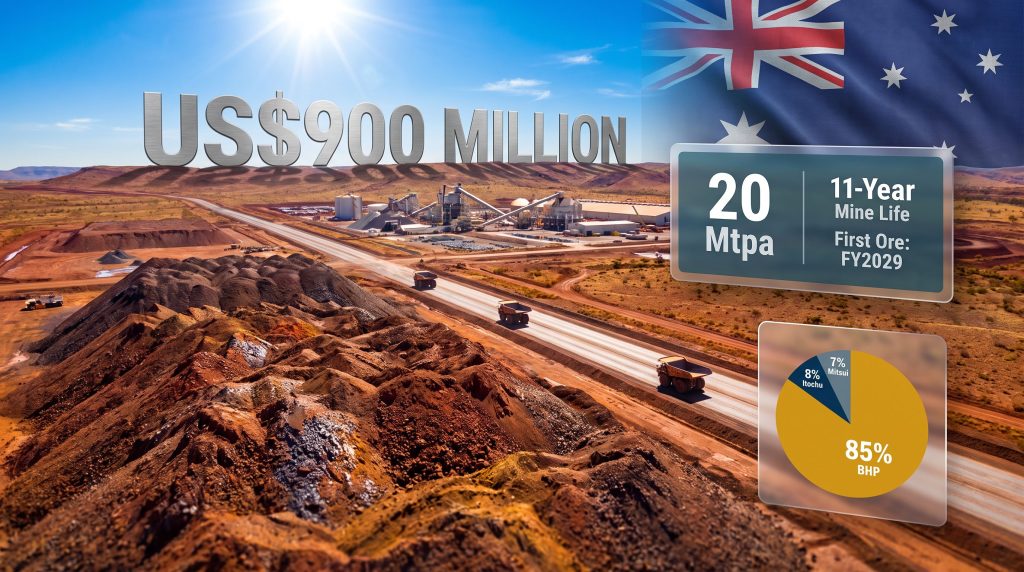
This distinction matters enormously for anyone modelling BHP's production trajectory. The project targets 20 million tonnes per annum (Mtpa) at full ramp-up, contributing directly to BHP's medium-term Western Australia Iron Ore (WAIO) target of 305 million tonnes per year (tpy) on a 100% basis. Without Ministers North, that target becomes structurally harder to defend as Yandi's remaining ore inventory shrinks.
Furthermore, understanding the iron ore demand prospects over the coming decade is essential context for assessing why BHP is prepared to lock in long-life capital now. Replacement-grade capital expenditure represents one of the most underleveraged analytical concepts in commodity investing. A project that maintains 20 Mtpa of output at a major hub can be as value-accretive as a greenfield expansion of equivalent scale, often at a fraction of the capital intensity per tonne.
Understanding this framing also resets expectations around near-term iron ore price signalling. Ministers North is not a bet on a price supercycle. It is a bet on price durability, specifically that seaborne iron ore demand from Asian steel producers will remain robust enough through the mid-2030s to justify locking in long-life production infrastructure today.
Ministers North: Technical Profile and Geological Significance
Location and Ore Characteristics
Ministers North sits approximately 85 km north-west of Newman and 15 km south-east of the existing Yandi Mining Operations in Western Australia's Pilbara region. Its classification as a Brockman-type ore deposit is a detail that carries significant commercial weight in seaborne iron ore markets.
Brockman iron formations are among the most sought-after iron ore deposit types globally. They typically deliver higher iron content and lower contaminant levels compared to Channel Iron Deposits (CID) such as those found at Yandi itself. In practice, this means:
- Higher lump-to-fines ratio potential, which commands premium pricing in steel markets preferring direct charge materials
- Lower alumina and phosphorus levels, critical quality parameters for blast furnace efficiency
- Greater suitability for blending with lower-grade ores to optimise product specifications across a portfolio
The shift from processing CID ore at Yandi to incorporating Brockman ore from Ministers North through shared infrastructure is not merely a volume story. It is a potential product quality evolution for the Yandi Hub's output blend, a dimension that production announcements often understate.
Project Specifications at a Glance
| Parameter | Detail |
|---|---|
| Total Investment | US$900 million (100% basis) |
| Annual Production Capacity | 20 Mtpa |
| Designed Mine Life | Approximately 11 years |
| First Ore Expected | FY2029 |
| Site Works Commencement | July 2026 |
| Haul Road Length | 13 km |
| Vegetation Clearing Permit | 300 hectares (approved September 2025) |
Infrastructure Strategy: The Brownfield Advantage
One of the most capital-efficient elements of the Ministers North development is its deliberate integration into the existing Yandi operational footprint. Rather than building standalone processing and logistics infrastructure, BHP is:
- Constructing a 13 km haul road and land bridge connecting Ministers North to Yandi
- Upgrading existing Yandi processing facilities to accommodate the new ore stream
- Installing new primary and secondary crushing capacity at Yandi to handle increased throughput volumes
This brownfield approach fundamentally reduces execution risk and capital intensity per tonne. The sunk cost of decades of Yandi infrastructure, including rail connections to Port Hedland and established processing circuits, becomes a cost advantage that greenfield competitors simply cannot replicate. The marginal capital required per tonne of production from Ministers North is substantially lower than a standalone mine of equivalent scale would demand.
The Yandi Hub Model: Hub-and-Spoke Mining as Strategic Architecture
BHP's approach to the Pilbara has long reflected a hub-and-spoke philosophy, where major processing and logistics hubs service a constellation of satellite orebodies. Ministers North is a textbook execution of this model, and understanding its mechanics helps contextualise why this investment structure generates durable returns.
The hub-and-spoke framework delivers several compounding advantages:
- Workforce continuity: Existing skilled labour pools at Yandi can be redeployed without the cost and timeline risk of building a new workforce from scratch
- Processing flexibility: Upgraded crushers and infrastructure at Yandi can handle varying ore blends from multiple satellite sources simultaneously
- Rail and port leverage: Ministers North ore feeds directly into BHP's established Pilbara rail network and Port Hedland export infrastructure, avoiding significant incremental logistics capital
- Regulatory familiarity: Operating within an established approvals framework reduces the timeline uncertainty that plagues genuinely new project developments
This model also creates an important optionality value that is rarely priced explicitly into analyst models. Once the haul road and upgraded processing infrastructure are in place, the incremental cost of bringing additional satellite orebodies within proximity into production is further reduced. Ministers North is not just a single project; it is an infrastructure platform.
Joint Venture Structure: Risk Architecture and Partner Signals
Ownership Breakdown
| Joint Venture Partner | Ownership Interest |
|---|---|
| BHP | 85% |
| Itochu Corporation | 8% |
| Mitsui & Co. | 7% |
The participation of two of Japan's most prominent trading houses in Ministers North, with stakes acquired in December 2025, carries strategic meaning beyond simple financial co-investment. Mitsui's involvement in the project reflects a calculated view from the Japanese industrial complex that high-grade Pilbara iron ore supply needs to be anchored through ownership, not just commercial contracts, across a multi-decade horizon.
For BHP, the joint venture structure achieves several objectives simultaneously:
- Distributes capital exposure across partners while retaining 85% operational control
- Aligns long-term supply interests of major offtakers with project development success
- Provides additional confidence underpinning the Final Investment Decision (FID) governance process
- Signals to broader capital markets that sophisticated industrial buyers are prepared to co-commit at this price deck and demand outlook
The willingness of Japanese trading houses to anchor equity stakes in long-life iron ore projects in 2025 and 2026 is itself a form of demand signalling that commodity price models built on short-term spot dynamics tend to miss entirely.
Regulatory Milestones and Environmental Approvals
Navigating Western Australia's Framework
The regulatory pathway for Ministers North involved two distinct approval streams. First, a Derived Proposal under Ministerial Statement 1105 governing iron ore development in the region. Second, a dedicated Clearing Permit authorising the removal of up to 300 hectares of native vegetation, with both approvals secured in September 2025.
Achieving these regulatory milestones well ahead of the July 2026 site works commencement date served a critical risk-management function. In large-scale mining development, regulatory uncertainty is frequently the most consequential variable in project timeline risk. By resolving approvals approximately nine months before construction commencement, BHP de-risked the FID process and provided certainty for joint venture partner planning.
The EPA's environmental assessment of the Ministers North Derived Proposal formed a central part of this regulatory process, underscoring the rigour applied before any site works could commence.
Environmental Considerations
The Pilbara's ecological profile is complex. The region hosts a range of endemic species and landform types that attract scrutiny under Western Australian and Commonwealth environmental frameworks. A 300-hectare clearing footprint, while significant in absolute terms, is relatively contained for a 20 Mtpa operation when benchmarked against historical Pilbara mine developments.
Investors applying ESG screening to long-life Australian iron ore assets increasingly assess not just the clearing footprint but the rehabilitation commitment structure. This includes bonding arrangements, progressive rehabilitation targets, and post-closure land management plans that accompany clearing approvals. These elements form an increasingly material component of the total project risk profile for institutional capital.
The next major ASX story will hit our subscribers first
What Ministers North Tells Us About the Iron Ore Market Outlook
Net Supply Neutrality: A Nuance That Matters
From a global seaborne iron ore supply perspective, Ministers North is a net-neutral event. The 20 Mtpa it introduces replaces declining Yandi volumes rather than adding incremental tonnes to an already well-supplied seaborne market. For commodity price modellers who rely on gross capacity announcements to update supply forecasts, this distinction can generate meaningful errors.
The practical implication is that BHP's WAIO output profile is being defended rather than expanded. Analysts building iron ore supply models should treat Ministers North as a volume sustainer, not a volume grower, at the system level. However, the broader context of iron ore surplus risks in 2025 makes the replacement framing even more commercially astute, as true volume additions into an oversupplied market would face far greater price headwinds.
The Embedded Price Deck Assumption
Approving an 11-year mine life project with first ore in FY2029 implies a specific view about the iron ore pricing environment through approximately 2040. The FID signals that BHP's internal planning assumptions support economic returns on US$900 million of capital across that duration. While the specific hurdle rate and price deck assumptions remain internal, the decision itself functions as a public signal: BHP's board and management believe Pilbara iron ore economics remain robust over a multi-decade horizon.
Pilbara's Structural Competitive Position
Australia's iron ore advantages are deeply embedded in both geography and infrastructure maturity, as the following comparison illustrates:
| Competitive Factor | Pilbara Advantage |
|---|---|
| Ore Grade | High-grade Brockman deposits command market premiums |
| Infrastructure Maturity | Decades of sunk rail, port, and processing investment |
| Proximity to Asian Markets | Shorter shipping routes versus Brazilian competitors |
| Regulatory Stability | Established approvals frameworks with predictable timelines |
| Workforce Expertise | Deep regional skills base in large-scale iron ore operations |
The Pilbara's freight cost advantage over Brazilian iron ore producers shipping to Asian buyers remains one of the most durable structural features of Australian iron ore competitiveness. Shorter voyage distances translate directly into lower delivered cost per tonne, a margin buffer that compounds in importance during periods of price pressure.
Consequently, the dynamics shaping China steel and iron ore markets in 2025 reinforce the logic of securing high-quality, low-delivered-cost supply from the Pilbara rather than higher-cost seaborne alternatives.
Key Takeaways for Investors and Industry Observers
The BHP Ministers North project approved decision represents far more than a single capital allocation event. It is a window into how the world's largest mining companies are thinking about long-duration commodity exposure in a period of genuine uncertainty about the pace of energy transition and its implications for steel demand.
Several dimensions deserve particular attention:
- Brownfield efficiency over greenfield ambition: US$900 million for 20 Mtpa over 11 years, leveraging existing infrastructure, represents a highly capital-efficient unit economics profile for a major mine development
- Brockman ore quality premium: The geological shift toward incorporating higher-grade Brockman ore into the Yandi Hub blend carries product quality implications that extend beyond simple volume accounting
- JV architecture as demand intelligence: Itochu and Mitsui's equity participation reflects Japanese steel industry conviction about long-term Pilbara supply security requirements
- Net supply neutrality: Iron ore price models that treat Ministers North as additive supply are likely to overestimate the bearish impact on the market
- Regulatory de-risking as value creation: Early approval milestones achieved in September 2025 materially reduced execution uncertainty well before capital was formally committed
Disclaimer: This article is intended for informational purposes only and does not constitute financial advice. Forward-looking statements regarding production targets, mine life, and market conditions involve inherent uncertainty. Past performance of iron ore markets and BHP's operational results do not guarantee future outcomes. Readers should conduct independent research and consult qualified financial advisers before making investment decisions.
Want to Spot the Next Major ASX Mineral Discovery Before the Market Does?
Discovery Alert's proprietary Discovery IQ model delivers real-time alerts on significant ASX mineral discoveries, turning complex mineral data into actionable insights for investors at every experience level — explore historic discoveries that have generated extraordinary returns, then begin your 14-day free trial at Discovery Alert to position yourself ahead of the market.