August 11, 2026
Why South Africa's Mining Sector Is Quietly Building Its Own Power Grid
The conventional image of a coal mine powering a city is well established. The reverse scenario, where a coal mine powers itself through solar energy, is a far more recent and revealing development. Across South Africa's mining belt, a structural shift is underway that has less to do with ideology and more to do with arithmetic. The Exxaro solar plant at a South African coal mine sits at the centre of this shift. Electricity costs have become one of the most volatile line items on a mining company's balance sheet, and the mathematics of on-site solar generation are increasingly difficult to argue against.
South Africa's national utility, Eskom, has delivered tariff increases well above the consumer inflation rate for more than a decade. Between 2010 and 2024, Eskom's average electricity tariff rose by over 600%, compounding operational cost pressures across the country's energy-intensive mining sector. Furthermore, load-shedding, South Africa's rotational power interruption programme, reached historic severity in 2023 and 2024, directly threatening mine productivity and workforce safety. For heavy industrial operators running continuous processes, grid dependency stopped being a neutral condition and became an active risk factor.
It is within this context that the South Africa mining decline has accelerated the search for structural energy solutions. The Lephalale Solar Project represents something more strategically significant than a single infrastructure investment — it represents a replicable commercial model.
When big ASX news breaks, our subscribers know first
What Is the Lephalale Solar Project and How Does It Work?
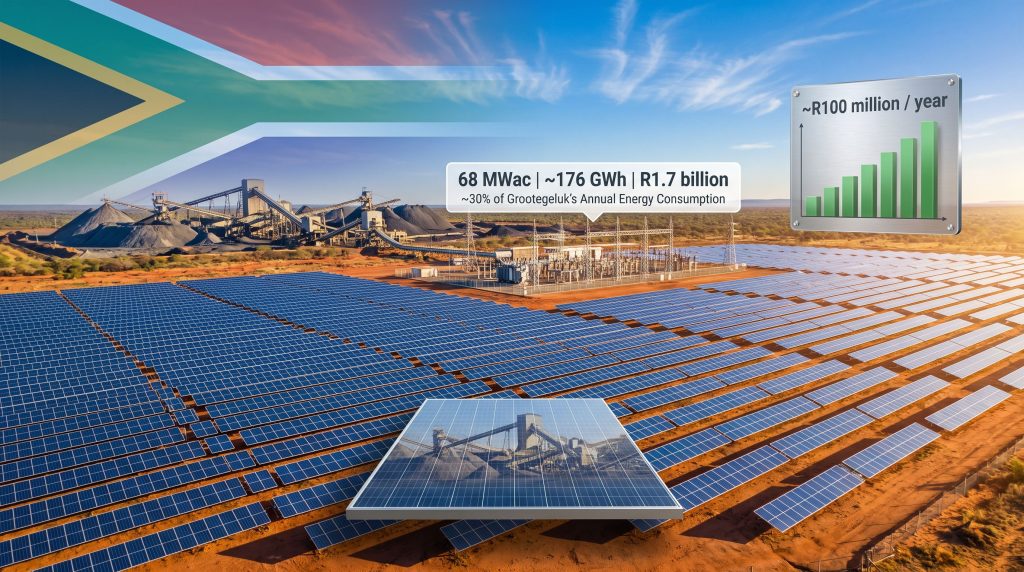
Developed through Exxaro Resources' renewable energy subsidiary Cennergi, the Lephalale Solar Project is a 68 MWac utility-scale photovoltaic facility situated approximately 25 kilometres west of Lephalale in Limpopo Province. The plant achieved full generation capacity in December 2025 and formally reached its Commercial Operations Date (COD) on 20 April 2026, marking the point at which the asset transitioned from a construction project to a revenue-generating operational facility.
The project's core design principle is behind-the-meter generation, meaning the solar electricity is consumed directly by Grootegeluk mine without transiting the public grid. Power flows from the array into the mine's main substation infrastructure, displacing Eskom grid draw during daylight operational hours. Where generation exceeds the mine's instantaneous consumption, up to 20 MW of excess capacity can be exported back to Eskom through the existing substation connection.
Key Project Specifications at a Glance
| Parameter | Specification |
|---|---|
| Installed Capacity | 68 MWac |
| Annual Energy Output | ~176 GWh |
| Capital Investment | R1.7 billion (~USD 92-104 million) |
| Power Agreement Term | 25-year PPA with Grootegeluk Mine |
| Scope 2 Emissions Reduction | ~17% annually |
| Estimated Annual Cost Savings | ~R100 million |
| Grid Export Allowance | Up to 20 MW excess capacity to Eskom |
One technical detail worth noting is the gap between the project's original design capacity of 80 MW and the final commissioned output of 68 MWac. This reduction reflects a common pattern in large-scale solar development, where site-specific constraints such as grid connection limits, land configuration, or substation capacity ratings result in a final installed figure below the initial concept. The 68 MWac rating refers to the alternating current output after conversion losses through inverters, which typically run 10 to 15 percent below the direct current nameplate capacity of the panels themselves.
The Behind-the-Meter Model: Why Industrial Mining Is the Ideal Use Case
Behind-the-meter solar generation works most efficiently when the host facility has a large, consistent, and predictable daytime electricity demand. Coal mining operations fit this profile almost perfectly. Unlike commercial or residential consumers whose electricity usage fluctuates significantly throughout the day, open-cut mining operations run heavy equipment, conveyors, crushers, processing plants, and ventilation systems at near-constant load profiles during operational hours.
This demand consistency is commercially critical for behind-the-meter solar because it maximises the proportion of generated electricity that is consumed immediately on-site rather than exported or curtailed. Every kilowatt-hour consumed directly by Grootegeluk displaces a kilowatt-hour that would otherwise be purchased from Eskom at prevailing tariff rates, which is where the financial case for the project is constructed.
The 25-year Power Purchase Agreement (PPA) between Cennergi and the Grootegeluk mine operation is the financial spine of the entire structure. Under a PPA arrangement, the mine agrees to purchase electricity from the generating entity at a contractually fixed or indexed price over the agreement term. This insulates Grootegeluk from Eskom's above-inflation tariff trajectory for the duration of the contract, transforming what would otherwise be an unpredictable variable cost into a long-term fixed energy price. For mining operations that plan capital expenditure cycles over decades, this kind of tariff certainty has considerable strategic value.
Financial Architecture: What R1.7 Billion Buys Over 25 Years
The R1.7 billion capital investment in the Lephalale Solar Project needs to be evaluated not as a single expense but as the upfront cost of a 25-year energy supply contract with known unit economics. In addition, the decarbonisation economic benefits compound over time as carbon pricing escalates.
- Annual electricity generation of approximately 176 GWh supplies roughly 30% of Grootegeluk's total annual electricity consumption
- Estimated annual electricity cost savings of approximately R100 million per year at current tariff levels
- At that savings rate, the project delivers a simple payback period of around 17 years, with the remaining 8 years of the PPA term operating at near-pure cost advantage
- As Eskom tariffs continue to escalate, the value of the fixed PPA price compounds, accelerating the effective payback timeline
- Carbon tax liability reduction adds an additional financial benefit layer that grows as South Africa's carbon price increases
The Carbon Tax Dimension
South Africa's carbon tax, introduced in 2019 and structured to escalate progressively, applies a charge on greenhouse gas emissions including Scope 2 emissions derived from purchased electricity. By generating approximately 176 GWh of its own renewable electricity annually, Grootegeluk directly reduces its purchased grid electricity volume, lowering its taxable Scope 2 emissions base by approximately 17%. As the carbon tax rate rises under South Africa's climate policy commitments, this avoided liability grows in nominal value each year, making the project's financial case increasingly robust over the latter half of the PPA term.
Limpopo's Solar Irradiance Advantage and Why It Matters
A factor that rarely receives adequate attention in project announcements is the specific solar resource quality at Lephalale. Limpopo Province sits within one of the highest solar irradiance bands in South Africa, which itself ranks among the top solar resource locations globally. The region receives average global horizontal irradiance (GHI) values in the range of 5.5 to 6.5 kWh per square metre per day, placing it comfortably above the thresholds required for utility-scale PV to be commercially competitive.
This irradiance profile is directly responsible for the project's annual output of 176 GWh from a 68 MWac array, implying a capacity factor of approximately 29 to 30 percent. For context, solar PV projects in Germany, one of the world's largest solar markets, typically achieve capacity factors of 10 to 12 percent. The Lephalale site's natural resource advantage means that each rand of capital investment generates significantly more electricity than equivalent capacity deployed in less favourable geographies, strengthening the investment case independently of any policy incentives.
Operational Complexities: Running a Solar Farm Next to an Active Coal Mine
The technical integration challenges of deploying a 68 MW solar array adjacent to an operating open-cut coal mine are substantial and are rarely discussed in project announcements.
Dust and Environmental Degradation
Coal mining operations generate persistent dust plumes that settle on PV panel surfaces, reducing their light transmission efficiency. Studies of dust soiling on solar panels in arid mining environments have documented generation losses of between 1 and 7 percent per month without active cleaning programmes. Grootegeluk, one of the largest coal mines in the world by reserve volume, operates draglines, haul trucks, and processing facilities that generate continuous particulate matter. The project's maintenance programme must account for systematic panel cleaning at a frequency that balances water consumption constraints with generation loss prevention.
Substation Bidirectional Power Flow Management
The existing substation infrastructure at Grootegeluk was originally designed for unidirectional power consumption from Eskom. Integrating a generation source requires the substation to manage bidirectional power flows, where electricity can either be imported from the grid or exported to it depending on instantaneous solar output relative to mine demand. This requires protective relay systems, synchronisation controls, and grid interface equipment capable of handling both import and export scenarios without creating instability on the local network.
Intermittency Management
Unlike a gas peaker or diesel generator, solar PV output varies with cloud cover, seasonal day length, and dust accumulation. Grootegeluk's operational load does not pause for cloud events. The system design must account for rapid ramp-down events where cloud coverage reduces solar output by 60 to 80 percent within minutes, requiring seamless automatic switching to increased Eskom grid draw. This transition management is handled through the substation's automatic voltage and frequency response systems, but configuring those systems for reliable operation requires detailed power flow modelling specific to Grootegeluk's load profile.
The next major ASX story will hit our subscribers first
How the Exxaro Solar Plant Compares to Broader South African Mining Renewables Activity
The Lephalale project does not exist in isolation. Consequently, renewable energy in mining has expanded rapidly across the continent, with South Africa's mining sector becoming one of the most active private offtake markets for renewable energy developers.
| Project | Capacity | Energy Type | Structure | Status |
|---|---|---|---|---|
| Exxaro Lephalale (Cennergi) | 68 MW | Solar PV | 25-year PPA | Operational (COD April 2026) |
| NOA / SPBM Supply Agreement | ~288 GWh/year | Renewable (mixed) | Supply contract | Announced July 2026 |
| Red Rocket / ENGIE | 890 MW | Solar PV | Generation permits awarded | Development phase |
| Vestas S Africa Wind Cluster | 420 MW | Wind | Commercial | Installation complete |
The regulatory catalyst enabling this wave of private generation was the 2021 amendment to South Africa's Electricity Regulation Act, which removed the 1 MW licensing threshold that had previously restricted private generation projects. Prior to this amendment, any generation facility exceeding 1 MW required a generation licence from the National Energy Regulator of South Africa (NERSA), creating a bureaucratic barrier that made small and medium industrial self-generation projects commercially unviable. The threshold removal opened the market to industrial-scale self-generation, and mining companies with large balance sheets and clear energy cost incentives were among the fastest movers.
Private PPAs have also become the preferred financing mechanism for South African renewable developers precisely because they bypass the historical bottlenecks of Eskom procurement processes. By contracting directly with creditworthy industrial offtakers, developers can access project finance on commercially viable terms without dependence on government procurement schedules.
The ESG Paradox at the Heart of the Lephalale Project
The Exxaro solar plant at a South African coal mine presents an analytical challenge for ESG frameworks that deserves honest examination rather than promotional framing. However, the Exxaro renewable energy strategy demonstrates that operational and environmental objectives need not be mutually exclusive.
The 17% reduction in Scope 2 greenhouse gas emissions is a genuine and measurable environmental benefit. Scope 2 emissions are those generated indirectly through the consumption of purchased electricity, and reducing them through on-site renewable generation is a legitimate decarbonisation pathway. However, Scope 1 emissions — those produced directly by Grootegeluk's mining operations including diesel combustion in haul trucks, dragline electricity consumption when sourced from fossil fuels, and methane released during coal extraction — are not addressed by the solar installation.
For ESG rating agencies and institutional investors evaluating Exxaro's climate positioning, this distinction matters considerably. The Lephalale project improves Exxaro's Scope 2 intensity metrics and reduces its carbon tax exposure, which are meaningful financial outcomes. But the project does not alter the fundamental emissions profile of coal extraction itself.
What the project does demonstrate is that operational decarbonisation of energy consumption at fossil fuel extraction sites is technically and commercially feasible. Several global mining operators including Rio Tinto, BHP, and Anglo American have deployed or announced on-site renewables at commodity extraction sites for exactly this reason. The Grootegeluk model sits within that global pattern of mining electrification and decarbonisation, using renewable self-generation to reduce the emissions intensity of mining operations without curtailing production volumes.
Scenario Analysis: What Sector-Wide Replication Could Deliver
Scenario Modelling: Sector-Wide Replication
If the Grootegeluk model — 68 MW of solar serving approximately 30% of a large mine's energy demand — were replicated across South Africa's 20 largest mining operations, the aggregate installed capacity could exceed 1,300 MW of industrial self-generation. This scale of deployment could potentially displace over 3.5 TWh of annual Eskom demand, representing a material contribution to South Africa's grid stabilisation challenge and reducing the volume of load-shedding events driven by industrial demand peaks. This projection is speculative and depends on site-specific feasibility, capital availability, and regulatory conditions at individual operations.
The scenario is not implausible. South Africa's mining sector accounts for a significant share of total national electricity consumption, and the economic incentives driving the Grootegeluk investment apply across the sector. The primary constraints on replication are capital availability, site-specific grid connection capacity, and the depth of management commitment to long-term energy strategy over short-term cost minimisation.
Frequently Asked Questions: Exxaro Solar Plant and South African Mining Renewables
What is the installed capacity of the Exxaro solar plant at Grootegeluk?
The Lephalale Solar Project has an installed capacity of 68 MWac, generating approximately 176 GWh of clean electricity per year.
How much did the Exxaro Lephalale solar plant cost to build?
The capital investment totalled R1.7 billion, equivalent to approximately USD 92 to 104 million depending on the rand/dollar exchange rate applied.
When did the Exxaro Lephalale solar plant begin commercial operations?
The plant reached full generation capacity in December 2025 and achieved its formal Commercial Operations Date on 20 April 2026.
What share of Grootegeluk mine's electricity does the solar plant supply?
The facility is sized to supply approximately 30% of Grootegeluk's annual electricity consumption through direct behind-the-meter generation.
Can the Exxaro solar plant export power to the Eskom grid?
Yes. When solar generation exceeds the mine's instantaneous demand, up to 20 MW of surplus electricity can be exported to Eskom's national grid via the mine's existing substation connection.
How does the solar plant reduce Exxaro's carbon emissions?
By replacing purchased grid electricity with on-site renewable generation, the project reduces Exxaro's Scope 2 greenhouse gas emissions by approximately 17% annually, which also reduces the company's carbon tax liability under South Africa's carbon pricing regime.
Key Takeaways
The Lephalale Solar Project demonstrates three compounding financial benefits that collectively justify the R1.7 billion investment. Furthermore, these benefits apply broadly across the South African mining sector, making the Grootegeluk model a template rather than an exception.
- Energy cost reduction through fixed PPA pricing that insulates Grootegeluk from Eskom tariff escalation over 25 years
- Carbon tax mitigation through a measurable 17% reduction in Scope 2 emissions, with growing financial value as South Africa's carbon price trajectory rises
- Grid independence through behind-the-meter generation that reduces dependence on Eskom's constrained and load-shed-prone transmission infrastructure
What makes the Grootegeluk model particularly replicable is that none of these benefits require extraordinary site characteristics. High solar irradiance, consistent industrial load profiles, and Eskom tariff exposure are conditions shared by dozens of South African mining operations. The 25-year PPA structure transforms the capital expenditure into a long-duration infrastructure asset with predictable returns — a financing profile that institutional investors and development finance institutions understand well.
The deeper significance of an Exxaro solar plant operating at a South African coal mine is not the apparent contradiction it represents but the commercial logic it validates. South Africa's energy transition will not follow a clean ideological narrative. It will be built, project by project, on the mathematics of cost reduction, risk management, and operational resilience. For a sector navigating grid instability and rising tariffs, that logic is becoming impossible to ignore.
This article contains forward-looking financial projections and scenario modelling for illustrative purposes only. These projections are not investment advice and should not be relied upon as forecasts of actual financial outcomes. Readers should conduct independent analysis before making any investment decisions.
Want to Track the ASX Mining Companies Navigating South Africa's Energy Transition?
Discovery Alert's proprietary Discovery IQ model delivers real-time alerts on significant ASX mineral discoveries the moment they are announced, turning complex sector developments into actionable investment insights — explore historic discoveries and their returns to understand the scale of opportunity, then begin your 14-day free trial at Discovery Alert to position yourself ahead of the broader market.