August 11, 2026
Arctic Oil's Most Consequential Bet: Inside the ConocoPhillips Alaska Willow Project
Few investment decisions in the modern energy sector carry as much concentrated risk and reward as committing billions of dollars to Arctic oil development. The physics of permafrost, the economics of remote logistics, and the volatility of crude prices all converge in projects that take years to build and decades to pay off. Against that backdrop, the ConocoPhillips Alaska Willow project stands as one of the most closely watched capital commitments in U.S. upstream energy history, not simply because of its scale, but because of how much is riding on its successful delivery.
When big ASX news breaks, our subscribers know first
What the Willow Project Actually Is and Where It Sits
Located within Alaska's National Petroleum Reserve (NPR-A) on the remote North Slope, the Willow project is a large-scale onshore oil development that received federal authorisation in 2023. The NPR-A is a federally managed landmass on Alaska's western North Slope, distinct from the Arctic National Wildlife Refuge, and has historically been designated for oil and gas exploration since the 1920s.
The approved project configuration consists of three drill pads, a reduction from the five pads originally proposed by ConocoPhillips. The U.S. Interior Department declined to authorise two of the five originally proposed sites, and as part of the final approved arrangement, ConocoPhillips also relinquished approximately 68,000 acres of NPR-A leases. This reduced footprint reflects the regulatory balancing act between resource development and environmental stewardship that defines nearly every large-scale energy project on federal land.
What makes Willow's location particularly challenging from an engineering standpoint is the combination of permafrost instability, seasonal access windows, and the absence of established road infrastructure. Drilling equipment, accommodation modules, and construction materials must be transported primarily via ice roads during Alaska's frozen winter months, creating narrow logistical windows that compress timelines and amplify costs. Furthermore, the Alaska drilling policy shift under recent administrations has added another layer of complexity to long-range project planning in the region.
Production Capacity, Reserve Scale, and How Willow Compares
The numbers underpinning the ConocoPhillips Alaska Willow project are substantial by any measure of modern onshore oil development.
| Metric | Willow Project |
|---|---|
| Peak Daily Production Capacity | ~180,000 barrels per day |
| Estimated Lifetime Output | ~600 million barrels |
| Approved Drill Pads | 3 (reduced from 5) |
| Leases Relinquished | ~68,000 acres |
| Estimated Project Cost | Up to $9 billion |
| Production Start Target | 2029 |
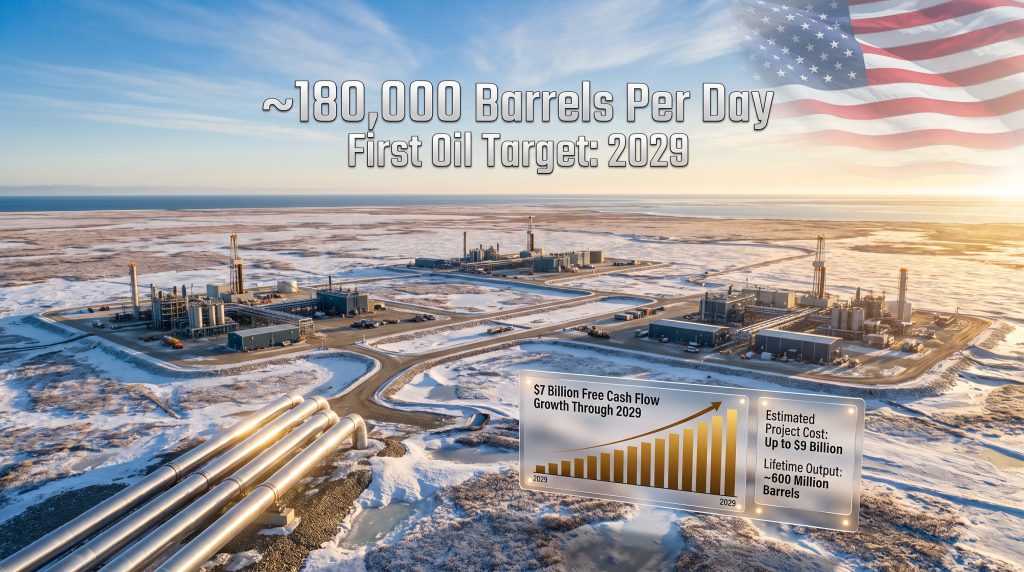
At peak output, Willow would produce roughly 180,000 barrels of crude oil per day, a volume comparable to the entire daily output of some mid-sized oil-producing nations. Across its operational lifespan, the project is projected to yield approximately 600 million barrels of oil in total, a figure that places it among the most significant single-asset developments in recent U.S. history.
For context, the North Slope has been producing oil since the late 1970s, primarily from the giant Prudhoe Bay field. Prudhoe Bay once produced more than 1.5 million barrels per day at its peak in the late 1980s, but output has declined steadily over decades. Willow will not reverse that long-term trend entirely, but it represents a meaningful addition to Alaska's production base.
Consequently, the Trans-Alaska Pipeline System requires sufficient throughput to remain operationally viable. Insufficient flow rates through the pipeline can cause the oil to cool and congeal, creating serious technical and economic problems. This makes new supply additions from projects like Willow operationally important beyond their standalone economics. Monitoring crude oil price trends will therefore be essential for evaluating Willow's long-term commercial viability.
How Does Willow Stack Up Against Other Major U.S. Projects?
The Willow project is widely regarded as one of the most ambitious onshore Arctic oil developments sanctioned in the United States in recent decades, reflecting both the scale of the resource and the engineering complexity involved. Its 600 million barrel lifetime estimate firmly distinguishes it from smaller incremental North Slope developments that have characterised Alaskan production in recent years.
The Economic Case: Revenue, Jobs, and Community Impact
ConocoPhillips projects that Willow could generate between $8 billion and $17 billion in combined revenue across federal, state, local, and community accounts over the project's lifetime. This wide range reflects the inherent uncertainty of long-duration commodity price forecasting and the sensitivity of royalty and tax receipts to crude oil price cycles.
On the employment side, the project is expected to support:
- Approximately 2,500 construction roles during the peak build-out phase
- Around 300 permanent long-term positions once production is underway
- Indirect economic activity across supply chain, logistics, and services sectors in Alaska
The North Slope Borough, the local government unit covering the area surrounding Willow, stands to benefit from property tax revenues generated by the project's infrastructure. Indigenous communities in the region hold a range of views on the development, and ConocoPhillips has framed its community engagement around compatibility with subsistence activities that are central to the cultural and nutritional fabric of North Slope communities.
Why $7 Billion in Free Cash Flow Depends So Heavily on Willow
ConocoPhillips has publicly committed to growing its free cash flow by $7 billion by 2029, a target that defines the company's medium-term financial identity. The problem, and the reason this number attracts such intense scrutiny, is how lopsided the dependency on Willow has become.
Analysis from Barclays indicates that Willow underpins close to 75% of the company's total free cash flow expansion target. That level of concentration in a single project introduces a form of execution risk that is unusual even for large independent oil companies. Any meaningful delay, cost overrun, or regulatory disruption at Willow would not simply dent the target — it would fundamentally reshape ConocoPhillips' financial trajectory through the late 2020s.
This dynamic is worth understanding from an investor psychology perspective. During heavy capital deployment phases, free cash flow is typically negative or suppressed, because the company is spending today to generate returns tomorrow. Institutional investors who are accustomed to dividend growth and buyback programmes can become impatient during these phases, particularly if the share price underperforms peers in the interim.
Cost Escalation: From $7.5 Billion to $9 Billion and What Drove It
The financial profile of the Willow project has shifted materially since initial approval.
| Cost Milestone | Estimated Project Cost |
|---|---|
| Original Approved Budget | ~$7.5 billion |
| Revised Cost Estimate | Up to $9 billion |
| Cost Increase | ~$1.5 billion |
| Primary Drivers | Inflation, supply chain disruption |
The $1.5 billion cost increase reflects broader pressures that have affected capital-intensive infrastructure projects across the energy sector. Persistent post-pandemic inflation in materials such as steel and insulation, combined with supply chain disruptions that have lengthened lead times for critical equipment, have pushed project costs higher across virtually every major development sanctioned in the 2022 to 2024 window.
For Arctic projects specifically, these pressures are amplified. Specialised cold-weather equipment, remote logistics, and the need for redundant safety systems in extreme environments mean that cost escalation is felt more acutely in projects like Willow than in conventional onshore developments in lower-48 states. According to upstream reporting on Willow's cost surge, these overruns have become a defining financial challenge for the project's business case.
ConocoPhillips has simultaneously been pursuing a company-wide cost reduction programme, including a workforce restructuring that involved laying off up to 25% of global staff, a move framed internally as necessary to close a per-barrel cost gap that had crept upward by approximately $2 per barrel over three years.
How Does the Trump Policy Environment Affect Willow?
In addition to cost pressures, the broader regulatory climate has evolved considerably. The Trump policy impact on resources has generally been supportive of domestic energy development, which may provide a more permissive regulatory backdrop for Willow's construction and permitting milestones going forward.
The next major ASX story will hit our subscribers first
Leadership Transition at a Critical Juncture
The timing of ConocoPhillips' CEO succession has drawn notable attention from analysts and institutional investors. Andy O'Brien, the company's long-serving Chief Financial Officer with nearly three decades at ConocoPhillips, was named to succeed Ryan Lance as Chief Executive Officer effective September 1. Lance, who led the company for 14 years, transitioned to an executive chairperson role.
The transition arrives at a particularly sensitive moment in the ConocoPhillips Alaska Willow project's development cycle, specifically during the construction mobilisation phase when cost discipline and project execution carry the highest operational risk. Lance's departure was described internally as the company being in its strongest-ever strategic position, a framing that signals confidence but also places considerable pressure on the incoming leadership to validate that characterisation through results.
Analysts at RBC Capital Markets observed that shareholders have invested substantial trust in ConocoPhillips' leadership team, and that O'Brien's immediate challenge will be managing high investor expectations at a time when the company's share price has lagged some of its major integrated peers. O'Brien has publicly stated that delivering the company's major projects and cost reduction programme represents the core priority for his leadership, describing it as a point of intense focus for both himself and his team.
Share Price Performance and the Heavy-Spend Discount
ConocoPhillips' stock outperformed most of its peers across the longer arc of Ryan Lance's tenure since 2012, trailing only EOG Resources among major U.S. exploration and production companies. However, the past three years tell a different story.
Over that period, the company's shares have underperformed both ExxonMobil and Chevron. This underperformance is not unusual for companies in sustained capital deployment phases. The market tends to apply what analysts sometimes call a heavy-spend discount, where investors withhold re-rating a stock until they can see tangible cash flow generation rather than projections.
The key inflection point for ConocoPhillips is therefore not just when Willow begins production, but when that production translates into sustained, visible free cash flow that competes with or exceeds what peers are already delivering. This creates a scenario-dependent investment thesis that hinges largely on schedule adherence and commodity price conditions through to 2029.
External Risks: LNG Disruptions, Legal History, and Commodity Sensitivity
The Willow project does not operate in isolation from the broader geopolitical and commodity environment. Furthermore, understanding the global LNG supply outlook is increasingly relevant, as LNG supply disruptions in a tight global gas market can affect energy price dynamics more broadly, creating secondary pricing effects across hydrocarbons.
ConocoPhillips has also been managing disruptions affecting large liquefied natural gas expansion projects in Qatar linked to the ongoing Middle East conflict. While these are separate assets, they add operational complexity to a leadership team already navigating a critical project execution phase.
On the regulatory front, the Willow project has faced legal challenges since before its approval. Environmental groups mounted multiple lawsuits seeking to block or curtail the development, arguing that the environmental review process was inadequate. While the three-pad configuration was ultimately authorised, the litigation history underscores the ongoing risk that further legal challenges could introduce delays or require additional mitigation measures.
Commodity price sensitivity is perhaps the most straightforward risk. The $8 billion to $17 billion revenue range projected for government and community receipts reflects scenarios across meaningfully different crude price environments. In addition, the trade war impact on oil markets introduces further unpredictability, particularly if prolonged trade tensions suppress global demand growth and weigh on long-term price forecasts.
The M&A Question: Willow Versus Acquisition Capacity
One of the less-discussed dimensions of the Willow project's capital demands is the opportunity cost it creates. With up to $9 billion committed to a single Alaskan development, ConocoPhillips' capacity to pursue major acquisitions simultaneously is constrained. This matters because the broader U.S. oil sector has entered a consolidation phase, with scale increasingly seen as a competitive requirement for managing per-barrel costs, securing infrastructure access, and attracting institutional capital.
Smead Capital Management, which holds approximately $220 million of ConocoPhillips stock according to LSEG data, has flagged that the new CEO will face pressure to evaluate acquisition opportunities as sector consolidation continues. The strategic tension is clear: pursue external growth and risk diluting focus on Willow's execution, or concentrate entirely on delivering the project and risk falling behind a consolidating peer group.
This balancing act between completing a transformative internal project and pursuing the scale that markets are rewarding elsewhere defines one of the central strategic dilemmas facing ConocoPhillips through the second half of the 2020s.
Willow Project Timeline: Key Milestones from Approval to First Oil
| Phase | Timeline | Key Milestone |
|---|---|---|
| Federal Approval | 2023 | Three-pad design authorised by U.S. Interior Dept. |
| Construction Mobilisation | 2024 to 2026 | Site preparation, logistics, workforce ramp-up |
| Infrastructure Completion | 2027 to 2028 | Facilities, pipelines, and drilling infrastructure |
| First Oil Target | 2029 | Production commencement on Alaska North Slope |
Frequently Asked Questions: ConocoPhillips Alaska Willow Project
How many barrels per day will Willow produce at peak capacity?
The project is designed to reach approximately 180,000 barrels per day at peak output, making it one of the largest single-asset onshore oil developments in recent U.S. history.
What is the total estimated cost of the Willow oil project?
The revised cost estimate is up to $9 billion, reflecting a $1.5 billion increase from the original approximately $7.5 billion budget, driven primarily by inflation and supply chain disruptions.
Where exactly is the Willow project located?
Willow is located within the National Petroleum Reserve-Alaska (NPR-A) on the North Slope, a federally managed region on Alaska's western Arctic coast.
How many jobs will Willow create?
The project is expected to generate approximately 2,500 construction-phase roles and around 300 permanent long-term positions once production begins.
When is first oil targeted?
ConocoPhillips is targeting 2029 as the year for initial production commencement at the Willow site.
Why was the project reduced from five pads to three?
The U.S. Interior Department declined to authorise two of the five originally proposed drill pads, and ConocoPhillips relinquished approximately 68,000 acres of NPR-A leases as part of the final approved configuration.
How much revenue will Willow generate for Alaska and the federal government?
ConocoPhillips projects combined government and community revenue of between $8 billion and $17 billion across Willow's operational lifetime, depending on prevailing crude oil prices and production performance.
Key Takeaways: Why Willow Is a Defining Asset for U.S. Oil Production
- Willow represents one of the largest onshore oil developments authorised in the United States in recent decades, with peak production capacity of approximately 180,000 barrels per day
- The project's revised cost of up to $9 billion reflects both the engineering complexity of Arctic development and the inflationary pressures that have affected capital-intensive projects industry-wide
- Approximately 75% of ConocoPhillips' medium-term free cash flow growth target depends on Willow's on-schedule delivery by 2029, creating an unusually high degree of single-project dependency
- Government and community revenue projections of $8 billion to $17 billion position Willow as a meaningful fiscal contributor to Alaska and federal accounts across its lifetime
- A CEO transition mid-project introduces execution risk that both analysts and institutional investors are actively monitoring, with the incoming leadership's ability to maintain cost discipline and schedule adherence under close scrutiny
- The Trans-Alaska Pipeline System's operational viability at low throughput levels gives Willow a systemic importance to Alaska's broader energy infrastructure that extends beyond its standalone production economics
This article contains forward-looking statements, production projections, and financial estimates based on publicly available information and analyst commentary. Actual outcomes may differ materially from projections due to commodity price volatility, regulatory developments, construction delays, and other factors beyond the company's control. This content is intended for informational purposes only and does not constitute financial or investment advice.
Want to Invest Ahead of the Next Major Energy or Resource Discovery?
Discovery Alert's proprietary Discovery IQ model delivers real-time alerts on significant ASX mineral discoveries, transforming complex resource data into actionable investment insights for both short-term traders and long-term investors — explore the historic returns major discoveries have generated and begin your 14-day free trial to position yourself ahead of the broader market.