August 26, 2026
The Upstream Imperative: Why Scale and Integration Now Define Aluminium's Competitive Frontier
Across the global aluminium industry, a structural shift has been gathering momentum for several years. The era of fragmented, single-geography upstream operators is giving way to a consolidation wave driven by a simple but powerful logic: producers that control the full journey from bauxite in the ground to refined alumina to primary metal possess a structural cost advantage that smaller, less integrated competitors simply cannot replicate. This dynamic is reshaping capital allocation decisions at the world's largest aluminium companies, and nowhere is that shift more visible than in the Alcoa acquisition of South32 alumina and bauxite assets, a transaction that redraws the upstream competitive map across three continents.
When big ASX news breaks, our subscribers know first
The Strategic Logic Behind a $5.6 Billion Upstream Consolidation
To understand why Alcoa has committed up to US$5.6 billion to this acquisition, it helps to appreciate the economics of primary aluminium production at scale. Bauxite, the ore from which alumina is refined and aluminium ultimately smelted, is not a particularly scarce resource globally. What is scarce is the infrastructure, operational expertise, and geographic positioning needed to move bauxite economically through refining into metal.
A company that owns contiguous or complementary assets across this chain can optimise logistics, reduce third-party procurement costs, and smooth out price volatility through internal transfer pricing. Furthermore, shifts in global bauxite supply dynamics are making upstream integration even more strategically compelling for producers seeking long-term cost certainty.
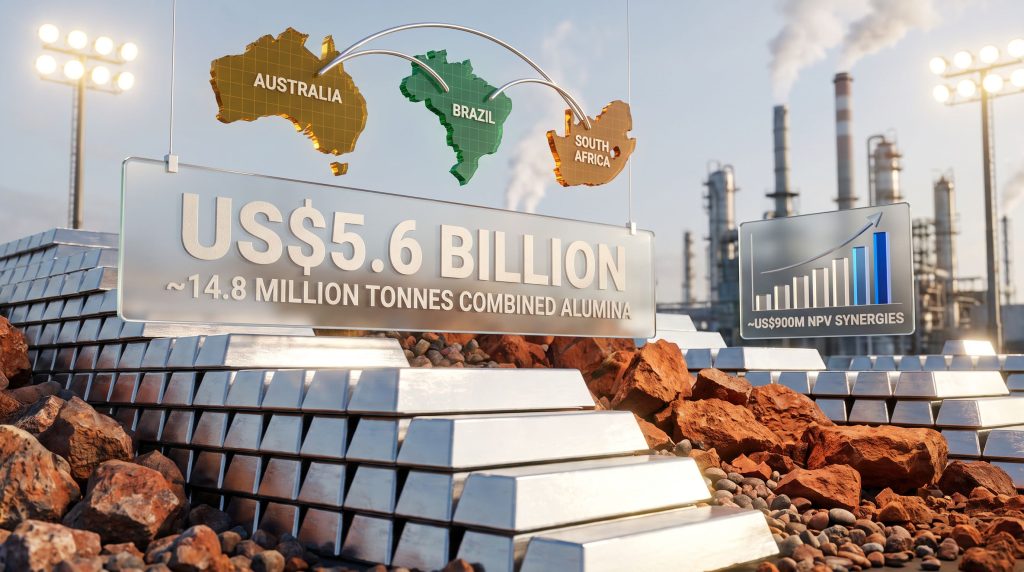
Alcoa's existing Western Australian operations already anchor one of the world's most efficient bauxite-to-alumina corridors. The addition of South32's 86% interest in Worsley Alumina and its associated Boddington bauxite mine creates a reinforced regional cluster where synergy realisation is not theoretical but near-term and operational. Alcoa has estimated approximately US$900 million in net present value from identified synergies, with Western Australia representing the most immediate source of value through tighter mining and refining integration.
Beyond the geography, the timing reflects broader macro conditions. Global demand for aluminium is growing steadily, underpinned by electrification trends, lightweight automotive manufacturing, and renewable energy infrastructure buildout. Against this backdrop, producers with locked-in, low-cost upstream access are positioned to capture disproportionate margin as cycle-driven alumina price fluctuations occur.
Deal Architecture: Breaking Down the $5.6 Billion Transaction Structure
The transaction is structured across four distinct payment components, each serving a different economic function:
| Payment Component | Estimated Value | Notes |
|---|---|---|
| Upfront Cash | US$3.1 billion | Core cash consideration |
| Alcoa Equity (New Shares) | ~US$1.0 billion | ~17 million newly issued shares |
| Assumed Net Debt and Leases | ~US$750 million | Liabilities transferred to Alcoa |
| Contingent Value Rights | Up to US$750 million | Price-linked, payable through 2030 |
| Rehabilitation Provisions | ~US$1.2 billion | Environmental obligations assumed |
| Implied Enterprise Value | Up to US$5.6 billion | Total transaction value |
The contingent value rights (CVRs) component deserves particular attention from an investor perspective. CVRs are instruments that entitle the holder to additional cash payments if certain conditions are met after deal closure. In this case, the conditions are tied to agreed alumina and aluminium price benchmarks through 2030. If spot prices for these commodities outperform those benchmarks over the coming years, South32 receives incremental cash payments from Alcoa, up to a maximum of US$750 million.
This structure is clever from both sides. For Alcoa, it caps total consideration if commodity prices remain moderate. For South32, it preserves exposure to an alumina price upcycle that the company is otherwise exiting. The CVRs effectively function as an embedded commodity price bet, aligning the economic interests of buyer and seller across a multi-year horizon.
South32 has indicated it intends to distribute approximately US$500 million worth of the Alcoa shares it receives to eligible shareholders via an in-specie, fully franked special dividend following transaction completion. This mechanism allows South32 investors to retain direct equity exposure to Alcoa's expanded aluminium platform if they choose, or liquidate that holding according to their own portfolio preferences.
Asset Geography: A Three-Continent Upstream Portfolio
Western Australia: The Worsley and Boddington Anchor
The centrepiece of the transaction from a strategic synergy perspective is South32's 86% interest in the Worsley Alumina complex, which is fed by bauxite from the Boddington mine. Western Australia already hosts some of the world's highest-quality bauxite deposits, characterised by high available alumina content and relatively low reactive silica — both critical quality parameters that influence refinery processing costs and alumina recovery rates.
In bauxite quality assessment, the ratio of available alumina to reactive silica is a foundational metric. High reactive silica demands greater caustic soda consumption during the Bayer process refining stage, directly inflating operating costs. Western Australian deposits have long been valued for their favourable chemistry in this regard, which is one reason the region hosts a disproportionate share of global alumina refining capacity relative to its bauxite production volume.
Brazil: Minority Stakes Across the Full Value Chain
Alcoa's Brazilian acquisitions span three distinct assets:
- A 33% interest in Mineração Rio do Norte (MRN), one of Brazil's largest bauxite mining operations located in the Amazon Basin state of Pará
- A 36% interest in the Alumar alumina refinery located in São Luís, Maranhão
- A 40% interest in the Alumar aluminium smelter co-located with the refinery
The MRN acquisition comes with an important caveat: it remains conditional on pre-emptive rights held by the mine's existing partners. Under the terms of MRN's joint venture structure, existing shareholders have the right to acquire South32's stake before it can be sold to a third party. If one or more partners elect to exercise those rights, Alcoa may receive a reduced interest in MRN or no interest at all, with corresponding adjustments to the purchase price.
Brazilian bauxite from the Amazon corridor is notable for its high gibbsite content, a mineralogical form of aluminium hydroxide that dissolves at lower temperatures and pressures during refining than other bauxite mineralogies such as boehmite or diaspore. This characteristic gives Brazilian bauxite a processing cost advantage at refineries designed specifically for its mineralogy.
South Africa: Hillside Aluminium and the Energy Dependency Question
The 100% acquisition of the Hillside Aluminium smelter in Richards Bay is both the most strategically significant and most operationally complex element of the South African component. Hillside is South Africa's sole primary aluminium smelter and provides liquid metal directly to the domestic downstream fabrication sector. The idled Bayside smelter property adjacent to Hillside is also included in the transfer.
Hillside's long-term operational viability is structurally dependent on securing a new electricity supply agreement before the current Eskom contract expires in 2031. Advanced discussions between South32, Eskom, and prospective energy partners are underway, with a lower-carbon power pathway under active consideration.
Primary aluminium smelting is extraordinarily electricity-intensive. Modern smelters typically consume between 13,000 and 15,000 kilowatt-hours of electricity per tonne of aluminium produced, making power cost the single largest variable expense in smelting economics. At Hillside's scale, even modest shifts in electricity pricing translate into tens of millions of dollars of annual cost variance. Alcoa has stated its intention to keep Hillside operational, but resolving the energy supply question well before 2031 is essential — and this aluminium power transition challenge is not unique to South Africa.
What Is Excluded: Mozal Aluminium in Mozambique
The Mozal Aluminium smelter in Mozambique is explicitly outside the transaction perimeter. It remains on care and maintenance while South32 evaluates separate divestment options. This exclusion is significant because it signals that South32's portfolio rationalisation is not a single transaction but a staged programme of asset disposals designed to progressively concentrate the business in higher-margin commodities.
How Transformative Is This Deal for Alcoa's Production Footprint?
The scale expansion across all three production tiers is substantial:
| Production Category | Estimated Incremental Addition | Combined Pro-Forma Output |
|---|---|---|
| Attributable Bauxite | ~18 million tonnes per annum | Materially expanded global position |
| Attributable Alumina | ~5 million tonnes per annum | ~14.8 million tonnes combined |
| Primary Aluminium | ~26% capacity increase | ~3.2 million tonnes combined |
At approximately 14.8 million tonnes of annual alumina output, the combined Alcoa entity would rank among the largest alumina producers globally, with a particularly dominant position in the Western Australian refining corridor. This matters not only for internal supply security but also for market pricing influence, given that Western Australian alumina refineries supply a significant proportion of globally traded alumina volumes.
The roughly 26% increase in primary aluminium capacity through the Hillside and Brazilian Alumar smelter additions is also strategically meaningful. Pure-play upstream producers derive competitive advantage not from finished product diversification but from cost-of-production leadership across a larger asset base. A wider portfolio provides more opportunities to idle high-cost capacity during price downturns while maintaining volume through lower-cost assets.
The Hillside Energy Problem: Scenario Analysis Through 2031
No analysis of this transaction is complete without a direct examination of the Hillside electricity risk. The scenarios facing this asset are materially different in their operational and financial implications:
| Scenario | Probability Consideration | Operational Outcome |
|---|---|---|
| Long-term renewable energy deal secured | Base case under active negotiation | Hillside continues; lower-carbon pathway established |
| Transitional Eskom extension negotiated | Contingency pathway | Short-term continuity; long-term uncertainty persists |
| No agreement reached by 2031 | Tail risk | Potential care-and-maintenance or closure |
The renewable energy pathway is particularly interesting from a strategic perspective. South African grid electricity remains heavily coal-dependent, meaning that a shift toward renewable power purchase agreements would simultaneously address Hillside's cost competitiveness, reduce its carbon intensity, and potentially satisfy the sustainability criteria of downstream aluminium buyers in Europe and North America. The mining decarbonisation benefits of such a move extend well beyond compliance, offering genuine operational and reputational advantages.
The next major ASX story will hit our subscribers first
South32's Strategic Rationale: Portfolio Simplification Toward Higher-Margin Metals
From South32's perspective, this transaction is the culmination of a strategic repositioning that has been underway for several years. The company has consistently communicated its preference for higher-margin, lower-capital-intensity commodities such as copper, zinc, manganese, and silver over energy-intensive primary metal production. Consequently, the aluminium value chain sale represents a deliberate and decisive step in that direction.
Following completion, South32 projects that approximately 85% of its pro-forma EBITDA will be generated by base and precious metals assets. This is a fundamental transformation of the company's earnings profile. Aluminium smelting, by contrast, is characterised by high fixed costs, significant energy price exposure, and margin compression during periods of weak metal prices or elevated power costs.
The in-specie distribution of approximately US$500 million in Alcoa shares to South32 shareholders is a shareholder-friendly mechanism that avoids the tax inefficiencies of a straightforward cash dividend while still returning capital to investors. Shareholders who wish to maintain exposure to the aluminium sector can retain their Alcoa shares; those who prefer South32's repositioned portfolio can divest them in the open market.
Regulatory and Approval Pathway: What Needs to Happen Before June 2027
Several conditions must be satisfied before the transaction can close:
- South32 shareholder approval at a general meeting, requiring standard majority thresholds
- Multi-jurisdictional regulatory review spanning Australian competition authorities, Brazilian antitrust regulators (CADE), and South African competition bodies
- Pre-emptive rights resolution at MRN, where existing partners have a defined window to elect whether to acquire South32's stake
- Rehabilitation provision and liability transfer mechanics to be finalised under binding legal documentation
The target closing date of the first half of 2027 provides approximately twelve months of runway for these approvals. However, multi-jurisdictional regulatory reviews involving assets across three continents carry inherent timing risk, particularly if any competition authority identifies concerns about market concentration in the global alumina refining sector.
Global Aluminium Market Implications: Supply Concentration and Competitive Dynamics
The broader industry implications of this transaction extend beyond Alcoa and South32 as individual companies. A combined entity producing nearly 15 million tonnes of alumina annually would hold meaningful influence over spot alumina pricing, particularly for Pacific Basin trade flows where Western Australian refineries compete with Chinese domestic production and alternative supply from India and Brazil.
For downstream buyers of primary aluminium, increased upstream consolidation is a double-edged dynamic. On one hand, larger integrated producers tend to operate more consistently through commodity cycles, providing supply reliability. On the other hand, reduced competitive fragmentation in the upstream sector can narrow buyer negotiating leverage over time. The top aluminium producers globally are increasingly pursuing exactly this kind of upstream consolidation playbook.
The CVR structure embedded in the deal also reflects a market expectation worth noting. By tying contingent payments to alumina and aluminium price benchmarks through 2030, both parties are implicitly acknowledging the possibility of a sustained price upcycle in these commodities. Whether driven by accelerating energy transition demand for aluminium, tightening bauxite supply geography, or policy-driven shifts in global trade flows, the CVR mechanism functions as a built-in hedge against Alcoa undervaluing the assets at a moment of future price strength.
Investor Perspective: Reading the Capital Allocation Signals
For investors, the Alcoa acquisition of South32 alumina and bauxite assets carries several distinct signals worth unpacking. Furthermore, understanding Alcoa's broader strategy provides important context for reading this transaction within a wider pattern of deliberate capital allocation:
- Upstream scale over downstream diversification: Alcoa is doubling down on its identity as a pure-play upstream producer rather than seeking vertical integration into fabricated products or finished goods. This is a high-conviction capital allocation choice that concentrates exposure to commodity price cycles.
- Equity dilution mechanics: The issuance of approximately 17 million new Alcoa shares worth around US$1 billion represents dilution for existing shareholders. The degree to which this is offset by accretive synergies and earnings expansion will be a central focus of market scrutiny post-announcement.
- CVRs as embedded optionality: From an investor perspective, the contingent value rights can be read as Alcoa writing a conditional commodity price option in favour of South32. If alumina prices surge above agreed benchmarks before 2030, Alcoa's consideration effectively increases by up to US$750 million.
- South32 shareholder value return: The in-specie distribution of Alcoa shares provides a direct, franked return of capital that is tax-efficient for eligible Australian shareholders, making the transaction structure relatively attractive from a personal tax perspective for retail investors in South32.
For those seeking further detail on Alcoa's rationale, the company's value-creating growth framework outlines how this acquisition fits its long-term upstream consolidation thesis.
Frequently Asked Questions: Alcoa Acquisition of South32 Alumina and Bauxite Assets
What Assets Is Alcoa Acquiring From South32?
Alcoa is acquiring South32's upstream aluminium interests spanning six assets: the Worsley Alumina refinery and Boddington bauxite mine in Western Australia, the Hillside Aluminium smelter and Bayside property in South Africa, and minority stakes in MRN bauxite, the Alumar alumina refinery, and the Alumar aluminium smelter in Brazil.
How Much Is the Deal Worth?
The implied enterprise value reaches up to US$5.6 billion, combining US$3.1 billion in upfront cash, approximately US$1.0 billion in newly issued Alcoa equity, around US$750 million in assumed net debt and lease liabilities, and up to US$750 million in commodity price-linked contingent payments through 2030.
When Is the Deal Expected to Close?
The transaction is targeted for completion in the first half of 2027, conditional on South32 shareholder approval and regulatory clearances across Australia, Brazil, and South Africa.
What Is Excluded From the Deal?
The Mozal Aluminium smelter in Mozambique remains outside the transaction. It is on care and maintenance while South32 assesses divestment options independently.
Why Is Hillside Aluminium Considered the Transaction's Primary Risk Asset?
Hillside's electricity supply agreement with Eskom expires in 2031. The smelter's long-term operational and financial viability depends entirely on securing a new power arrangement, ideally incorporating renewable energy, before that date. Without a satisfactory outcome, the risk of care-and-maintenance status or permanent closure cannot be discounted.
What Does the Deal Mean for Global Alumina Supply?
The combined Alcoa entity is projected to produce approximately 14.8 million tonnes of alumina annually, strengthening its position as one of the world's largest alumina producers and deepening supply concentration in the Western Australian refining corridor, which serves as a critical reference point for global alumina spot pricing.
Key Takeaways: Why the Alcoa-South32 Transaction Is a Structural Inflection Point
- The US$5.6 billion transaction represents one of the most significant upstream aluminium consolidation events in over a decade, reshaping competitive dynamics across the bauxite-alumina-aluminium value chain
- Alcoa gains approximately 18 million tonnes of attributable bauxite and 5 million tonnes of attributable alumina capacity, with Western Australia representing the highest near-term synergy opportunity
- The ~US$900 million NPV synergy estimate is anchored in operational integration rather than financial engineering, lending it credibility over purely financial deal rationales
- South32 executes a high-conviction portfolio pivot, with 85% of pro-forma EBITDA shifting to base and precious metals post-transaction
- The Hillside Aluminium energy dependency is the most material embedded risk, with the 2031 Eskom contract expiry creating a defined decision horizon for both operational and capital planning
- Contingent value rights through 2030 create an innovative price-sharing mechanism that preserves alignment between buyer and seller across a multi-year commodity cycle
- The pre-emptive rights risk at MRN introduces genuine uncertainty around the Brazilian bauxite component that investors should monitor as the approval process unfolds
This article is for informational purposes only and does not constitute financial advice. Forecasts, synergy estimates, and production projections referenced herein are based on company announcements and publicly available information. Readers should conduct independent due diligence before making any investment decisions.
Want to Capitalise on the Next Major Minerals Discovery Before the Market Moves?
The upstream consolidation reshaping the global aluminium industry highlights precisely why being first to identify transformative resource discoveries creates the most significant investment opportunities — Discovery Alert's proprietary Discovery IQ model delivers real-time ASX mineral discovery alerts, turning complex geological and commodities data into actionable insights for investors at every experience level. Explore historic discoveries and their exceptional returns, then begin your 14-day free trial to position yourself ahead of the market.