August 26, 2026
India's Mining Sector Stood at a Fiscal Crossroads Long Before 2026
For decades, the economics of mineral extraction in India were shaped less by geology or commodity markets and more by the unpredictable behaviour of state-level fiscal policy. A mining company operating iron ore in Odisha faced an entirely different cost architecture than one extracting the same mineral in Jharkhand or Karnataka. This was not a matter of operational efficiency or resource quality. It was a function of which state government happened to be in power and how aggressively it chose to exercise its taxing authority over mineral-bearing lands.
That structural inconsistency became the defining constraint on India's mining investment environment. The Mines and Minerals (Development and Regulation) Amendment Act of 2026, which came into force in August 2026, is the legislative response to that constraint. To understand why Mines and Minerals Development Act tax uniformity matters, it is necessary to first understand the depth of the problem it was designed to solve.
When big ASX news breaks, our subscribers know first
The Architecture of India's Pre-Reform Mining Tax Burden
Fourteen Layers of Fiscal Complexity
State governments across India collectively applied approximately 14 distinct categories of taxes, charges, fees, and levies to mining operations. These included royalty payments, auction premiums, dead rent, District Mineral Foundation contributions, goods and services tax, and transit fees. On top of this baseline, certain states independently introduced taxes on mineral-bearing lands, a category that had no uniform definition or cap across jurisdictions.
The cumulative effect was severe. In certain states, the additional charges imposed beyond standard royalty obligations reached as high as 20% of operational costs. For a capital-intensive industry with long project lifecycles and thin early-stage margins, that kind of fiscal variability did not merely reduce profitability. It made long-term financial modelling nearly impossible.
Mining project financing typically requires lenders to stress-test cash flows across a 15 to 25-year operational period. When state-level taxes can be introduced, modified, or expanded at any point in that window, the entire financial model becomes unreliable, and with it, the project's bankability.
The 2024 Supreme Court Ruling That Changed the Stakes
The situation worsened materially following a landmark 2024 Supreme Court verdict that confirmed the constitutional authority of state governments to levy additional taxes on mining operations within their territories. That ruling effectively opened the door to a new wave of state-level fiscal impositions, as detailed analysis from Vaid's ICS on states, parliament, and the mining question makes clear.
The consequences were swift. Karnataka, Jharkhand, and Tamil Nadu introduced fresh mining taxes or levies in the ruling's aftermath. The cumulative financial exposure created by this wave of new imposts was significant. Conservative industry estimates placed the incremental liability faced by public sector undertakings alone at approximately ₹1.5 lakh crore, a figure that represented not just a cash flow challenge but a balance sheet risk capable of constraining capital expenditure for years.
Equally damaging was the uncertainty around retrospective application. When states can impose levies that apply to past operations, mining companies are forced to hold capital in reserve against liabilities that may or may not materialise, effectively taxing future investment before it is even committed.
What the 2026 Amendment Actually Does
The Mechanism of Section 9D
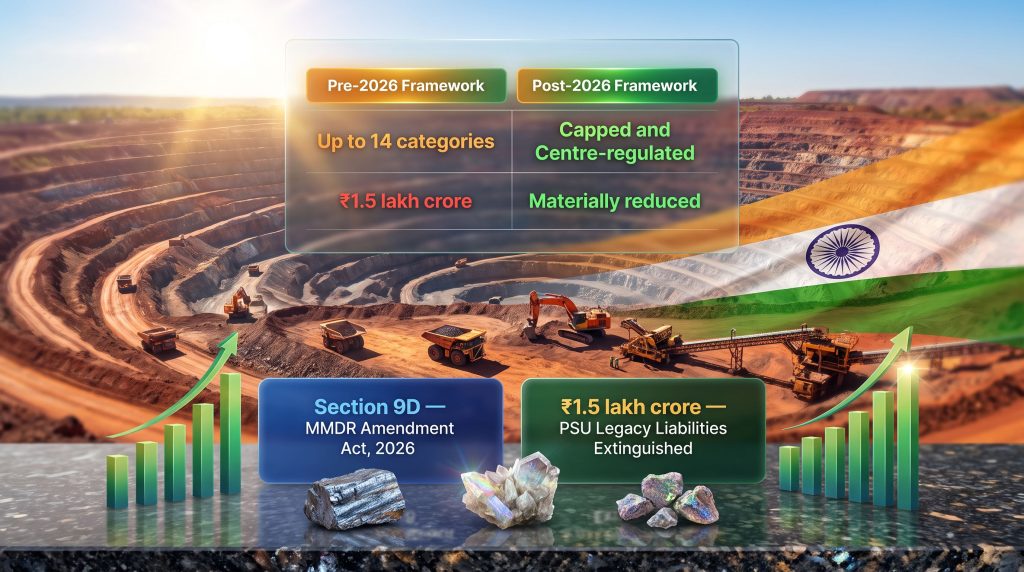
The Mines and Minerals (Development and Regulation) Amendment Act of 2026 addresses the root cause of fiscal fragmentation through a single, structurally significant insertion: Section 9D. This provision prohibits state governments from imposing any tax, cess, or levy on mineral rights or mineral-bearing lands, whether calculated on the basis of mineral quantity, value, royalty, or any other metric, unless the specific conditions prescribed by the Central Government under Section 13 are satisfied.
This is not an outright elimination of state taxing authority. It is a conditional restriction. States retain the theoretical ability to levy charges, but only within a framework defined at the national level. The practical effect is a shift from open-ended state discretion to a Centre-governed fiscal baseline.
Section 13 empowers the Central Government to establish the rule-making framework that defines what permissible state-level charges look like. The quality and timeliness of that rule-making will ultimately determine how effective the reform proves to be in practice.
How Legacy Liabilities Are Being Resolved
One of the reform's most consequential features concerns the treatment of retrospective levies. The amendment draws a clear line between what has already been paid and what remains outstanding.
| Legacy Levy Category | Treatment Under the 2026 Amendment |
|---|---|
| Unpaid or unrecovered past state levies | Declared invalid and unenforceable |
| Amounts already deposited or recovered by states | Non-refundable; treated as settled |
| Pending retrospective claims against PSUs | Extinguished under the new framework |
| Future state-imposed cesses without Centre approval | Prohibited under Section 9D |
This asymmetric approach is a pragmatic compromise. States do not lose revenue they have already collected, which reduces political resistance to the reform. At the same time, the overhang of unresolved retrospective claims — the primary source of the ₹1.5 lakh crore liability estimate — is removed entirely. For India's major public sector miners, this is not a minor administrative adjustment. It is a structural clearing of balance sheet risk.
Fiscal Predictability and Its Effect on Mining Investment
What Tax Uniformity Means in Operational Terms
Mines and Minerals Development Act tax uniformity is not simply a phrase describing consistent tax rates. In operational terms, it means that a mining company can now model the full fiscal cost of a project over its entire lifecycle against a nationally governed framework, rather than against the shifting preferences of individual state administrations.
The contrast with the pre-reform environment is stark:
| Parameter | Pre-2026 Framework | Post-2026 Framework |
|---|---|---|
| Number of applicable state levies | Up to 14 categories | Capped and Centre-regulated |
| Retrospective liability exposure | Open-ended | Extinguished for unpaid claims |
| State discretion to impose new taxes | Broad, post-2024 SC ruling | Restricted under Section 9D |
| Investor cost modelling certainty | Low | Materially improved |
| PSU financial exposure (conservative estimate) | ₹1.5 lakh crore | Substantially reduced |
Project IRR and the Cost of Fiscal Uncertainty
From an investment perspective, unpredictable fiscal regimes do not merely reduce returns. They inflate the cost of capital by widening the risk premium that lenders and equity investors attach to a project. When a greenfield mining operation carries an open-ended state tax liability, the effective hurdle rate rises, and marginal projects that might otherwise be viable become uneconomic.
By replacing variable, state-discretionary imposts with a predictable, Centre-governed structure, the reform has the potential to improve the internal rate of return for both greenfield and brownfield mining investments. Fewer contingency reserves need to be held against unknown fiscal exposures, freeing capital for productive deployment in exploration, infrastructure, and processing capacity.
This dynamic is particularly relevant for India's critical minerals pipeline. Furthermore, the surging critical minerals demand in 2025 underscores why lithium, cobalt, nickel, and rare earth element projects — which are capital-intensive, technically complex, and characterised by long development timelines — are precisely the asset class most sensitive to fiscal unpredictability. A stable tax environment lowers the threshold at which these projects become financeable.
Industry Response to the Reform
Public Sector Miners Welcome Balance Sheet Clarity
India's major state-owned mining and steel companies have responded positively to the legislative change. Steel Authority of India Ltd characterised the amendment as delivering greater clarity and uniformity in mineral taxation, with specific emphasis on its resolution of retrospective levy uncertainty, a factor the company had identified as a source of material operational and financial risk.
NMDC's Chairman and Managing Director Amitava Mukherjee described the reform as addressing long-standing operational bottlenecks caused by non-uniform state taxes and unanticipated cesses that had increased the cost and complexity of mineral extraction. With the ₹1.5 lakh crore PSU liability overhang now extinguished, India's state-owned miners gain the balance sheet headroom to redirect capital toward production expansion and infrastructure investment.
Implications for Private and International Capital
The reform's significance extends beyond the public sector. For private investors and international mining companies, the pre-reform environment carried what financial analysts describe as a sovereign risk premium specific to Indian mineral projects. That premium reflected not political instability in the conventional sense, but the unpredictable intervention of sub-national governments in project economics.
A nationally governed fiscal baseline removes a meaningful component of that premium. Project financing becomes more straightforward when lenders can underwrite against a stable cost structure. Equity investors gain the ability to compare Indian mining assets against international peers on a more transparent basis. Consequently, the broader mining commodity outlook for copper and uranium suggests that India's improved fiscal environment could attract significant new capital flows into its resource sector.
The reform does not eliminate all investment risk in Indian mining. Permitting timelines, infrastructure access, and community engagement remain significant variables. But by resolving fiscal unpredictability, it removes one of the most structurally damaging barriers to capital allocation in the sector.
Broader Policy Alignment and Constitutional Dynamics
Navigating Centre-State Tensions
The 2026 amendment navigates a genuinely contested constitutional space. India's federal structure grants state governments significant authority over natural resources within their territories, and the 2024 Supreme Court verdict had reinforced that authority. The new legislation does not override that ruling. It operates within it, using Parliament's power to establish a national framework for mineral development to define the conditions under which state levies are permissible.
This conditional architecture is important. The reform's long-term effectiveness depends on the Central Government exercising its Section 13 rule-making authority promptly and transparently. Delay in establishing the permissible levy framework could create a new form of uncertainty, one where states are restricted but the permitted alternative is undefined. The MMDR Amendment Act overview from DD India outlines how the legislation seeks to boost investment and mineral-led growth through precisely this kind of structured approach.
Connection to Critical Minerals and Industrial Policy
The reform's timing is not incidental. India's ambitions in critical minerals, battery metals, and rare earth elements have been constrained by the same fiscal unpredictability that burdened conventional mining operations. The alignment between Mines and Minerals Development Act tax uniformity and India's broader industrial objectives is direct. In addition, critical minerals and energy security considerations are increasingly shaping how nations prioritise domestic resource development.
A domestically viable mining sector capable of attracting long-term capital is a prerequisite for:
- Achieving meaningful self-sufficiency in battery-grade minerals for the electric vehicle supply chain
- Supporting the National Steel Policy's production targets, which depend on reliable domestic iron ore and coking coal supply
- Reducing import dependence for critical inputs used in defence, aerospace, and clean energy technologies
- Advancing Atmanirbhar Bharat objectives that require competitive domestic mineral extraction at scale
Each of these objectives is undermined when project economics are distorted by unpredictable state-level fiscal interventions. The 2026 amendment directly addresses that underlying vulnerability. Furthermore, India's lithium supply strategy from Australia demonstrates just how seriously the nation is approaching mineral self-sufficiency at the international level. India's improved domestic mining framework also has implications for resource and energy exports, potentially reshaping bilateral trade dynamics across the Asia-Pacific region.
The next major ASX story will hit our subscribers first
Frequently Asked Questions: MMDR 2026 and Tax Uniformity
What does the Mines and Minerals Development Act tax uniformity reform actually change?
It replaces a fragmented system of up to 14 state-level taxes and levies with a nationally governed framework, prohibiting states from independently imposing new charges on mineral rights or mineral-bearing lands without Central Government approval.
Which states had introduced new mining taxes after the 2024 Supreme Court ruling?
Karnataka, Jharkhand, and Tamil Nadu were among the states that moved to introduce additional mining levies following the Supreme Court's 2024 affirmation of state taxing authority over mineral operations.
How does Section 9D differ from a complete ban on state mining taxes?
Section 9D restricts rather than eliminates state taxing authority. States can still impose levies, but only within conditions prescribed by the Central Government under Section 13, making it a conditional rather than absolute restriction.
What happens to mining companies that have already paid state levies that are now deemed invalid?
Amounts already deposited with state governments are not refundable under the amendment. Only unpaid or unrecovered retrospective claims are extinguished. This asymmetric treatment protects state revenues already collected.
Why does fiscal predictability matter specifically for critical minerals investment?
Critical minerals projects typically require 10 to 20 years from discovery to sustained production. Over that horizon, even modest annual fiscal uncertainty compounds into substantial project-level risk, raising the cost of capital and making marginal deposits uneconomic to develop.
Disclaimer: This article contains forward-looking analysis and illustrative comparisons intended for informational purposes. Figures relating to PSU financial exposure are based on conservative industry estimates as reported in the public domain and should not be interpreted as definitive financial assessments. Readers should conduct independent due diligence before making investment decisions related to the Indian mining sector.
Want to Track the Next Major Mineral Discovery Before the Market Moves?
Discovery Alert's proprietary Discovery IQ model delivers real-time alerts on significant ASX mineral discoveries, transforming complex mineral data into clear, actionable investment insights suited to both short-term traders and long-term investors. Explore Discovery Alert's dedicated discoveries page to understand how historic mineral discoveries have generated substantial market returns, and begin your 14-day free trial today to position yourself ahead of the broader market.