August 26, 2026
The Caribbean Gas Corridor and the Global LNG Race of the 2020s
Offshore gas development has always operated on timescales that humiliate short-term thinking. The fields discovered in one decade rarely reach commercial production until the next, and the market conditions that justified initial investment rarely resemble those that greet first gas. This structural lag between discovery and monetisation is not merely a technical inconvenience — it is the central risk variable that separates projects that transform regions from those that quietly expire in regulatory limbo.
Nowhere is this tension more visible right now than in the southern Caribbean, where a convergence of resource scale, infrastructure proximity, and geopolitical complexity is reshaping how international energy capital approaches frontier offshore development. The Loran Phase 2 Venezuela gas project sits at the precise intersection of all three forces, and understanding it requires examining not just what the licence award means today, but what the project must navigate between now and a Final Investment Decision that remains years away.
When big ASX news breaks, our subscribers know first
Resource Architecture: Understanding the Loran-Manatee System
Before analysing the commercial and regulatory dimensions, it is worth grounding the discussion in the geology itself, because the Loran-Manatee accumulation is not a marginal discovery requiring optimistic assumptions to justify interest. It is a genuinely substantial offshore gas system whose scale commands attention regardless of the political overlay.
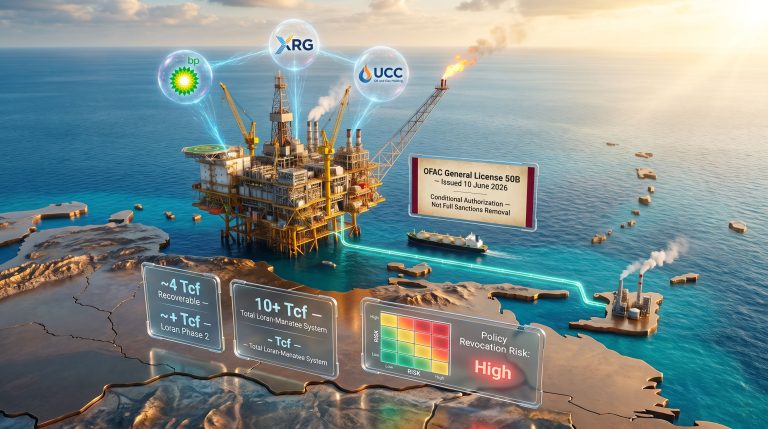
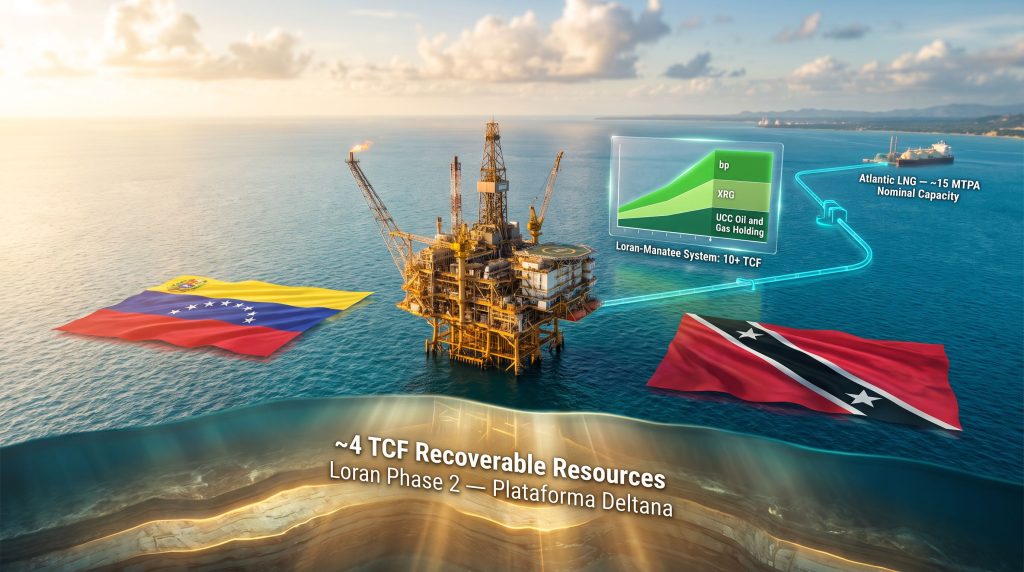
The Loran-Manatee accumulation straddles the maritime boundary between Venezuela and Trinidad and Tobago in the Plataforma Deltana region of the eastern Venezuelan offshore shelf. The broader system is estimated to contain in excess of 10 trillion cubic feet (TCF) of recoverable gas resources across its full extent, according to Reuters reporting on the consortium's August 2026 licence award. The Venezuelan Loran field component alone carries a total resource assessment of approximately 7.3 TCF, a volume that places it among the more significant undeveloped offshore gas accumulations in the entire Atlantic Basin.
Loran Phase 2 specifically is attributed with approximately 4 TCF of recoverable resources — the portion of the field now licensed to the bp-led consortium. To contextualise that number: Trinidad and Tobago's Atlantic LNG facility has exported roughly 20–25 million tonnes of LNG annually at peak throughput, and 4 TCF of recoverable gas represents a multi-decade supply contribution at meaningful production rates.
The Plataforma Deltana setting is geologically distinct from the heavy oil belts that define Venezuela's onshore reputation. The offshore shelf here hosts conventional dry gas accumulations with characteristics more comparable to Trinidad's established producing fields than to the bitumen-heavy Orinoco belt that dominates Venezuelan oil headlines.
This geological distinction matters commercially. Conventional offshore gas is technically less complex to produce than unconventional resources, though deepwater environments introduce their own capital intensity challenges. The Loran field's resource quality partially explains why international majors have maintained interest in the area despite Venezuela's well-documented institutional and sanctions-related risks.
Consortium Architecture: Who Holds Loran Phase 2 and Why It Matters
The ownership structure of the Loran Phase 2 consortium is analytically significant beyond the simple fact of who holds equity. The composition signals strategic intent across three very different organisational contexts.
| Parameter | Loran Phase 1 | Loran Phase 2 |
|---|---|---|
| Primary Licence Holder | Shell | bp-led consortium |
| Operator | Shell | bp |
| Equity Partners | Shell (primary) | bp, XRG, UCC Oil and Gas Holding |
| Working Interest Structure | Not equally divided publicly | Equal across all three partners |
| Estimated Resources | Portion of 7.3 TCF field total | ~4 TCF recoverable |
| Development Expectation | Parallel with Phase 2 | Parallel with Phase 1 |
| Licence Instrument | Prior grant | August 2026 award |
bp's operator role carries specific weight in this context. Operational designation is not a passive title — it determines the pace of pre-FID technical activities, the selection of drilling contractors and subsea vendors, HSE framework design, and critically, primary responsibility for managing compliance across multiple regulatory jurisdictions. The fact that bp accepted operatorship rather than taking a passive equity position signals a higher threshold of commitment than a financial participation alone would imply.
XRG, functioning as ADNOC's international investment vehicle, brings a different strategic logic to the consortium. XRG was established specifically to build a diversified global gas and LNG portfolio outside the Gulf Cooperation Council's established hydrocarbon infrastructure. Its existing positioning in Argentina provides a second data point in an emerging Latin American gas strategy, and Loran Phase 2 extends that footprint into the Caribbean corridor. The commercial rationale rests on three pillars: the scale of the resource base, the logistical proximity of Trinidad's liquefaction infrastructure, and LNG's increasing role as a flexible cross-regional gas transport mechanism.
UCC Oil and Gas Holding completes the three-way equal partnership. As a less publicly profiled participant relative to bp and XRG, UCC's precise role in areas such as local content obligations, financing arrangements, or regional relationship management warrants closer attention as the project progresses toward pre-FID milestones. Equal working interests across all three partners create a balanced governance structure, but they also introduce the risk of decision-making friction if the partners' respective regulatory environments diverge — particularly given the U.S. sanctions dimension discussed below.
The Regulatory Pathway: From April MOU to August Licence
The August 2026 licence award did not emerge as an isolated event. It followed a formal Memorandum of Understanding concluded in April 2026 between bp and Venezuela covering offshore exploration cooperation and future development opportunities in the Plataforma Deltana area. The four-month interval between the MOU and the formal licence instrument reflects Venezuela's minimum regulatory processing timeline under its current hydrocarbon framework, which requires coordination between PDVSA, the Ministry of Petroleum, and in cross-border cases, diplomatic engagement with Trinidad and Tobago.
The MOU structure itself is analytically important for a reason that is sometimes overlooked: it demonstrates Venezuela's willingness to construct a pre-negotiated commercial pathway for international capital before executing the formal licence. This sequencing reduces the regulatory uncertainty that deters many frontier investors, though it does not eliminate the sanctions layer that sits above the domestic Venezuelan framework entirely. Furthermore, U.S. policy on PDVSA adds another layer of complexity that the consortium must navigate carefully throughout the pre-FID period.
Cross-border offshore gas fields introduce a regulatory complexity that purely domestic developments avoid entirely. The Loran-Manatee accumulation's position straddling two sovereign maritime boundaries means that any full-field development programme must ultimately reconcile Venezuelan licensing, Trinidadian regulatory consent, and bilateral framework agreements governing unitisation and resource allocation — three separate approval chains that must advance in rough coordination.
The parallel development of Phase 1 under Shell and Phase 2 under the bp consortium creates an additional coordination challenge. Two separate operators, two distinct licence instruments, but a shared geological system means that production interference, reservoir pressure management, and infrastructure sharing decisions will require inter-operator alignment that goes beyond what either licence document can fully mandate.
Sanctions Architecture: The Variable That Overrides Everything Else
U.S. sanctions on Venezuela's energy sector represent the most consequential external variable affecting the Loran Phase 2 Venezuela gas project's trajectory. Understanding how these sanctions function is essential to evaluating the project's realistic probability of reaching FID.
The U.S. Office of Foreign Assets Control (OFAC) has historically managed Venezuelan energy sector exposure through a combination of general licences and specific authorisations rather than blanket prohibitions. This nuanced architecture means that the consortium's current activities are most likely proceeding under an existing OFAC authorisation framework — but that framework is subject to modification or revocation at any point based on U.S. foreign policy priorities toward Venezuela. The broader Venezuela energy market pressures and the wider geopolitical risk landscape compound these uncertainties considerably.
Three forward-looking scenarios capture the range of plausible outcomes:
Scenario A: Stable Sanctions Relief (Base Case)
- Current OFAC authorisations remain valid and are renewed as required
- bp progresses pre-FID technical work including seismic acquisition and preliminary well design
- Timeline to FID extends into the 2028–2030 window, subject to offtake contract progress and gas price visibility
- Probability: Moderate, contingent on U.S.-Venezuela diplomatic stability
Scenario B: Sanctions Tightening (Adverse Case)
- OFAC authorisations are revoked or allowed to lapse following a deterioration in U.S.-Venezuela relations
- bp and XRG are forced to suspend activities pending a sanctions review
- Venezuela seeks alternative consortium partners from jurisdictions not subject to OFAC constraints
- Probability: Elevated if U.S. political conditions shift toward a maximum pressure posture
Scenario C: Full Sanctions Removal (Optimistic Case)
- A comprehensive diplomatic resolution removes energy sector sanctions entirely
- International capital accelerates into Venezuelan offshore; competition between Phase 1 and Phase 2 operators intensifies
- FID could potentially advance to 2027–2028; Atlantic LNG infrastructure access becomes the primary bottleneck
- Probability: Low in the near term but cannot be excluded over a 5–7 year horizon
The distinction between a U.S. sanctions authorisation and a Venezuelan government licence is critical and frequently conflated in media coverage. Both are legally necessary but are issued by entirely different authorities under entirely different legal frameworks. A project can hold a valid Venezuelan licence and still be commercially inoperable if OFAC authorisation lapses.
Monetisation Pathways: Atlantic LNG as the Critical Infrastructure Pivot
The route by which Loran Phase 2 gas reaches global markets is not a secondary commercial consideration — it is the foundational variable around which project economics are built. Five monetisation pathways exist in principle, each carrying distinct advantages and constraints:
| Monetisation Route | Primary Advantage | Key Challenge | Infrastructure Dependency |
|---|---|---|---|
| Atlantic LNG (Trinidad) | Existing liquefaction capacity (~15 MTPA nominal) | Nominal vs. effective capacity gap | Trinidad and Tobago regulatory approval |
| Dedicated LNG Terminal | Full commercial control over offtake | Very high capital expenditure | New construction in Venezuelan waters |
| Regional Caribbean Gas Sales | Shorter logistics chain | Limited demand base | Pipeline or FSRU deployment |
| Long-Term LNG Contracts | Revenue certainty; project bankability | Inflexible pricing structures | Dependent on chosen liquefaction route |
| Spot LNG Sales | Maximum pricing flexibility | Revenue volatility | Dependent on chosen liquefaction route |
Atlantic LNG's nominal installed capacity of approximately 15 million tonnes per annum (MTPA) makes it the most immediately accessible liquefaction route for Venezuelan offshore gas. However, a critical distinction exists between nominal capacity and effective operational throughput. Reuters has reported operational limitations and feed gas supply constraints at Atlantic LNG that mean the facility's actual available processing capacity must be assessed independently of its nameplate specification.
For the Loran Phase 2 consortium, securing processing capacity at Atlantic LNG is not simply a matter of knocking on a commercial door — it requires Trinidad and Tobago's regulatory consent, bilateral framework alignment, and a long-term gas supply agreement that satisfies Atlantic LNG's operational planning requirements. The global LNG supply outlook for the mid-2030s will be a decisive factor in how attractive those terms ultimately prove to be.
There is also a market timing dimension that adds complexity. The International Energy Agency has identified 2026 as a landmark year for global LNG supply growth, with major capacity additions across the United States, Canada, and Qatar coming online. This expansion creates a paradox for frontier producers: improved market access in theory, but intensifying competition for long-term offtake contracts in practice.
Loran Phase 2 gas will not reach markets before the early-to-mid 2030s under even optimistic assumptions, by which point the current supply wave will have been absorbed or will be competing for contract renewals. Whether that timing works in the project's favour depends entirely on how mid-2030s demand curves evolve — a variable no current model can resolve with confidence.
Disclaimer: All scenario projections, timeline estimates, and market forecasts contained in this analysis are speculative in nature and should not be interpreted as investment advice. Actual outcomes will depend on regulatory, geopolitical, commercial, and technical variables that cannot be predicted with precision.
The next major ASX story will hit our subscribers first
Regional Implications: Venezuela, Trinidad and Tobago, and the Caribbean Energy Equation
The Loran Phase 2 Venezuela gas project carries implications that extend well beyond the consortium's balance sheets. For Venezuela, the project represents a potential pathway to monetise offshore gas resources that have remained commercially stranded for decades due to underinvestment, institutional deterioration, and sanctions exposure.
Direct benefits would include royalty and fiscal revenues, employment in specialised offshore services, technology transfer through the bp operator relationship, and a broader rehabilitation of Venezuela's offshore operational capabilities. In addition, the U.S. policy impact on resources across the region means that geopolitical headwinds could simultaneously constrain and reshape how Venezuela engages with international capital markets.
For Trinidad and Tobago, the calculus is more nuanced. The country occupies a structurally unique position: it is simultaneously a potential infrastructure provider through Atlantic LNG, a co-holder of resources in the shared Loran-Manatee accumulation through its Manatee field, and a sovereign state whose regulatory consent is a prerequisite for cross-border gas flows. Trinidad's domestic gas production has faced declining output pressure in recent years, and Venezuelan feed gas could provide a supply bridge that extends Atlantic LNG's operational viability beyond what purely domestic Trinidadian resources can sustain.
At a broader regional level, if Loran Phase 2 reaches commercial production, it would materially strengthen the case for the southern Caribbean as a durable Atlantic LNG export platform rather than a legacy infrastructure zone in managed decline. The combination of Venezuelan resource scale, Trinidadian liquefaction expertise, and international operator involvement creates a multi-stakeholder ecosystem with genuine global market connectivity. For further context on the development scope of the broader Loran-Manatee system, the IEPTC project overview provides useful technical background.
Pre-FID Risk Register: The Seven Variables That Will Determine Project Fate
Deepwater offshore gas projects require simultaneous alignment across multiple risk categories before a Final Investment Decision can be commercially justified. For Loran Phase 2, the complexity is compounded by the multi-jurisdictional and sanctions-overlay environment. Historical precedent from comparable cross-border offshore developments suggests pre-FID timelines of four to seven years are common even under favourable conditions.
The seven decisive variables are:
- OFAC Sanctions Status — Whether existing authorisations remain valid and are renewed throughout the pre-FID period without disruption
- Venezuelan Institutional Continuity — The stability of the licensing framework and PDVSA's reliability as a sovereign counterparty over a multi-year development horizon
- Atlantic LNG Access Negotiation — Whether Trinidad and Tobago grants commercial and regulatory processing access for Venezuelan gas, and on what economic terms
- Offshore Capital Cost Estimation — Deepwater drilling and subsea infrastructure costs in a frontier environment with limited recent operational precedent to anchor cost models
- Long-Term Offtake Commitments — Whether creditworthy buyers can be contracted before FID at prices that support project-level economics and lender requirements
- International Gas Price Trajectory — TTF, Henry Hub, and Asian LNG benchmark movements across the 2026–2030 pre-FID window
- Partner Financing Capacity — Whether bp, XRG, and UCC can collectively mobilise the capital required for a deepwater offshore gas development under current market and sanctions conditions
What makes the Loran Phase 2 pre-FID challenge distinctive is not that any single one of these variables is insurmountable in isolation — it is that all seven must reach a simultaneously acceptable state before capital can be committed. The interconnected nature of these risks means that progress on offtake contracting may stall pending sanctions clarity, while sanctions clarity may be contingent on diplomatic conditions that are entirely outside the consortium's control.
Frequently Asked Questions: Loran Phase 2 Venezuela Gas Project
What is the Loran Phase 2 Venezuela gas project?
Loran Phase 2 is the second development phase of Venezuela's offshore Loran gas field, located in the Plataforma Deltana area of the eastern Venezuelan offshore shelf. It holds an estimated 4 trillion cubic feet of recoverable gas resources and was formally licensed in August 2026 to a three-party consortium led by bp, with XRG and UCC Oil and Gas Holding as equal partners. Reuters confirmed the licence award and the consortium's equal working interest structure.
Who are the three equal partners in the Loran Phase 2 consortium?
The partners are bp (serving as operator), XRG (ADNOC's international gas investment vehicle), and UCC Oil and Gas Holding. All three hold equal working interests in the licence.
How does Loran Phase 2 differ from Loran Phase 1?
Phase 1 was previously licensed to Shell, which serves as operator for that portion of the field. Phase 2 was awarded to the bp-XRG-UCC consortium in August 2026. Both phases are expected to be developed in parallel under separate licence instruments, but they share an underlying geological system, which introduces reservoir management coordination requirements.
What is the total size of the Loran-Manatee gas system?
The combined Loran-Manatee accumulation is estimated to contain more than 10 TCF of recoverable resources. The Venezuelan Loran field component is assessed at approximately 7.3 TCF in total, with Phase 2 accounting for roughly 4 TCF of that figure.
What role do U.S. sanctions play in the project?
U.S. OFAC sanctions on Venezuela's energy sector require the consortium to maintain valid authorisations throughout all phases of project activity. The status of these authorisations — whether they are renewed, modified, or revoked — represents the most consequential external variable affecting the project's ability to reach FID and ultimately commercial production.
When could Loran Phase 2 achieve first gas?
Given the complexity of pre-FID requirements across multiple regulatory jurisdictions, combined with offshore infrastructure development timescales, first gas from Loran Phase 2 is unlikely before the early-to-mid 2030s under even optimistic scenario assumptions. This timeline estimate carries significant uncertainty and should not be treated as a commercial commitment or forecast.
Conclusion: Three Conditions That Separate Transformation from Stagnation
The Loran Phase 2 Venezuela gas project holds genuine transformative potential for Caribbean energy geopolitics. A 4 TCF offshore gas resource, operated by one of the world's largest energy companies, with infrastructure access to an established liquefaction platform, represents a combination of attributes that few frontier developments can match.
However, the gap between potential and execution in Venezuelan offshore gas development has historically been measured not in technical barriers but in regulatory, sanctions-related, and institutional ones. Three conditions must align simultaneously for Loran Phase 2 to progress from licence award to transformative project:
- Regulatory stability across three sovereign jurisdictions — Venezuela must maintain a credible licensing framework, Trinidad and Tobago must grant infrastructure access, and OFAC authorisations must remain in force
- Commercial bankability — long-term offtake contracts must be secured at economics that satisfy lender requirements before FID can be justified
- Sustained partner commitment — bp, XRG, and UCC must remain aligned on strategy, financing, and risk tolerance across a pre-FID period that could extend to 2030 or beyond
Whether all three converge will determine whether the Loran-Manatee system becomes the foundation of a revitalised Caribbean LNG corridor or remains, as it has for decades, an exceptional resource waiting for conditions that never quite align.
Want to Stay Ahead of the Next Major Resource Discovery?
Discovery Alert's proprietary Discovery IQ model delivers real-time alerts on significant ASX mineral discoveries, transforming complex geological data into actionable investment insights for both short-term traders and long-term investors — explore historic examples of exceptional discovery returns to understand what early positioning can mean, then begin your 14-day free trial at Discovery Alert to ensure you never miss the market's next major opportunity.