August 26, 2026
The Hidden Architecture of Sanctioned-Environment Energy Development
When international energy majors commit capital to politically restricted jurisdictions, the project economics visible to the market rarely capture the full complexity of what determines success or failure. The financial models, resource estimates, and infrastructure synergies are secondary to a more fundamental question: does the legal architecture actually permit the activity, and for how long? This is precisely the lens through which the Loran Phase 2 Venezuela sanctions framework must be evaluated. Before examining reservoir volumes or LNG offtake potential, the compliance framework itself deserves rigorous scrutiny, because everything downstream of that framework depends on its stability.
When big ASX news breaks, our subscribers know first
What OFAC General License 50B Actually Does and Does Not Permit
The U.S. sanctions regime governing Venezuela is administered by the Office of Foreign Assets Control and remains one of the most complex and actively managed sanctions architectures in operation. Unlike sectoral sanctions that apply broadly to an industry, the Venezuela framework targets specific individuals, entities, and transaction types, with enforcement authority sitting directly with the U.S. Treasury Department.
General licenses are a technical tool within this architecture. They function as pre-approved authorisations for defined categories of activity that would otherwise be prohibited. Critically, they are not equivalent to sanctions removal. The underlying restrictions remain intact, and the general licence simply carves out a narrow corridor of permissible conduct for named parties conducting named activities under specific conditions.
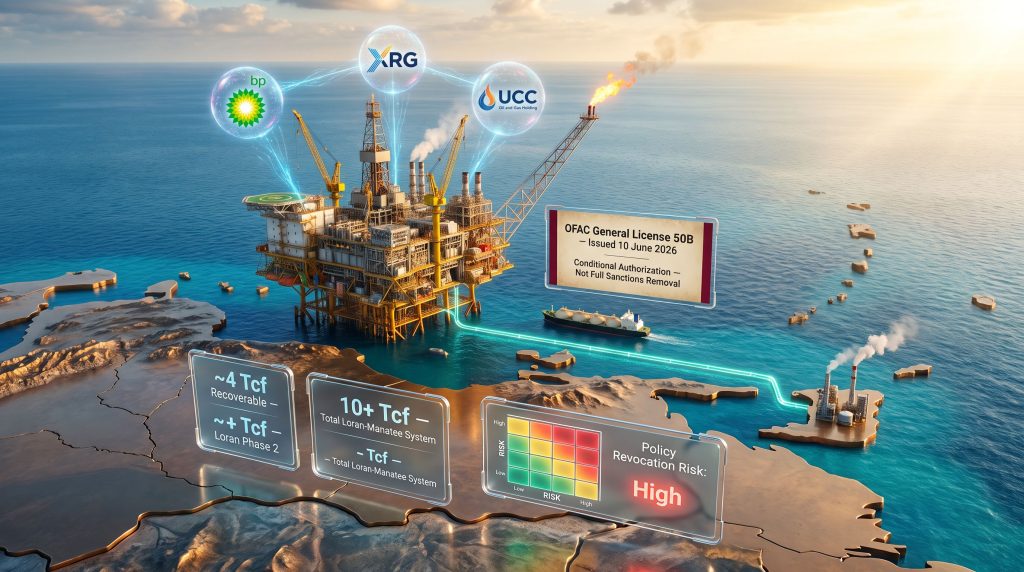
OFAC General License 50B, issued on 10 June 2026, authorises specific named companies, including BP, to engage in defined upstream oil and gas transactions in Venezuela. The four structural conditions embedded in GL 50B govern:
- Permissible contract structures that define what commercial arrangements can be entered into
- Approved payment routing mechanisms specifying which financial channels can be used for transactions
- Counterparty restrictions limiting which Venezuelan state entities and sub-contractors can be engaged
- Mandatory reporting obligations requiring ongoing transparency from named licensees to OFAC
What GL 50B does not authorise is equally important. It does not open Venezuela's energy sector broadly to international investment, does not eliminate the requirement for counterparty screening against the Specially Designated Nationals list, and does not guarantee that future transactions arising from the project will remain within the scope of authorised activity. Furthermore, the U.S. policy on Venezuela continues to evolve in ways that directly affect the durability of any general licence framework.
General licences issued under the OFAC framework can be amended or revoked without advance notice. Any project operating under GL 50B, regardless of the capital already deployed, carries exposure to sudden and potentially irreversible policy discontinuity.
Consortium Structure and the Multi-Party Compliance Calculus
Who Holds Working Interests in Loran Phase 2?
The licence for Loran Phase 2 was awarded on 13 August 2026 to a three-party consortium structured around equal working interests. BP holds the operator designation, while XRG, which functions as ADNOC's international investment vehicle, and UCC Oil and Gas Holding each hold equivalent stakes.
BP's role as operator carries a distinct compliance weight under GL 50B. The operator designation means BP bears primary responsibility for managing the day-to-day interface with Venezuelan counterparties, structuring contracts in ways that satisfy OFAC requirements, and ensuring that all reporting obligations are met on the consortium's behalf.
XRG's Strategic Positioning and the UAE-U.S. Dimension
XRG's participation introduces a geopolitical layer that goes beyond typical joint venture dynamics. As an Abu Dhabi-linked entity operating internationally, XRG sits within a complex bilateral framework involving U.S.-UAE relations. While the UAE maintains a cooperative relationship with the United States on most financial regulatory matters, XRG's involvement in a Venezuela-focused project authorised under a U.S. sanctions licence creates an indirect compliance dependency that could be affected by shifts in that bilateral relationship.
XRG has been building a Latin American gas portfolio, with existing operations in Argentina representing one component of what appears to be a regional diversification thesis. Loran Phase 2 could function as a strategic complement to those Argentine positions, allowing XRG to access Caribbean-linked LNG infrastructure and Atlantic basin buyer networks. However, geopolitical trade risks of this nature add a layer of uncertainty that commercial models alone cannot fully account for.
UCC Oil and Gas Holding and Multi-Party Compliance Complexity
Less publicly documented than its consortium partners, UCC Oil and Gas Holding introduces a third jurisdictional compliance dimension. In multi-party consortia operating under OFAC general licences, each partner carries independent obligations. A compliance failure by any one party can expose the entire consortium to enforcement risk, even if the other partners have maintained full adherence to licence conditions.
Resource Scale vs. Sanctioned-Environment Deliverability
Loran Phase 2 and the Broader Loran-Manatee System
| Metric | Estimated Figure | Source |
|---|---|---|
| Loran Phase 2 recoverable gas | ~4 trillion cubic feet (Tcf) | Reuters, August 2026 |
| Total Loran-Manatee system resources | 10+ Tcf recoverable | Reuters, August 2026 |
| Atlantic LNG nominal capacity | ~15 million tonnes per annum | Atlantic LNG official |
| IEA LNG expansion designation | 2026 identified as high-growth supply year | IEA 2026 Outlook |
The Loran-Manatee system straddles the maritime boundary between Venezuela and Trinidad and Tobago, with Phase 2 representing approximately 4 Tcf of the broader resource base. These are significant volumes by any standard, but resource scale and deliverability in a sanctioned environment are fundamentally different concepts.
Offshore development in Venezuela's Plataforma Deltana region involves deepwater execution challenges that, in a non-restricted jurisdiction, would already carry material cost and technical risk. Layered on top of standard deepwater complexity is the sanctions premium: insurance costs escalate in restricted environments, equipment suppliers conduct enhanced due diligence before engaging, and financing institutions apply heightened scrutiny to project structures that touch sanctioned jurisdictions, even when a general licence is in place.
Why the IEA's 2026 LNG Outlook Complicates the Commercial Case
The International Energy Agency has characterised 2026 as a year of substantial growth in the global LNG supply outlook, driven by major new projects in the United States, Canada, and Qatar coming online. While this expansion broadens the overall market, it simultaneously intensifies competition for long-term offtake contracts. Buyers with multiple supply options have reduced incentive to accept the sanctions-linked provenance risk associated with Venezuelan-origin LNG, particularly when comparably priced, unrestricted supply is available from other sources.
Five Compliance Checkpoints Before a Final Investment Decision Can Be Reached
A Final Investment Decision on Loran Phase 2 cannot be reached through commercial logic alone. Before FID becomes possible, the consortium must navigate a layered compliance sequence:
- OFAC licence validity confirmation at each project milestone, verifying GL 50B remains in force and has not been amended to exclude the activity being undertaken
- Payment and revenue routing approval, structuring all financial flows through sanctions-compliant banking channels that will not expose correspondent banks to secondary sanctions exposure
- Counterparty due diligence across all Venezuelan state entities and sub-contractors, with ongoing screening against the Specially Designated Nationals list as personnel and corporate structures change
- Continuous reporting and disclosure compliance with the transparency obligations imposed on named licensees under GL 50B
- Cross-border transport agreement compliance, with any pipeline or LNG offtake arrangement involving Trinidad and Tobago requiring independent satisfaction of U.S. regulatory requirements, separate from the Venezuelan licence framework
The Trinidad and Tobago Infrastructure Connection
Geographic Logic and Operational Reality
The physical proximity of Venezuela's Plataforma Deltana to Trinidad's existing gas processing and liquefaction infrastructure is the foundational commercial rationale for the entire Loran development concept. Atlantic LNG, with nominal capacity of approximately 15 million tonnes per annum, represents the most accessible processing pathway for Venezuelan offshore gas.
However, Reuters has reported that Atlantic LNG has faced operational constraints and feedstock limitations in recent periods. Nominal capacity figures must therefore be treated with caution, as effective available throughput may differ materially from the headline numbers.
Monetization Routes and Their Regulatory Exposure
| Monetisation Route | Primary Advantage | Key Compliance Risk |
|---|---|---|
| Atlantic LNG tolling arrangement | Existing infrastructure, minimal new capex | Bilateral U.S.-Trinidad sanctions alignment required |
| Dedicated LNG facility development | Full commercial control | Maximum capital exposure in restricted jurisdiction |
| Regional Caribbean gas market | Shorter supply chains, less logistics complexity | Shallow demand base; sanctions framework still applies |
| Long-term offtake contracts | Revenue visibility and project bankability | Buyer counterparty sanctions screening required |
| Spot LNG sales | Commercial flexibility | Price volatility amplified by sanctions risk premium |
For Trinidad and Tobago, the Loran connection represents both an opportunity and a political balancing act. Access to additional feedstock gas could extend the productive life of Atlantic LNG's existing trains, providing economic and employment benefits. At the same time, positioning as a processing hub for Venezuelan gas means navigating Washington's expectations within the bilateral relationship, a calculation that Trinidadian policymakers cannot afford to miscalculate.
The next major ASX story will hit our subscribers first
Comparative Risk Profile: Loran Phase 2 Against Conventional Offshore Development
| Risk Dimension | Loran Phase 2 | Conventional Offshore Project |
|---|---|---|
| Regulatory authorisation | Conditional under GL 50B | Standard permitting framework |
| Policy revocation risk | Elevated, no advance notice required | Negligible under normal conditions |
| Counterparty screening burden | Extensive and ongoing | Routine due diligence |
| Buyer market access | Restricted by sanctions provenance | Open to all qualified buyers |
| Revenue routing complexity | High, requiring specialised structuring | Standard commercial banking |
| Geopolitical exposure | Elevated, multi-jurisdictional | Context-dependent |
The broader geopolitical risk landscape surrounding sanctioned-jurisdiction investments adds yet another layer of complexity that financial models frequently underestimate. Consequently, if GL 50B were amended to exclude new upstream capital commitments, BP would face a binary decision point: move rapidly to lock in pre-FID approvals before the restriction takes effect, or suspend operations and pursue a new or amended licence. Historical precedent from prior Venezuela-related OFAC amendments suggests neither path is low-cost.
The Five Variables That Will Ultimately Determine Loran Phase 2's Fate
Analysts and investors evaluating this project need to track five interdependent variables, none of which is fully within the consortium's control:
- Sanctions stability: Whether GL 50B retains its current scope across a multi-year development timeline that extends well beyond the political cycles that shaped its issuance
- Offshore execution costs: Whether deepwater drilling and subsea infrastructure costs in Venezuela's complex operating environment can be managed within a commercially viable range
- LNG market receptivity: Whether long-term contract buyers in Asia and Europe will accept Venezuelan-origin cargoes given the sanctions-linked provenance risk, particularly when alternative supply exists
- Buyer counterparty compliance: Which categories of LNG importers can legally structure receiving arrangements under the current sanctions architecture without triggering secondary sanctions exposure
- FID timing: How much runway remains before potential U.S. policy-driven market disruption narrows or eliminates the authorisation window, creating a race-against-the-clock dynamic for pre-FID commitments
Frequently Asked Questions: Loran Phase 2 and Venezuela Sanctions
What is OFAC General License 50B?
OFAC General License 50B is a conditional authorisation issued by the U.S. Treasury's Office of Foreign Assets Control on 10 June 2026. It permits specifically named companies, including BP, to conduct defined oil and gas transactions within Venezuela under strict compliance conditions. It does not represent a broad lifting of sanctions.
Have Venezuela Sanctions Been Removed for This Project?
No. The Venezuela sanctions regime administered by OFAC remains in effect. GL 50B creates a narrow, conditional legal corridor for authorised activities only. The underlying restrictions on all other Venezuela-related transactions remain fully operative.
Who Are the Consortium Partners in Loran Phase 2?
BP serves as operator, with XRG and UCC Oil and Gas Holding each holding equal working interests. The licence was formally awarded on 13 August 2026, according to Reuters reporting.
How Large Is the Loran Phase 2 Resource?
Reuters reported approximately 4 trillion cubic feet of recoverable gas associated with Phase 2 specifically, within a broader Loran-Manatee system estimated to hold more than 10 Tcf of total recoverable resources.
Can GL 50B Be Revoked While the Project Is Underway?
Yes. OFAC general licences can be amended, restricted, or revoked at any time without requiring advance notification to affected parties. This represents one of the most material risk factors for any project operating under a conditional authorisation in a sanctioned jurisdiction.
What Role Does Trinidad and Tobago Play in the Monetisation Strategy?
Trinidad's Atlantic LNG facility, with nominal processing capacity near 15 million tonnes per annum, is the most immediately accessible infrastructure for converting Venezuelan offshore gas into exportable LNG. However, effective available capacity may be lower than nominal figures suggest, and any transit or processing arrangement must independently satisfy U.S. sanctions compliance requirements.
Whether Loran Becomes a Precedent or a Cautionary Case Study
The Loran Phase 2 Venezuela sanctions story is ultimately about whether the conditions that make a project commercially logical can remain stable long enough for that logic to translate into physical infrastructure and gas flows. The resource is substantial, the geographic proximity to processing infrastructure is genuine, and the consortium brings technical credibility. However, the authorisation framework that makes it all legal exists within a political environment that has historically demonstrated willingness to adjust Venezuela-related policy with limited regard for project-level disruption.
Whether Loran Phase 2 reaches FID will establish a meaningful precedent for how international energy majors assess and structure OFAC-licensed upstream investments in restricted jurisdictions. The project's trajectory will also signal to future licence applicants what compliance architecture is realistically required to satisfy OFAC's evolving expectations for sanctioned-environment development. For the Caribbean energy market more broadly, this project sits at the intersection of resource potential and regulatory constraint — a combination that could either unlock a transformative supply addition for the region or demonstrate precisely why the gap between authorisation and execution in sanctioned environments is so difficult to close.
This article contains forward-looking analysis and scenario projections. Nothing in this content constitutes financial or investment advice. Readers should conduct independent due diligence and consult qualified legal and compliance professionals before making decisions related to activities in sanctioned jurisdictions.
Want to Identify the Next Major Resource Discovery Before the Broader Market Does?
While complex geopolitical and sanctions frameworks shape the fate of large-scale energy projects like Loran Phase 2, Discovery Alert's proprietary Discovery IQ model cuts through market noise to deliver real-time alerts on significant ASX mineral discoveries — visit the Discovery Alert discoveries page to explore how historic finds have generated extraordinary returns, and begin your 14-day free trial today to position yourself ahead of the market.