August 26, 2026
The Hidden Bottleneck Shaping Australia's Iron Ore Dominance
Long before a single tonne of Pilbara iron ore reaches a steel mill in Japan, South Korea, or China, it must pass through one of the most logistically demanding chokepoints in global commodities trade. The challenge is not finding the ore, nor extracting it, nor even moving it hundreds of kilometres by rail across one of the world's most remote landscapes. The binding constraint, one that has quietly shaped billions of dollars in capital decisions for decades, sits at the water's edge: the port.
Understanding this dynamic is essential context for evaluating what the Monadelphous BHP Nelson Point contract, valued at approximately A$200 million, actually represents. On the surface, it is a construction award. At a deeper level, it is a strategic intervention in the throughput arithmetic that determines how much iron ore Australia can ship to the world. Furthermore, understanding the iron ore demand outlook helps frame just how consequential these port-level decisions truly are.
When big ASX news breaks, our subscribers know first
Contract Snapshot: Key Details at a Glance
| Contract Detail | Information |
|---|---|
| Contract Value | ~A$200 million |
| Client | BHP |
| Location | Nelson Point, Port Hedland, WA |
| Project Program | Port Debottlenecking Project 2 (PDP2) |
| Scope | Structural, mechanical, piping, electrical and instrumentation |
| Project Start | August 2026 |
| Completion Target | 2028 |
| Contractor | Monadelphous Group |
Work commenced immediately following the August 2026 award, with full construction and commissioning of Car Dumper 6 targeted for completion by 2028.
Why Port Hedland Is the World's Most Critical Bulk Export Terminal
Port Hedland, located on the northwest coast of Western Australia, handles a larger volume of bulk commodities than any other single port on the planet. That distinction is not incidental. It reflects decades of deliberate infrastructure investment tied to the extraordinary scale of the Pilbara's iron ore deposits, which rank among the largest and highest-grade concentrations of the mineral anywhere in the world. In this context, Australia's iron ore advantage is built as much on port infrastructure excellence as on the ore deposits themselves.
BHP operates two distinct port precincts within the facility:
- Nelson Point, the primary hub handling the bulk of BHP's Pilbara output, equipped with dedicated rail unloading and vessel loading systems
- Finucane Island, a secondary precinct with its own car dumper and ship-loading infrastructure, operating in parallel with Nelson Point
Together, these precincts receive iron ore delivered by trains often stretching well over two kilometres in length, carrying ore that has travelled hundreds of kilometres from inland mining operations. The interface between those trains and the ships waiting in port is where car dumpers become indispensable.
The Mechanics of a Car Dumper: What Most People Don't Know
A car dumper is not a simple piece of equipment. It is a large-scale rotary industrial structure that clamps an entire loaded rail wagon, rotates it through approximately 160 degrees, and discharges the ore contents onto conveyor systems that feed the ship loaders positioned along the wharf. Each cycle must be completed with precision to maintain the continuous flow that high-volume port operations demand.
What is rarely appreciated outside the industry is that car dumpers do not operate in isolation. Each unit is the first link in a tightly sequenced chain that includes receiving hoppers, conveyor networks, stackers, reclaimers, and finally the ship loaders themselves. A disruption to any one car dumper ripples through the entire system.
This sequencing dependency explains why redundancy, specifically the ability to take one unit offline for maintenance without halting operations, carries such significant commercial value. BHP currently operates five car dumpers across its two Port Hedland precincts. Car Dumper 6 at Nelson Point is not simply an addition; it is an operational buffer that transforms maintenance scheduling from a throughput constraint into a routine activity.
BHP's Port Debottlenecking Project 2: Strategic Rationale and Scope
PDP2 is frequently described in shorthand as a capacity expansion programme, but that framing undersells its strategic logic. The more precise characterisation is that PDP2 is a supply chain efficiency programme designed to unlock volume that already exists within BHP's mining and rail systems but cannot reach export vessels quickly enough due to port-side constraints.
This distinction matters for investors and industry observers. Expanding mining output requires new tenements, environmental approvals, workforce expansion, and years of development capital. Expanding port throughput, by contrast, targets infrastructure that already sits within an established operational footprint. The cost-per-incremental-tonne economics are fundamentally different, and generally far more favourable. Consequently, moves like this iron export capacity expansion at Port Hedland represent some of the most capital-efficient investments available to major iron ore operators.
Monadelphous's Growing PDP2 Exposure
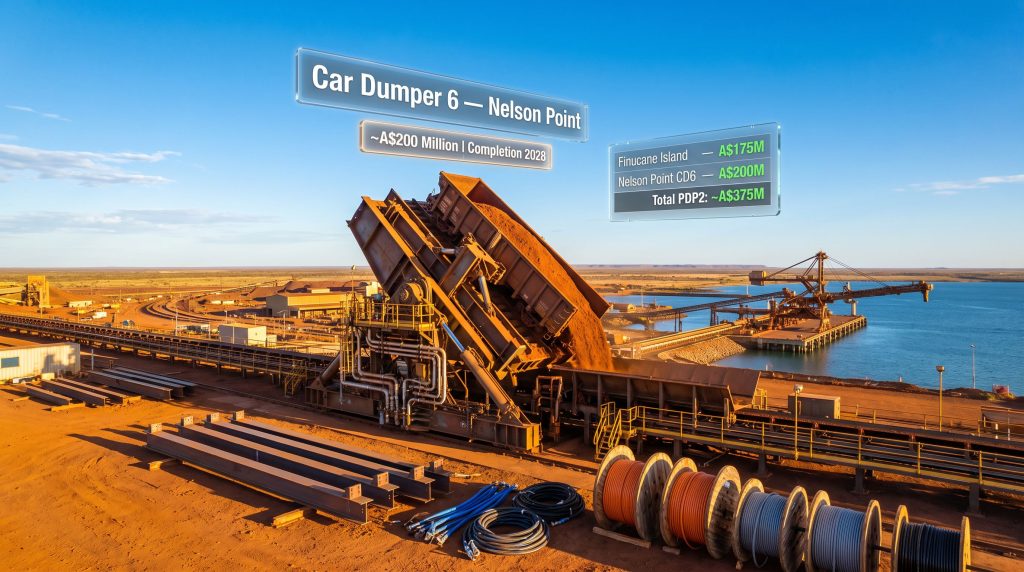
The Nelson Point Car Dumper 6 contract is the second PDP2 award Monadelphous has secured in 2026, bringing its combined exposure under the programme to approximately A$375 million.
| Contract | Value | Precinct | Scope | Awarded |
|---|---|---|---|---|
| Finucane Island Car Dumper Works | A$175 million | Finucane Island | Civil, structural, mechanical, piping and electrical | January 2026 |
| Nelson Point Car Dumper 6 | A$200 million | Nelson Point | Structural, mechanical, piping, electrical and instrumentation | August 2026 |
| Total PDP2 (Monadelphous) | ~A$375 million | Both Precincts | Multi-discipline construction | 2026 |
There is an important distinction between the two contracts that is not immediately obvious from the headline figures. The January 2026 Finucane Island award involved equipment replacement during a planned operational shutdown, requiring precise outage coordination and minimal margin for schedule overrun. The Monadelphous BHP Nelson Point contract, by contrast, involves new-build construction from foundation through to commissioning. The technical profile, risk complexity, and duration of the latter are meaningfully different, which partly explains the higher contract value despite broadly similar disciplines being engaged.
How Monadelphous Earned This Award: The Contractor Qualification Barrier
One aspect of the car dumper construction market that receives limited attention in mainstream coverage is how narrow the qualified contractor pool actually is. The combination of rotating heavy structural fabrication, high-voltage electrical systems, precision mechanical alignment, hydraulics, and complex instrumentation at the scale required for bulk port operations represents a capability barrier that most construction companies cannot clear.
Monadelphous's position within that pool was established not through bidding strategy alone, but through demonstrated delivery on prior Nelson Point projects. The company completed the Car Dumper 3 Replacement at Nelson Point in 2025, a refurbishment that extended that unit's operational life by approximately a decade. That project served as both a technical proof of concept and a relationship-deepening exercise with BHP's engineering and procurement teams.
Monadelphous's managing director has publicly attributed the company's continued contract success to the sustained value it delivers through long-term client relationships and a consistent record of project execution, rather than price competition alone. That philosophy reflects a broader truth in Tier 1 mining services: for technically complex, high-consequence scopes, operators prioritise competency certainty over marginal cost savings.
The Five Engineering Disciplines Underpinning Car Dumper 6
The scope delivered under the Monadelphous BHP Nelson Point contract spans five distinct technical domains, each requiring specialist subteams and careful integration:
- Structural works – fabrication and erection of the primary steel framework that supports the rotary dumper mechanism and absorbs the dynamic loads of wagon rotation
- Mechanical installation – assembly and precision alignment of rotating components, drive systems, clamping mechanisms, and associated heavy machinery
- Piping systems – hydraulic circuits and process piping networks that power and lubricate the dumper's operational components
- Electrical works – power distribution infrastructure, motor control centres, and high-voltage connections that drive the dumper's rotating and conveying equipment
- Instrumentation – sensors, programmable control systems, and safety interlock networks that govern automated operation and provide real-time operational data
Delivering all five disciplines under a single contract, rather than splitting them across multiple packages, requires a contractor with genuine multi-discipline depth. This integrated delivery model reduces interface risk for BHP and is a meaningful competitive differentiator for Monadelphous.
Monadelphous's Broader Pilbara Pipeline: Beyond Port Hedland
The PDP2 contracts sit within a wider iron ore services pipeline that Monadelphous is actively building across the Pilbara region, extending beyond BHP to encompass other Tier 1 operators.
Through its Kerman Contracting subsidiary, Monadelphous recently secured a A$165 million contract for infrastructure development at Rio Tinto's Brockman Syncline 1 project. That scope encompasses construction of a heavy equipment workshop, vehicle washdown facilities, tyre-change bays, and bulk fuel storage and refuelling infrastructure, representing the kind of mine-site services work that complements but is distinct from the port construction focus of the PDP2 contracts.
| Project | Client | Value | Type | Status |
|---|---|---|---|---|
| Car Dumper 6, Nelson Point | BHP | ~A$200M | New construction | Active (2026-2028) |
| Finucane Island Car Dumper Works | BHP | ~A$175M | Equipment replacement | Active (2026) |
| Brockman Syncline 1 Infrastructure | Rio Tinto | ~A$165M | Mine infrastructure | Active |
| Car Dumper 3 Replacement | BHP | Undisclosed | Refurbishment | Completed (2025) |
The capacity to run parallel, large-scale programmes across both BHP and Rio Tinto simultaneously, without apparent resource conflict, speaks to the depth of Monadelphous's workforce and project management infrastructure in Western Australia. It also reduces the client concentration risk that can make single-client-dependent contractors vulnerable to changes in one operator's capital expenditure cycle.
The next major ASX story will hit our subscribers first
Port Throughput Efficiency: The Investment Variable Few Retail Investors Understand
For investors tracking iron ore exposure, the temptation is to focus primarily on ore price movements and production volumes. Port throughput efficiency, however, is a variable that can materially affect revenue realisation even when both price and production volumes are favourable. Indeed, the broader China steel and iron ore market dynamics make port-level performance increasingly consequential for Australian exporters.
Consider a scenario where a car dumper goes offline unexpectedly during a period of peak shipping demand. The ore is mined. The trains are loaded. But if the port cannot receive and transfer wagons at the required rate, vessels waiting at anchorage accumulate demurrage charges, contracted volumes go unfulfilled within the agreed window, and spot market opportunities are missed. These costs and missed revenues compound quickly at the scale of a major Pilbara operation.
PDP2 addresses this problem structurally rather than reactively. By adding a sixth car dumper at Nelson Point and upgrading equipment at Finucane Island, BHP creates the operational flexibility to maintain full throughput during scheduled maintenance, rather than being forced to choose between servicing equipment and shipping ore.
This infrastructure logic also has a speculative dimension worth noting. Industry observers have pointed to the possibility that PDP2's throughput gains, once fully realised, could allow BHP to meaningfully increase its annual Pilbara shipment volumes without committing the capital required for new mine development. Furthermore, when considering iron ore tariff impacts and shifting trade dynamics, having maximum port flexibility becomes even more strategically valuable. If Pilbara ore demand from East Asian steel markets remains robust through the late 2020s, the revenue upside from unlocked port capacity could substantially exceed the programme's construction cost. This remains a forward-looking perspective and is not guaranteed by the project's engineering scope alone.
Frequently Asked Questions: Monadelphous BHP Nelson Point Contract
What is the value of the Monadelphous BHP Nelson Point contract?
The contract is valued at approximately A$200 million, covering the full design, installation, and commissioning of Car Dumper 6 at BHP's Nelson Point facility in Port Hedland, Western Australia.
When will Car Dumper 6 be completed?
Construction and commissioning work is scheduled for completion by 2028, with works having commenced immediately following the August 2026 contract award.
What is BHP's Port Debottlenecking Project 2?
PDP2 is a capital investment programme targeting the removal of throughput constraints at BHP's Port Hedland iron ore export terminal. It involves infrastructure upgrades across both the Nelson Point and Finucane Island precincts to increase the volume of iron ore that can be processed and shipped per year.
How many PDP2 contracts has Monadelphous secured?
As of August 2026, Monadelphous holds two PDP2 contracts from BHP, totalling approximately A$375 million: the A$175 million Finucane Island award from January 2026 and the A$200 million Nelson Point Car Dumper 6 award from August 2026.
What prior work did Monadelphous complete at Nelson Point?
Monadelphous completed the Car Dumper 3 Replacement Project at Nelson Point in 2025, a refurbishment programme that extended the operational life of that unit by approximately ten years.
Key Takeaways
- The Monadelphous BHP Nelson Point contract, valued at ~A$200 million, is a new-build construction programme covering five engineering disciplines across structural, mechanical, piping, electrical, and instrumentation scopes
- Combined PDP2 contract value for Monadelphous now stands at approximately A$375 million, positioning the company as BHP's primary construction partner for Port Hedland capacity expansion in 2026
- Car Dumper 6 addresses a structural throughput constraint by providing maintenance redundancy across BHP's car dumper fleet, eliminating the need to reduce export volumes during scheduled servicing
- PDP2 represents a capital-efficient pathway to incremental iron ore revenue by leveraging existing mine and rail infrastructure through targeted port-side investment
- Monadelphous's concurrent activity across BHP and Rio Tinto Pilbara projects, with a combined active pipeline exceeding A$540 million, demonstrates the depth of its Tier 1 mining services capability in Western Australia
Readers seeking additional context on BHP's Port Hedland operations and Australian iron ore export infrastructure can explore related industry reporting at Australian Mining.
This article contains forward-looking statements and projections relating to port throughput outcomes and iron ore market conditions. These involve inherent uncertainty and should not be construed as financial advice. Readers should conduct independent research before making investment decisions.
Want to Stay Ahead of Major ASX Mining Opportunities?
Discovery Alert's proprietary Discovery IQ model delivers real-time alerts on significant ASX mineral discoveries — cutting through complex data to surface actionable opportunities the moment they're announced. Explore how historic discoveries have generated substantial market returns on Discovery Alert's dedicated discoveries page, and begin your 14-day free trial today to position yourself ahead of the broader market.